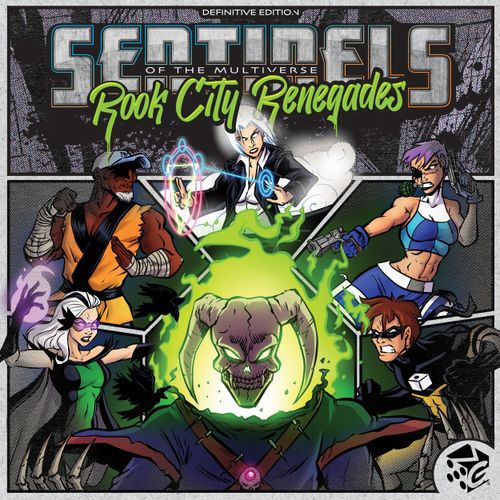
Sentinels of the Multiverse: Definitive Edition – Rook City Renegades
Sentinels of the Multiverse: Definitive Edition – Rook City Renegades Rulebook
Table of Contents
Table of Contents
Components
- 1 Villain HP Spinner
- 1 Additional Large HP Spinner Wheel
- 14 "1" HP Tokens
- 3 Nemesis Tokens
- 7 Irreducible Damage Tokens (the token reads: "Damage dealt by this target is IRREDUCIBLE")
- 6 Hero Character Cards
- 24 Hero Variant Character Cards
- 6 Hero Decks (6 decks of 40 cards each)
- 11 Villain Character Cards
- 9 Villain Decks (9 decks of 25 cards each)
- 21 Divider Cards
- 5 Environment Decks (5 decks of 15 cards each)
- 9 Event Cards
- 9 Critical Event Cards
- 5 Reminder Cards
- The Operative's Side Deck (1 deck of 10 cards)
The additional large HP spinner wheel is to replace the large wheel from the core game, as it was slightly miscut leading to difficulties turning it smoothly.
If you're missing any components, or if anything arrived damaged, please email [email protected] to get a replacement.
Sleeves
If you want to sleeve all the cards in Sentinels of the Multiverse: Rook City Renegades, you'll need 3 sizes of sleeves:
- 35 "tarot" size card sleeves, 70mm by 120mm, for the Hero character cards and Reminder cards
- 29 "large scale" size card sleeves, 88mm by 130mm, for Villain character cards and Event cards
- 550 "standard" size card sleeves, 63mm by 88mm, for all of the Hero, Villain, and Environment deck cards
You can purchase packs of sleeves specially built for this exact purpose on the Greater Than Games webstore: http://store.greaterthangames.com! Just search for the Sentinels of the Multiverse card sleeves on our store to find the types and numbers of sleeves you need.
New Rules and Clarifications
New Keyword: SUDDENLY!
SUDDENLY! is a new keyword that has a specific effect whenever a card with that keyword ends up in your hand.
SUDDENLY!: If this card is ever in your hand, immediately play it. If this card is drawn during setup, draw a card and shuffle the SUDDENLY! card back into the deck. At the start of the game, each Hero will have a hand of 4 cards, none of which with the SUDDENLY! keyword.
- If a SUDDENLY! card is in the hand of a Hero who cannot play cards, it cannot be played. However, as soon as that Hero can ever play cards, the SUDDENLY! card must immediately be played.
SUDDENLY! cards add an element of chaos and hint at a struggle for control. Not being able to plan for them means they often mess things up at least a bit when they are played.
Villains with Multiple Character Cards
In Rook City Renegades, there are two Villains with more than one Villain character card, but in two different ways.
The Chairman is the main Villain character card for the Villain deck "The Organization." However, he has his right-hand assassin The Operative, who also has her own Villain character card. She also has a "side deck," which we explain in the next section. The Villain character cards for The Chairman and The Operative both start the game in play, and you have to defeat The Operative in order to take down The Chairman.
For the Villain deck "The Fey-Court," The Dagda and The Morrigan are both equal rulers of the Fey-Court and both start in play. You cannot win the game by knocking only one of them out — both must be defeated in order to win that way. However, The Dagda does give you an alternate victory condition to work towards on his flip side.
In all cases in which there are multiple Villain character cards, two main rules apply:
- When a Villain character card is destroyed, remove it from the game unless it or another card in play says otherwise.
- When there are no Villain character cards in play, you win the game, unless a card in play says otherwise.
Introducing: The Side Deck
The Operative's deck is the first instance of a "side deck," which does not follow the regular rules of a deck in Sentinels of the Multiverse.
A side deck is made up of cards of the same type as the play area it is placed in during setup. It has its own trash, separate from any other trash in its play area. Do not play, reveal, discard, summon, discover, or interact with cards in side decks in any way unless the card telling you to do so specifically names the side deck. It is not affected by effects that refer to "each deck," "the villain deck," "any deck," or similar effects.
The Operative's side deck is a deck of Villain cards, but it is not "the Villain deck" for effects that reference decks. It does not play a card during the Villain turn PLAY PHASE, like the Villain deck does, instead only playing cards when instructed to do so by other cards in play.
Tokens on Villain Character Cards
Some Villains use tokens to track certain game elements. To track these effects, you can use HP tokens or any other sort of tokens or similar objects you have available. Tokens referred to by a Villain character card mean only those tokens, not any other tokens added to a card, such as damage boosting/reducing tokens or even tokens related to other effects from other decks.
When a Villain character card with tokens on it flips, leave the tokens on that card. They are not affected by the flip, unless something in play says otherwise.
Conflict Resolution
This section is an update to the Conflict Resolution rules printed in the rulebook that came with the core game.
Whenever cards are played, put them into the appropriate play area starting from left to right in the order in which they were played. During Villain and Environment turns, when resolving the order of PHASE effects (or effects with a unique icon, like Omnitron's Exterminate and Fabricate text), resolve them in the order those cards were played, from left to right in that play area. During Hero turns, effects in each PHASE are resolved in the order of that Hero's choosing.
In ambiguous situations, such as tied HP or multiple targets damaged simultaneously, the players choose the outcome or order of effects.
Hero Complexity
The Heroes in Rook City Renegades are rated for complexity of their Hero decks, on a scale from 1 to 10, where 1 is the least complicated and 10 is the most.
| Hero | Complexity |
|---|---|
| Expatriette | 4 |
| Setback | 6 |
| NightMist | 7 |
| Mr. Fixer | 5 |
| The Harpy | 9 |
| Alpha | 7 |
FAQs
- Can I destroy a card from my hand? "Destroy" only affects cards in play. You cannot destroy cards in a hand, a deck, or a trash.
- Can a One-Shot card be destroyed while it's being played? One-Shots do not count as cards in play and cannot be the target of destroy effects.
- If I have the option to use multiple powers during my POWER PHASE and only use one, do I get to draw extra cards during my DRAW PHASE? No. You draw one extra card in your DRAW PHASE when you don't play any cards on your PLAY PHASE and don't use any powers on your POWER PHASE during your turn.
- If it's your turn and you skip or are made to skip your PLAY and POWER PHASES, you still draw 2 cards for the DRAW PHASE. However, getting an off-turn DRAW PHASE doesn't let you draw 2 cards.
- What happens if a card is played from the top of the deck or something like that and the play is in some way against the rules, such as another copy of a Limited card? If a Hero card is being played but cannot be played for any reason, it goes to the Hero's hand. If a non-Hero card is being played but cannot be played for any reason, it goes into its associated trash.
- When and in what order do the PHASE effects happen on my turn? When a card has a phase effect on it, it occurs on the indicated phase of the play area the card is in, each time that phase occurs. Effects that activate on each phase act in the order outlined by the "Conflict Resolution" rules on page 5 of this rulebook.
- A card lets a Hero deal damage to a target, and then says that something happens to "that target" as a result. If the damage is redirected to another target, does the second effect happen to the initial target, or to the target it was redirected to? The second target. The Wraith's Stun Bolt is a good example of this. The Wraith deals 1 lightning damage to a target. Then, that target deals −1 damage until The Wraith's START PHASE. If the damage The Wraith is dealing is redirected, it's the final target who actually gets the −1 damage modifier.