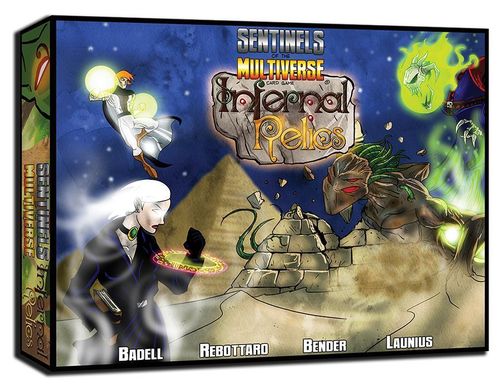
Sentinels of the Multiverse: Infernal Relics
Sentinels of the Multiverse: Infernal Relics Rulebook
Table of Contents
Table of Contents
What's New?
Both of the two new heroes in Infernal Relics have unique mechanics by which their decks operate. Below is a quick overview of Nightmist's spell icon mechanic, and on the next page we cover The Argent Adept.
Nightmist's Spell Icon Mechanic
Nightmist, the cursed paranormal investigator, has a spell icon on each of her cards in the lower right corner, as shown on the card example below.
Note that her cards can reference the spell icon of other cards in her deck or hand. This represents the unpredictable nature of her magical abilities while still providing Nightmist with powerful options.
Each copy of a card in Nightmist's deck has a different spell icon value, so a good deal of her strategy comes from deciding which cards to use and which to hold on to for later.
Example card: Heedless Lash. One-Shot, Spell. "Reveal the top card of your deck. Nightmist deals herself and 1 other target that card's spell icon infernal damage. Put the revealed card into your hand or into play." Flavour quote: "By the light of the stars and the power of untold gods!" - Nightmist, Tome of the Bizarre #6. The spell icon is the red star badge in the card text and the lower right corner; the number shown in that badge is the card's spell icon value.
The Argent Adept
The Argent Adept features a multi-layered mechanic involving instrument cards which can activate the Perform and Accompany text of three types of ongoing cards: Melodies, Harmonies, and Rhythms.
Example cards (callout text as printed):
- This is an instrument card. Instruments have Powers which can activate certain ongoing cards.
- Drake's Pipes. Equipment, Instrument. Power: Activate the Perform text of up to 2 different Melody cards.
- This is a Melody card. Melodies have Perform abilities, which are particularly strong.
- Rhapsody of Vigor. Ongoing, Melody. Perform: Up to 5 targets regain 1 HP each.
- This is a Harmony card. Harmonies have Perform and Accompany abilities.
- Alacritous Subdominant. Ongoing, Harmony. Perform: One player may play 1 card now. Accompany: You may use a Power now. If you do, destroy this card.
- This is a Rhythm card. Rhythms have Perform and Accompany abilities.
- Counterpoint Bulwark. Ongoing, Rhythm. Perform: Select up to 2 targets. Until the start of your next turn, reduce damage dealt to those targets by 1. Accompany: One player may draw 1 card now.
Perform and Accompany abilities are different from Powers in that they must be activated by either an instrument card or The Argent Adept's innate power. However, they are also more versatile, as they can be used multiple times per turn, if there are multiple ways of activating them in play.
Turn Sequence
Villain Turn
- Start: Follow any instructions on any cards in play which occur at the start of the villain turn.
- Play: Reveal the top card of the villain deck and play it, following any instructions printed on that card.
- End: Follow any instructions on any cards in play which occur at the end of the villain turn.
Hero Turn
- Start: Follow any instructions on any cards in play which occur at the start of this hero's turn.
- Play: This hero's player may choose to play one card from their hand, following any instructions printed on that card.
- Power: This hero's player may choose to use one power from one of their cards in play which has a power.
- Draw: This hero's player may draw the top card of their hero deck.
- End: Follow any instructions on any cards in play which occur at the end of this hero's turn.
Environment Turn
- Start: Follow any instructions on any cards in play which occur at the start of the environment turn.
- Play: Reveal the top card of the environment deck and play it, following any instructions printed on that card.
- End: Follow any instructions on any cards in play which occur at the end of the environment turn.
Damage
All damage has a "type" which relates to the nature of that damage. In many cases, damage type does not matter when it comes to damaging targets. However, some cards and abilities interact with damage type in a variety of ways. The Sentinels of the Multiverse damage types are: Cold, Energy, Fire, Infernal, Lightning, Melee, Projectile, Psychic, Radiant, Sonic, and Toxic.
Damage can also be irreducible, regardless of its type. Whenever damage is irreducible, it cannot be decreased by any effect. Irreducible damage can still be increased or redirected. However, if a target is immune to damage, or if an effect prevents damage to a target entirely, irreducible damage cannot be dealt to that target.
More Information
The next few pages contain some frequently asked questions and their answers, along with examples to further explain and inform. After that, you'll find the glossary, full of handy definitions of keywords and important game terms. Also, the back of the rulebook has a simple turn order diagram.
Need more information? Go to www.sentinelsofthemultiverse.com, where we share exciting news from Greater Than Games, extended character bios for the heroes and villains of Sentinels of the Multiverse, and an active online community!
Gameplay FAQs
Over the course of a game, there are situations in which the effects of multiple cards take place simultaneously or have competing effects.
In all situations, card effects that happen simultaneously take effect in the order in which the cards were played.
Example: At the start of Gloomweaver's turn, if his three relics are in play, his instructions say to flip his character cards. The Grimoire of Curses says that at the start of the villain turn, each player may discard one card. However, if all three relics were in play, then Gloomweaver would flip first, as he was in play first, and then the Grimoire of Curses would activate.
Additionally, there are times when players encounter ambiguous situations.
In any ambiguous situation, the players choose the outcome.
Example: At the end of the villain turn, Akash'Bhuta's card Arboreal Phalanges deals the no-villain target with the highest HP (H) minus 1 Melee damage. The Argent Adept and Nightmist are currently tied for highest HP at 12 HP each in a four player game. After brief consideration, the players decide that the 3 Melee damage should be dealt to Nightmist.
Do damage bonuses apply to each instance of damage or to total damage?
Damage bonuses apply to each instance of damage. If a card or power breaks out damage in any way, each instance is increased appropriately.
Example: At the end of the villain turn, Apostate deals the hero target with the highest HP (H) minus 2 Melee damage and (H) minus 2 Infernal damage. In a 3 player game, that would be 1 Melee and 1 Infernal damage, but if some effect increased Apostate's damage by 1, then he would deal 2 Melee and 2 Infernal damage.
(H) = the number of heroes. See the Turn Order sheet at the end of this rulebook.
Game FAQs - Continued
If irreducible damage is increased, can it be decreased again?
No. If 2 points of irreducible Fire damage is being dealt, and that is increased by an environment card to 3 points, all of the damage is still irreducible and cannot be reduced.
If a target is immune to damage somehow, is it still considered a target?
Yes. Even though the Chairman is immune to damage on his "Master of the Underworld" side, he is still a target.
If my hero can use more than one Power per turn, can I use the same Power twice? What if I have multiple copies of the same "Power" in play?
Each Power in play can be used a maximum of once per turn, regardless of how many Powers your hero may use that turn. If a card is not limited, you can have multiple copies of it in play. However, each copy of that card is considered its own Power. Since you are limited to activating one Power per turn, you may thus only activate one of the two "instances" of the Power during your Power phase.
Glossary
Active: An active hero has more than 0 HP. A hero is active if they are not incapacitated.
Character Card: A unique card which represents the primary or a major character of a deck. Character cards do not have the same back as the rest of their deck, rather, they have a unique back that provides their extra rules, such as a villain's flip side or a hero's incapacitated abilities.
Current HP: The HP of a target, relative to how much damage that target has taken, if any. For instance, a target with a maximum HP of 7 that has been dealt 2 damage has a current HP of 5.
Destroy: When a card is destroyed, it is removed from play and placed in the appropriate trash.
Deck: The set of cards associated with a specific hero, villain, or environment. All cards in a deck have a uniform back.
Device: Keyword appearing on villain cards. Devices have HP. When played, devices remain in play, but are destroyed when reduced to 0 or fewer HP.
Draw: When a hero card is drawn, that hero card goes into the hero's player's hand, unless stated otherwise.
Environment: An environment is a deck not played by a player which simulates the environment in which the game takes place. Environments have a deck of 15 environment cards. Like targets, environments can be sources of damage, but, unlike targets, the environments themselves do not have HP and cannot be dealt damage, though some cards in an environment deck do have HP.
Environment Card: Any card from an environment deck.
Environment Target: Any target that is also an environment card. If a card affects non-environment targets, it can affect any targets that are not environment cards.
Equipment: A keyword appearing on hero cards. Equipment remains in play after being played and can only be destroyed by cards which specifically target equipment cards.
Flip: Villain character cards are flipped when certain criteria are met. For example, Akash'Bhuta's villain character cards are flipped when the environment trash is shuffled into the environment deck. Hero character cards are flipped when that hero is reduced to 0 or fewer HP.
Hero: A hero is a character played by a player. Heroes have character cards, which list the maximum HP of the hero and their innate power on the front, and their incapacitated abilities on the back. Each hero has a deck of 40 hero cards.
Hero Card: Any card from a hero deck.
Hero Character Card: The main card for a hero. Heroes have character cards, which list the maximum HP of the hero and their innate power on the front, and their incapacitated abilities on the back.
Hero Target: Any target that is also a hero card or a hero character card. If a card affects non-hero targets, it can affect any targets that are not hero cards or hero character cards.
HP: HP stands for "hit points" and represents the amount of damage that a target can take before it is destroyed. Only certain cards have HP. All cards with HP are targets.
Immune: If a target is immune to damage, its current HP cannot be reduced by damage. However, it may still be targeted by damage. Also, it can still be destroyed by cards that destroy targets without dealing damage.
Incapacitated: A hero is incapacitated when reduced to 0 or fewer HP. When this occurs, immediately remove all of that hero's cards from the game and flip the hero character card. On the back, the hero has incapacitated abilities, one of which can be used on each of that hero's subsequent turns. Incapacitated heroes cannot regain HP as they no longer have HP.
Indestructible: If a card is indestructible, it cannot be destroyed or removed from play. If a target is indestructible, it stays in play even if it is reduced to 0 or fewer HP.
Innate Power: Powers printed on the front of the hero character card.
Irreducible: If damage is irreducible, it cannot be reduced by any effect. Irreducible damage can still be increased or redirected. Irreducible damage can also be prevented entirely by effects that prevent damage, or by targets that are immune to damage.
Keyword: The words in the rectangular box at the top of any game text section. Any keywords not defined in this glossary will make sense circumstantially.
Limited: A keyword appearing on hero cards. Limited cards are unique, in that only one card of that name can be in play at one time. If a limited card with the same name as a limited card already in play would come into play, the second card is put into the appropriate trash instead.
Maximum HP: A target's HP as printed. A target cannot regain HP past its maximum HP amount.
One-Shot: A keyword appearing on hero and villain cards. The effects of a one-shot card happen immediately upon being played, after which the one-shot card is moved to the appropriate trash.
Ongoing: A keyword appearing on hero and villain cards. Ongoing cards remain in play after being played and can only be destroyed by cards which specifically target ongoing cards or destroy all cards in play.
Play: When a card is played, the text on it takes effect, and then the card either stays in play or goes to the appropriate trash, depending on the type of card. Hero cards are played from players' hands, while villain and environment cards are played from the top of the villain or environment decks, respectively.
Power: An ability possessed by heroes that can be used during a hero's power phase. A given power may only be used once per turn, even if a hero is allowed to use more than one power during their turn.
Redirect: Damage that is redirected does not affect the original target. Instead, it affects the target to whom it is redirected.
Restore: When a target has HP restored, increase its current HP by that amount, up to but not exceeding its maximum HP.
Nemesis: Each villain has a nemesis hero indicated by the hero icon of the nemesis located on the villain character card. Heroes and villains who are nemeses have their damage increased by one when dealing damage to each other.
Round: The period of time beginning with the start of the villain turn, proceeding through each of the hero turns, and ending with the end of the environment turn.
Sentinels of the Multiverse: The greatest cooperative, fixed-deck, comic book themed card game in the multiverse!
Target: Any card with HP is a target.
Trash: Each deck in the game has a trash into which cards from that deck are placed when they are destroyed, discarded, or otherwise moved there.
Turn: The portion of the game during which all of the actions associated with a given deck take place. The three types of turns in Sentinels of the Multiverse are hero turns, villain turns, and environment turns.
Villain: A villain is a character not played by a player. Villains have character cards, which list the maximum HP of the villain as well as the setup, gameplay, and advanced rules for that specific villain. Villain character cards have two sides, and may flip in the course of play. Each villain has a deck of 25 villain cards.
Villain Card: Any card from a villain deck.
Villain Character Cards: The main cards for a villain. Villains have character cards which list the maximum HP of the villain as well as the setup, gameplay, and advanced rules for that specific villain.
Villain Target: Any target that is also a villain card or a villain character card. If a card affects non-villain targets, it can affect any targets that are not villain cards or villain character cards.
Turn Order
Turn order sheet printed on the back of the rulebook.
Villain Turn
- Start! Start of the villain turn
- Play! Play a villain card
- End! End of the villain turn
Hero Turns
- Start! Start of the hero turn
- Play! Play a hero card
- Power! Use a power
- Draw! Draw a hero card
- End! End of the hero turn
Environment Turn
- Start! Start of the environment turn
- Play! Play an environment card
- End! End of the environment turn
(H) = the number of heroes