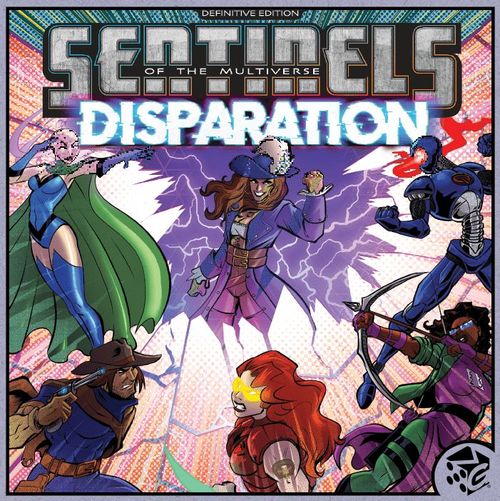
Sentinels of the Multiverse: Definitive Edition – Disparation
Sentinels of the Multiverse: Definitive Edition – Disparation Rulebook
Table of Contents
Table of Contents
Components
- 1 NP Spinner (caption as printed in the source)
- 1 further spinner wheel (its caption is not legible in the source)
- 33 "1" HP tokens
- 6 Nemesis tokens
- 7 Hero character cards
- 36 character cards (artwork of the Visionary's variant character cards; the caption reads only "character cards")
- 9 character cards (Ennead artwork, caption reads "character cards")
- 9 Villain character cards for the Ennead (caption partly illegible in the source)
- 30 Hero Principle cards
- 22 cards (caption partly illegible in the source)
- 6 Hero decks (6 decks of 40 cards each)
- 9 Villain decks (9 decks of 25 cards each)
- The Visionary's Dark Side deck (1 deck of 10 cards; caption partly illegible in the source)
- 5 Environment decks (5 decks of 15 cards each)
- 9 cards (caption cut off in the source)
- 9 Event cards
If you are missing any components, or if anything arrived damaged, please email [email protected] to get a replacement.
Sleeves
If you want to sleeve all the cards in Sentinels of the Multiverse: Disparation, you will need 3 sizes of sleeves:
- 52 "tarot" size card sleeves, 70mm by 120mm, for the Hero character cards and the Ennead character cards
- 27 "large scale" size card sleeves, 88mm by 130mm, for the Villain character cards and the Event cards
- 580 "standard" size card sleeves, 63mm by 88mm, for all of the Hero, Principle, Villain, and Environment cards
You can purchase packs of sleeves specially built for this purpose on the Greater Than Games webstore at greaterthangames.com. Search the store for card sleeves for Sentinels of the Multiverse to find the sleeves you need.
New Rules and Clarifications
Hero Side Decks
The Visionary is the first Hero with a side deck: the Dark Side deck. The rules for side decks were introduced in the Rook City Renegades expansion for Sentinels of the Multiverse.
A side deck is made up of cards of the same type as the play area it is placed in during setup. It has its own trash, separate from any other trash in its play area. Do not play, reveal, discard, summon, discover, or interact with cards in a side deck in any way unless the card telling you to do so specifically names the side deck. Effects that refer to "each deck," "a Hero deck," "your deck," or similar wording do not affect it.
The Visionary's Dark Side deck is a Hero card deck, but it is not "a Hero deck" for effects that refer to decks. You do not draw from it during your DRAW PHASE. You play the top card of the Dark Side deck, or draw cards from it, only when other cards in play instruct you to.
Heroes with Multiple Character Cards
In Disparation, we introduce a Hero deck that comes with two Hero characters: Darkstrife and Painstake.
Darkstrife and Painstake are individual Hero characters, but they share one deck and are designed to be played by a single player. Each has their own HP, but they share one play area and one hand of cards.
Darkstrife and Painstake each have a unique power printed on their Hero character card. Either one of them may be used whenever you use a power, as long as that Hero character card is active.
If one of them is incapacitated, turn that Hero character card over, but the powers on the incapacitated side cannot be used. They take their turns normally, and their cards stay in play. Only when both Darkstrife and Painstake are incapacitated do you stop having PLAY, POWER and DRAW PHASES, and you may use an incapacitated power on your turn, choosing among the powers of both incapacitated cards. Each can be incapacitated individually, but because they share one Hero deck and one Hero play area, they count as only one Incapacitated Hero when both of them are incapacitated.
If something causes your Hero (as opposed to a "target Hero") to deal damage to itself, you choose each time which of them takes the damage. Whenever an effect that targets or refers to a Hero is applied to them non-specifically, you choose which of them it affects.
We recommend using their standard Hero character cards the first time you play with them. Each of their variants is designed to be played together, but you may use any Darkstrife and Painstake variant character cards together.
Note: The ⑪ value (as printed in the source) is not determined by the number of Hero character cards, but by the number of Heroes, and Darkstrife and Painstake count as one Hero. They add one to ⑪, not two.
Villains with Multiple Character Cards
In Disparation, there is only one Villain with multiple Villain character cards (unlike the two introduced in Rook City Renegades), but it makes up for that with numbers!
The Ennead are nine "gods" who intend to dominate the world with their supernatural powers. Each of them has its own smaller Villain character card, along with a main Villain character card that explains the rules and setup of the Ennead. Each member of the Ennead counts as a character card. However, because of the rules on its main character card, when they are defeated they are not removed from the game. Instead, they move to an Incapacitated side, where they still have an impact on the game. To defeat the Ennead, you must eliminate one of its members. All the rules you need to know to play against the Ennead are written on its main character card, although those rules change when you face its Critical Event.
Tokens Used by Specific Villains
Certain Villains use tokens to track what happens in the game, such as the decay of Heroes caused by Necrosis, or Grimm's record of how you play your roles. Tokens referred to by a Villain character card mean only those tokens, not any tokens related to effects from other decks, or reminder tokens such as damage boost/reduction tokens or Nemesis tokens.
- When a Villain character card with tokens on it is flipped, leave the tokens on that card.
- Whenever a character card is replaced by another character card, move the tokens to the new card.
- When a card with tokens on it is destroyed, buried, or removed from the game in any other way, remove the tokens from the game.
- When a Hero character card with tokens on it is incapacitated, remove the tokens from the game. Tokens cannot be added to incapacitated Hero character cards.
New Keyword: SUDDENLY!
SUDDENLY! (Spanish: "¡Súbitamente!") is a keyword that has a specific effect whenever a card with that keyword ends up in your hand.
SUDDENLY!: If this card is ever in your hand, immediately play it. If this card is drawn during setup, draw a card and shuffle the SUDDENLY! card back into the deck. At the start of the game, each Hero has a hand of 4 cards, none of which have the SUDDENLY! keyword.
- If a SUDDENLY! card is in the hand of a Hero who cannot play cards, it cannot be played. However, as soon as that Hero can play cards, the SUDDENLY! card must be played immediately.
Phase Effects on Hero Turns
Phase effects during Hero turns occur in the order chosen by the Hero.
Principle Cards
The question this answer responds to is not printed in the source.
No! Heroes in a game are not required to use Principle cards. Playing with a full set of Principles, with some Principles, or with none will work fine. It is up to you.
You may place a Principle card next to your Hero character card, or slide it under your Hero character card so that the art is covered and only the text shows. Unless you are playing with the same Hero as the one shown on the Principle card, the art is mainly there to give you an idea of how a Hero might change with that Principle.
Note: Principles are not considered "balanced play." Certain Principles may not work as intended with certain characters, such as Hero character cards with particularly low HP, or Heroes without extra powers in their deck. In the rare case that a Principle does not work correctly with a Hero, replace that Principle by drawing a random substitute from the deck, or use the earlier system of drawing 3 more cards and discarding 2 of them.
Hero-specific note: On page 4 (as printed in the source; Darkstrife and Painstake are introduced on page 5 of this book), we introduced Darkstrife and Painstake. They are two Hero characters, but they share only 1 Principle card. If that card has a cost, such as an HP reduction, those costs are divided equally between their two Hero character cards. If the Principle makes your Hero deal damage to itself, you choose each time which of them receives the damage. Any bonus granted by the Principle is shared by both Darkstrife and Painstake.
Hero Variants
This set also contains many Hero Variant character cards. As in Sentinels of the Multiverse: Definitive Edition, each Hero has its main character card, plus a First Appearance variant. In addition, each Hero in this collection has two different Story variants, some of which explore alternate-reality versions of those heroes.
Nine of the core game's Heroes also receive Story Variant character cards, many from disparate realities: America's Boldest Legacy, Extreme Tachyon, Frostbite (a vampiric version of Absolute Zero), The Ashen Heir (a Void Virtuoso who uses the Argent Adepts deck in a decidedly NightMist way), a version of Captain Cosmic in which the villain Galactra takes that role, Shockwave (a valiant Tempest bounty hunter), Eternal Haka, Ra: Horus of Two Horizons, and Redeemer Fanatic. In addition, there are versions of each member of the Freedom Six: the heroes who faced Iron Legacy in his timeline. They are Tachyon, Absolute Zero, Tempest, Unity, The Spectre, and Bunker (who is in fact a reformed version of the villain known as Terror Train, wearing parts of Bunker's suit).
Hero Complexity
The Heroes in Disparation are rated for the complexity of their Hero decks, on a scale from 1 to 10, where 1 is the least complicated and 10 is the most.
| Hero | Complexity |
|---|---|
| Chrono-Ranger | 6 |
| K.N.Y.F.E. | 3 |
| Parse | 7 |
| Omnitron-X | 8 |
| The Visionary | 7 |
| Darkstrife & Painstake | 9 |
Hero Play Notes
The following play notes describe each Hero deck from this set. The source's biographical sections are not transcribed.
Chrono-Ranger
Chrono-Ranger's deck has plenty of clever tricks, but its goal is to get the job done through its Reward cards. Put those rewards into play, place them on targets you plan to destroy soon, and reap the benefits. That, together with its accurate shooting, its bounty-hunting skills, and a clever arsenal of future technology weapons, will surely win you the game!
K.N.Y.F.E.
K.N.Y.F.E.'s name tells you almost everything you need to know about her. In fact, her two key cards, called "Kinetic Neutralizer" and "Flawless Executions," help her weaken her targets and finish them off. Her cards make it easy to destroy targets and reward her for doing so. Many of her cards give her the option to draw or play more cards, depending on whether she needs more resources or whether it is time to strike more blows.
Parse
Parse is a sensible, focused and very intelligent person who sees reality like no one else. She brings her knowledge, her perception and her skill with the bow and arrow to the fight, handling all three at once, mainly through her Ongoing cards, each of which can be used to look ahead in the decks and see what is coming. She uses that knowledge to strengthen her allies, provide information to her team, and even attack a weak point herself when the time is right.
Omnitron-X
Omnitron-X's deck is full of interesting gadgets, and most of them are parts of Omnitron-X itself! Its Component cards make up most of its cargo, although it also has Defensive Plating cards that optimize its armor against certain types of damage. It also has two specific Protocol cards: "Production Processes," to put cards into play and keep Omnitron-X running smoothly, and "Attack Systems," for when it is time to deal damage! Like the original villain Omnitron, Omnitron-X has FABRICATE and EXTERMINATE text on its cards, which can be activated by other cards in the deck. Focus on one or the other, or switch between them as needed.
The Visionary
The Visionary's deck represents her struggle for control: control of others, control of the situation, control of herself, and control of her future. She is better at some things than others. Besides the danger lurking in her deck in the form of SUDDENLY! cards, she also has to contend with the pressure of her Dark Side deck. That deck holds powerful effects, but you have little control over, or ability to predict, what comes next, and there is always a cost to taking advantage of the dark side, although it may not be you who pays that cost...
Darkstrife & Painstake
Darkstrife and Painstake are new to the Sentinels roster. They are the first Hero with two different Hero character cards working together, and the division between them explains much of their deck. Their deck cards use two resources, Soul and Æterna, and they need to spend and manage both so as not to get into trouble. With Darkstrife and Painstake, you will probably hold many cards in hand, but you will need to spend them quickly, and there are drawbacks to not doing so optimally. Also keep in mind that Painstake's Demonic Form might show up unexpectedly and cause problems for your heroes...
Villains
Disparation's Villains are threats from all corners of the Multiverse. Although the Heroes are in danger from each of them, some are much harder to defeat! Similar to the complexity of the Heroes, the Villains are rated for difficulty from 1 (the least challenging) to 10 (the most challenging).
| Villain Name | Difficulty |
|---|---|
| The Captain | 5 |
| The Dreamer* | 4 |
| Miss Information | 5 |
| Iron Legacy | 8 |
| Apostate | 3 |
| The Ennead** | 7 |
| Grimm | 3 |
| Necrosis | 4 |
| The Ruler of Æternus*** | 8 |
The source's chart also gives each Villain's nemesis icon, which is a picture and is not reproduced here. The footnotes below refer to those icons.
* The Dreamer has no nemesis icon on its villain card, since it is a kind of nemesis of The Visionary, but sharing the icon would be mechanically incorrect. However, many of The Dreamer's Nightmare cards bear The Visionary's nemesis icon.
** Ra is the nemesis of The Ennead, although its nemesis icon does not appear on the character card The Ennead's Sanctuary. The Ennead is made up of 9 aspiring gods, each with its own smaller Villain character card, each bearing Ra's nemesis icon.
*** Each Prince of Æternus has a Hero nemesis icon, but in addition, whoever takes the throne gains the nemesis icons of both Darkstrife and Painstake.
The Captain
The Captain is one of the simplest villains in Disparation. She has her crew of time pirates, her pirate ship and her desire to rob all the Heroes. She will take your cards and, when she has enough, she will join the time stream and cannot be defeated until you return her to normal time. But just because she is less strange than the other villains in this collection, do not think she is not a threat. She is still a time-traveling pirate with a taste for theft and plunder.
The Dreamer
The Dreamer is dreaming, but those dreams are Nightmares! You must defeat enough of them to try to wake her from her restless sleep... but then things get even more dangerous! The Dreamer is a threat to everything around her, and her Nightmares keep attacking the Heroes. Clear the field of Nightmares so you can wake young Vanessa Long, but be careful: you could lose the game if she comes out of the fight too badly damaged!
Miss Information
Aminia Twain was the administrative assistant of the Freedom Five for many years, earning the respect of the whole hero community. However, no one noticed in time that she had been replaced by a version of herself from an alternate reality: one who knew all of the heroes' secrets and handled them with impunity. When her character card is face up, you are not yet aware that she is the dangerous Miss Information, and discovering it requires facing some painful clues! Note that when Aminia Twain's character card is face up, she does not count as Miss Information, and when her character card is flipped, Miss Information does not count as Aminia Twain. Beware the distractions in her deck: yes, they only try to keep you from discovering what is happening and who the true villain is, but they are still dangerous! But not as dangerous as Miss Information herself...
Iron Legacy
Legacy is often considered the best of all the great heroes of the Multiverse, so seeing such a terrible form of Paul Parsons is, to say the least, demoralizing. He has only 32 HP. How tough can he be? You will soon find out. Iron Legacy hits even harder than Legacy ever did, without the same self-control as his kinder self. And all of the powers of the Legacy line are now problems for the heroes who oppose him. His deck is full of powerful Ongoing cards that cannot be easily removed, since they are Indestructible while his character card is face up. Damage him enough to flip his character card and you will have the chance to get rid of some Ongoing cards... but he hits even harder then, trying to heal himself and return to the front of his card.
Apostate
Villain decks are usually made of One-Shot and Ongoing cards, with objectives of types that match the villain. Not so Apostate's deck. Here you will not find One-Shot or Ongoing cards. There are Relics, amplifiers of his power, and tools to deceive and dismay the Heroes. There are Demons, who guard the Relics, fight the Heroes and steal their belongings. And there are the Lies. His Lies are the focus of the first part of the game, where he tells each of the Heroes Lies, impacting them in several ways, wounding and hindering them, pulling them away from their teammates and from the truth. If you manage to get through the Lies to face Apostate directly? Well, at least you will have a more normal fight on your hands at that point. But it is still not especially normal.
The Ennead
The Ennead has a lot to do, which is appropriate for a group of nine gods bent on conquest. Its main character card represents the Ennead's Sanctuary, and when its Relics are played, they summon members of the Ennead into the fight. Each member of the Ennead also has an icon representing its domain: the HAND, the SUN or the ANKH. Relics and One-Shots will activate those icons, giving the activated members of the Ennead the chance to act directly. You must defeat any member of the Ennead that is summoned in order to win... with luck, you will not have to face all nine...
Grimm
Grimm cares most about everyone playing the Roles he assigns to them. If you play your role, Grimm and you will get along... although it may be a disaster for you, your friends and your world! But Grimm will at least be pleased. However, if you try to resist, Grimm may have to take matters into his own hands! Still, you must resist if you want to defeat Grimm. Otherwise, you will be lost forever in his tales.
Necrosis
Necrosis creates Husks that fight for it, made from the scraps of things its rapid decay has destroyed. And that decay is affecting all of you too! The Heroes gain tokens over the course of the fight with Necrosis, but those tokens are terrible marks of certain destruction. Stopping Necrosis's rot is as hard as fighting... the forces of life and death!
The Ruler of Æternus
Æternus itself is far from a passive setting: it stirs up hatred and violence among the Princes, forcing them to fight, betray and butcher one another without end. Every drop of spilled blood and every cry of anguish feeds the realm's insatiable appetite for suffering. If any of the Princes shows indulgence toward war or pleasure, Æternus conjures new horrors to spur them back into brutal action. The intrigues and clashes between the Princes never cease. Even when one of them rises to subdue the others, the dreadful allure of the throne awakens new ambitions in rival hearts, feeding still more treachery. In the end, the realm cares little who rules, as long as torment reigns.
The front of The Ruler of Æternus shows an interesting truth about the realm: an empty throne. Most of the time, no being controls this realm. However, this is one of those occasions when torment raises its ugly head, and some fearsome being is destined for the throne. When a Demon occupies the throne, the character card is turned over, and the card of whoever occupies the throne passes to the character card itself.
Whoever sits on the throne is now the ruler of Æternus. For now...
Note: Effects marked with the Ruler's icon (printed as "/4£" in the source text, which is garbled) are not active unless an effect in play activates them.
Environments
The Multiverse is vast and strange, full of beauty and danger, and some of its places are represented here by Environment decks. Environment decks are rated by Peril, from 1 (the least dangerous Environment) to 10 (the most dangerous).
| Environment Name | Peril |
|---|---|
| The Block | 6 |
| Silver Gulch, 1883 | 4 |
| The Tomb of Anubis | 7 |
| The Final Wasteland | 7 |
| Æternus | 5 |
The Block
The Block is in the middle of a conflict between the Inmates and the F.I.L.T.E.R. Agents who run the place. The prisoners are dangerous, and most of them hate the Heroes, since they are often guilty, at least in part, of their own imprisonment. The F.I.L.T.E.R. Agents are not great admirers of Heroes either, so do not expect allies in The Block. Just try to keep your head down.
Silver Gulch, 1883
This is the Wild West! Or rather, the Weird West! The Hayes Boys are a trio of outlaws who have stolen a piece of property that they are more than willing to use indiscriminately. The lawman Pratt will help you, but keep in mind that you have crossed a time portal to get here, and if that portal closes before you return... you could be stuck in the past! Yee-haw!
The Tomb of Anubis
This place is great. Mummies, trials, relics and even an ancient Egyptian god. Yes, The Tomb of Anubis has it all! You will have to overcome the Trials, but doing so can earn you rewards. Beware Ammit. She cannot be trusted.
The Final Wasteland
The Final Wasteland is populated by mythical creatures that have survived the end of the world. The Cryptids will devour you, if they get the chance! Stay in safe spaces, such as Con's Bunker and the Ancient Library, but make sure the Cryptids do not knock down their walls!
Æternus
This Environment deck is not as punishing as the similarly named Villain deck, but that does not make it a pleasant holiday spot. Its most prominent inhabitants are demons who threaten anyone foolish enough to find themselves in Æternus, but they have their own plans, just as we do... What if you face the Villain The Ruler of Æternus in the Æternus Environment? The torments will increase, given the synergies between the two decks. The internal struggles and torment of Æternus can be seen in every card, one way or another, and your stay here will be brief, one way or another. Pray that you can choose your path.
FAQs
These are frequently asked questions from the Sentinels community, gathered by our playtesters.
General Questions
- Can something that is not a target deal damage? No. Only targets can deal damage.
- When a card tells you to do one of two things, can you always choose either option, or do you have to choose something that actually has an effect? You must choose something that can happen, but not something that will necessarily have an effect. For example, you can choose to have a target deal damage to itself if it is immune to damage, but not if it cannot deal damage to itself. You cannot choose to destroy one of your Ongoing cards if you have no Ongoing cards in play, but you can choose to destroy an indestructible Ongoing card, which will not cause destruction but is still a valid choice. If you have no cards in hand, you cannot choose to discard a card, but you can choose to discard your hand. You can choose to pick up, discover, summon or rescue a card that is not in the selected location, but the effect will fail and nothing will happen. If you have to choose between two actions that cannot be carried out, choose one of them and follow the instructions as best you can, as you would with any other card effect, even if the result is incomplete. (For example, if an effect says "Either destroy 1 Equipment card or discard 2 cards," and there are no Equipment cards in play and you have only 1 card in hand, you cannot complete either option, so you may choose to destroy the Equipment unsuccessfully and keep your 1 card.)
- Do "after destroying a card," "whenever a card is destroyed," and "each time a card is destroyed" mean the same thing? Yes. They mean that the effect occurs once the triggering event has concluded.
- What does "bury your trash" mean? Turn your trash over so that all the cards in it are face down, without changing their order. Pick up your deck and place that face-down pile on the bottom of your deck. If there are no cards in your trash, nothing happens.
- If a target would take X damage and the damage is redirected, is X recalculated? Yes. Redirected damage is always recalculated, and if that recalculation changes the value of X, that new value is considered as well.
- When do the PHASE effects of a card that has been moved happen? What happens if a card tries to move to the play area it is already in? What about a card played "next to" another card? When you move a card to another play area, place it to the right of all the cards in that play area. When you play or move a card "next to" another card, place it immediately to the right of the existing card. When resolving PHASE effects during a Villain or Environment PHASE, resolve all cards from left to right. During a Hero turn, PHASE effects are resolved in the order chosen by the player. If a card is moved to a play area it is already in, no movement occurs. However, if that effect does something in "that play area," it means the play area the card is in, even without the movement.
Hero Questions
- What is an "allied Hero"? An "allied Hero" is a Hero other than the Hero named in the text. Likewise, allied targets or characters are targets or characters of the same type other than the one named. The "allies" of a target are targets of the same type (Hero, Villain or Environment) other than that target. So Villains cannot have allied Heroes, just as Hero targets cannot have allied Villain targets. Targets are not their own allies, and Heroes are not their own allies.
- Do Hero character cards count as "destroyed" when they are incapacitated? No. When they would be destroyed, they are incapacitated instead.
- When a Hero is incapacitated during its own PLAY, POWER or DRAW PHASE, what happens? It immediately moves to that Hero's END PHASE. (See the next-to-last entry under "General Questions" on page 31 of the source.)
- If a Hero has a card in its deck, hand or trash that does not belong to it when it is incapacitated, where does that card go? To the trash appropriate for that card.
- What are "your" cards? The cards in your deck, your side deck if you have one, and your character card(s) are "yours," even when they are in your hand, deck, trash or any other play area. Principle cards are not "yours" in this sense. Like Event cards, they do not count as "cards in play," whether yours or not.
- If the Chrono-Ranger's "Time Grenade" buries a One-Shot card that is being resolved, do effects that trigger "after playing a card" activate? Yes, since a card was played. It is no longer there, but it was played!
- The K.N.Y.F.E. card "Kinetic Neutralizer" says "After K.N.Y.F.E. destroys a target, draw 1 card." What counts as K.N.Y.F.E. destroying a target? When K.N.Y.F.E. deals enough damage to a target to destroy it, she has destroyed that target. In addition, when a card says to destroy a target, such as "Part of the Job," that counts. Similarly, "Crushing Uppercut" can destroy an Environment card, and if that Environment card turns out to be a target, that also counts. However, paying costs to destroy a card does not count, such as discarding 2 One-Shot cards to destroy the Environment card "Hostage Situation" in the Megalopolis Environment, since K.N.Y.F.E. herself did not destroy that target.
Villain Questions
- If a Villain character card is flipped during its own END PHASE text, do I follow the END PHASE text on the new side? Yes. This can even happen again if the card is flipped again during its new END PHASE text! However, if the Villain character card is flipped during the END PHASE text of a different card in its play area, do not go back. The time to resolve that text has passed.
- If a Villain character card is flipped midway through resolving the Advanced END PHASE text on one side of its character card, has the window for non-Advanced END PHASE effects on the side it was flipped to been lost? No. It is still in the END PHASE of the Villain character card, so it carries out all the END PHASE effects of the side it has just flipped to, Advanced or not.
- When do the START PHASE and END PHASE effects of Event cards occur? After the START PHASE or END PHASE effects of Villain character cards, but before the START PHASE or END PHASE effects of any other Villain card.
- Can Parse's "Buffer Overflow" discard an Ennead character card that is being summoned by its Relic card? No. Those cards are not being played in the normal way, since they are not being played from a deck, so they cannot be affected by Buffer Overflow. However, Parse could use Buffer Overflow to discard the Relic card that would summon that member of the Ennead.
Environment Questions
- If the Æternus card "Grey Incursion" is played during an END PHASE, does that phase stop immediately? Yes. The phase immediately moves to the START PHASE of the next turn. (See the next-to-last entry under "General Questions" on page 31 of the source.)
Principle Questions
- Does the "Principle of Fire" affect fixed damage? Yes, because it changes the text that creates the damage in the first place.
- What happens when the "Principle of Magic" raises or lowers nonsensical numbers? Do not worry about the grammar: you can "draw 1 card" or "discard 0 cards." For checks such as "Discard 0 cards. If you do..." or "Each time you destroy the card 0 this way...," you do not follow the resulting instruction.
- What happens if someone plays one of your cards for you while you have the "Principle of Longevity"? It is still your card being played, so it still goes under the Principle card.
- When using the "Wildcard Principle," during which part of your PLAY PHASE can you play the top card of your deck? Since phase effects occur during Hero turns in an order chosen by that Hero, you can choose to play the top card of your deck before, after, or between any other actions you take during your PLAY PHASE.