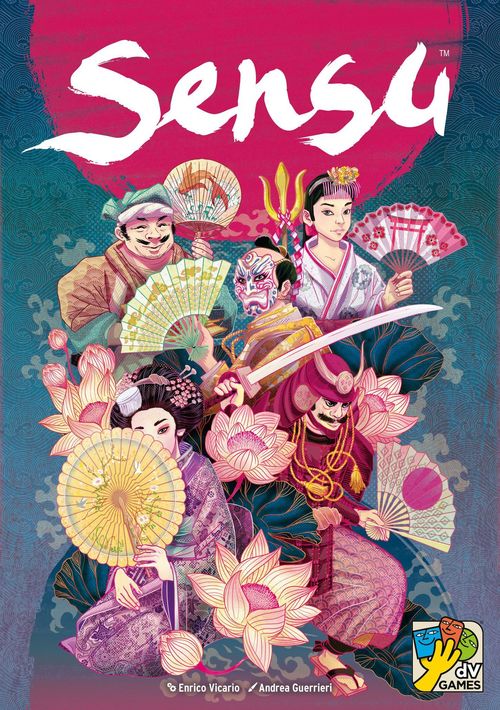
Sensu
Sensu Rulebook
Table of Contents
Table of Contents
Contents
- 90 Fan cards: divided into three series of different types and colors (Gun-sen, Hi-ōgi, Mai-ougi); each series shows values 1 to 9 (three times) with fan sections of 1 to 4 sticks, and three wild cards with values 1/2/3, 4/5/6, and 7/8/9, with 1 stick.
- 15 Closed fan cards: 5 for each type of fan.
- 5 Summary cards (front: "Redeeming Cards"; back: "Fan Powers").
- These rules.
Aim of the Game
Each player tries to obtain a combination of cards in their hand with a total value of 20. They can then play that combination to redeem one or more of the cards in it. They will use the redeemed cards to build their own personal fans. The first player to complete two fans of different types will be the winner!
Setup
- Separate the Closed fan cards by type and create three face-up decks on the table (one of each type) within reach of all players.
- Use the Fan cards to form a deck:
- for four or five players, use all the cards;
- for two or three players, remove all cards with two wind symbols from the game.
- Shuffle the deck and deal each player five cards face down, which will make up their starting hand. Leave the rest of the deck face down in the center of the table as a draw deck.
- Each player leaves space in front of them for a personal discard pile (next to the draw deck) and for an area where they will build their fans over the course of the game.
- Give a Summary card to each player. Leave the rest in the box.
- The youngest player starts the game.
Example of a three-player game: the draw deck is in the center, the three Closed fan decks are within reach of all players, and each player has a personal discard pile and a fan-building area.
The Game
The game is played in turns, in clockwise order, starting with the first player. On your turn, choose and perform one single action, choosing between:
- Draw one card
- Play a combination
1. Draw one card
You can draw:
- the top card of the draw deck, or
- the card on top of any discard pile (including yours).
After you have drawn, if you have six cards in your hand, you must discard one card, face up, in your personal discard pile, to get back to five cards.
At the end of this action, your turn ends and play passes to the player on your left.
2. Play a combination
This action is performed in two steps, in order:
- a) play a combination to redeem cards
- b) build fans
a) Play a combination to redeem cards
If you hold a combination of cards whose values added together is exactly 20, you can play it in front of you. If you do, you redeem the card of the combination with the highest number of sticks (this card will be used in step b) Build fans, see ahead).
Redeeming bonus cards
Depending on the combination played, in addition to the card with the highest number of sticks, you may also redeem up to two additional bonus cards, according to these rules:
- If there are at least two matching numbers in the combination, redeem one bonus card;
- If there are at least three fan sections of the same type in the combination, redeem one bonus card.
If you meet both conditions, redeem two bonus cards. For each bonus card you are entitled to, redeem the card with the lowest number of sticks in the combination.
Note: In all the cases above, if there are several cards that have the smallest or largest number of sticks, you can always freely choose from those the card(s) you prefer.
Keep all the redeemed cards face up in front of you—you will use them in the next step b) Build fans (see ahead). Discard the other cards of the combination in your discard pile, face up, in the order you want.
Examples
Example 1: combination of 6, 7, 7.
By playing this combination, you immediately redeem the value-6 card (the one with more sticks). In addition, because there is a matching pair of numbers in the combination, you also redeem one of the value-7 cards of your choice (with fewer sticks). The other 7 ends up in your discard pile.
Example 2: combination of 2, 3, 6, 9.
With this combination, you can choose to redeem either the 2 or the 3 (same, greater number of sticks). In addition, because there are three fan sections of the same type, you redeem the 9 (smallest number of sticks). The two remaining cards must be discarded.
Example 3: combination of 2, 2, 4, 5, 7.
With this combination, you get one of the 2s of your choice. You also redeem the two cards with the fewest sticks, having both three fan sections of the same type and two matching numbers. So, you get the 7 and either 4 or 5, your choice. The two remaining cards must be discarded.
Wild cards
There are some wild cards in the deck that show three numbers instead of one: 1/2/3, 4/5/6, and 7/8/9. You can use a maximum of one wild card in each combination.
When you play a combination, you can give the wild card any of the three values shown (to reach the sum of 20). However, wild cards can only contribute to the bonus for three fan sections of the same type, and they can never be considered for a matching pair of numbers, regardless of the value they are given.
Example: combination of 3, 5, wild card 1/2/3, 9.
With this combination, to get the sum of 20, you assign the value 3 to the wild card. You redeem the card with the highest number of sticks, the 3. There are at least three fan sections of the same type, so you also get one of the cards with the fewest sticks, that is, one of your choice between the 9 and the wild card. The bonus for two cards with the same value is not awarded: the 3 and the wild card (which is worth 3), do not count as a pair. The two remaining cards are discarded.
b) Build fans
After playing a combination and redeeming one or more cards, place them face up in front of you to build fans (two fans must be completed to win the game!). You can have a maximum of three fans in front of you, one of each type. Each card can only be added to the fan of its own type. Place it slightly offset on top of any previous cards so the total number of sticks is always visible (see illustrations). If a fan type is not yet present, you start one with the newly redeemed card. Cards placed in previous rounds cannot be removed from fans.
When a fan has exactly 10 sticks, it is complete and no additional sticks can be added to it. When a fan is complete, "close" it and place a Closed fan card of the same type on top of it, taking it from the relevant deck.
If you cannot use one or more of your redeemed cards because the corresponding fan is complete or because the number of sticks on the card would cause the limit of 10 to be exceeded, discard the unusable cards face up on your discard pile, in any order you wish.
Illustration: an incomplete Mai-ougi fan, an incomplete Hi-ōgi fan, and a closed Gun-sen fan.
At the end of this action, your turn ends and play passes to the next player clockwise.
If, at any time, the draw deck runs out, form a new deck by shuffling all the discard piles together.
End of the Game
As soon as a player completes their second fan, the game ends: that player wins!
Game Variations
After a few games, you can introduce one or both of the following game variants.
The powers of the fans
Each type of fan has a special power, which is applied when you add the second card bearing the corresponding symbol to your fan. The power is activated immediately, and symbols on cards added to the fan later have no further effect.
The three special powers must always be applied if possible. The corresponding actions are explained below.
- HI-ŌGI (ancient fan made of thin wooden sticks) — Wisdom: Draw three cards, choosing them from the discard piles and/or the draw deck.
- MAI-OUGI (used in dances and theater) — Harmony: Take one card from the top of any discard pile and add it to one of your fans.
- GUN-SEN (war tool employed by the Samurai) — Courage: Remove the last card from an unclosed fan of each opponent and move it to the respective player's discard pile. You cannot remove a card with a power symbol.
The chosen fan
At the beginning of the game, shuffle the Closed fan cards face down into a single deck, assign one card face up to each player, and keep the others face down in the center of the table. Keep the card you receive in front of you: it is your "chosen fan," which you must close before any others. You can start building other fans as well, but you will not be able to close them before your chosen one (discard any redeemed cards that turn out to be unusable because of this rule).
After completing your chosen fan, close it with the corresponding card and draw a new card from the Closed fan deck: if it is of the same type as the fan you just closed, discard it and draw again until you find a different Closed fan, which becomes your new "chosen fan." If the Closed fan deck runs out, reform it by shuffling the discarded cards.
Solo Play
Build the game deck using the 27 Fan cards that have only one wind symbol (one set of cards from 1 to 9 for each type of fan) and return the other cards to the box. Shuffle the deck and place it face down on the table, leaving room for a discard area, an area to place up to four columns of cards, and an area to build fans.
The object of the game is to score as many points as possible, ideally by building three fans of 10 sticks, one of each type.
Each turn, you can take one of two actions:
- Draw a card from the deck: Place it either on top of the discards or at the bottom of one of the four columns, slightly offset on top of any cards already present, which remain visible.
- Play a combination: You can use three, four, or five cards, taking them from the bottom of each column and/or the top of the discards. Attention: You can only use one card per column!
The rules for combinations and fan building are the same as in the basic game.
The game ends when the deck of cards runs out or when you close your third fan.
Your score is the total number of sticks in the fans in front of you, whether incomplete or closed, added to the total number of sticks on any cards left in the deck (in case you have closed all three fans).
The level of your victory corresponds to your score, according to this list:
| Score | Level |
|---|---|
| 0 - 19 | Gutted |
| 20 - 24 | Beginner |
| 25 - 29 | Apprentice |
| 30 - 34 | Samurai |
| 35 - 39 | Master |
| 40+ | Grandmaster |