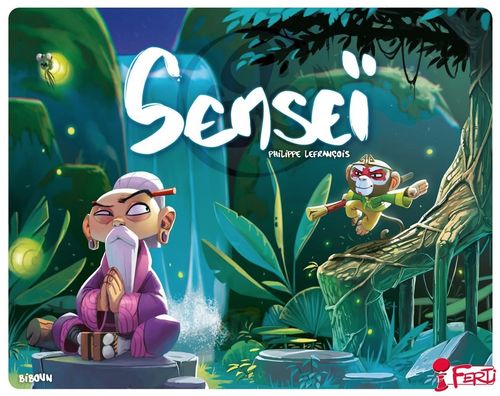
Senseï
Senseï Rulebook
Table of Contents
Table of Contents
Material
- 1 reversible game board
- 14 wooden stones
- 2 painted figurines
Goal of the Game
To be the first player to bring his character to the opposite side of the board.
Preparation
At the beginning of the game, players choose a version to play: "Arashi" or "Sizukana". The explanations of the two versions are below. The stones are placed in a line on two opposite edges. Each player's character is placed on the middle stone of his chosen colour (either green or red) — fig. 1.
How to Play
Each player has three choices on his turn. He must choose to perform at least one of the three following actions (in any order):
- move a stone of his colour
- move a second stone of his colour or move the first stone an additional space
- move his character
Move His Stones
The stones move horizontally or vertically without changing direction (it is forbidden to move a stone diagonally) — fig. 2. So, to move a stone horizontally and vertically, you need to use two actions. Only one stone can be placed on each square. A stone with a character on it cannot move. A stone is stopped by an opponent's stone.
During each turn, a player can execute one or two movements of stones (the two movements can be made by the same stone). Movements may be made in any order. For instance, the movement of a character can be made between two movements of stones.
| Version Arashi | Version Shizukana |
|---|---|
| You can move your stones as many squares as you wish as long as the spaces are open (not blocked by your opponent) — always in only one direction. | You can move your stones only one square. |
Note: only one version is chosen for playing at the beginning of each game.
Move His Character
A character can move between two stones of his colour — fig. 3 — if:
- the stones are aligned along the same line horizontally, vertically or diagonally;
- there are no opponent's stones between his two stones.
The length of the movement is not limited.
End of the Game
The first player to bring his character to one of his own stones, positioned on the opponent's start line, wins the game!
Unfair Game
If a player blocks the game by creating a line that may not be crossed by the opponent's stones, then he may lose the game due to unfair game play if his opponent puts at least three stones in contact with the impassable line — fig. 4.
Variant Shizukana
Rules are the same. Only the placement of the stones changes at the beginning of the game. Each player has two stones on the opponent's start line — fig. 5.
Variant Arashi-Expert
(on the opposite side of the board — fig. 6)
The stones cannot move through or fall into the pits. However a player's character can move over the pits.
Unfair game: the pits are treated like uncrossable stones.