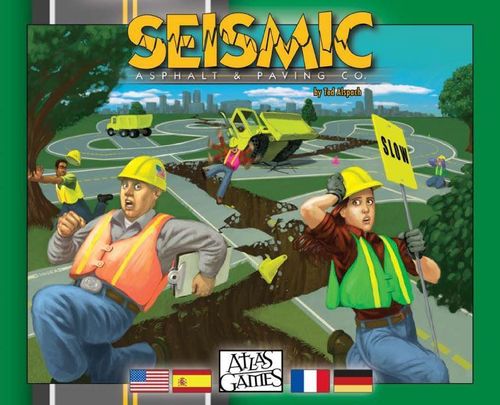
Seismic
Seismic Rulebook
Table of Contents
Components
Seismic is designed for 2 to 4 players, ages 10 and up. Play time is 30 to 60 minutes. Seismic contains the following pieces in addition to this rules sheet: 60 highway tiles, 13 intersection tiles (numbered +1 to +6), 6 quake tiles (numbered 1.0 to 6.0), 1 San Andreas tile, 80 road crew markers (20 each of 4 colors).
Setup
Before playing, follow these steps:
- Each player chooses a color and takes those road crew markers.
- Place the San Andreas tile in the middle of the play area.
- Separate out 2 straight highway tiles, 2 loose curves, 2 tight curves, and the 6 quake tiles. Shuffle these together face down, then draw 6 of them at random and place them back in the box without looking at them. Now, turn all of the rest of the tiles face down and shuffle the remaining 6 tiles back into them, again without looking. This becomes the draw pile.
- Turn over the top two tiles of the draw pile and place them face up within reach of all the players. If a quake tile is turned over, it's discarded from the game and another tile is drawn in its place.
- The player seated nearest to a solid doorframe goes first, and play proceeds clockwise around the table.
Game Play
On your turn, you draw a tile, place a tile, and may place a road crew (if possible).
First, flip over a tile from the draw pile so there are 3 face-up tiles available. Then choose one of these tiles and place it adjacent to another tile already played on the table, in a legal configuration. The new tile must be oriented so that one of its highway edges touches a highway edge of the other tile, and all other abutting edges must also match: green edges must match other green edges, and highway edges must match other highway edges. Also, no tile may be placed in a location where it extends over the edge of the table. If none of the 3 tiles may be legally placed, discard them from the game and turn over 3 new tiles, then proceed with your turn.
After placing a tile, you may also place a single road crew marker on one of that tile's highway fragments, but only if that fragment is not part of a highway section that has a marker already on it somewhere; the color of the marker makes no difference. If you place an intersection tile, you may put a road crew marker on one of the small highway fragments protruding from its central red hexagon, again as long as that fragment is not a piece of a highway section with a marker anywhere along its length.
A highway section is a string of connected highway fragments that may be finished on each end by intersections. A highway section can be as little as one fragment long — such as the fragments on intersection tiles — or a chain of dozens of highway fragments.
Quakes
When you turn over a quake tile from the draw pile, it causes some of the played tiles to be discarded immediately. First, find the side of San Andreas that has the most tiles extending from it in a straight line, even if those tiles aren't contiguous. Because the San Andreas tile is a hexagon, you'll have six choices. In case of a tie, you get to choose which of the tied sides the quake affects.
On the side impacted by the quake, remove the number of tiles indicated by the magnitude of the quake; for example, 3.0 means you'll remove 3 tiles. Start with the tile adjacent to San Andreas, and move outward in a straight line, not counting empty spaces. If there aren't as many tiles as indicated on the quake tile, remove as many as there are. Any road crew markers on the discarded tiles are also removed and returned to their players.
After removing the quaked tiles, flip over another tile so 3 are face up and proceed with your turn. If another quake tile is drawn, repeat the process.
End Game
The game ends when the last tile has been placed, or when there aren't any available incomplete highway sections left — when both ends of all the highways on the table finish in an intersection or at the edge of the table. At that point, scoring begins.
Remove all road crew markers from incomplete highway sections. A section is complete only if each end of the highway finishes in an intersection or San Andreas, or if both ends finish in the same intersection or San Andreas. A "loop" section that is not attached to an intersection or San Andreas is considered incomplete.
For each complete highway section occupied by a player's road crew marker, score 1 point per highway fragment in it to that player, removing the marker once its section is tallied. If a highway runs through the same tile more than once, score 1 each time the highway passes through that tile. Also add any additional points from the intersections on each section; San Andreas scores 6 points, as a +6 intersection. Don't add points for the small fragment of highway projecting from an intersection's central red hexagon. If a highway begins and ends at the same intersection or San Andreas, count the intersection or town twice.
If multiple players have road crew markers on the same completed highway section, the player with the most markers receives that section's points. In case of a tie, full points are given to all tied players.
In the end, the player with the most points wins! In case of a tie, the tallest player wins as he's most likely to be seen amid the rubble.
Variants
The following variants can be added:
The Big One: Put the 6.0 quake tile aside. Mix the remaining 5 quake tiles with 2 straight tiles, 2 loose curves, and 1 tight curve, then put 5 of those in the box, mixing the remaining 5 into the draw pile. Next take 5 tiles from the draw pile, shuffle the 6.0 quake in with them, and place those 6 tiles at the bottom of the draw pile.
Road Crew's Dilemma: After placing a tile, you may place another tile instead of a road crew marker. The next player flips 2 tiles.
Aftershocks: After a quake is resolved, each player may rotate 1 placed tile to a new orientation, as long as it remains legally placed. Start with the player whose turn it is, and move clockwise. No tile may be turned more than once for a single quake. Road crews on turned tiles remain on their starting fragment, which can result in more than one road crew per section.
Twin Cities: Using 2 copies of Seismic, place the first San Andreas tile as usual, and then place the second San Andreas tile 8 spaces away. Mix 4 straight tiles, 4 loose curves, and 4 tight curves with all 12 quakes, putting 12 into the box and shuffling the remaining 12 back into the draw pile. When a quake occurs, both San Andreas tiles are impacted — the player whose turn it is chooses which is affected first. Include the other San Andreas tile when calculating which side has the most tiles, but don't discard it. If any highway section directly connects both San Andreas tiles, it's scored with a bonus of +10 in addition to the +6 from each town.