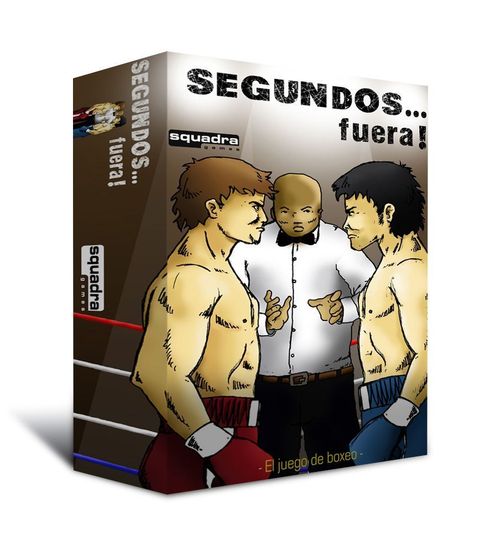
SEGUNDOS...fuera!
SEGUNDOS...fuera! Rulebook
Table of Contents
Table of Contents
Components
Each player has:
- An attacking deck of 36 cards with values from 1 to 5. There are two types: punch and feint + punch.
- A defending deck of 36 cards with values from 1 to 5. There are two types: block and dodge.
- The ring, where each boxer keeps track of:
- Endurance: each boxer has 100 endurance points for the whole fight (see the Endurance Track).
- Damage taken in each round (see the Damage Track).
- The 12 rounds.
Getting Ready for the Round
At the beginning of each round, draw 7 cards from your attacking deck and 7 cards from your defending deck. Discard 1 card from each. A discarded card goes back to the top of its deck (attacking and defending), so you will draw it next round. The remaining cards are your attacking and defending cards for that round (a 6-card attacking hand and a 6-card defending hand).
Playground
To avoid confusion or problems, it is important to follow the order for placing components, as well as where each boxer plays their attacking and defending cards. Follow the layout diagram, which shows each boxer's attacking pile, attacking discard pile, defending pile and defending discard pile, the In the Corner Strategy Cards area, the Outstanding Movement area (3), and the ring positions numbered 1 to 6.
Control of the Fight and Playing Cards
To throw a punch, a boxer has to be in control of the fight. Control can be kept or can be lost as the result of playing cards.
To throw a punch, the boxer in control of the fight plays an attacking card, and the opponent plays a defending card. Then see the result (whether the punch lands or not).
Cards are usually played face down, but sometimes they are played face up.
Way of Playing Cards
- Face up. The boxer who has control of the fight, after examining their cards, plays an attacking card face up. The opponent then plays a defending card to avoid the attack.
- Face down. The boxer who has control of the fight, after examining their cards, plays an attacking card face down. The opponent, in the same way, plays a defending card face down to avoid the attack. Both cards are revealed at the same time.
Working Out Punches
Compare the attacking card value (A) with the defending card value (D).
-
If A > D (attacking is higher than defending): a punch is landed. When a boxer lands a punch, add damage points to the opponent equal to the difference between the attacking and defending card values (see Damage). The opponent also loses that number of endurance points (see Endurance). The attacking boxer keeps control of the fight and can continue attacking with a card face down.
Example: attacking card value 4, defending card value 2. The defender adds 2 damage points and subtracts 2 endurance points on their tracks.
-
If A < D (defending is higher than attacking): the defender takes control of the fight, whether the defending card was a block or a dodge.
-
If A = D:
- a) If the defending card was a block, no punch is landed. The attacking boxer must play the next card face up.
- b) If the defending card was a dodge, the defending boxer takes control of the fight.
Feint + Punch
If the attacking card is a feint + punch, its value is considered plus 1 if the defending card's value is equal or lower. A feint + punch card always hits a blocking or dodging card with the same or a lower value.
Example: a feint + punch of 3 + 1 has a value of 4 and lands a punch against any defending card of value 3 or lower.
Endurance and Damage
Each boxer has some skills that must be managed throughout the fight.
Endurance
Endurance represents the boxer's tiredness. Each boxer starts with 100 endurance points. Every time you throw a punch, or your opponent lands a punch, you lose endurance.
When a boxer reaches certain endurance levels (50, 30 and 20 endurance points), some effects appear. The boxer becomes slower, or starts the round with some damage points instead of 0 as normal. The endurance track labels 50 and 30 as "descanso" (rest) and 20 as "cansancio" (tiredness); the quick guide does not explain these labels further. Endurance points are recovered between rounds.
Damage
Damage is the punishment boxers inflict on each other during the round. The Damage Track runs from 0 to 10:
- 8 or 9 damage points: a cut happens (the track labels 8 as "ceja abierta", open brow).
- 10 damage points: a knockdown happens (the track labels 10 as "derribo", knockdown).
You should avoid these if you can, or if your opponent lets you.
The track also shows markers labelled "1st knockdown" (around 4) and "2nd knockdown" (around 6). The quick guide does not explain these markers in text.
When a round starts, the damage track returns to 0, except when the boxer is cut or has reached some endurance levels.
In the Corner Strategy Cards
Every time a round ends, the boxers receive advice and tips in their corners. Each boxer chooses an In the Corner Strategy Card, which can be used in the following round. The card is chosen in a hidden way and is revealed at the start of the round.
Strategy cards have different effects: they increase attacking or defending card powers, let you choose some cards when you have to draw, or help close a cut, among others.
Outstanding Movement Cards
Each boxer has their own outstanding movement cards. They work like jokers, and can be used defending or attacking, when the boxer chooses. Each boxer has only 3 outstanding movement cards, and only one can be used in a round.
Knock Down and Clinch Cards
Knock Down and Clinch cards are played when these situations happen. The quick guide names them but does not explain how they work, so their rules are not included in this rulebook.
How to Win
As in a boxing fight, you can win by K.O. or by judges' decision.
-
a) By K.O. A boxer is knocked down (by a landed punch of 4 or more damage points, or by accumulating 10 or more damage points in the same round) and does not stand up in the protection count.
-
b) By judges' scoring. Every round, each boxer gets a scorecard number of points (10, 9, 8 or 7) according to the punches landed, the damage made, and whether there were any knockdowns. This simulates judges' scorecards. The boxer who adds up the higher total over the 12 rounds is the winner.