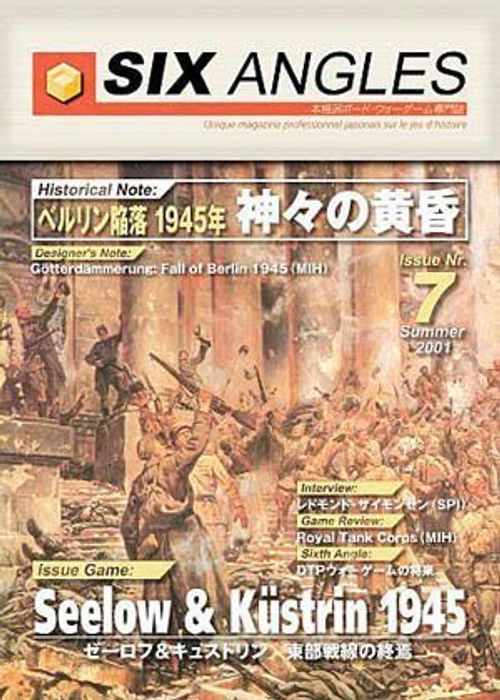
Seelow & Kustrin 1945
Seelow & Kustrin 1945 Rulebook
Table of Contents
Table of Contents
- 1.0 Introduction
- 2.0 Components
- 3.0 Sequence of Play
- 4.0 Stacking and Zones of Control (ZOC)
- 5.0 Movement
- 6.0 Anti-Tank Fire
- 7.0 Combat
- 8.0 Artillery
- 9.0 Reinforcements
- 10.0 Special Rules
- 11.0 Scenario 1: Küstrin Relief Operation
- 12.0 Scenario 2: Assault on the Seelow Heights
- Play Example
- Notes on Materials Not Reproduced
1.0 Introduction
Seelow & Kustrin is a two-player tactical game, at battalion and regiment scale, that recreates two battles of the Eastern Front in the closing period of the Second World War. Its subjects are the German Küstrin relief operation, begun on 27 March 1945, and the Soviet all-out attack on the Seelow Heights, begun on 16 April 1945.
The game is played in a set sequence called game turns. One game turn represents three real hours in daylight, or four real hours at dawn, dusk, or night. The winner is decided by the position on the map after twelve completed game turns.
2.0 Components
2.1 Map
The A2 game map shows the terrain of the Oder river region in eastern Germany, where the real battles were fought, at a scale of 1 to 60,000.
The hexagonal grid printed over the map is the unit of distance for movement and fire. The hexes are called "hexes" and the dividing line between adjacent hexes is the "hexside."
Each hex carries a four-digit number. The distance from the centre of one hex to the centre of an adjacent hex represents 960 metres. Around the edge of the map are the various charts and tables needed for play.
2.2 Counters
Counter Sheet 2 of the appendix carries the combat units of both the German and Soviet armies used in this game. The unit counters are called "units."
The numbers and symbols printed on a unit show its combat strength, its movement capacity, its unit size and branch, its troops' morale, and its range.
The game also includes markers, in addition to units, to show the state of play.
2.21 Reading a Unit
- Unit name. The unit name is the historical designation of the unit. Where two names are printed, the upper name is the parent formation (division, corps, and so on) and the lower name is the unit's own designation. On artillery units, the upper name is the unit designation and the lower name is the calibre of the gun it carries.
- Unit size symbols. The size symbols mean: X = brigade; III = regiment; II = battalion; I = company.
- Abbreviations. Soviet abbreviations: Gd = Guards; T = Tank Corps; M = Mechanised Corps; AAG = Army Artillery Group; KAG = Corps Artillery Group; Mix = Mixed. German abbreviations: FJ = Fallschirmjäger (paratroop); Fuh = Führer; Fus = Light Infantry (Fusilier); G = Grenadier; Kurm = Kurmark; Mun = Münchberg; PG = Panzergrenadier; SB = Assault Gun Brigade; SS = Waffen-SS; VAK = National Artillery Corps; VG = Volksgrenadier (National Assault Infantry); Tr = Training; v.War = von Wartenburg.
- Anti-tank fire value. The anti-tank fire value is the number used when the unit fires at an armoured enemy unit. The combat value is the number used when the unit makes a normal attack on an unarmoured enemy unit, and when an unarmoured unit is the target of a normal attack.
- Movement class. A unit whose movement value is printed on a yellow background is a foot unit. A unit whose movement value is printed on a red background is a vehicle unit.
- Armour. A unit with a red circle printed with a number on its left side is an armoured unit. All other units are unarmoured.
2.22 Unit Types
The unit-type legend on the counters sorts units into foot units, vehicle units, and artillery units (the last under a separate heading, "Artillery Units (Vehicle Units)" for the vehicle-mounted types in the legend). The legend lists the following types.
- Foot units. German: infantry and fallschirmjäger (paratroop). Soviet: rifle (sniper) units.
- Vehicle units. German: armoured grenadiers, the III Panzer assault gun, Hetzer, Panzer IV (H and Lang versions), Panther V, and the Tiger II (Königstiger). Soviet: mechanised infantry, vehicle-borne snipers, T-34/85, IS-2m, ISU-152, and the Marshal Zhukov unit.
- Artillery units. German: 75 mm, 100 mm, 105 mm, 155 mm and 88 mm guns and howitzers. Soviet: mixed artillery (guns, howitzers and rocket launchers) and 122 mm howitzers.
2.23 Markers
The game includes three kinds of marker:
- Disrupted marker (混乱マーカー): placed on a unit that is disrupted.
- Moved / Fought marker (移動済/戦闘済マーカー): shows that a unit has moved or has fought.
- Game Turn marker: placed on the game turn track to show the current game turn.
3.0 Sequence of Play
The game advances by repeating the following sequence. Each step is carried out in order from the top. When the whole sequence has been carried out once, one game turn is complete.
3.1 Turn Sequence
German player stage
- German player artillery fire phase. The German player may use his own artillery units to fire at enemy unarmoured units. The German player may also turn over his artillery units that did not fire in this phase, placing them in move mode.
- German player movement phase. The German player may move his own units within their movement allowance. Artillery units that were placed in move mode in step 1 may also move in this phase.
- Soviet player anti-tank fire phase. The Soviet player may use his own units to fire at adjacent enemy armoured units. Fire results apply immediately.
- German player anti-tank fire phase. Following the same rules as step 3, the German player may use his own units to fire at adjacent enemy armoured units.
- German player combat phase. The German player may use his own units to attack adjacent enemy unarmoured units.
Soviet player stage
- Soviet player artillery fire phase. Following the same rules as step 1, the Soviet player may use his own artillery units to fire at enemy unarmoured units. The Soviet player may also turn over his artillery units that did not fire in this phase, placing them in move mode.
- Soviet player movement phase. Following the same rules as step 2, the Soviet player may move his own units within their movement allowance. Artillery units that were placed in move mode in step 6 may also move in this phase.
- German player anti-tank fire phase. Following the same rules as step 3, the German player may use his own units to fire at adjacent enemy armoured units.
- Soviet player anti-tank fire phase. Following the same rules as step 3, the Soviet player may use his own units to fire at adjacent enemy armoured units.
- Soviet player combat phase. Following the same rules as step 5, the Soviet player may use his own units to attack adjacent enemy unarmoured units.
Administrative stage
- Disruption recovery phase. Each player rolls one die for each of his own units carrying a disrupted marker and tests for recovery. If the number rolled is equal to or less than the morale value printed on the unit, the unit recovers and the disrupted marker is removed. If the die roll is greater than the unit's morale value, the disrupted marker stays on the unit. In addition, only in the disruption recovery phase of a night turn, a player may change his own artillery units in move mode to fire mode (see 10.2).
- Turn marker advance phase. Finally, advance the Game Turn marker one space on the game turn track.
A game turn is complete after these steps. The sequence is repeated twelve times, and the game then ends.
3.2 Special Turns
3.21 Of the twelve turns in the game, turns 1, 6 and 8 are "twilight turns," and turn 7 is the "night turn." Movement, anti-tank fire, artillery fire, and combat during these turns are subject to certain restrictions (see 10.2).
3.22 All turns other than the twilight and night turns are "daylight turns." No special restrictions apply to actions carried out in daylight turns.
4.0 Stacking and Zones of Control (ZOC)
There is a limit on the number of units that may occupy one hex. Placing counters on top of one another in a hex is called "stacking," and this restriction is called the "stacking limit."
Most units also exert an effect called a "Zone of Control" (ZOC) over the six hexes surrounding the hex they occupy.
4.1 Stacking Limit
4.11 The stacking limit applies at all times throughout the game, including during the movement phase of each side. However, when a unit retreats, it may pass through a hex that temporarily exceeds the stacking limit in order to retreat (see 7.55).
4.12 The German player may stack up to three of his own units in one hex. However, a battalion-sized unit counts as two units for stacking purposes only. Unit affiliation does not affect stacking.
4.13 The Soviet player may place only one of his own units in one hex. However, the Marshal Zhukov unit is treated as exempt from the stacking limit and may be stacked with other units of its own side.
4.14 Markers are not subject to the stacking limit.
4.2 Zones of Control (ZOC)
4.21 Units on the map are treated as exerting a Zone of Control (ZOC) over the six hexes around them at all times, with the exceptions listed here. Exception: disrupted units and the Soviet Marshal Zhukov unit have no ZOC.
4.22 A unit's ZOC does not extend to an adjacent hex that the unit could not enter by movement.
4.23 A unit's ZOC from a hex at elevation level 1 does not extend into a hex at elevation level 3. However, a unit's ZOC from a hex at elevation level 2 or 3 extends into hexes at elevation levels 3, 2 and 1.
4.24 A unit that moves into an enemy ZOC during its movement must stop there for the rest of that phase's movement, even if it still has movement points remaining (see 5.18).
4.25 A hex in which both sides' ZOCs are present is considered a ZOC for both sides. A unit's ZOC has no effect on friendly units.
4.26 At the start of its own movement phase, a unit that is in an enemy ZOC hex may leave that hex by spending additional movement points (see 5.22).
4.27 For purposes of retreat only (see 7.5), the presence of a friendly unit cancels the effect of an enemy ZOC.
4.28 Where several units exert ZOC over the same hex, the effects do not stack.
5.0 Movement
A unit always moves using its own movement allowance. Each unit may move within its movement allowance during one friendly movement phase. A unit may spend all, part, or none of its movement allowance.
5.1 Expending Movement Points
5.11 When moving, a unit must take account of the terrain of the hex it is entering and the terrain of the hexside it crosses. The movement cost for each terrain type differs between foot units and vehicle units. These costs are listed in the Terrain Effects Chart on the map.
5.12 When a foot unit crosses a stream hexside, it must spend an additional 2 movement points on top of the movement cost of the terrain of the hex it is entering. When a vehicle unit crosses a stream hexside into an adjacent hex without using a track or road, it must spend all of its movement points for that turn, regardless of the terrain of the hex it enters.
5.13 When moving across a hexside that carries a road, track, or railroad, a unit may ignore other terrain and spend only the movement points for that hexside.
5.14 When moving into a hex at a higher elevation level, a unit must spend, for each level of increase, an additional 1 movement point if it is a foot unit or an additional 2 movement points if it is a vehicle unit, on top of the movement cost of the terrain of the hex it enters. However, when using roads, tracks or railroads, no additional movement cost is required.
5.15 Even if the hex before and the hex after a move are at the same elevation level, if the unit first crosses a hexside down to a lower level, it must spend the additional movement points. For example, if a foot unit moves from hex 2516 to hex 2417, it spends a total of 2 movement points: 1 for the clear terrain and an additional 1 for entering the higher-elevation hex.
5.16 A unit may not make a move if it has no movement points remaining, or lacks the points needed to enter the hex. (There is no rule in this game that a unit can always move at least one hex regardless of its movement points.)
5.17 Movement is not compulsory. In each friendly movement phase, the player may move as many or as few of his units as he wishes, and the rest need not move. Provided he spends the movement points required for each hex, a unit may move or change facing in any direction.
5.18 A unit that moves into an enemy ZOC during its movement must stop there for the rest of that phase's movement, even if it still has movement points remaining (note 5.23). However, artillery units may not move into a hex in an enemy ZOC.
5.19 A unit with zero movement points at that moment (an artillery unit in fire mode) may make no movement.
5.2 Movement Restrictions
5.21 A unit may under no circumstances move into a hex occupied by an enemy unit.
5.22 A unit that was in an enemy ZOC hex at the start of the movement phase may leave that enemy ZOC hex by spending an additional 2 movement points. However, a unit may not move directly from one enemy ZOC hex into another enemy ZOC hex.
5.23 A disrupted unit is treated as having its movement allowance halved (fractions rounded down). In addition, a disrupted unit may not move into a hex in an enemy ZOC.
5.24 A unit may not transfer unused movement points to another unit, nor carry them over to the next game turn.
5.25 The stacking limit (4.1) also applies during movement. A player may not move his units in a way that would exceed the stacking limit.
5.26 Once the player's hand has left a unit that is in the middle of a move, that unit's movement for that movement phase is treated as complete.
5.27 A player may move a unit off the map. For this purpose, the hex beyond the map edge is assumed to exist, and carries the same terrain as the edge hex (or, where there is more than one terrain type, the one that costs less movement). A unit that has left the map this way is not treated as destroyed, but it may never return to the map.
5.28 During a twilight turn, a unit other than artillery may move using half of its movement allowance (fractions rounded up). During a night turn, a unit other than artillery may move using one quarter of its movement allowance (fractions rounded up). However, in either case, a unit may not move into a hex in an enemy ZOC. Artillery units may make no movement at all during twilight or night turns.
5.29 In Scenario 2, "Assault on the Seelow Heights," German units may make no movement at all in the movement phase of turn 1. However, fire, artillery fire, normal attacks, retreats and advances after combat may be carried out as normal.
6.0 Anti-Tank Fire
In a friendly anti-tank fire phase, each unit may fire at an adjacent enemy armoured unit.
Anti-tank fire is at the option of the firing player and is not compulsory.
6.1 Restrictions on Anti-Tank Fire
6.11 A unit may fire only once in one friendly anti-tank fire phase. That means a unit may fire twice in total during one game turn.
6.12 The only targets of anti-tank fire in its phase are enemy armoured units. Unarmoured units are not targets of fire in this phase and are not affected by fire results (exception: 7.57).
6.13 In one shot, a unit may fire only at one unit in an adjacent hex. In its own fire phase, a player may freely examine the contents of an enemy stack to decide whether to fire.
6.14 When several units fire at the same target, their fire values are added together and resolved as a single shot.
6.15 When a target hex contains several enemy armoured units, in order to fire with two or more friendly units at one particular armoured unit, at least one friendly unit must have fired at each of the other armoured units in that hex. For example, if the target hex contains three enemy armoured units and two or more of your units are to fire at one of them, at least four friendly units are needed. Except for this kind of case, a player is never forced to carry out anti-tank fire.
6.16 The fire value of one unit may not be divided. For example, a unit with an anti-tank fire value of 5 may not split it into 2 and 3 to fire at two different enemy tank units.
6.17 A unit carrying a disrupted marker may not fire. A unit with an anti-tank fire value of zero may not fire at enemy armoured units. Furthermore, during a night turn (10.2), no unit may fire at enemy units.
6.18 A unit may not fire at an enemy unit in an adjacent hex that it cannot enter by direct movement with the movement points it has at that time.
6.2 Resolving Anti-Tank Fire
(1) First, declare a particular enemy armoured unit as the "target" and add the anti-tank fire values of all units firing at that unit.
(2) The firing player rolls one die and adds the terrain modifier for the hex occupied by the target unit to the number rolled.
(3) Consult the Anti-Tank/Artillery Fire Resolution Table, and apply the result at the intersection of the anti-tank fire value and the die result immediately to the target unit.
6.3 Terrain Modifiers
6.31 If the hexside between the firing unit and the target unit is a stream, the fire value of every unit firing across that hexside is halved (fractions rounded up). For this purpose, the presence or absence of roads, tracks and railroads has no effect.
6.32 If the target unit's hex is one elevation level higher than the firing unit's hex, the firing unit's fire value is halved (fractions rounded up). If the target unit's hex is two elevation levels higher than the firing unit's hex, the firing unit's fire value is reduced to one quarter (fractions rounded up). For this purpose, the presence or absence of roads, tracks and railroads has no effect.
6.33 These modifiers are all cumulative.
6.4 Non-Terrain Modifiers
6.41 Each armoured unit has its armour modifier printed as a white number in a red circle. When an armoured unit is fired upon, the armour modifier is added to the die roll in resolution.
6.42 If the target unit is disrupted at the time it is fired upon, 2 may be subtracted from the die roll in resolution.
6.43 For all fire during a twilight turn (10.2), 2 is added to every die roll for fire resolution.
6.5 Fire Results
6.51 Fire results are shown by a number or a letter.
6.52 If the fire result is "M," the owning player of the target unit rolls one die and makes a morale check (6.6).
6.53 If the fire result is a number from "1" to "5," the owning player of the target unit rolls one die, adds the result number to the die roll, and makes a morale check.
6.54 If the fire result is "E," the target unit is treated as destroyed and is removed from the game immediately.
6.55 If the fire result is "−" (dash), the fire has no effect.
6.56 If the fire result is a number printed in a white circle, the armoured unit that was the target loses one step immediately, in addition to the morale check (6.7). This step loss is applied before the unit makes its morale check.
6.6 Morale Check
6.61 Each unit has its own morale value printed on it. When a unit is required to make a morale check, its owning player rolls one die and compares the result with this value.
6.62 If the die roll is equal to or less than the unit's morale value, the unit passes the morale check and may remain in its hex.
6.63 If the die roll is greater than the unit's morale value, the unit immediately retreats 2 hexes (7.5) and then becomes disrupted (7.6).
6.64 A unit carrying a disrupted marker is treated as having a morale value 2 lower than printed.
6.7 Step Loss
6.71 All units other than artillery units, the Marshal Zhukov unit, and German armoured units have two steps of strength (steps). At the start of the game, all units are placed with their full-strength face up.
6.72 If a full-strength armoured unit suffers a fire result with a green circled number, the unit is immediately turned over to its reduced-strength face. If a reduced-strength armoured unit suffers a fire result with a green circled number, that unit is treated as destroyed and is removed immediately.
6.73 A unit that has been turned to its reduced-strength face never returns to full strength during the game.
6.74 Artillery units, the Marshal Zhukov unit, and all German armoured units have no reduced-strength face. Therefore, if these units suffer one step of loss, they are treated as destroyed and are removed immediately.
7.0 Combat
In the friendly combat phase, a player may use his own units to attack adjacent enemy unarmoured units. This is called a "normal attack."
For the purposes of combat resolution, the player carrying out the resolution is always called the "attacking player," and his opponent is the "defending player," regardless of the overall state of the battle.
7.1 General Restrictions
7.11 An attacking unit may make a normal attack only once in one friendly combat phase. A defending unit may be attacked by the enemy only once in one combat phase.
7.12 The only targets of normal attacks in the combat phase are the unarmoured units of the defending player. Armoured units are not targets of attack in the combat phase and are not affected by fire results (exceptions: 7.35 and 7.57).
7.13 The attacking player may freely decide whether each individual friendly unit makes an attack. Within a stack, he may have only some of the units attack, while the others do not attack.
7.14 Several defending units stacked in one hex may not be attacked separately. The attacker must add together the combat values of these units and attack them as one. However, the combat value of any armoured unit in the defending hex is not added to the defending total.
7.15 There is no limit on the number of attacking units that may take part in one normal attack. However, every attacking unit taking part in that attack must be adjacent to the defending unit that is the target.
7.16 The combat value of one unit may not be divided. For example, a unit with a combat value of 5 may not split it into 2 and 3 for use in separate attacks. Nor may several defending hexes be attacked as a single combat.
7.17 A unit carrying a disrupted marker may not make any attack. In addition, during a night turn (10.2), no unit may attack enemy units.
7.18 A unit may not make a normal attack on an enemy unit in an adjacent hex that it cannot enter by direct movement with the movement points it has at that time.
7.19 A unit that fired in the same player-stage artillery fire phase, or that fired in the anti-tank fire phase, may still take part in a normal attack. Those earlier actions do not affect this.
7.2 Resolving a Normal Attack
(1) First, declare a particular enemy unarmoured unit (or stack) as the "attack target."
(2) Add together the combat values of all the defending unarmoured units that are the attack target, and add together the combat values of all the attacking units taking part in the attack on it.
(3) Compare the totals from (2) and convert them to a simple ratio found on the Combat Results Table. In doing so, any attack with a ratio of 1:3 or less is resolved as 1:3. Any attack with a ratio of 8:1 or more is resolved as 8:1.
(4) Apply the various ratio modifiers listed in rule 7.3.
For example, if the total combat value is 13 for the attacker and 3 for the defender, the ratio is 4:1. However, if the defending hex is a level 2 woods and every attacking unit is at level 1, then a 3-column leftward shift applies, and the final ratio is 1:1.
(5) The attacking player rolls one die while consulting the Normal Attack Resolution Table, applies the modifiers from 7.3, and then finds the intersection of the modified die roll and the ratio after modification. The number and symbol printed there is the result of this combat. The result is applied immediately.
(6) If, as a result of the combat, the defending units are destroyed or retreat so that the target hex is empty, the attacker may advance some or all of the units that took part in the attack into that hex, within the stacking limit. This is called an "advance after combat."
(7) That completes the resolution of one combat. The remaining combats are resolved one at a time in the same way. However, the results of one attack (retreats, advances after combat, step losses) must be carried out before the next attack is resolved.
7.3 Modifiers to Combat Resolution
7.31 If the defending unit's hex is a village or woods, the ratio is shifted one column to the left for resolution.
7.32 If the defending unit's hex is a town or swamp, the ratio is shifted two columns to the left for resolution.
7.33 If a stream runs along the hexside between all the attacking units and the defending units, the ratio is shifted one column to the left for resolution. For this purpose, the presence or absence of roads, tracks and railroads has no effect.
7.34 If the defending unit's hex is one elevation level higher than the hex of all the attacking units, the ratio is shifted one column to the left for resolution. If the defending unit's hex is two or more elevation levels higher than the attacking units' hex, the ratio is shifted two columns to the left for resolution. If the attacking units are at different elevation levels, judge by the attacker at the highest elevation level. For this purpose, the presence or absence of roads, tracks and railroads has no effect.
7.35 If an armoured unit takes part on the attacking side, the ratio is shifted one column to the right for resolution. If an armoured unit is included on the defending side, the ratio is shifted one column to the left for resolution.
If armoured units are present on both sides, this modifier cancels out and has no effect.
7.36 If a disrupted unit is included among the defending units, 2 is subtracted from the die roll in resolution.
7.37 For attacks carried out during a twilight turn (10.2), 2 is added to the die roll in resolution.
7.38 These modifiers are all cumulative.
7.4 Combat Results
7.41 Combat results are shown by a number or a letter. "A#" is the result for the attacking unit and "D#" is the result for the defending unit. Results are always applied to the defending side first.
7.42 If the combat result is a number from "1" to "5," the player on the affected side checks the morale value of each unit that took part in the combat on his side, and immediately retreats 2 hexes every unit whose morale value is equal to or less than that number. Note that a unit that is already disrupted is treated as having its morale value reduced by 2. A unit retreated in this way becomes disrupted automatically in the hex it retreats to.
7.43 If the combat result is "E," all units of the affected side that took part in the combat are treated as destroyed and are removed from the game immediately.
7.44 If the owning player of a unit that was forced to retreat wishes, he may accept one step loss on the affected unit instead of retreating. In this case, the owning player chooses one unit from among those on his side that took part in the same combat and applies the one-step loss to it. (This is not a step loss applied separately to each unit that does not retreat.)
7.45 If the combat result is a green circled number outlined in white, one additional step loss is applied automatically, separately from the result above. In this case too, the step loss is applied to only one unit among those on the affected side that took part directly in the combat.
However, where several units took part in the same combat, then even if the results of 7.44 and 7.45 overlap, two steps of loss may not be applied to one unit. Each must be applied as one step loss to a separate unit.
7.5 Retreat
7.51 A retreat is always carried out by the unit's owning player, measured in hexes. A retreat resembles a movement, but no movement points are spent for it at all. A retreating unit must end its retreat 2 hexes away from the hex it was in before the retreat.
7.52 A retreating unit must, as far as possible, retreat to a hex that does not violate the stacking limit.
7.53 A retreating unit may not retreat into a hex occupied by an enemy unit, or into an enemy ZOC hex that contains no friendly unit. Nor may it retreat across a hexside that it could not cross by normal movement.
7.54 A unit may also retreat off the map, as in movement. However, such a unit is not treated as destroyed, but it can never return to the game.
7.55 When a retreat would pass through a hex containing other friendly units in a way that exceeds the stacking limit, the retreating unit must continue retreating until it reaches a hex that does not exceed the stacking limit. Also, when this situation arises, the retreating unit and all friendly units in the hexes it passed through that would exceed the stacking limit become disrupted automatically, and disrupted markers are placed on them immediately.
7.56 If a unit retreats into a hex containing friendly units, and those friendly units are then retreated or destroyed by enemy fire or attack in the same phase, the unit that retreated into that hex first is removed automatically, regardless of the combat result.
7.57 When a unit is forced to retreat, its owning player may retreat together with it any units that were in the same hex as the retreating unit. In this case, the units retreating together may include units that did not take part in the combat.
7.58 A unit with zero movement points at that moment (an artillery unit in fire mode) may not retreat. Such a unit, when forced to retreat, is removed as destroyed at that moment. (This destruction is not regarded as the "retreat alternative loss" of 7.44.) In addition, if for any reason a required retreat cannot be carried out, the unit is removed automatically as destroyed.
7.6 Disruption
7.61 A unit that is disrupted may not fire. In addition, a disrupted unit may make a move in the friendly movement phase using half of its movement allowance (fractions rounded down).
(No rule 7.62 appears in the printed rulebook; the numbering runs from 7.61 to 7.63.)
7.63 When a disrupted armoured unit is fired upon, 2 is subtracted from the die roll in resolution of the fire. In addition, when a stack containing a disrupted unarmoured unit is attacked by the enemy, 2 is subtracted from the die roll in resolving the combat.
7.64 A disrupted unit may not spot (8.2) for its own artillery.
7.65 When a disrupted unit makes a morale check, 2 is added to the die roll in resolution.
7.66 Even if disruption results are received more than once, the effect does not change, and no additional penalty is applied.
7.67 In the disruption recovery phase of each game turn, the player rolls one die for each of his own disrupted units and compares the result with that unit's (printed) morale value. If the die roll is equal to or less than the unit's morale value, the unit recovers and the disrupted marker is removed. If the die roll is greater than the unit's morale value, the disrupted marker remains on the unit.
Note that a unit at reduced strength has its morale value lowered by 1 compared with the same unit at full strength.
7.68 A disrupted unit may not move into an enemy ZOC hex. In addition, a disrupted vehicle unit may not move across a stream hexside, except when using a road, track or railroad.
7.69 In a recovery test from disruption, enemy ZOCs have no effect at all.
7.7 Advance After Combat
7.71 In the friendly anti-tank fire phase, if the target unit retreats or is destroyed and the target hex is left empty, the unit that fired may advance into the vacated hex.
7.72 In the friendly combat phase, if the defending unit retreats or is destroyed and the target hex is left empty, the unit that attacked may advance into the vacated hex.
7.73 An advance after combat requires no expenditure of movement points.
7.74 Even if the defender retreated 2 hexes, only one hex, the vacated one, may be entered by an advance after combat.
7.75 When making an advance after combat, a unit may advance directly from one enemy ZOC hex into another enemy ZOC hex.
7.76 Only the units that took part in the fire or attack that directly caused the target hex to become empty may make an advance after combat. However, an advance after combat that would exceed the stacking limit may not be made.
7.77 An advance after combat is not compulsory. Whether to carry it out is the choice of the firing or attacking player, but if he does, it must be carried out before the next fire or attack is resolved.
7.78 An artillery unit may not make any advance after combat, whatever its state.
8.0 Artillery
A player may use his artillery units to fire at enemy units within their range. However, no fire of any kind may be carried out during a night turn.
8.1 Methods of Artillery Attack
8.11 An artillery unit may attack enemy units in each of the following three ways, once in each phase:
- In the friendly artillery fire phase, fire at an enemy unarmoured unit that is not adjacent (indirect fire).
- In the friendly anti-tank fire phase, fire at an adjacent enemy armoured unit (anti-tank fire).
- In the friendly combat phase, attack an adjacent enemy unarmoured unit (normal attack).
8.12 When an artillery unit in move mode makes anti-tank fire or an attack against an adjacent enemy unit, it is treated in the same way as normal infantry and other units.
8.13 Each artillery unit carries its range printed on a yellow circle. This range is the maximum distance, from the hex the artillery unit occupies to the target hex, for indirect fire.
8.14 For indirect fire by artillery units alone, against an enemy unarmoured unit that is not adjacent, the player first declares which friendly artillery units take part in the fire, adds together their fire values, and then chooses the target hex for the artillery fire.
He then rolls one die while consulting the Anti-Tank/Artillery Fire Resolution Table. If the target hex is a village, town, woods or swamp, the total fire value is halved (fractions rounded down) before resolution. In addition, for fire carried out during a twilight turn, 2 is added to every die roll for the fire.
8.15 The result of indirect fire is applied, in the same way as the result of anti-tank fire, to every enemy unarmoured unit in the target hex, individually (see rules 6.5, 6.6 and 7.57). For example, if the indirect fire result against an enemy stack consisting of one tank unit and one infantry unit is "1," the infantry unit must make a morale check with 1 added to the die roll. Note that the armour value of an armoured unit has no effect at all on the resolution of indirect fire.
In addition, armoured units are never affected by artillery fire results.
8.16 If the result of indirect fire is a number outlined in green in a white circle, the owning player of the target units must select one of his own unarmoured units in that hex and apply a one-step loss to it. This step loss is applied before the unit makes its morale check.
8.17 Indirect fire may be carried out only in the friendly artillery fire phase. Indirect fire may not be carried out during the anti-tank fire phase or the combat phase.
8.18 An artillery unit carrying out indirect fire may do so only once in one friendly artillery fire phase. In addition, indirect fire against the same target hex is resolved as one shot, with the fire values of the artillery units firing added together. That is, the same target hex may not receive more than one indirect fire attack in one artillery fire phase.
However, if a unit that was retreated by one indirect fire attack is again fired upon by enemy indirect fire in the hex it retreated to, that retreated unit is treated as having been shelled again in that hex, and the result of artillery fire on that target hex applies to it.
8.19 For an artillery unit to carry out indirect fire, its target hex must be "spotted" by a friendly unit (see 8.2).
8.2 Spotting and Line of Sight
8.21 To carry out indirect fire at an enemy unit, a friendly unit must "spot" that enemy unit. For a unit to spot an enemy unit, a line called a "line of sight" must be drawn from the hex the spotting unit occupies to the hex the enemy unit occupies.
8.22 A line of sight may be drawn to a village, town, or woods hex, but may not be drawn through such a hex to the hex beyond it.
When judging the line of sight, use the line joining the centre points of the hexes (a small set square or similar may be used to check as needed).
8.23 Elevation level has a large effect on the line of sight. When the spotting unit's hex and the enemy unit's hex are at the same elevation level, any hex in between at a higher elevation level blocks the line of sight.
Also, where the spotting unit's hex and the enemy unit's hex are at different elevation levels, judge the line of sight with reference to the example on the following page.
8.24 A unit may draw a line of sight of up to 3 hexes in length to an enemy unit at the same or a higher elevation level. A unit may draw a line of sight of up to 4 hexes in length to an enemy unit one elevation level lower. A unit may draw a line of sight of up to 5 hexes in length to an enemy unit two elevation levels lower.
8.25 Villages, towns and woods block a line of sight where the elevation levels are the same. Also, where a unit is spotting from a higher elevation hex to a lower one, a line of sight may be drawn to a hex containing such an obstacle, but the hex one beyond it is a "dead ground" hex and no line of sight may be drawn to it (see Example 2 below).
8.26 During a twilight turn (10.2), regardless of the elevation level of the spotting unit, the maximum length of a line of sight is 2 hexes.
8.27 During a night turn (10.2), no unit may spot an enemy unit.
8.3 Artillery Unit Modes and Movement
8.31 At all times in the game, an artillery unit is in either fire mode (front side) or move mode (reverse side).
An artillery unit in fire mode may make indirect fire, anti-tank fire, and normal attacks, but may not move.
An artillery unit in move mode may move, but may not make indirect fire or normal attacks, and, except for the German 88 mm gun, may not make anti-tank fire.
A German 88 mm gun unit in move mode may make anti-tank fire at an adjacent enemy armoured unit, using the anti-tank fire value printed on the reverse side of the counter.
8.32 In the friendly artillery fire phase, the player may turn over to move mode any artillery unit that did not fire during that phase. However, an artillery unit in move mode may not be changed back to fire mode here (see 8.35).
8.33 If an artillery unit is required to retreat for any reason, the unit is automatically treated as destroyed and removed from the game, regardless of its mode.
8.34 An artillery unit may not move into a hex in an enemy ZOC.
8.35 A player may change an artillery unit in move mode back to fire mode only in the disruption recovery phase of a night turn. In all other turns, an artillery unit in move mode may not be changed to fire mode.
8.36 An artillery unit may make no movement at all during twilight or night turns.
8.37 The combat values of artillery units in move mode are shown in brackets. These combat values are used only when calculating the ratio for a combat in which an artillery unit in move mode is attacked by the enemy.
An artillery unit in move mode may not take part in a friendly normal attack against an adjacent enemy unit.
9.0 Reinforcements
Both sides receive reinforcement units that enter the map partway through the game.
9.1 Entry of Reinforcements
9.11 Reinforcement units enter the map during their owning player's movement phase. To bring one on, first place the reinforcement unit in the off-map area adjacent to the designated entry hex. Next, enter the designated entry hex by normal movement, and then move from there into an adjacent hex on the map. Movement points are expended from the moment the unit enters the entry hex.
9.12 A reinforcement unit may not be brought on at an entry hex occupied by an enemy unit. A reinforcement unit may be brought on at an entry hex in an enemy ZOC, but in this case too it must follow the normal rules and end its movement in that enemy ZOC hex.
9.13 There is no limit on the number of reinforcement units that may enter from one entry hex. However, a reinforcement unit may not be brought on in a way that causes the stacking limit to be exceeded at the end of that movement phase.
9.14 If its owning player wishes, a reinforcement unit's entry may be delayed to a later turn.
10.0 Special Rules
10.1 Marshal Zhukov
10.11 The game includes a unit for Marshal Zhukov, commander of the Soviet 1st Belorussian Front. This unit represents Marshal Zhukov himself and his bodyguard.
10.12 The Marshal Zhukov unit has a sighting range 3 hexes longer than normal units, but only during daylight turns and only when it is in a hex at elevation level 2 or 3.
For example, a Marshal Zhukov unit at elevation level 3 may, during a daylight turn, spot an enemy unit at elevation level 1 eight hexes away. However, if Marshal Zhukov is in a level 1 hex, there is no increase in sighting range.
10.13 The German army may not spot the Marshal Zhukov unit. That is, the German army may not carry out indirect fire against the Marshal Zhukov unit.
10.2 Twilight and Night
10.21 During a twilight turn (dawn and dusk), artillery units may make no movement at all, and the movement allowance of units other than artillery is halved (fractions rounded up).
10.22 During a night turn, artillery units may make no movement at all, and the movement allowance of units other than artillery is reduced to one quarter (fractions rounded up).
10.23 Units other than artillery that move during a twilight or night turn may not enter a hex in an enemy ZOC.
10.24 For fire carried out during a twilight turn (indirect fire and anti-tank fire), 2 is added to every die roll for fire resolution.
10.25 No fire of any kind may be carried out during a night turn.
10.26 During a twilight turn, regardless of the elevation level of the spotting unit, the maximum length of a line of sight is 2 hexes.
10.27 During a night turn, no unit may spot an enemy unit.
10.28 A player may change the mode of an artillery unit from move mode to fire mode only in the disruption recovery phase of a night turn. In all other turns, an artillery unit in move mode may not be changed to fire mode.
11.0 Scenario 1: Küstrin Relief Operation
This scenario covers the German Küstrin relief operation, begun on 27 March 1945.
In this scenario, only the area of the game map whose hex numbers end in xx01 through xx08 is used (that is, the upper half).
11.1 Initial Deployment
11.11 The Soviet player deploys his own units first. The units used in this scenario and the hexes they are placed in are given in the separate "Soviet Deployment Table."
11.12 When the Soviet deployment is complete, the German player deploys his own units. The units used in this scenario and the hexes they are placed in are given in the separate "German Deployment Table."
11.2 Reinforcements
11.21 In this scenario, neither side receives reinforcement units.
11.3 Special Rules
11.31 Throughout the whole game, the German army suffered from shortages of ammunition and fuel. The following rules are provided to represent that situation.
11.32 In the recovery phase of each game turn, the German player must add 2 to every die roll made to attempt recovery from disruption.
11.4 Victory Conditions
11.41 In this scenario, the result of the game is judged from the total of victory points (VP) earned by the German player.
11.42 At the end of the game, for each German unit located in hex 3102, 3103, 3204 or 3503 that can trace a line of communication to any hex on the western edge of the map, the German player earns 5 VP. These units may have moved from the hex in which they were first placed.
11.43 A line of communication is a continuous chain of hexes. The chain may curve in any way, but it may not pass through a hex occupied by a Soviet unit, through an enemy ZOC hex that contains no German unit, or across a major river hexside that is not crossed by a road or track.
11.44 The German player earns 1 VP for each Soviet unit he destroys.
11.45 At the end of the game, if the German player's total VP is 12 or more, the game is a German victory. If the German player's total VP is less than 6, the game is a Soviet victory. If the German player's total VP is 7 to 11, the game is a draw.
12.0 Scenario 2: Assault on the Seelow Heights
This scenario covers the Soviet all-out attack on the Seelow Heights, begun on 16 April 1945.
12.1 Initial Deployment
12.11 The Soviet player deploys his own units first. The units used in this scenario and the hexes they are placed in are given in the separate "Soviet Deployment Table."
12.12 When the Soviet deployment is complete, the German player deploys his own units. The units used in this scenario and the hexes they are placed in are given in the separate "German Deployment Table."
12.2 Reinforcements
12.21 The Soviet army receives the following reinforcements:
- From the northern map edge, hexes 2001 to 2401, on turn 7: 416th Rifle Division (3 units).
- From the northern map edge, hexes 2501 to 3001, on turn 8: 396th Heavy Self-Propelled Artillery Regiment.
12.22 The German army receives the following reinforcements:
- From the southern map edge, hexes 2117 to 2417, on turn 3: 1230th Armoured Hunter Company of the 169th Infantry Division.
- From the western map edge, hexes 1004 to 1012, on turn 4: 1st Company and 3rd Company of the 8th Armoured Battalion of the 20th Panzergrenadier Division, and the 9th Armoured Hunter Company of the 9th Fallschirmjäger Division.
12.3 Special Rules
12.31 German units may make no movement at all in the movement phase of turn 1. However, fire, artillery fire, normal attacks, retreats and advances after combat may be carried out as normal.
12.4 Victory Conditions
12.41 The result of this scenario is first judged from the position on the map at the end of turn 7.
If, at the end of turn 7, either player has met the conditions set out in 12.42 and 12.43, the game ends as a victory for the player who met them.
If neither player has met these conditions, the game continues until turn 12, and is then judged according to 12.44 and 12.45.
12.42 At the end of turn 7, if a Soviet unit is present in one of the town hexes of Seelow (hexes 1409, 1410, 1509, 1510), or in any hex adjacent to them, the game ends as a Soviet strategic victory.
Also, if the Soviet player controls three of the following towns or villages, the game ends as a Soviet operational victory:
- Gusow (1205)
- Neulangsow (1605)
- Wellwitz (1506)
- Seelow station (1609)
- Friedersdorf (1612)
- Dolgelin (1713)
- Rübenhen (1915)
12.43 At the end of turn 7, if no Soviet unit is present on the western bank of the Haupt Canal (hexes 1003, 1103 through 1809, and hexes along the stream running from 1810 to 2217), or on any ground to its west, the game ends as a German operational victory.
12.44 At the end of turn 12, if the Soviet player controls all the town hexes of Seelow and also Dieterdorf (1012), together with all the road hexes between them (1111, 1211, 1310), the game ends as a Soviet strategic victory.
If, at the end of turn 12, the Soviet player controls all the town hexes of Seelow (and no more), the game ends as a Soviet operational victory.
12.45 At the end of turn 12, if the German player controls all the town hexes of Seelow, the game ends as a German strategic victory.
If, at the end of turn 12, the German player controls at least one of the town hexes of Seelow, the game ends as a German operational victory.
12.46 "Control" means that one side has a unit in the hex, or that it was the last to pass through the hex. For this determination, enemy ZOCs have no effect at all.
Play Example
The diagrams that accompany these examples are not reproduced here.
Example 1: Resolving anti-tank fire against an enemy tank unit.
The Soviet IS-2m of the 85th Guards Tank Regiment at hex 2110 fires at a German Panzer IV of the 1st Company, 8th Tank Battalion, 20th Panzergrenadier Division, at hex 2011 (diagram A). The fire value is 9. The hexes are on flat ground at the same elevation, so there is no terrain modifier. The die roll is 5, and the Panzer IV's armour value of 1 is added, giving 6. On the Anti-Tank/Artillery Fire Resolution Table, the intersection of fire value 9 and result 6 gives a green-circled "1." The German Panzer IV has only one step, so the green-circled loss (immediate one-step loss) applies and it is destroyed.
If the German tank had been on terrain as shown in diagram B, the fire value would have been halved by the elevation difference to "5," and the result would be "−" (no loss).
Example 2: Resolving a normal attack against an enemy infantry unit.
The Soviet 112th Guards Rifle Regiment of the 39th Guards Rifle Division at hex 2011 is attacked by three German units of the 20th Panzergrenadier Division: the 1st Battalion of the 76th Panzergrenadier Regiment, and the 1st and 2nd Battalions of the 90th Panzergrenadier Regiment (diagram C). The attacking combat total is 9 and the defending combat value is 3, a ratio of 3 to 1. However, because the hexside between all attacking and defending units is a stream, the ratio is shifted one column to the left, and the final ratio is 2 to 1. The die roll is 1, and the result is "D4."
If the 1st Battalion of the 76th Panzergrenadier Regiment were in hex 2010, the stream modifier would not apply, and the result would be a green-ellipse "D4" (diagram D).
Notes on Materials Not Reproduced
The following are printed on the map or on separate sheets and are not in the rulebook text: the Terrain Effects Chart, the Anti-Tank/Artillery Fire Resolution Table, the Combat Results Table (called the Normal Attack Resolution Table in 7.2), and the German and Soviet Deployment Tables for the two scenarios. The unit counters and their symbols are on Counter Sheet 2.