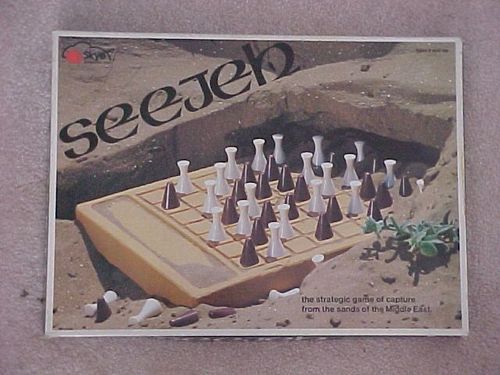
Seejeh
Seejeh Rulebook
Table of Contents
Table of Contents
Object of the Game
Object of the Game: To render your opponent incapable of offense or defense by the capture of his playing pieces.
How to Play
How to Play: The players choose by any means, who will play the tels. The tel player plays first in both phases of Seejeh.
Positioning
Positioning:
-
The tel player places two tels onto the playing grid, onto any two open squares that he chooses, except for the center inscribed square, which must remain open in the positioning phase.
-
The jug player then places two jugs onto the playing grid, onto any open squares that he chooses.
-
Play continues in this manner until both players have positioned all 24 of their playing pieces onto the playing grid, covering all squares except the center inscribed square.
Engagement
Engagement:
- The tel player plays first by moving a tel onto the center inscribed square from an adjacent square. This move may result in the capture of a single jug, or in the multiple capture of more than one jug. Captured playing pieces are removed from the playing grid, opening the grid for greater maneuverability and strategy. The tel player, after capturing an opposing piece, may continue to play in that turn, by moving the same tel only, as long as each move results in the capture of an opposing piece.
A turn consists of moving a playing piece one square in any direction forward, backward, left or right, onto an open square. If the move does not result in the capture of an opposing playing piece, play passes to the opposing player.
Each player may make more than one move per turn, as long as each move results in the capture of an opposing playing piece. When no additional captures are possible, play passes to the opposing player.
- Play continues in this manner until one player has gained such a tactical advantage over the opposing player that continued play is useless. The player with the decided tactical advantage is declared the winner.
Blockade
Blockade: At any point in the game of Seejeh, a player may be incapable of moving any of his playing pieces on the playing grid. That player may call blockade, which enables him to remove any opposing playing piece from the playing grid that he chooses, at his turn.
The opposing player then may remove any playing piece of the player calling blockade, from the playing grid, at his turn.
If this maneuver does not eliminate the blockade, the game then ends in a draw.
Each player may call blockade only once in each game of Seejeh.
Winning, Barriers and Draws
If in the play of the game, one player creates a barrier behind which a piece of his can move freely, and refuses to open this barrier, then play ends. At this point, the player with the greater number of pieces on the board is the winner.
If both players have the same number of pieces left, the game ends in a draw. Therefore, it is always possible for a player, who is on the defensive throughout most of the game, to eventually be the winner. Both players must constantly be aware of all possible strategies.
If the game ends in a draw, remove the playing pieces from the playing grid, and begin another game of Seejeh, this time moving for a victory.
Playing Hints
Playing hints: Certain squares on the playing grid offer varying advantages for defense and offense than others.
Playing pieces positioned on the four corner squares cannot be captured at any time, but can provide for the capture of opposing pieces.
Playing pieces positioned on the outer row of the playing grid can only be captured from the sides, but can provide for the capture of opposing playing pieces either to the sides or to the front.
These positions, while offering tactical advantages on defense, restrict the offensive abilities of the playing pieces while on these squares.
Playing pieces positioned on squares closer to the center inscribed square offer greater offensive advantages, but are more vulnerable to capture themselves, from all directions. Therefore, it is extremely important that players weigh all possibilities open to them in the positioning phase of Seejeh. A correct placement of pieces can result in an important capture or multiple capture of opposing pieces early in the engagement phase, and enable that player to take an insurmountable offensive advantage, from which the opponent may never recover.