See Sek
See Sek Rulebook
Table of Contents
Table of Contents
0. Disclaimer
There is no official set of rules for this game. This document describes the rules as best remembered by its author, and they may differ from how the game is played in many areas. The author had not done extensive research or had experience with many people playing this game at the time of writing.
Common American gaming terminology, and some of the author's own pet translations, have been applied throughout. These terms are not intended to be official or binding in any way, nor are they guaranteed to be related to the Chinese term they translate.
1. History and Physics
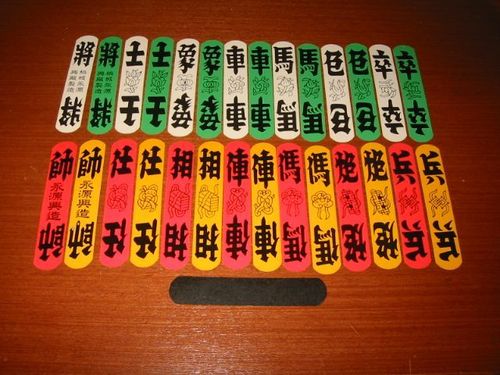
Four Color Cards (abbreviated 4CC) have an obvious origin in Mahjong and Xiangqi (Chinese Chess), but are usually printed on cards. The cards tend to be long and narrow (one set has a ratio of about 1:6), and it takes a lot of experience and skill to hold a typical hand (up to 21 cards) and handle the cards without bending them. The hand is held in a fan which looks rather like a Chinese fan when held correctly. The game is usually played on the ground or on an impromptu surface.
2. The Deck
A deck of 4CC consists of 117 cards, although a full deck may historically have been 120 cards.
The deck consists of four suits of 28 cards each, plus 5 jokers (possibly 8 jokers, historically). Each suit is denoted by the background color on the card:
- Green (G)
- White (W)
- Yellow (Y)
- Red (R)
The jokers are also printed on a red background, but the red is usually a deeper shade than the Red suit. The backs of the cards are usually orange in color.
Like a mahjong set, there are four identical cards of each denomination. There are 7 denominations (ranks) in each suit, each repeated four times to make 28 cards per suit. The 7 denominations are identical to the seven types of pieces in Xiangqi:
- General/King (K)
- Advisor/Guard (A)
- Elephant (E)
- Chariot/Rook (R)
- Horseman (H)
- Cannon (C)
- Footman/Pawn (P)
The Yellow and Red suits use the characters for the Red Army in Xiangqi; the Green and White suits use the characters for the Black/Blue Army in Xiangqi. The characters are printed in black ink, although some decks use red ink for some suits.
The five jokers (J) do not belong to any suit. Occasionally some jokers are printed identically to each other; this has no special significance.
The centers of the cards are usually decorated with symbols that may indicate the manufacturer or be related to the card. These are irrelevant to gameplay.
3. The Object
The object of the game is similar to mahjong or rummy — create a winning "hand" composed entirely of melds. (Here "meld" is used in the sense of a grouping and does not necessarily have to be exposed to the other players.) There are eight types of melds, organized into four main groups:
One-card Meld: A meld composed of a single card. This card must be a General or a Joker.
Two-card Meld (Pair): A meld composed of two identical cards (in suit AND rank). It is debatable whether this card can be a General or a Joker — in actual play, there is no reason to have a Two-card Meld with Generals or Jokers. It simplifies the rules of play to assume that Generals and Jokers cannot be in Two-card Melds.
Three-card Melds: There are four types:
- Command Group: A General, Advisor, and Elephant in the SAME suit.
- Field Group: A Chariot, Horseman, and Cannon in the SAME suit.
- Triple: Three identical cards (in suit AND rank). There is no need for the card to be a General or a Joker.
- Three-Footman Group: Three Footman cards of DIFFERENT suits. They may be any suits as long as they are all different, i.e., no two are identical. (If all three are identical, it is a triple instead.)
Four-card Melds: There are two types:
- Quad: Four identical cards (in suit and rank). The usual caveats about Generals and Jokers apply.
- Four-Footman Group: Four Footman cards, one in each of the four suits.
Note the following about melds:
- Jokers are NOT wild cards. They may only be used in one-card melds.
- Every card except the Footmen and the Jokers can be in exactly one type of group: Command or Field (or, if preferred, call them High Sequences and Low Sequences).
- A winning hand consists of 21 cards.
4. The Setup
The game has been played with anywhere from 2 to 4 people; with more people (or even with 4) there aren't really enough cards for a good game, and often the hand size is reduced and/or extra packs are shuffled together.
For the first game, a dealer is chosen by an arbitrary method. For subsequent games, the dealer remains dealer if they won the previous game, otherwise dealership moves to the right (counterclockwise).
The dealer is in charge of getting the cards shuffled and dealing a hand of 20 cards to each player. This is not as easy as it sounds; the cards can't really be riffle-shuffled and have a tendency to fly out of the hand when attempting to overhand shuffle. In general, the cards from the previous game are all rearranged in the center, moved around a bit, and face-up cards are turned over as in mahjong. Special care must be taken so that no card gets bent during the process. The dealer then collects all cards into a neat stack, does a few overhand cuts, then metes out the hands in packets of 5.
The rest of the cards are called the Draw Pile, and are placed in a central location, usually fanned a bit to the side instead of stacked neatly. Future draws are always taken from one end of the Draw Pile.
A player holds their cards in a fan. Inexperienced players are usually discouraged from playing, but sometimes they are allowed to put their cards face down on the ground. Some players take pre-existing melds that they do not plan to touch and put them in one big facedown stack next to them.
(Informally, players sometimes dispense with formalities and just allow everyone to grab 20 cards without collecting them into a neat stack first. The resulting mess of cards then becomes the Draw Pile.)
5. The Play
Most turns consist of the following sequence of steps:
- A. Draw.
- B. Meld.
- C. Discard.
They are described in detail below.
A. Draw
The player takes the top card of the Draw Pile and flips it over in front of themselves for all to see. The player does NOT take the card into their hand.
B. Meld
The player may, if they wish, bring out cards from THEIR HAND to meld (create a meld) with the drawn card. They may bring out any number of cards up to three, and including zero, as long as exactly one meld is created that includes the drawn card. The meld is left face up on the table. The player cannot use cards that are not in their hand to meld — specifically, they cannot use previously opened melds (but they can break up or use melds still held in their hand).
Example 1: The drawn card is a White Horseman (WH). The player can meld by bringing out:
- WH (Pair)
- WHWH (Triple)
- WHWHWH (Quad)
- WR WC (Field Group, with a White Chariot and White Cannon)
Example 2: The drawn card is a Black General (BK). The player can meld by bringing out:
- nothing (One-card meld)
- BA BE (Command Group, with a Black Advisor and Black Elephant)
The player cannot meld by bringing out another BK.
If, after a meld, a player's hand consists completely of melds or is empty, the player can declare that they have won, and display their hand. The current game is then over and the hand is scored (see Scoring, below).
C. Discard
If the player melded the drawn card, they may then discard any card they wish. It is laid face-up on their right-hand side so that all players may see it, especially the player seated to their right.
If the player decided not to, or was unable to, meld the draw, they MUST discard the draw. In practice, Generals and Jokers are never discarded, and it is reasonable to make a ruling that Generals and Jokers cannot be discarded.
If, after a discard, a player's hand consists completely of melds or is empty, the player has NOT won, since they only have 20 cards. They need another One-card meld to win.
After the Discard, the next player, sitting to the right, begins their turn.
Stealing another player's draw or discard
This is the basic sequence of play. However, there are two other modifications to play that can change this sequence:
- Melding another's Draw; and
- Melding another's Discard.
The modification is simple: under certain conditions, a player can meld another player's draw or discard card. Play immediately shifts to the player who claimed the card, who then treats the situation as if they had just melded a card, and then discards a card. Play then proceeds to the right of that person, as normal. As a consequence, players in between may lose their turn, and a player may even lose the chance to meld their own draw.
The priority conditions are as follows. When in conflict, a lower number takes priority over a higher number. (Conditions 0 and 3 are not really stealing someone else's draw, but rather using one's own draw.)
- 0. A person winning on their own draw takes priority over anything below. They should call "zhimo".
- 1. If the card is needed to win immediately by completing any type of meld, the player calls "hu", and can meld the other person's card to win. If several players call "hu", the player whose turn would come first in normal order gets priority. Any player may call "hu".
- 2. If the card is needed to finish a Quad (not a Four-Footman Group), the player calls "gan", and can meld the other person's card. If the card is needed to finish a Triple, the player calls "pong", and can meld the other person's card. Any player may call "gan" or "pong".
- 3. If the card is needed to finish a Group (Command, Field, Three-Footman, or Four-Footman) or a One-card meld (but not a Pair), a player may claim it when they themselves have just drawn that card.
- 4. If the card is needed to finish a Group (Command, Field, Three-Footman, or Four-Footman), a player may claim it when the previous player (and no other) has just drawn or discarded that card. The player should call "chi".
Note that a player may not complete a one- or two-card meld from another player's draw or discard unless it is for a win.
6. Play Etiquette
- It is considered proper etiquette to call out drawn cards and discards as they are shown.
- It is considered poor etiquette to delay a call just to see what the player will do with their draw.
- It is considered poor etiquette to refuse a player's priority call on your drawn card, even if you have already melded it — players should meld their drawn cards only after everyone has had a chance to see it, but if they don't, it's their own fault.
- It is considered poor etiquette to make a call on a draw or discard after the next draw or discard has been made. (No retroactive calls.)
7. Scoring
A winning hand is scored as follows:
- Each four-card meld: 2 points
- Each three-card meld: 1 point
- Each two-card meld: no points
- Each one-card General meld: 1 point
- Each Joker: 3 points
Some households score a four-card meld as 4 points instead of 2, and some introduce bonuses for certain patterns — this is discouraged in the interest of keeping the game simple.
A good checksum is to note that the total number of points in a winning hand should always be odd.
Generally, points are turned into monetary units (e.g., dollars) and are paid to the winner by the loser (the player who discarded the winning card, or, if the card was drawn, all players pay that amount).
Scoring may, of course, be adjusted to taste.