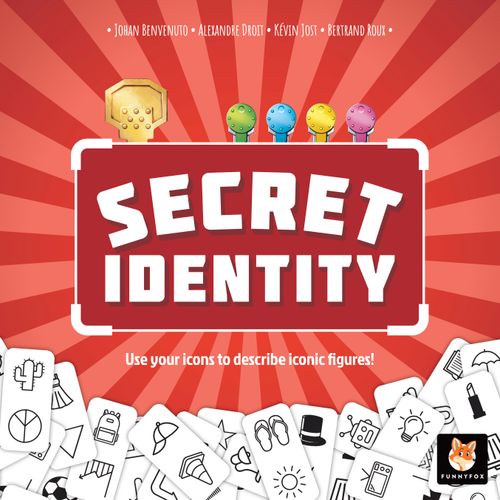
Secret Identity
Secret Identity Rulebook
Table of Contents
Table of Contents
Components
- 8 personal safes
- 64 Voting keys (8 per player)
- 90 Picto double-faced cards
- 8 Mystery keys
- 8 "30" scoring tokens
- 8 markers
- 150 Character double-faced cards
- 1 main game board
Setup
-
Place the main board in the middle of the table.
-
Mix the 8 Mystery keys and place them face down in the middle of the table.
-
Shuffle the Character cards and place 8 of them on the designated spots of the main board. Create a deck with the remaining cards.
Tip: If everyone agrees, you can replace one or several cards from the main board, especially if some characters are not known by all players.
-
Keep the "30" scoring tokens nearby.
-
Shuffle the Picto cards and deal 10 to each player. Put the remaining cards back into the box: you will not be using them during the game.
-
Each player chooses a color and takes the following:
- 1 personal safe
- 8 Voting keys
- 1 marker they place next to the scoring track
Goal of the Game
In SECRET IDENTITY, you are assigned a Mystery key that designates one of the 8 Character cards in the middle of the table. With the help of your Picto cards, you have to make the other players guess your Character card and, at the same time, guess theirs in order to gain the most victory points. Each round, new characters will be drawn, but your Picto cards will not be replaced! Be sure to make the right choices and calculate the risks...
By the end of the 4th round, the player with the most victory points will be the winner!
Playing a Round
Each player takes, at random, one of the Mystery keys on the table and secretly looks at its number. This number corresponds to the Character card they must make others guess during this round. Then, they place the key in the corresponding space of their personal safe (the one marked with the key symbol) making sure to hide the key number under the magnetic tab to avoid showing it to the other players.
In order to make others guess their character, each player chooses 1, 2, or 3 Picto cards from their hand and places them face up or down on the designated spots of their personal safe. Only one pictogram should remain visible.
Players can place their Picto cards in two different spots:
- On the green side the pictogram represents the character
- On the red side the pictogram does not represent the character
The placement within the red and green sides does not matter. For example, placing a card on the rightmost green spot does not mean "greener."
Advice: Each player is free to interpret the green and red side in any way they want. The green side might represent a characteristic, one thing the character likes, or even reflect your opinion on the character. Conversely, the red side might indicate something the character is not, something they do not like, something they lack, etc.
Examples:
- Homer Simpson — a brain pictogram on the red side: "lacks a brain"
- Hercules — a teddy bear on the red side, a muscular arm and a sword on the green side: "not a child, but a ruthless warrior"
- Pinocchio — a fish on the red side, a tree on the green side: "gets swallowed by a whale and is made out of wood"
In this last example, you could place the fish (which represents the whale) on the green side because it characterizes the story of Pinocchio, or on the red side to indicate that it is a misadventure for the character. It is up to you to figure out which will be the most evocative for the other players!
Warning: Picto cards used in each round are discarded and you will not be able to draw new ones during the game. Use them sparingly!
Once all of the players have chosen and placed their Picto cards on their personal safes, proceed to the voting phase.
Voting Phase
Each player votes to guess the character of the other players, repeating the following steps for each opponent:
- The player takes the Voting key of their color indicating the number of the character they think belongs to the opponent.
- They place the key, without showing its number, on one of the designated spots of the opponent's safe. The number on the key must be kept under the magnetic tab, only becoming visible when they lower the tab during the scoring phase.
The player cannot give hints or help the other players in any way. They can only rely on the chosen Picto cards.
Once all of the players have voted, proceed to the scoring phase.
Scoring Phase
In turns, each player lowers the magnetic tab on their personal safe to reveal the Mystery key that indicates the number of the character they were trying to make other players guess, as well as all the other players' Voting keys. If the numbers match, they score points! If not, too bad...
Each player scores:
- 1 point per opponent that guessed their character.
- 1 point per character they guessed correctly.
Advance your markers on the scoring track accordingly.
Example: Emma is the green player, and her character is Harry Potter (spot number 2 of the main board). All players have voted and Emma reveals the answer. As we can see here, the blue, red, and purple players have guessed correctly. They receive 1 point each and advance their markers one space on the scoring track. However, the white player is incorrect and does not score any points. Since Emma has been able to make 3 players guess her character, she scores 3 points and advances her marker 3 spaces on the scoring track.
Each player proceeds in the same way until all points have been counted.
Clarification: If a player exceeds 30 points, they take the "30" scoring token, place it beside them, and continue moving from the bottom of the scoring track.
Once the scoring phase is finished, and if you have not reached the 4th round yet (see "End of the game"), start a new round. Recover your Voting keys and gather the Mystery keys face down. Discard the Character cards and Picto cards used during the last round, removing them from the game, and reveal 8 new Character cards. Each player takes a new Mystery key at random that indicates the character they will make other players guess during this new round.
End of the Game
The game ends after 4 rounds. The player with the most victory points wins the game. In case of a tie, the tied player with the most Picto cards wins. If there is still a tie, players share the victory.
Cooperative Variant
Setup
In order to play the cooperative variant, you will only need:
- The main game board
- A complete set of the same color (1 personal safe, 8 Voting keys and 1 marker)
- The 8 Mystery keys
- 17 Character cards
-
Deal as many Picto cards to each player as indicated by the following chart:
Players Picto cards per player 3 to 4 players 10 5 to 6 players 8 7 to 8 players 6 -
Place the main board in the middle of the table.
-
Mix the 8 Mystery keys and place them face down in the middle of the table.
-
Shuffle the Character cards and place 8 of them on the designated spots of the main board. Create a deck with the remaining cards.
Playing the Game
- During their turn, each player randomly chooses a Mystery key and tries to make the other players guess it by placing 1-3 Picto cards on the designated spots of their personal safe.
- The other players discuss and decide on one character together. The active player is not allowed to help the other players in any way. If they guess the correct answer, they advance one space on the scoring track.
- Then, the active player discards the Character card and Picto cards they used. Replace the used Character card with a new one from the deck.
- The 8 Mystery keys are, once again, mixed face down, and it's the next player's turn to make the others guess a Character card, starting over from step 1.
- The game ends after 10 turns, when the last card of the deck has been placed and the last round is played.
The goal of the game is simple: try to guess as many correct answers as possible!
- 0-2 correct answers: Hmm... is someone there?
- 3-5 correct answers: There is still some work to do!
- 6-8 correct answers: Not bad, you are almost there!
- 9-10 correct answers: Such a talent! You are great mentalists!