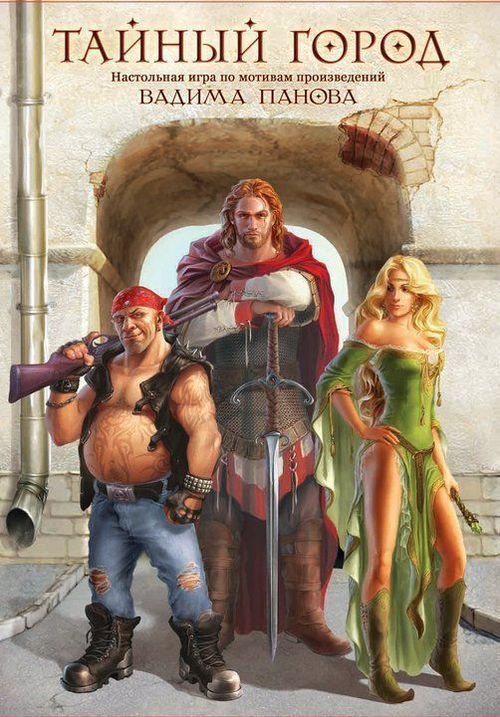
Secret City
Secret City Rulebook
Table of Contents
Table of Contents
Game Contents
The game contains the following elements:
- A box
- This rulebook
- 147 game cards, including:
- 6 House decks of 7 cards each
- 24 Spell cards
- 24 Mercenary cards
- 24 Artifact cards
- 3 unique cards: Cortes, Anna, and Arkan of Desires
- 24 Territory cards
- 6 Strategy cards
- 64 each of Influence tokens, Mana tokens, and Money tokens
Preparation
Open the box carefully and take out all the game components.
Sort the game cards into decks:
- House decks
- Spell deck
- Mercenary deck
- Artifact deck
Separate and set aside the territories by type:
- Territories that produce money
- Territories that produce mana
- Territories that produce Influence points
Set out the money, mana, and Influence tokens in separate piles, and thoroughly shuffle the Spell, Mercenary, and Artifact decks.
Decide by lot or by agreement which Houses you will play. Take the House decks of your Houses, as well as your home territory. Place your House's Leader and your territory on the table.
Example: As a result of the draw, Dima got the right to play the Great House Nav (Навь). He takes the deck of the Dark Court, the cards whose back is marked with the Nav symbol. He then takes the Grand Prince card out of this deck and places it on the table. The remaining cards he places face down next to it. After that he takes the Citadel of the Dark Court from the same deck, which is also marked with the Nav symbol, and places it on the board.
At the start of the game each player draws 1 card into hand from each of the Artifact, Mercenary, and Spell decks. Then the players divide up the territories. This is done as follows:
Each player, starting with the first, chooses 1 territory of any kind; then the second player does the same, and so on until the last player. The last player takes 1 territory, then one more, and the order then runs in reverse. This continues until every player has 3 territories. If fewer than 6 players are playing, put the unused decks and the remaining territories back in the box.
The player who receives the office of the company "Unpleasant Sensations" (Неприятные ощущения) takes the Cortes card and places it on that territory. In the same way, the owner of Anna's Apartment places the Anna card there, and the owner of the Throne of Power places the Arkan of Desires card there.
Game Play
The game is played in turns. Each turn consists of several phases.
The players go through each phase one after another, clockwise, starting with the first player. This means that all players first go through Phase 1 in sequence, then Phase 2 begins, and so on.
Example: Dmitry, Anton and Petr begin the next turn. The first player is Petr. After careful thought, he chooses the strategy Careful Research (Внимательные исследования) for this turn, declaring that the strategy's target will be Anton. Anton, who acts second, quickly orients himself and takes the strategy Skilful Manipulation (Умелые манипуляции), turning it over to its attacking side, and announces that this turn he will capture Petr's territories with his black magic. Dmitry decides to intervene in the conflict on Anton's side, and also to look after his own advantage, and plays the strategy Subtle Intrigues (Тонкие интриги) against Petr.
After the strategies have been assigned, Petr collects income from his territories and draws the cards he needs, trying to accumulate the maximum amount of money and mana to successfully oppose two opponents at once. Anton, on the contrary, uses the abilities of his territories, trying to get the maximum mana to prepare a massive spell attack. Dmitry uses the special abilities of his territories and draws several needed cards from different decks. When this phase is complete, the opponents begin buying mercenaries.
Brief Overview of the Turn Phases
When all the necessary cards have been distributed, agree among yourselves on the number of turns. The standard suggestions are:
- 6 players: 6 turns
- 5 players: 7 turns
- 4 players: 8 turns
- 3 players: 9 turns
- 2 players: 10 turns
You may choose one of these options, or agree on your own, based on the number of players and the time available.
- Initiative — in this phase the players determine who will act first.
- Choosing strategies — here the players choose one of the Strategy cards and assign their targets.
- Using territories — the players receive income from their territories in this phase and use their special abilities, including drawing cards from the decks.
- Buying cards from hand — here the players buy Mercenaries and Artifacts from hand and may use various spells.
- Resolving strategies — this is a long combat phase in which the players support strategies and oppose them.
- End of turn — here the players pay for assistance, discard excess cards from hand, and turn face up the Mercenaries and Heroes that they turned during the bidding for the right to be first player.
Description of the Turn Phases
Initiative
Turn 1. On the first turn, the first player is determined by lot.
Turn 2 and later. On the second and later turns, bidding for Initiative takes place. The bidding works as follows: any player, starting with the first and continuing clockwise, may turn face down any of his own characters. The strength printed in the bottom right corner of a turned card counts as that player's Initiative.
The player with the highest Initiative chooses who will be the first player; the remaining players act in turn, clockwise.
If no player takes part in the bidding for Initiative, the first player is the one sitting to the left of the previous turn's first player.
Tip: Sometimes it is advantageous to become the first player yourself — if you need to obtain a particular strategy, or to make any other player the first player.
All characters turned during the bidding for Initiative remain turned and cannot be assigned to resolve any strategies until the end of the turn. These characters may still be the targets of any spells and strategies, just like any other characters.
Tip: When you apply a destruction spell to a card lying face down — for example "Dragon's Spit. Kill any Mercenary or Hero with strength 4 or more." — you turn that card face up and look at its strength. If the card's strength matches the one stated in the spell, the card is destroyed and leaves the field. See Killing.
Example: The end of the game is approaching. Anton, who has a small lead in Influence points, wants to secure his advantage and successfully play the strategy Subtle Intrigues. To do this, at the start of the turn he turns his Manticore, with strength 3, for the right to be first player.
However, Petr intends to prevent this and turns the Black Moryana, with strength 4, thereby taking the right. After thinking for a while, Anton adds the White Moryana, with strength 2, to his Manticore. In this way he gets a total strength of 5, wins the Initiative, and takes the strategy he needs — but for the rest of the turn he loses two of his characters. The Manticore and the White Moryana used by Anton, and the Black Moryana used by Petr, remain turned until the end of the turn.
Tip: If you have the Griffin Mercenary, then when you add its strength to the bidding for Initiative, do not turn this card. You may also use the Griffin for any actions this turn. Each Griffin adds its strength to Initiative only once.
Choosing Strategies
This is a very important phase. In it the players decide what exactly they plan to do this turn. This planning takes place through the choice of one of the 12 available strategies.
The game has 6 base strategies, each of which allows the player to capture any opponent's territory. The game also has 6 non-base strategies, each of which allows the player to carry out various actions needed for victory.
Tip: 2 strategies are combined on one card for a reason. Sometimes it is useful to take a strategy you do not need, so that it does not go to an opponent, and to use it to capture a territory.
Strategies have the following types, shown on the strategy card as a picture: Weapon, Magic, and Intrigue.
It is important to choose a strategy type that you can successfully support with your Mercenaries and Heroes. See Resolving Strategies.
Strategy cards look like this: Weapon symbol, Magic symbol, Intrigue symbol.
The first strategy is chosen by the first player. He takes one of the 6 strategy cards and immediately declares whether he is playing the base or the non-base strategy from that card, and also states against which player it will be directed. Declining to declare a strategy is not allowed.
The second player chooses any of the 5 remaining strategies. Each player may have only 1 strategy, so if fewer than 6 people are playing, then once all players have chosen their strategy, the remaining ones are removed until the next turn.
Using Territories
In this phase the players use their territories to receive income or to activate their special abilities. All territories except the home territory of your House activate their ability instead of producing income. You must therefore work out what is more important — to receive the resource you need, or to activate the territory's ability.
Taking cards. When you take a card from a House deck, you may choose any card from that deck; if you want to take a card from the Artifact, Spell, or Mercenary decks, you take the top card. You put the card you take into your hand without showing it to your opponents.
Example: In the previous turn almost all of Petr's troops were destroyed, and he badly needs Mercenaries. So in the income phase from his territories he takes one Hero from his House deck, and also uses the ability of his Pavilion of the Deceivers (Павильон Обманщиц), taking the top card of the Mercenary deck. Unfortunately, he was unlucky and drew a weak Chel-Sorcerer (Чел-колдун) with a small strength of 2. Weighing the cards he took, he decides to take a risk and use the ability of the Bar "Sullen Pause" (Угрюмая пауза) to draw an Artifact, hoping that he will get a good Artifact warrior. Hooray! Luck finally smiled on him, and he has in hand the powerful Golem "Lunatic" (Лунатик). After all these manoeuvres he has practically received no resources, but he has drawn 3 extra cards he needed.
Buying Cards from Hand
In this phase the players may place any number of Heroes and Mercenaries from hand, paying the price in resources shown in the top left corner of the card.
At the same time, each player may have no more than 6 characters on the table, including the Leader, House Heroes, and Mercenaries. If you play the faction of the Masans (Масаны), you may have 7 characters while your Hero Lazar (Лазарь) is on the battlefield. When you have 6 characters on the table, you may replace any one of them by discarding its card.
Tip: A House Leader cannot be discarded from the battlefield.
House Artifacts. Along with Heroes, you may buy any House Artifact that you have in hand, and place it on the table under your control. You may place the Arkan of Desires under your control if you have the Throne of Power.
After the placement of Mercenaries and Artifacts is finished, the battle phase of Resolving Strategies begins.
Resolving Strategies
The battle phase proceeds in rounds. During a round the players take actions in turn, starting with the first player.
During one round each player may perform one and only one action from the following list:
- Assign a Mercenary, Hero, or Leader under his control in support of any declared strategy.
- Assign a Mercenary, Hero, or Leader under his control in opposition to any declared strategy.
- Use one Spell from hand.
- Use a special ability of a character.
- Pass his action.
Passing actions. If you have any free characters not assigned to a strategy, you may not pass, and you must assign one of them in support of or in opposition to some strategy.
Helping other players. During the game you may ask other players for help, or offer your own. To do so, before the start of any of your actions you declare the contract you are offering. The options are:
- Request for help (to everyone): "I will pay X money (or X mana) to whoever can support / oppose this strategy."
- "I am ready to oppose / support this strategy. Who will offer what?"
- Request for help (to a player): "Petr, what do you want for sending this Hero into this strategy?"
- Offer of help: "I can send this Hero somewhere; I will consider offers."
- Request for non-interference: "Petr, if you do not take any part in this strategy, I owe you…"
- Promise of non-interference: "I will do nothing against this strategy if you pay me…"
Once a deal is announced, any player may accept it, but another player cannot interrupt the announced deal, i.e. one may not offer other deals while a deal is announced. If all players refuse the deal, you must perform your action. The next time, you may offer a deal only on the next round. Offering deals out of turn is not allowed.
A deal is carried out by the player immediately when the round reaches him. While a player has a concluded contract, he may not conclude a new one.
Example: Dmitry addresses everyone with a request to support his strategy Contract Killing (Заказное убийство), which he is playing against Petr, and promises 1 gold for it. Anton agrees to Dmitry's offer, after which the contract is considered concluded and no one else may accept it. Petr, who acts after Dmitry, would gladly buy Anton's help away, but he cannot outbid an already concluded contract.
To fulfil the agreement, on his turn Anton assigns the Hvanan mercenary (printed in the Russian source as "Хвананаемника", a name that could not be checked against other text) in support of Dmitry's strategy. The contract counts as fulfilled, and at the end of the turn Dmitry must pay it and give Anton 1 gold. What matters is that the contract is fulfilled regardless of the success or failure of this strategy. Anton has kept his word and must receive his reward for the help.
Tip: In the Secret City a word is valued very highly, so you may not break a concluded contract or fail to honour the obligations you have taken on.
All payments for help are made in the current turn. This means that you may not ask for help in this turn while promising to pay for it in the next. Money and mana for help are paid at the end of the turn, after the Resolving Strategies phase is over.
If a player does not have enough mana or money to pay the agreed sum for help, he must give his debt to the person he owes in Influence points, at the rate of 1 Influence point for each 1 resource he owes. If the player does not have enough Influence points, the person he owes may take any territory of that player of their choice as payment of the debt.
Assigning a character in support of or in opposition to a strategy.
A Mercenary, Hero, or Leader may be assigned in support of or in opposition only to strategies whose type matches the strategy symbols shown on the character's card: Weapon, Magic, or Intrigue.
Example: Dmitry needs to support his strategy Skilful Manipulation. The opponents beat him with a margin of only 1. But, unfortunately, he has only the Fata left, which, although it has strength 5, has only one strategy symbol — Magic. Skilful Manipulation is a strategy based on intrigue, so the Fata cannot support it, and Dima cannot support his strategy, and it is considered failed.
When a character is assigned in support of a strategy, it is placed on the strategy card in the FOR zone (ЗА). When it is assigned in opposition, it is placed in the AGAINST zone (ПРОТИВ). Its Strength is added, respectively, to the support or the opposition of that strategy.
Tip: A strategy can win successfully only if the total strength of the Mercenaries and Heroes assigned in support of it is greater, by at least 1, than the total strength of all Mercenaries and Heroes assigned in opposition to it. Strength is counted taking into account all spells cast on the Mercenaries and Heroes, or on the strategies themselves.
Using spells. To use a spell (or an Artifact, except Mercenary Artifacts and House Artifacts), pay the price shown in the top left corner of the card, show the spell to your opponents, and discard it from hand, acting as described on the spell card.
If a spell gives a bonus to the strength of a Mercenary or Hero (for example, the spell "Forge Hammer" (Кузнечный молот), which adds +2 to strength), then such a spell is placed on top of the card it affects and stays in play until the end of the Resolving Strategies phase. Spells that are cast on strategies are used in the same way.
When a spell or Artifact has an immediate effect (for example, the spell "Intimate Canopy" (Интимный полог), which forces an opponent to discard 2 cards from hand), then that spell is placed at the bottom of the Spell deck. Having used his single action, the player passes the turn in this round of the battle on to the next player in turn.
Example: Dmitry is playing the strategy Subtle Intrigues against Petr. Since Dmitry plays for the Great House Nav, it is important for him that this strategy succeeds, since the abilities of the Heroes of his House depend on this strategy. Petr, in turn, plays for the Great House Chud (Чудь). He has comparatively few Influence points, and he intends to prevent Dima's victory. Let us see how events unfold.
Dmitry assigns Santyaga (Сантьяга) in support of this strategy, gaining an immediate advantage of 4 points. Petr responds no less aggressively, bringing in Masan (Масан) with strength 5 in opposition. Dmitry does not give up and strengthens his Santyaga with the spell Forge Hammer for +2. (Santyaga, with her total strength of 6, beats the opposition), however Petr spends his last 2 mana on the spell Veil of Desire (Вуаль желания), and Santyaga, with her strength of 6, stops giving the bonus.
Special abilities. Some characters have special abilities which may be used in battle (for example, Santyaga). Abilities are used by the same rules as spells — that is, outside battle, at any moment you consider convenient, and in battle by spending your action and passing the turn to the next player. Some abilities are logically applied precisely in battle.
Thunderer (Громовержец). The game has a unique Mercenary — the artifact Golem "Thunderer" (Громовержец). Once per turn this Mercenary may "jump" from one strategy to another.
This is best shown by an example:
Dmitry has assigned the Thunderer in opposition to Petr's strategy Subtle Intrigues. However, Petr is already winning by a margin of 5 strength. On the other hand, in the strategy Skilful Manipulation Dmitry lacks exactly 1 strength to win. Dmitry takes the Thunderer from the forces opposing the strategy Subtle Intrigues and immediately moves it into support of Skilful Manipulation.
End of the Resolving Strategies phase. The Resolving Strategies phase ends at the moment when all players pass their action two rounds in a row.
Tip: This situation usually arises when all players understand that they can no longer do, or do not want to do, anything else during Resolving Strategies, so formally there is no need to wait two circles — mutual understanding that no one can (or wants to) do anything more is enough.
When the battle is over, the successful and failed strategies are determined. To do this, for each strategy the Strength of all characters assigned in its support is summed (taking into account the bonuses from spells). The resulting total Strength is compared with the total Strength of all characters assigned in opposition to the strategy (taking into account the bonuses from spells).
A strategy is considered SUCCESSFUL if the Strength assigned in its support is greater than the Strength assigned in opposition to it. A strategy is considered FAILED if the Strength assigned in opposition to it is greater than or equal to the Strength assigned in its support.
After the strength is counted, all characters return under the control of their owners. Spells cast on them go to the discard pile of the appropriate deck. House spells that were used are removed from the game. All characters that were turned face down are turned back to their original position.
Failed strategies are discarded until the next turn.
All players whose strategies succeeded play, in turn order, the action described on their strategy card.
Tip: Note that most strategies let you choose a target. That is, for the strategy Contract Killing you choose the target only when the strategy succeeds.
At this same moment all special abilities of your Heroes that are tied to the successful resolution of strategies are triggered. When all successful strategies have been played, the turn ends.
Territory Capture
All base strategies are aimed at capturing enemy territories. Note that a House territory cannot be the target of such a capture, even if the player has no other territories. When you capture any territory, take it from its owner and move it under your control.
During one turn, only one territory can be taken from a player with capture strategies: it is received by the first capturing player who succeeds against that player.
Tip: Remember that by capturing a territory you not only get it for yourself, you also deprive your enemy of a valuable source of resources and of all the possibilities associated with that territory.
Example: Petr captured the Throne of Power belonging to Anton. The Arkan of Desires card lying on it passes to Petr. But in the same turn Anton captures Anna's Apartment, belonging to Petr. Anna, whom Petr placed on the table at the start of this turn, remains under his control.
Gaining Influence Points for Successful Strategies
If your advantage in a successful strategy over the forces opposing you is 5 or more, you receive one Influence point. If, in addition, your strategy is the most natural one for your House (as, for example, the strategy Subtle Intrigues for the House Nav), you receive one more Influence point thanks to the special feature of your Leader.
End of Turn
All players who owe money or mana for help to other players must immediately pay their debts as described in the section Helping Other Players.
All players count the cards in their hands. The maximum number of cards in hand is 6. If at the end of the turn a player has 7 or more cards in hand, he must discard any excess cards so that 6 cards remain in his hand.
Tip: The exception is the player who plays the faction of the Humans (Челов) with the Hero Larisa (Лариса) on the table. For him the maximum hand size is 7.
Leader
This is your character — the head of the House you are playing, and at the same time your strongest Hero. His special feature is that he cannot be the target of spells, and he cannot be killed by the strategy Contract Killing.
Discarding Cards from Hand
When you discard any card from your hand, it is placed at the bottom of the deck from which you took it.
You do the same with Mercenaries and Heroes when you want to replace them with new, stronger troops.
Killing
When, as a result of a spell or a successful strategy, a Mercenary dies, its card is removed from the field and placed at the bottom of the corresponding deck — the Mercenary deck if it is an ordinary Mercenary, and the Artifact deck if it is an Artifact Mercenary.
A killed Hero leaves the game and cannot be summoned again.
House Deck
This is the embodiment of the power and might of your House. Its main distinguishing feature is that everything in it is acquired for Influence points, so use it very carefully, because the one who gathers the most Influence points wins.
All cards in this deck are single-use, and after use they leave the game. One more important feature of it is that when you draw any card from the House Deck, you may choose any card you need.
The House Deck is a powerful weapon, and it must be used carefully and at the moment when it is absolutely necessary.
End of the Game
The game ends when the last turn is over. The winner is the player who has the greatest number of Influence points at the end of the last turn. He may be justifiably proud of himself — his House now rules the Secret City.
Until the moment when the Great Houses of the Secret City clash again in fierce struggle for power.