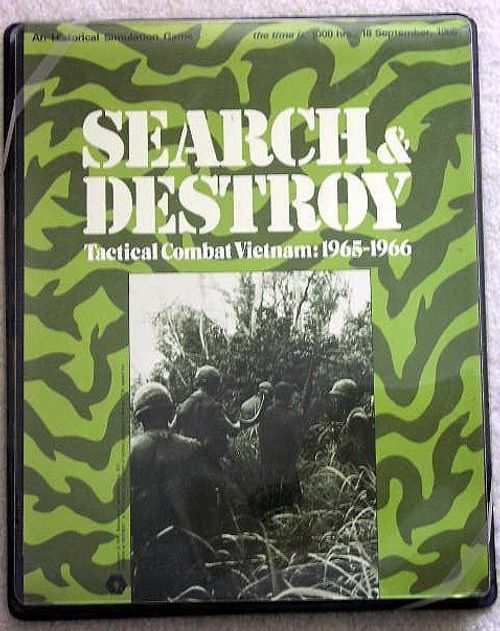
Search & Destroy: Tactical Combat Vietnam – 1965-1966
Search & Destroy: Tactical Combat Vietnam – 1965-1966 Rulebook
Table of Contents
Table of Contents
- 1.0 Introduction
- 2.0 General Course of Play
- 3.0 Game Equipment
- 4.0 Sequence of Play
- Basic Game Rules
- 5.0 Movement
- 6.0 Combat
- 7.0 Combat Results
- 8.0 Terrain Effects Chart
- 9.0 Setting Up the Game
- 10.0 Victory Conditions: How to Win the Game
- Standard Game
- 11.0 Hiding
- 12.0 Search
- 13.0 Leadership
- 14.0 Standard Game US Deployment
- 15.0 Variable Orders of Battle for the NLF Player
- Advanced Game [Optional Rules]
- 16.0 Improved Positions
- 17.0 Movement and Fire
- 18.0 Ambush
- 19.0 Increased Fire Rate and Ammunition Supply
- 20.0 Casualty Combat Results
- 21.0 Artillery, Air Strike, and Tank High Explosive [HE] Fire
- 22.0 Tanks and Armored Personnel Carriers [APC's]
- 23.0 Interrogation
- 24.0 Organization of Forces
- 25.0 ARVN Ranger Units
- 26.0 Helicopter Gun Support
- 27.0 Optional Scenarios
- 28.0 Alternate Simultaneous Movement System
- 29.0 Game Notes
1.0 Introduction
Search & Destroy is a squad level simulation of typical tactical combat between American and/or ARVN and North Vietnamese and/or Viet Cong units in the period 1965-67 in Vietnam. There are three types of games: the Basic Game; the Standard Game; and the Optional Game. Each of these games is more complicated than the preceding one due to the addition of rules. Preferably, the Players should experience the Basic Game first and then escalate through ascending levels of complexity until they find a rules mix with which they are most comfortable.
2.0 General Course of Play
The game is played in Game-Turns, each of which is divided into four functionally different Phases (to be subdivided into segments). Search & Destroy is basically a two-Player game. Each Player may move or attack with his squads during a given Game-Turn. This is done by moving the units through the hex grid or utilizing their weapons. In some cases, some units may also pick up certain portable items such as wounded men or various types of Viet Cong Caches. In the Optional Game, one of the rules permits missions plotted simultaneously by each Player at the beginning of the Game-Turn and the remainder of the Game-Turn is spent executing or attempting to execute the plots. Each Player maneuvers his units and fires his weapons at the units of the Enemy Player. The Player controlling the disposition, movement and combat of the North Vietnamese, the Viet Cong, the peasants, the Caches and the dummy counters is termed the "NLF Player" (National Liberation Front). The Player controlling the disposition and movement of the United States Infantry units, ARVN (Army of the Republic of Vietnam), intelligence units and Ranger teams is called the "US Player." Generally, at the start of the game, the NLF Player's units are turned face-down on the map. The US Player must explore this array of face-down counters in order to engage the NLF. The NLF Player must manipulate his combat units and dummy counters in order to avoid being caught in a situation where the US Player can bring to bear his superior firepower. The game consists of Scenarios, each of which details the amount of forces and counters that each Player receives and the length of the game. The game is won by accumulating more game points than one's opponent (see Victory Conditions).
3.0 Game Equipment
3.1 The Game Map
The game map shows a typical coastal area of Central South Vietnam: several small villages intermixed with forests, streams and rice paddies. A hexagonal grid has been superimposed on the map to enable the Players to determine movement, positioning and firing ranges of their units. There are seven different types of terrain represented on the map. These have varying effects on combat and movement (see the Terrain Effects Chart, 8.0).
3.2 The Playing Pieces
The playing pieces simulate the various military units, civilian groups, objects and markers that effect a typical military operation, such as an arms cache counter, which represents crates of weapons. A number of counters represent "false intelligence" and are used by the NLF Player to confuse the US Player. The combat units and civilian counters have more than one characteristic and get most of the attention.
3.3 Types of Units
3.31 US Combat Units
The US combat counters are the American Infantry Squad (two sides, A and B), the American M-48 Tank, the American M-113 APC, the ARVN Rangers and the ARVN Intelligence unit.
3.32 US Non-Combat Personnel Units
The US non-combat personnel counters are the American Battalion Commander, the American Forward Observer, the American Medical Aid Team, the American Company Commander and the American Platoon Leader.
3.33 US Markers
The US markers are the American Killed Marker, the American Wounded Marker, the Artillery Center of Impact, the US Ammunition Supply, the Tank HE Center of Impact and the Air Strike Center of Impact.
3.34 NLF Combat Units
The NLF combat counters are the NLF Leader, the NVA Hard-Core Squad, the VC Militia and the Sniper.
3.35 NLF Non-Combat Personnel Units
The NLF non-combat personnel counters are the Porter and the Peasant.
3.36 NLF Markers
The NLF markers are the Arms Cache, the Ammunition Cache, the Administrative Records, the Radio Equipment, the Rice Cache, the Anti-Personnel Traps, the Ambush Marker, the NLF Killed Marker, the NLF Wounded Marker and the Anti-Tank Mine. The Dummy counter is listed with the NLF non-combat personnel units.
3.37 Neutral Markers
The neutral markers are the Improved Position and the Pinned marker.
One sheet of die-cut counters, containing the two differently colored sets, is supplied. The counters represent individual squads in the case of combat units. These counters are used to compose a force given in each Scenario for each Player. It is strongly recommended that the Player store his counters in the boxed compartments, segregating the different colors and types. The playing pieces are distinguished primarily by type and Attack Strength, if applicable.
3.4 Definition of Terms
Attack Strength: This number represents the basic offensive strength of the unit. It is the largest number on the counter. Note that units have either one Attack Strength Point or two Attack Strength Points. All other numbers on the unit are superfluous and are for historical flavor only.
Defense Strength: This is not represented on the unit. Rather, the Defense Strength is a function of the type of terrain in which the defending unit is situated (see 8.0, Terrain Effects Chart).
Movement Allowance: Again, this is not represented on the counter. Rather, every combat or personnel and dummy unit has twelve Movement Points. Essentially, entering one hex expends one Movement Point (see 8.0, Terrain Effects Chart) from its total Movement (Point) Allowance. Other units have a zero Movement Allowance.
3.5 Unit Type Definitions
Combat Units represent armed forces of men who engage in fire, and Anti-Personnel weapons.
Non-combat personnel units represent groups of persons who may only be targets, and not originate fire. These two types (except the Anti-Personnel weapons) are lumped into a category of "personnel" units. Marker units represent the actual physical presence on the map of something (which is not composed of personnel) or to indicate a certain status of a unit.
3.6 Game Scale
Each hex in Search & Destroy represents 50 meters of ground from hexside to opposite hexside. Each combat unit represents a squad of men (6 to 12 individuals), except for snipers (1 man). Non-combat personnel units represent two or more men who are either unarmed or normally do not use their weapons. Non-personnel units represent booby-trapped areas (Anti-Personnel weapons) or quantities of material (radios, 200 lbs. of rice, Administrative Records, ammunition, etc.).
3.7 Game Equipment Inventory
A complete game of Search & Destroy should include the following parts:
- One Game Map
- One Rules Folder
- One Set of Die-Cut Counters
- One Die
- One Game Box
4.0 Sequence of Play
The game is played in turns called Game-Turns. Each Game-Turn is divided into four Phases. All action must take place in exact sequence as outlined below. The Player whose Player-Turn is in progress is called the "Phasing Player".
4.1 Sequence Outline (Basic Game)
This outline should be followed when using the Basic Game Rules (sections 5.0 - 10.0).
A. FIRST PLAYER-TURN (US Player)
- Movement Phase: The Phasing Player may move any or all of his personnel units in any direction or combination of directions to the limit of each individual unit's Movement Allowance, and subject to the movement rules.
- Combat Phase: The Phasing Player may execute attacks on Enemy units as outlined in the combat rules.
B. SECOND PLAYER-TURN (NLF Player)
The Phasing Player repeats the procedure above for his units.
C. GAME-TURN RECORD
Players record the passage of one complete Game-Turn. There are six Game-Turns in a complete game. At the conclusion of six complete Game-Turns, the game ends and victory is evaluated.
4.2 Sequence Outline (Standard Game)
This outline should be followed when using the Standard Game Rules (sections 11.0-15.0).
A. FIRST PLAYER-TURN (US Player)
-
Movement Phase: The Phasing Player (US) may move any or all of his personnel units in any direction subject to the movement rules and up to the limit of each individual unit's Movement Allowance.
-
Search Phase: a) Search Segment: The US Player carries out searches in the appropriate Enemy occupied hexes (see 12.0). b) Surprise Attack Segment: If any hex that is searched by the US Player contains an NLF combat unit, that unit immediately attacks the searching US unit. The results are applied immediately. c) Anti-Personnel Attacks: Any hex that was searched by a US unit that contains an anti-personnel weapon immediately attacks the searching US unit. The results are applied immediately.
Note that b and c take place contemporaneously, depending on the moving unit.
-
Combat Phase: The US Player may execute attacks on Enemy units as outlined in the combat rules.
-
NLF Cache Destruction Phase: The US Player may elect to destroy NLF non-personnel, non-weapon units on hexes that he occupies that were discovered in a previous Game-Turn (exception: 20.14).
-
Pinned Removal Phase: The US Player removes any Pinned markers from his units that were pinned in the previous Game-Turn.
B. SECOND PLAYER-TURN (NLF PLAYER)
- Command Control Determination Phase: The Phasing Player (NLF) determines which of his units are not in Leadership control, in accordance with the rules section 13.0.
- Movement Phase: The Phasing Player may move any or all of his personnel and dummy counters in any direction subject to the movement rules, and up to the limit of the individual unit's Movement Allowance.
- Combat Phase: The Phasing Player may execute attacks with his combat units against Enemy units as outlined in the combat rules. Any Friendly unit that so fires is turned face-up.
- Pinned Removal Phase: The Phasing Player removes any Pinned markers from units that were pinned in a previous Game-Turn.
- Hiding: All face-up NLF combat units that were not turned up in this Game-Turn either through US searches or combat are now inverted (face-down).
C. GAME-TURN RECORD
Players now note the passage of another Game-Turn.
Basic Game Rules
5.0 Movement
GENERAL RULE:
During the Movement Phase, the Phasing Player may move as many or as few of his personnel units as he desires, so long as their Movement Allowance is not exceeded. All personnel units have a Movement Allowance of twelve Movement Points for each Movement Phase. Non-personnel units do not have a Movement Allowance, but on occasion may be carried by personnel units.
PROCEDURE:
Move each personnel or dummy unit, tracing the path of movement through the hex grid. Once a given unit has been moved and the Player's hand withdrawn from that unit, it may not be moved again during that Movement Phase.
5.1 How To Move Units
5.11 During a given Movement Phase, only the Phasing Player's units may be moved. Non-phasing Player's units may never be moved during the opposing Player's Movement Phase. (Enemy units that are being transported by the Friendly Player's personnel units may be transported during a Friendly Player-Turn.)
5.12 Movement is calculated in terms of Movement Points. Personnel units expend Movement Points from their Movement Allowance when moving through the hexagonal grid. The cost to enter a given hex varies with the terrain entered and traversed (see the Terrain Effects Chart).
5.13 No combat may take place during either Player's Movement Phase (exception: see Optional Sniper and Search rules and 5.5).
5.14 Units may move through Friendly units freely, but they may not end their movement in the same hex as any other Friendly unit. Enemy occupied hexes may never be entered, except by US units after Probing (see 5.33).
5.2 Movement Inhibitions and Prohibitions
5.21 Units may never end their movement in the same hex or traverse a hex which is occupied by any Enemy unit, whether personnel or not (exception: see 5.3, Carrying Non-Personnel Units).
5.22 No more than one unit may end its movement in a given hex, regardless of terrain. (Exception: see 5.35, 5.5, and 20.6.)
5.23 Units may enter hexes adjacent to other units, whether Enemy or Friendly, freely. There are no "Zones of Control" in Search & Destroy.
5.24 A given unit may only move or fire in the same Player-Turn; it may not do both. Units may move and pick-up to transport in the same Player-Turn, but they may not fire and pick up in order to transport in the same Player-Turn. Units which are Pinned may not transport. NLF Sniper units may never transport.
5.25 The NLF Player may never move Peasant units after initial placement.
5.3 Transportation of Non-Personnel Units and Probes
5.31 US personnel units (only) may choose to transport, i.e., pick up and carry a non-personnel unit (Anti-Personnel traps may not be transported by either Player). In order to do so, the transporting unit must expend six additional Movement Points in the same hex with the unit to be transported. The transporting and the transported units may move off as one unit freely after this Movement Point expenditure. Transported units may voluntarily be dropped at any time during a Player's Movement Phase, without Movement Point penalty (see 5.35). Units which are transporting have their remaining Movement Allowance halved.
5.32 The NLF Player has certain specialized "Porter" units. Only these NLF units may transport non-personnel units. In order to pick up a non-personnel unit, the porter unit must expend only three additional Movement Points in the same hex as the units to be transported. It may then move out freely. Again, the Porter unit's Movement Allowance is halved while transporting.
5.33 Note that Friendly units may not enter the same hex with Enemy units (other than face-up non-personnel units). However, in each Game-Turn, the US Player may probe one and only one Enemy-occupied hex. This is done by having a unit end its Movement Phase in an adjacent hex. At the beginning of the Combat Phase, a probe is announced of a given hex, and, at the end of the Combat Phase, the unit in that hex is revealed. If it is a non-combat non-personnel unit, then the probing unit, in the subsequent Movement Phase of the next Game-Turn, may enter that hex and begin to transport it. If it is a dummy or Porter unit, it is immediately removed from the map. If it is an Anti-Personnel unit, see rules section 5.5. If it is a combat personnel unit, it is placed face-up and may be attacked in the ensuing Combat Phase (in the following Game-Turn; see 10.2.)
5.34 US units may always directly enter a hex containing an already exposed NLF non-personnel unit (see 6.3) without hesitating for a Probe. Both Players may always directly enter a Friendly occupied hex, although they may not end the Movement Phase stacked (unless transporting, picking up or dropping off a non-personnel unit).
5.35 If a personnel unit is engaged in transport, it may not use its weapons, and if it is fired upon, it immediately drops the transported unit, and is exited by the owning Player from that hex to an adjacent hex most distant from the firing hex. To once again pick up the non-personnel unit, the entire procedure is repeated.
5.36 The only time in which a Player may have two Friendly units in the same hex is when one personnel unit is picking up or dropping off another (non-personnel) unit or currently transporting it.
5.37 Under certain optional rules "Killed" or "Wounded" markers representing killed or wounded men are placed on the map. For all practical purposes, these are treated as non-personnel units and may be transported (see 20.0). However, these markers may never be destroyed by either Player.
5.38 Note that NLF Anti-Personnel units may never be transported by either Player. Once they are placed by the NLF Player at the beginning of the game, they remain in that hex.
5.39 Additionally, dummy units may pretend to transport other dummy units. They act in the same exact way as real Porter units transporting real units.
5.4 Destroying Non-Personnel Units
5.41 Each Player has the option to destroy certain Enemy non-personnel units rather than pick them up. In any Movement Phase that the transporting unit could pick up the non-personnel unit, it has the option to eliminate the unit by expending the same six Movement Points.
5.42 Only combat units may destroy Enemy non-personnel units.
5.43 Only certain types of non-personnel units may be destroyed, i.e., only caches of the NLF Player, and ammunition supply of the US Player. Killed or Wounded markers and Anti-Personnel weapons may not be destroyed.
5.5 Anti-Personnel Units
5.51 Anti-Personnel units are unique units in several ways. They are the only combat, non-personnel units in the game and are always NLF units. They may only attack US units that attempt to expose them ("probe" in the Basic Game; "search" in the Standard Game).
5.52 Anti-Personnel units automatically attack enemy units at the moment they are exposed. The attack uses the "2 to 1" column of the Combat Results Table, and "2" is added to the resolving die roll, i.e., a six would become an effective eight before consulting the table.
5.53 Anti-Personnel units may never be transported or removed by either Player. They remain active for the entire game, regardless of being exposed.
5.54 Attacks by Anti-Personnel units occur at the end of the U.S. Movement Phase. Pinned results from Anti-Personnel attacks never apply. Cases 5.55-5.57 apply only to the Standard Game.
5.55 "Pinned" results against US units present on an Anti-Personnel unit never apply, regardless of whether they are caused by the Anti-Personnel unit or another NLF unit. "Pinned" results from Anti-Personnel units never apply even if the unit is not in the same hex.
5.56 Under certain optional rules, casualties are left in the same hex as the Anti-Personnel unit if caused by it. They may not be re-attacked; however, any unit (a Medical Unit in the Optional Rules) which enters the hex to retrieve the casualty is attacked.
5.57 US personnel units may only leave an Anti-Personnel unit's hex by the same hexside they entered from, unless this hex is occupied by any face-down NLF unit, or a face-up NLF combat unit. If so occupied, the unit in the Anti-Personnel unit's hex may leave by any other hexside that the Player wishes.
(See 12.4)
6.0 Combat
GENERAL RULE:
Combat occurs between opposing units at the Phasing Player's discretion. The Phasing Player is the attacker; the non-Phasing Player, the defender, regardless of their overall position. Combat may only occur between units within range of one another (see 6.13).
PROCEDURE:
Total the Attack Strengths of all the attacking units involved in a specific attack, and compare it to the Defense Strength of the unit in the hex under attack. Defense Strength is computed by the type of terrain hex that the defending unit occupies. This comparison is stated as a probability ratio (combat odds): Attacking Strength to Defending Strength. These odds are simplified and rounded off to conform to those found on the Combat Results Table. Odds which simplify unevenly are rounded off in favor of the defending Player. For example, odds of eleven to three are rounded off as three to one. Apply the results immediately before resolving any other attacks being made during that Combat Phase.
In the case of the US Player firing at concealed NLF units, the combat is resolved first. Only if the combat result is one of Points scored (or casualties inflicted in the Optional Game) does the NLF Player then reveal whether the unit is a personnel unit or not. If not a personnel unit, the combat is ineffective. If it is, the unit is revealed and the points scored (or casualties extracted).
CASES:
6.1 Which Units May Attack
6.11 During the Combat Phase of his Player-Turn the Phasing Player may attack any and all Enemy units that are within range of Friendly units capable of fire. Only those Friendly units which are within range of Enemy units may participate in an attack upon that unit (exception: see 21.0, Artillery Fire, Optional Rule).
6.12 Only combat units may engage in combat (attack). However, any personnel unit may be the target of an attack.
6.13 All ground combat units have a Fire-Range Allowance of eight hexes. That is, they may use their Attack Strength against any target which is within an eight hex radius of their position (exception: see Line of Sight).
6.14 Attacking is completely voluntary. Units are never compelled to attack and not every unit within range of an Enemy unit need participate in a given attack.
6.15 No unit may attack more than once per Combat Phase, and no Enemy unit may be attacked more than once per Combat Phase.
6.16 Units which are currently suffering a "Pinned" result (see Combat Results Table) may not fire in their own ensuing Player-Turn.
6.17 Units which have moved in their immediately preceding Friendly Movement Phase may not fire during their Friendly Combat Phase.
6.2 Line of Sight
6.21 For a given unit to fire at an opposing unit, it must be able to trace a line of sight from the attacking hex to the defending hex.
6.22 A line of sight from attacking hex (exclusive) to defending hex (inclusive) may never exceed eight hexes.
6.23 The line of sight of the attacking unit may be blocked by several terrain features. Trace the line of sight by describing a straight line from the center of the attacking hex to the center of the defending hex. If at any point along its length this line is intersected by a hex containing forests, buildings, personnel units or crosses two berm hexsides (one has no effect), then the line of sight is blocked, and the attacking units may not attack that particular defending unit. Hexsides common to two "blocking" terrain hexes also block the line of sight, whether crossed or longitudinally bisected. Note that if any portion of a hex contains a terrain feature, the entire hex has that feature.
6.24 The line of sight extends eight hexes from the firing unit's hex in the absence of blocking terrain, unless it enters inhibiting (broken) terrain. The line of sight becomes four hexes if any of the first four hexes are broken terrain. It ends in the first broken terrain hex if any of the last four hexes (only) are broken terrain.
6.25 There are certain exceptions to blocking the line of sight. If all of the intervening hexes traversed by the line of sight, from the attacking hex to the defending hex, are open terrain (or broken terrain up to four hexes as above), the firing unit can attack the defending units even if it is in a broken or blocking terrain hex, up to eight hexes in distance. The target unit is revealed only if a point or casualty result is inflicted (see Procedure). Units may never fire through more than one berm hexside.
6.26 Regardless of the above conditions, units capable of fire may always fire into adjacent hexes.
6.27 Note that the line of sight may cut across more hexes than the actual hex distance between the attacking and defending hexes. Range is figured on the minimum number of hexes between the attacking and defending units, including the hex occupied by the defender, but not that of the attacker. However, a line of sight is always a perfectly straight line.
6.28 When firing at helicopters, the NLF Player's units never have their line of sight blocked or inhibited by terrain; the line of sight is the full eight hexes (see 9.13).
6.29 Examples of Line of Sight: The firing unit is in hex "A". It may not fire at hex "B", since it is more than four hexes distant with intervening broken terrain. It may fire at hex "C", since terrain in the target hex does not affect Line of Sight, and the hexside being longitudinally bisected has only one blocking adjacent hex. It may not fire at hex "D", since the hexside bisected has two hexes with blocking terrain (woods). It may fire at hex "E", since the river has no effect, nor does terrain in the target hex.
6.3 Revealing NLF Units
6.31 Any NLF combat unit which engages in combat (i.e., uses its Attack Strength) or is otherwise exposed is immediately turned face-up and is left in that mode for the remainder of the game. It may never again be turned face-down. Exposed dummy and porter units are immediately removed from play.
6.32 Additionally, NLF units may be exposed by the US Player probing a given hex (see 5.33). Again, note that the US Player may only probe one hex on the entire game map during a given Game-Turn.
6.33 Note that NLF units may be exposed due to the effects of fire (see Combat Procedure).
6.34 All NLF units in open or broken terrain hexes to which the US Player may trace unobstructed lines of sight (see 6.2) are immediately revealed at the instant they are sighted (during either Player's Movement Phase).
6.35 NLF units, once exposed, may never be turned face-down again. If dummy or porter units are revealed, they are immediately removed from the map.
7.0 Combat Results
7.1 Combat Results Table
(Printed on the game mapsheet. The NLF Player's copy of the table is the same table printed upside down.)
| Die Roll | 1 to 3 | 1 to 2 | 1 to 1 | 2 to 1 | 3 to 1 | 4 to 1 | Die Roll |
|---|---|---|---|---|---|---|---|
| 1 | • | • | • | • | • | P | 1 |
| 2 | • | • | • | • | P | P | 2 |
| 3 | • | • | • | P | P | 20 P 10 | 3 |
Reading the results: the primary effect is shown in bold-face (see 7.2). Where a result has a figure to the left of the bold letter, that is the NLF Player's Victory Points; the figure to the right is the US Player's Victory Points.
7.2 Explanation of Combat Results
Odds less than 1-3 are treated as 1-3. Odds greater than 4-1 are treated as 4-1. Note that the primary effect of the fire upon the target is shown in bold-face.
P = Pinned: Unit may not move or fire during its ensuing Player-Turn.
D = Destroyed: All Enemy units in that hex are destroyed (removed from the map).
The other numbers on either side of the bold-face letter are the number of Victory Points awarded to either Player for obtaining that result against the Enemy personnel target. The number to the right is the Victory Points awarded to the US Player; the number to the left is the Points awarded to the NLF Player. Additionally, the lower case "h" to the left of the NLF Player's Point-award indicates that a US helicopter is shot down if the Player was firing at a helicopter. If a helicopter is shot down, the NLF Player receives fifty Victory Points.
8.0 Terrain Effects Chart
(Printed on the game mapsheet.)
| Terrain Type | Defense Strength | Infantry Movement Point cost to enter hex | Vehicle Movement Point cost to enter hex |
|---|---|---|---|
| Open hex | 1 | 1 MP | 3 MP |
| Building hex | 2 | 2 MP | 6 MP |
| Broken Terrain hex | 2 | 2 MP | 6 MP |
| Treeline hex | 3 | 3 MP | 12 MP |
| Forest hex | 3 | 3 MP | 12 MP |
| Berm hexside | NA | +1 MP | +3 MP |
| River hexside |
If any part of a hex has a terrain pattern, the whole hex is that terrain. Defense Strengths are not cumulative; in case of ambiguity, use the higher Defense Strength. NA = Not Applicable. MP = Movement Point.
9.0 Setting Up the Game
There is one Basic Scenario. Essentially, the NLF Player receives a given number of units varying in type, some personnel, others not. He receives ten peasants, three rice caches, one records cache, one radio cache, two snipers, three hard-core V.C., and seven dummies. The US Player receives one simplified infantry company (that is, twelve infantry squads and one company commander). The game proceeds for six full Game-Turns, whereupon all action ceases and the Players evaluate their standing in the game by totalling Victory Points.
9.1 Placing the Units
9.11 The NLF Player places his units first. They must be placed face-down on any hex on the map within the following limitations: Peasant units may only be placed in clear terrain, broken terrain, building or tree-line hexes. No more than two of the peasant units may be placed in tree-line hexes.
9.12 After the NLF Player has finished placing his units face-down on the map, the US Player may land his units on the map. All US units land by helicopter. The helicopters are not represented by counters, they are merely a concept. Each helicopter unit may carry one unit and land it on the map. Helicopters do not trace their path of approach to landing zones. The units are simply placed face-down directly on the hex on which they are landing. Helicopters may only land units in open or broken terrain hexes. Each hex that the US Player lands a unit on must be adjacent to at least one other hex that the US Player lands a unit on, and may be adjacent to no more than one other landing hex (total of two). Each of these landing hexes must be adjacent to another landing hex. Thus all of the landing hexes form a single hex-wide snake, a contiguous path of landing hexes. The US Player receives twelve infantry squads and one company commander. The US units are placed face-down in their landing hexes.
9.13 As the US Player lands his units, the NLF Player may choose to fire at the landing helicopters with his NLF hard-core units or leader units only. As the helicopters are landing they defend with one Defense Strength Point each, regardless of the type of terrain they are landing in. The fire is executed during the US Player's Movement Phase prior to the actual landing of his units. After fire has been allowed (if any), the units are turned face-up. The helicopter may be fired at in its landing hex only, not during its "approach".
9.14 The US Player may not move or fire in the Game-Turn in which he lands his units.
9.15 Helicopters may never land a unit on a hex that contains a hut or road terrain, or any counter (exception: 20.6).
10.0 Victory Conditions: How to Win the Game
The game is essentially won by accumulating Victory Points. Victory Points are accumulated in two manners. First, by action of the Points Combat Results Table (see 7.0). Secondly, by the US Player's capture or destruction of certain caches and types of units (see table). Thirdly, by the Player's deliberate or accidental wounding of peasants.
10.1 Combat Results Points
Each Player should keep track on a separate sheet of paper of all the Victory Points he has scored during the game from the Combat Results Table.
10.11 The US Player receives points for capturing or destroying certain caches (see the Material Points Schedule).
10.12 Material Victory Points: The US Player gains the points indicated for the disposing of each NLF cache as listed on the accompanying schedule:
| Type of Cache | US Victory Points for Destroying | US Victory Points for Capturing |
|---|---|---|
| Rice | 5 | 0 |
| Ammunition | 20 | 30 |
| Arms | 20 | 30 |
| Radio Equipment | 30 | 50 |
| Records | 10 | 50 |
The US Player receives the points for capture if the unit is in his possession at the end of the last Game-Turn, i.e., is currently being transported by a US unit.
10.2 Killing Peasants
If, during the game, either Player should fire upon a hex occupied by peasants, he rolls the die in a normal fashion. The Victory Point value he would ordinarily receive is doubled, and the Enemy Player receives that value. The firing Player receives no points for the killing of peasants.
10.3 Final Victory
The Player with the larger Victory Point total is the victor; however, if, during the course of play, the US company commander is destroyed, the US Player may not declare himself the victor. The NLF Player may declare himself the victor only if he has the greater point total. If he does not, the game is a draw.
STANDARD GAME RULES
The Standard Game Rules give additional rules to add to the realism of Search & Destroy, and inform the Players as to which cases of the Basic Game Rules are modified or eliminated.
Standard Game
The Standard Game rules are used in conjunction with the Basic Game rules, except where they are modified or eliminated.
11.0 Hiding
NLF combat units that have been exposed may be reconcealed by the NLF Player (i.e., turned face-down) at the end of an Friendly Player-Turn if the unit did not fire in that Player-Turn and if at the end of the Player-Turn it is not adjacent to any US Player personnel unit, or in the line of sight of any such unit. This rule supercedes rule 6.3 of the Basic Game.
12.0 Search
GENERAL RULE:
In the Standard Game, US units no longer need to probe an Enemy-occupied hex. Instead, they search Enemy-occupied hexes in order to expose Enemy units. Searching basically consists of entering the same hex as an Enemy unit, and then discovering what that unit is. These rules supercede 5.33, 5.34, and 5.36.
PROCEDURE:
A US unit may enter a hex containing any unexposed Enemy unit at the cost of three additional Movement Points. The NLF Player then must inform the US Player after all movement ceases if any of the hexes entered contains a combat unit. If so, the US Player must return the entering unit to the hex that it entered from. In any case, the NLF unit is exposed at the end of the US Player's following Combat Phase.
12.1 Searching a Hex Containing an Enemy Combat Unit — Surprise Attack
12.11 Whenever a US unit attempts to enter a hex containing an Enemy combat unit, it exposes itself to an attack. This attack comes immediately before the US Player's Combat Phase of the same Player-Turn immediately after the return of the US units to the hex from which they attempted to enter.
12.12 The entering US units may only be attacked by the NLF unit whose hex it tried to enter, and no other.
12.13 Combat results of this "Surprise Attack" are applied immediately, i.e., before the US Player's Combat Phase.
12.14 NLF units which have been searched in this manner are not required to attack the entering US unit.
12.15 Of course, any NLF combat unit, even if it has not been revealed, is subject to attack in the US Player's Combat Phase.
12.16 Surprise Attack combat odds are computed in the same manner as normal attacks. However, the die roll is increased by "2" before consulting the Combat Results Table, i.e., a "6" would become an "8".
12.2 Limitations of Search
12.21 There is no limitation on the number of hexes that the US Player may search in a given Game-Turn.
12.22 A given US unit may only search one hex per Game-Turn and must end its movement in that hex.
12.23 A unit may only attempt to search a given hex if upon entering that hex it has three additional Movement Points remaining to expend.
12.24 Only US combat units may engage in a Search procedure.
12.3 Searching Hexes Containing Enemy Non-Combat Units
12.31 US units searching a hex that does not contain an Enemy combat unit expose the unit in that hex at the end of the Combat Phase of the same Player-Turn.
12.32 Dummy and Porter units exposed by Search are immediately removed from the map.
12.33 Peasant units exposed by Search remain in place. They are considered captured and may be interrogated (see Optional Rules, 23.0).
12.34 Markers which are exposed remain in place.
12.35 All other units, i.e., caches, remain in place. The US Player may elect to destroy them by leaving one combat unit in that hex in a pinned position (place marker) for one entire Friendly Player-Turn. Alternatively, the unit may pick up the cache and transport it (see 5.3).
12.4 Anti-Personnel Weapons
12.41 In each Order of Battle, the NLF Player receives a certain number of Anti-Personnel markers which are placed in the same manner as other units, i.e., face-down in any hex. These are effectively booby-trapped areas.
12.42 In the course of entering a hex to search, a US unit may enter a hex containing anti-personnel weapons. After all US movement has ceased (and immediately after US units that have searched Enemy unit occupied hexes have been moved back to their entry hexes), the NLF Player informs the US Player which units have been booby-trapped. After the "Surprise Attacks" (see 12.1) are executed, but before the US Player's Combat Phase, the booby trap attacks.
12.43 All anti-personnel weapons automatically attack US personnel units (those which search its hex) at a 2-1 attack, adding two to the die roll.
12.44 NLF units never suffer the effects of anti-personnel weapons.
12.45 US units suffer all combat effects from these attacks except Pinning. A Pinned result has no effect on US units attacked by anti-personnel weapons.
12.46 US units beginning their Movement Phase on an anti-personnel unit's hex may freely leave that hex. If they choose (or are forced) to stay in that hex they suffer the results of the trap again. However, they may only leave that hex by way of the hex entered from, unless the hex is now Enemy occupied. In that case, the unit may choose to risk remaining in the anti-personnel hex, or it may leave through any other hexside.
12.47 In Optional Rules using the Casualty Combat rules, the casualties remain on the anti-personnel hex. A medical unit must enter the hex to retrieve the bodies, and it suffers the results of attack.
12.48 Anti-personnel weapons may never be transported by either side, nor may the US Player destroy them with combat units as he could an NLF cache.
13.0 Leadership
GENERAL RULE:
Each Player has certain factors which occasionally inhibit the operations of his units. This is due to a communications problem for the NLF Player and occasional drastic drops in morale for the US Player.
PROCEDURE:
At the beginning of each respective Player-Turn, the Phasing Player decides which of his mobile units (combat, personnel, and dummy units) are in command control. Only these units retain their full Movement Allowance and Attack Strength.
13.1 NLF Leadership
13.11 NLF leadership emanates from their leader (cadre) units. For a given NLF unit to be in leader control, it must begin its Player-Turn within eight hexes of a leader unit.
13.12 Lack of leadership affects different types of NLF units differently (personnel only). Hard-core guerrilla units retain their full fire abilities (i.e., Attack Strengths) but have their Movement Allowance halved (drop fractions). VC militia units also halve their Movement Allowances, and may only fire on a Player-Turn after they have been fired at, and at a hex from which they were attacked. Sniper, Cadre, Porter and Dummy units always retain their full movement and combat abilities.
13.13 Units may always make Surprise Attacks (see 12.16).
13.2 US Leadership
13.21 There are really two types of US leadership inhibitions. Each time a personnel unit receives a casualty (on the optional Combat Results Table) or receives any points scored against it, the unit has a chance to be incapacitated for some time. Additionally, if the platoon commander unit receives casualties or points, his entire platoon is affected.
13.22 Each time a US unit suffers a casualty (or has points scored against it) due to any type of combat, a die is rolled. If the die result is "1", it is affected by leadership loss (radio or squad leader knocked out, or panic ensues). The die is rolled again, and one-half the number rolled (rounding up) is the number of Game-Turns that the unit suffers this loss. Thus, if this loss occurred at any point in Game-Turn Four, the unit would suffer the loss through the end of Game-Turn Seven with a die-roll of "6". Individual squad units that suffer this loss of leadership may not engage in any "search", nor may they fire unless they have been fired upon in the immediately prior Enemy Player-Turn. They may only fire into hexes that have fired upon them in the preceding Combat Phase. The lapse of command control should be recorded by unit designation, and Game-Turn of recovery.
13.23 If the platoon leader receives a casualty or point, it must roll for leadership loss (one = loss of leadership). If the platoon leader unit suffers leadership loss, every squad in that platoon must additionally roll for loss of leadership. In this case, a die roll of one, two or three means that the squad unit of that platoon is affected by loss of leadership.
13.24 In certain scenarios more than one platoon is involved, as well as the company commander (see 24.0). If a company commander suffers a casualty or point loss result, it rolls for loss of leadership just like any other unit, with a die roll of "1" meaning that the unit is affected; if that higher unit loses leadership, a die is rolled for each platoon commander. If a one, two or three is rolled, the platoon commander is affected by loss of leadership. For each platoon commander that is affected by loss leadership, a die must again be rolled for every squad in that platoon. A die roll of one, two or three signifies that that squad has lost leadership control also. Company non-platoon units are affected like platoon commanders if the company commander loses command control; if they receive a combat result they react like a normal unit (see 24.0 for a greater elucidation on company structure).
14.0 Standard Game US Deployment
GENERAL RULE:
In practice, the US units in this period did not land completely in company formations. Rather, the more typical landing pattern was platoon by platoon.
PROCEDURE:
The landing formation by helicopter is the same as in the Basic Game. However, all of the units need not be contiguous to one another. Rather, separate groups of no fewer than four combat units (and any number of ancillary personnel units) may be landed separately, regardless of how far any other group might be.
15.0 Variable Orders of Battle for the NLF Player
In the Standard Game, three variable Orders of Battle are available to the NLF Player.
PROCEDURE:
Before the game starts, the NLF Player rolls the die and keeps the result secret from the US Player until after the game. The NLF Player then sets up as per normal using the Order of Battle as indicated by the die roll. The Variable Orders of Battle are listed below:
VARIABLE NLF ORDER OF BATTLE
| Units | Die Result 1,2 | Die Result 3,4 | Die Result 5,6 |
|---|---|---|---|
| Peasants | 10 | 3 | 9 |
| Rice | 3 | 2 | 2 |
| Records | 1 | 2 | 2 |
| Radio | 1 | 1 | 1 |
| Ammunition | 2 | 1 | 2 |
| Arms | 1 | 1 | 1 |
| Sniper | 1 |
Advanced Game [Optional Rules]
Optional rules are intended to expand the scope of the game, at a loss of ease of play. Players may use the following rules separately or in conjunction. Proceed with caution, and do not feel compelled to use every or any rule. Rule 19.0 is the most difficult as additional bookkeeping is required.
16.0 Improved Positions
GENERAL RULE:
Personnel and Dummy units which do not not engage in any activity during a Friendly Player-Turn may increase their effective Defense Strength while they remain in that hex. (The printed text reads "do not not".)
PROCEDURE:
At the end of such a Player-Turn, the Player may place an Improved Position marker on the unit.
16.1 Requirements for Improved Positions
16.11 Units must not move, fire, pick-up, drop, or be in the process of transporting during the Player-Turn in which they improve their position. They must not be "Pinned" at the time of the marker placement.
16.12 Players need not improve their units' positions, even if their units meet the requirements. The NLF Player, for instance, might not wish to point out the location of his combat units.
16.2 Duration of Improved Position Effectiveness
Units cease to be in Improved Positions if they move out of the hex, or pick up another unit. They may perform any other operation, and remain in the hex for any number of Game-Turns, without losing the effect of their Improved Positions. The Improved Position marker is removed from the hex when its effectiveness ends. The Improved Position is a situation of the unit, not the land in the hex. Subsequent pinning of a unit in an Improved Position does not affect the improvement.
16.3 Effects of Improved Positions
Units in Improved Positions have the normal Defense Strength of the hex doubled at any time the marker remains in place.
17.0 Movement and Fire
GENERAL RULE:
In the Standard Game, combat units may not move and fire in the same Friendly Player-Turn. This Optional Rule permits combat units to perform both.
PROCEDURE:
Combat units may fire in a Friendly Combat Phase at one-half normal Fire Strength if the unit has expended no more than six Movement Points during its Movement Phase. All other restrictions on units firing remain unchanged. All fractions are rounded up, i.e., a "1" Attack Strength halved remains a "1".
18.0 Ambush
GENERAL RULE:
At the beginning of each game, the NLF Player has the option of placing Ambush Markers. This enhances the attack effectiveness of a given unit.
PROCEDURE:
As the NLF Player is placing his units, he may place an Ambush Marker in one hex in the line of sight of each Friendly Combat unit. In order to do this, he must delete one dummy unit from initial unit placement. He must assign a given unit (by unit I.D. and hex number) to that Ambush Marker on a separate sheet of paper.
CASES:
18.1 Effects of Ambushes
18.11 Whenever a US Player's unit ends its Player-Turn on a hex with an Ambush Marker, the specified NLF combat unit (see 18.5) assigned to that Ambush Marker may fire at the ambushed unit with increased effectiveness during the NLF Player Combat Phase.
18.12 When ambushing a unit, add "two" to the actual Combat Results die roll of the ambushing unit for that attack, before referring to the Combat Results Table. Thus, a roll of "six" becomes an "eight" in an ambush.
18.13 Ambush Markers are never removed from the map; they always remain effective within the requirements of 18.21. All units may ignore an Ambush Marker for stacking purposes after it is revealed.
18.2 Duration of Ambush Effect
18.21 In order to maintain an Ambush effect, the ambushing unit(s) must not be moved. If it is moved, the Ambush Marker remains on the map (assuming it has not been revealed) but is no longer effective.
18.22 After the Ambush Marker is triggered (revealed), the effect of Ambush Fire remains, within the limitations of 18.21.
18.3 Limitations of Effect
Viet Cong Militia may not have an Ambush Marker assigned to them.
18.4 Crossfire
If a unit that is assigned an Ambush Marker and any other non-assigned NLF unit(s) are firing at a US unit on an Ambush Marker, the plus two die roll is still in effect.
18.5 Assigning Ambush Markers
18.51 During the initial set-up, the NLF Player assigns, on a separate sheet of paper, a specific NLF combat unit to the specific Ambush Marker. There may be more than one unit assigned to the same Ambush Marker.
18.52 A given unit may only be assigned to one Ambush Marker.
19.0 Increased Fire Rate and Ammunition Supply
GENERAL RULE:
Each time a unit fires at one hex with its normal Attack Strength, it expends what is termed a "Unit of Fire". Under this rule, units have only a certain number of "Units of Fire", and they may expend them at a rate faster than that possible in the Standard Game.
PROCEDURE:
Players must keep track of the number of Units of Fire that each unit has expended and has remaining. This should be done by recording the unit designation, the number of units of fire available at the beginning of the Game-Turn, and the number expended in each subsequent Game-Turn.
19.1 Increased Fire Rate
19.11 Infantry units may expend up to two units of fire per Combat Phase (see 19.2, Ammunition Supply); they may expend these units of fire into a single hex, thus effectively doubling their Attack Strength, or they may apply each of the two units of fire to two targets (which targets may be separated from each other by no more than one intervening hex). US non-infantry units may not use increased fire.
19.12 In game functions where a unit has its Attack Strength halved, it still expends one unit of fire. It may double to full Attack Strength by expending two units of fire.
19.2 Ammunition Supply
19.21 Each US infantry unit has six units of fire (this requires record keeping); each NLF unit has four units of fire. A unit may fire one or two (see 19.1, Increased Fire Rate) units of fire per Combat Phase. Once you are "out of ammo", you can no longer fire, although NLF units reaching NLF Ammunition and US units reaching a supply unit Cache, may resupply. US non-infantry have unlimited units of fire.
19.22 The NLF unit resupplies by moving onto the Ammunition Cache and remaining there for one Combat Phase without firing. NLF Ammunition Caches have an "unlimited" ammo resupply.
19.23 The US Player may drop a supply counter which carries 24 units of fire. Each unit must move to it to be supplied; alternatively, a combat unit may transport it as they transport Enemy caches. To resupply, the US unit must spend one entire Combat Phase, unpinned, on his Ammunition Supply counter without firing.
19.24 The Ammunition Supply counter is carried by helicopter, and suffers the same restrictions on landing as the original landing. Additionally, the helicopter carrying the Supply counter may be shot down as it lands with the subsequent loss of the Ammunition Supply counter, just as in the original landing (see 9.13).
19.25 Units may not use Enemy Supply counters or Ammunition Caches for purposes of resupplying, even if captured. Units may never resupply beyond their initial allotment (see 19.21).
20.0 Casualty Combat Results
(Printed on the game mapsheet. Used only with the Optional Combat Resolution System, 20.1.)
| Die Roll | 1 to 3 | 1 to 2 | 1 to 1 | 2 to 1 | 3 to 1 | 4 to 1 | Die Roll |
|---|---|---|---|---|---|---|---|
| 1 | • | • | • | • | • | P | 1 |
| 2 | • | • | • | • | P | P | 2 |
| 3 | • | • | • | P | P | P W | 3 |
The rules text does not define the letters P, W and K on the table; they are transcribed as printed. "h" is read as the helicopter-shot-down marker, by analogy with the Points table in 7.2.
20.1 How to Use the Casualty Combat Results Table
20.11 Using this system of combat resolution, the procedure for resolution is the same as the Point Combat Results Table. However, the results are completely different. The Player suffering the losses places the marker representing the dead or wounded man (men), termed casualties, in the hex where the loss is suffered.
20.12 Casualty markers are ignored completely for stacking purposes, and are treated as non-personnel units for Transportation purposes.
20.13 Most personnel units remain on the map after suffering casualties. However, certain units are removed if they suffer any casualties. These are: NLF Sniper units, Porter units, US Medical units and US Forward Observers. Moreover, no more than one casualty (preferably KIA) may be inflicted on an NLF Sniper unit; the other units may suffer more than one casualty, but are nevertheless also removed if even only one casualty is inflicted.
20.14 Casualties may not be hit by any type of fire, whether Ground, Air or Artillery.
20.2 Transportation of Casualties
20.21 Casualties are transported in the same manner as non-personnel units, and all rules of Transporting (see 5.3) apply.
20.22 US casualties may only be transported by US Medical units and NLF Porter units.
20.23 NLF casualties may be transported by any personnel unit, Friendly or Enemy.
20.3 Effects of Casualties
20.31 US units that receive a casualty may not move until the casualty has been removed directly by helicopter or by a Medical unit. The NLF units are free to move.
20.4 Abandoned/Captured Casualties
20.41 Each Player receives Victory Points for inflicting any casualties on the opposing Player. The number of Points varies with the Player, the type of casualty and possession of the casualty at the end of the game.
20.42 The US Player receives full value for casualties inflicted on the NLF Player only if they were inflicted from an adjacent hex, or the casualty has been captured by the US Player, or the casualty is in a hex which has been entered. He receives one-half value if inflicted by ground fire, but none of the above conditions prevail. He receives no Points if inflicted by non-ground fire, and none of the above apply.
20.43 The NLF Player automatically receives full value of Victory Points for casualties inflicted. Additionally, he receives double the normal if he has captured the casualty(ies), i.e., has an NLF unit(s) stacked with it, or they are left on an anti-personnel unit, or it is not occupied by a US unit at the end of the game.
20.5 Casualty Victory Point Schedule
(use with Casualty Combat Results Table)
| Type of Casualty | Points awarded to NLF for US casualties | Points awarded to US for NLF casualties |
|---|---|---|
| Each WIA | 20 | 10 |
| Each KIA | 40 | 15 |
| Each KIA or WIA abandoned | 60 | 25 |
| Each helicopter destroyed | 20 | NA |
| Each peasant wounded or killed by Enemy Player | 15 | 10 |
20.6 MEDEVAC [Medical Evacuation]
20.61 US casualties may be removed from the map directly by helicopter. The procedure is exactly as outlined in sections 9.12 and 9.13, with the same restrictions on landing hexes (not patterns) and the same dangers of NLF units firing at the helicopter. At the beginning of the Friendly Movement Phase, the Player specifies which hexes will have a MEDEVAC. The NLF Player may then fire at the "helicopter". If shot down, it cannot evacuate. If not, it may pick up the casualties, and play resumes with the normal Movement Phase.
20.62 There is no limitation on the number of MEDEVACS that may be performed in a given Game-Turn or game. There may only be one pick-up per hex per Game-Turn.
20.63 Each MEDEVAC may pick up two casualties per Game-Turn per hex.
20.64 Additional casualties may be caused by the MEDEVAC being shot down.
21.0 Artillery, Air Strike, and Tank High Explosive [HE] Fire
GENERAL RULE:
In addition to the normal Ground Attack combat generated by combat personnel units and vehicular ground attack fire (see 22.0), the US Player receives (in certain Scenarios) HE Fire. HE Fire is allocated on the basis of Strength Points per hex attacked, based on the type of attack. There are three types of attack: Artillery, Air Strike, and Tank High Explosive Fire.
HE Fire is resolved in a separate Segment from the normal ground attack fire (see 21.4).
PROCEDURE:
After the allocation of all HE Fire from Artillery, Air Strikes and Tanks for a given Game-Turn, the total number of HE Strength Points attacking a given hex are added up and this combined strength attacks all personnel units (only) in that given hex, using the normal Combat Results Table. Either the casualty (20.0) or the point (7.1) Combat Results Table may be used with this rule.
21.1 Strength Point Characteristics
21.11 Air Strikes attack each hex in the Zone of Effect (i.e., the eight hexes which are being attacked by the Air Strike) with nine Strength Points. Tank HE Fire, originating from the tank's turret gun and not affected by the use of the normal ground Attack Strength of the tank, attacks a given hex with twelve Strength Points. Artillery may attack a given hex with six or twelve Strength Points, depending on whether there is one target zone or two for a given battery.
21.2 Patterns of Fire Diagrams
(The rulebook's diagrams show the Artillery Strike Pattern (seven hexes around the impact marker), the Tank HE Fire (one hex only), and three Possible Air Strike Patterns, Examples 1 to 3.)
21.21 Each type of HE Fire has an impact marker. This impact marker signifies that the central point of the attack and the other hexes attacked by the HE Fire (in the case of Air Strikes and Artillery fire) are arranged in hexes contiguous or linked to this impact marker.
21.22 Note that tank HE Fire affects only the hex in which the impact marker is placed.
21.23 The placement of the impact marker in the case of observed fire is definite. It is placed upon the sighted hex that the Forward Observer unit dictates to be the impact hex. In the case of unobserved fire, the Player designates a hex as the impact hex and then it is forced to move randomly (see 21.3).
21.24 Artillery Fire is always in the same six hex pattern in regard to the final position of the Artillery impact marker. If the impact hex were 5504, that hex and all the surrounding hexes, except the one directly south of it (5505) are affected by the Artillery Fire.
21.26 The hex of final placement of the impact marker must always be attacked.
21.3 Observed and Unobserved Fire
21.31 Artillery Fire and Air Strikes which are unobserved are subject to the randomization of their impact markers. By observing the impact hex, Forward Observers may eliminate the randomization effect.
21.32 In order to observe an impact hex, the Forward Observer must have a normal, direct line of sight into the hex (see 6.2). Only Forward Observers may perform this function.
21.33 Tank Fire may not be unobserved.
21.34 Each Forward Observer may observe for any number of attacks, and any number of hexes to eight.
21.35 The Forward Observer may change the observed hex(es) from Game-Turn to Game-Turn without restriction. Forward Observers may observe even when pinned.
21.36 When fire is unobserved, a die must be rolled twice for each impact marker. The first die roll indicates the direction of the randomization of the impact marker: 1 = north, 2 = northeast, 3 = southeast, 4 = south, 5 = southwest, 6 = northwest. The second die roll indicates the distance in that direction that the impact marker must be moved: 1 = 1 hex, 2 = 2 hexes ... 6 = 6 hexes.
21.37 An Artillery battery, whether by observed or unobserved fire, may fire at two impact hexes instead of one. In this case, its Attack Strength in each hex in both patterns is reduced from the normal 12 Strength Points to 6. If observed, the Forward Observer may observe both impact hexes. If unobserved, both impact markers are randomized as in 21.36. A single battery may not fire at two hexes (simultaneously) which are more than 4 hexes apart, although its impact markers may be randomized as much as 16 hexes apart.
21.4 Combat Resolution Segments
21.41 To handle the various types of firing using HE Fire, it is necessary to fragment the Combat Phase into Segments.
A. Initial Impact Marker Placement Segment: Place the impact markers for available HE Fire in the desired impact hexes.
B. Unobserved Impact Marker Randomization Segment: Artillery and Air Strike impact markers in unobserved hexes are randomly moved to their final hexes (21.36).
C. HE Fire Resolution Segment: After specifying the exact pattern of any Air Strikes, the US Player calculates the Attacking Strengths of all HE type attacks (against hexes containing NLF personnel units or face-down units) and resolves them.
D. Normal Ground Fire Resolution Segment.
21.42 Only personnel units are affected by HE Fire. Non-personnel units are never affected.
21.43 Conceivably three types of HE Fire may be used against a given hex: Tank, Air Strike and Artillery. The strengths of all three would be totalled prior to resolution.
21.44 An NLF unit may now be attacked twice in a given Combat Phase; once by HE and again by normal Ground Fire.
21.5 Inhibitions on "HE" Fire
21.51 Whenever HE Fire (via Artillery or Air Strike) is used by the US Player, there is the possibility of delay in the arrival of this fire. This delay never applies to the use of Tank HE Fire.
21.52 At any time that the US Player wishes to use the Scenario-available Artillery HE Fire or Air Strike HE, he must announce this fact at the beginning of his Friendly Combat Phase. At this point, the Player is committing himself to using the Artillery battery or a given Air Strike. Upon announcing the use of HE Fire, the US Player rolls the die for the arrival of the HE Fire for each separate battery of artillery and/or individual Air Strike (see 21.57 for table).
21.53 The US Player has allotted to him Air Strikes and Artillery fire, as given in Scenarios. Before being able to use any of this fire, the US Player must declare that he is "calling in" that fire. That is, he is exercising his option to use this available fire.
21.54 The US Player should note that he gives Victory Points to the NLF Player by "calling in" his available HE Fire. The NLF Player receives 20 Victory Points for each Artillery battery used in the game regardless of the number of times fired, and 50 Victory Points for each use of an Air Strike pattern.
21.55 The US Player may only use HE Fire as allotted by the Scenario; he may never use this in excess of the allocation.
21.56 Artillery fire is allocated by battery. This battery, once available and used by the US Player, may be used by the US Player each subsequent Game-Turn, without any additional penalty or delay. Air Strikes, however, are "one shot" affairs. If an Air Strike is allocated, and then used, this single use exhausts it. It may not thereafter be used.
21.57 There is no limit to the amount of HE Fire that may be allocated to a given hex or hexes. Any number of Air Strikes or Artillery batteries may be assigned to the same or overlapping patterns.
21.58 HE Delayed Arrival Table
| Die Roll | Game-Turns of Delay |
|---|---|
| 1 | 0 |
| 2 | 1 |
| 3 | 1 |
| 4 | 1 |
| 5 | 2 |
| 6 | 2 |
Explanation of Results:
- 0 = HE Fire may be used in the Combat Phase it is called for.
- 1, 2, etc. = the number of Game-Turns that the HE arrival is delayed (e.g., a result of "2" on Game-Turn 1 would delay the [word missing in source] until Game-Turn 3).
The potential of having available HE Fire does not mean that it must be used; rather, it only means that the planes and/or artillery are "on call", i.e., may immediately be used by the US Player. Once the HE Fire has been called in, however, the Victory Points are awarded the NLF Player, regardless of whether it is used, or even if it arrives after the end of the Scenario. If Scenario-allocated, but not called in, no Victory Points are awarded.
22.0 Tanks and Armored Personnel Carriers [APC's]
GENERAL RULE:
Certain Scenarios in Search & Destroy allow the US Player to use tanks (M-48's) and APC's (M-113's). These vehicles are invulnerable to ordinary infantry fire and may only be affected by Scenario-assigned weapons, e.g., RPG-7's (a type of anti-tank rocket) and mines.
CASES:
22.1 Vehicle Fire Power
22.11 APC's and tanks effectively have a normal Ground Attack Strength of six Strength Points which may only be used within the limitations of line of sight (see 6.2). This fire may only be applied to a single hex.
22.12 Additionally, tanks (only) have a turret gun which may be fired. This has the effect of one hex of Artillery fire, i.e., it attacks a single hex with twelve Strength Points. This fire may be combined with Artillery and/or Air Strike Attacks (see 21.0). Again, this fire may only be applied to a single hex. It functions like normal ground fire for the operation of line of sight, except that its line of sight extends indefinitely in open terrain.
22.13 Tanks may use both types of fire in a single Game-Turn, and direct each type of fire against different hexes (or the same hex), although each type of fire may only be directed against a single hex.
22.14 Vehicles may only use their fire power in a Combat Phase of a Friendly Player-Turn in which they have used one-half or less of their available Movement Points in the immediately preceding Movement Phase.
22.2 Vehicle Movement
All vehicles have a Movement Allowance of 32 Movement Points. These are expended in movement in the same manner as infantry units. However, vehicles have a separate column on the Terrain Effects Chart for the amount of Movement Points expended in entering each type of terrain.
22.3 Attacking Vehicles
22.31 Vehicles may only be attacked in two ways: by hidden mines, and by personnel-carried RPG-7's (anti-tank rockets). In any Scenario where the US Player receives vehicles, the NLF Player receives four mines, and each NLF cadre unit receives one RPG-7, non-reloadable. The RPG-7 may only be fired once per scenario.
22.32 Mines are not depicted on the game map. Rather, the NLF Player writes down on a separate sheet of paper which hex numbers the mines are placed. They may never be moved and affect any vehicle which enters the hex, although they have no effect on any infantry unit that enters the hex. They are not affected by Air Strikes or Artillery fire.
22.33 If a vehicle unit enters a hex (at any point during its movement) which contains a mine unit, the NLF Player notifies the US Player immediately of this fact and the vehicle may move no further during that Movement Phase. At the conclusion of the Movement Phase, prior to any resolution of the Combat Phase, the vehicles are "attacked" by the mine. For each vehicle attacked by the mine, a die is rolled to determine the effectiveness of the attack (see: Vehicle Defense Table).
22.34 Vehicles may be attacked by RPG-7's, which are carried by NLF Cadre units. RPG-7's are used in the Combat Phase just like ordinary infantry fire originating from that unit. The RPG-7 must obey all line of sight restrictions as dictated in case 6.2. During the Combat Phase that the NLF unit utilizes the RPG-7, it may not engage in ordinary infantry fire.
22.4 Vehicle Defense Table
| Die Roll | Result |
|---|---|
| 1 | ● (No Effect) |
| 2 | ● (No Effect) |
| 3 | i (Immobilized) |
| 4 | i (Immobilized) |
| 5 | i (Immobilized) |
| 6 | i (Immobilized) |
| 7 | D (Destroyed) |
| 8 | D (Destroyed) |
22.41 Explanation of Results: Mines attack vehicles using the Vehicle Defense Table. If the vehicle is an APC add "two" to the die roll. RPG-7's attack all vehicles using the Vehicle Defense Table. Add "two" to the die roll for all attacks (adding four if an APC is defending).
- ● = No Effect.
- i = Immobilized. Vehicle may not move for the remainder of the game. However, it attacks and defends normally.
- D = Destroyed. Vehicle is destroyed (removed from the map).
22.42 If any result is scored against an APC transporting units, all units in the APC instantly undergo a 3-1 attack. These units are then placed in a hex adjacent to the APC by the American Player.
22.5 Vehicle Transportation
22.51 APC's may transport infantry units at their own rate of movement. Tanks may never be used as transport.
22.52 Units may embark or disembark from APC's at a Movement Point cost of four for the unit and sixteen for the APC. This may occur at any point during the Movement Phase and both units may separate and move off after embarkation or disembarkation. Units may not embark or disembark during the same Movement Phase.
22.53 APC's are not affected in their defensive value or their Movement Allowance by the presence of infantry units being carried.
22.54 APC's may only carry a single infantry squad unit (i.e., an infantry unit with an Attack Strength). In addition, or instead, they may carry any number of infantry units which have no Combat Strength (such as Medical units, Leader units, etc.).
22.55 Infantry units that are being transported by APC's may be affected by adverse effects to the APC due to the operation of the Vehicle Defense Table (see 22.4).
22.56 Units which are being transported by vehicles may not utilize their Attack Strength, nor may they be attacked independently. They are considered to be inside the M-113 and may not fire out, or be fired upon. The only way a unit may be attacked while being transported is by an attack on the M-113 APC.
23.0 Interrogation
GENERAL RULE:
Interrogation allows the US Player to uncover certain NLF non-personnel units by the simple method of interrogating Peasants or Porters who are discovered by Search (see 12.0).
PROCEDURE:
Each time a Peasant or Porter unit is discovered by the Search Procedure, it is left face-up on the map. It becomes a marker for all purposes after discovery. It is not a unit, and may not move or suffer casualties. It may be moved onto or through freely by either Player. After discovery, the former unit may be interrogated; after interrogation it is removed from the map. The unit may be interrogated at the end of any Player-Turn, including the Player-Turn of discovery. It may be interrogated by any unpinned unit which ends its Movement Phase in the hex of discovery. The Player need not interrogate every turn that he may.
CASES:
23.1 How US Units Interrogate
23.11 Basically, the US Player may interrogate once per Game-Turn and only one unit is available for interrogation. The Player may choose not to interrogate any unit.
23.12 The US Player rolls the die once at the end of each complete US Player-Turn for each Peasant or Porter counter being interrogated and consults the Interrogation Results Table (23.3) for the result. Only one unit counter may be interrogated per Player-Turn by the US Player. A given Peasant or Porter counter may only be interrogated twice by US units, after which it may not be interrogated again and is removed from the map.
23.13 When interrogation does reveal the location of an NLF cache, the US Player chooses which type of cache (of the ones indicated) shall be turned face-up; the NLF Player chooses which cache of that type he will turn up. Caches revealed by interrogation may not be moved by the NLF Player. If the US Player chooses a cache-type which is not available to be revealed, the NLF Player may choose any other type to be revealed.
23.14 If, in the second attempt at interrogation, the US Player kills a peasant being interrogated, the NLF Player is awarded twenty Victory Points; if wounded, the NLF Player receives ten Victory Points.
23.15 When NLF Porters are under interrogation, the die is rolled twice in the same US Player-Turn; the first result is read from the "First Attempt" column and the second result from the "Second Attempt" column. Both results are effective immediately. If the second result is "Peasant Eliminated", then the Porter can be considered as eliminated by interrogation. The NLF Player receives fifteen Victory Points.
23.16 In all interrogation, the US Player has the option of stopping after the first die-roll.
23.2 How ARVN Interrogate
Basically, ARVN units interrogate in the same fashion as US units. However, ARVN units may interrogate any number of units in a given Game-Turn if they end the Player-Turn in the same hex with them. However, when they interrogate either Peasants or Porters, they must roll for three attempts; they may not stop at one or two attempts. Thus, they are more effective, but are more dangerous. ARVN units may not interrogate units that have already been interrogated by a US unit.
23.3 Interrogation Results Table
Results of Interrogation Attempts:
| Die Roll | 1st Attempt | 2nd Attempt | 3rd Attempt |
|---|---|---|---|
| 1 | • | • | • |
| 2 | • | A or D | A or W |
| 3 | • | A or C | A or C |
| 4 | R | A, C, or D | PK |
| 5 | W or R | PW | PK |
| 6 | A | PW | PK |
Explanation of Results:
- • = No intelligence gained.
- A = Located one Arms Cache.
- D = Locate one Documents (Records) Cache.
- W = Locate one Weapons (Arms) Cache.
- C = Locate one Communications Equipment (Radio) Cache.
- R = Locate one Rice Cache.
- PW = Peasant Wounded.
- PK = Peasant Killed.
24.0 Organization of Forces
GENERAL RULE:
In the Optional Game Scenarios, the Players receive forces based on an organization. Thus, the US Player might receive an infantry company which is composed of a certain type and number of units. This rule simplifies the presentation of Optional Scenarios by detailing the components of larger organizations.
24.12 Players should note that although the ARVN units use the same counters as the US units, in each case the ARVN units have their Attack Strength halved when using a US type unit (e.g., infantry squad).
24.21 The NLF Player additionally receives certain mine and rocket launcher weapons whenever the US Player uses vehicles (see 22.3).
24.3 Organization and Leadership
Organization frequently influences the effect of leadership loss on subordinate units, especially in US units (see 13.0).
24.31 NLF units depend entirely on distance from their leader units to determine the effects of leadership loss; their nominal organization is given for curiosity value only.
24.32 Basically an NLF platoon in the game is composed of five units, one of them a leader (Cadre) unit. The composition of the platoon varies, as to whether or not it is NVA or VC. Three platoons make up a company, and three companies make up a battalion. Except for one additional leader to represent a battalion commander, all other non-platoon units have been eliminated from the battalion structure. In reality, there are many extraneous types, but the selection of Scenarios steered away from sappers, Women's Labor Corps attachments, heavy machine guns, etc.
24.33 The US Organization is somewhat more complex than that of the NLF. Basically, it depicts the infantry organization used by all divisions in Vietnam, whether Marine, Aircav or standard. This can be divided into levels of organization. When using the Leadership rules, the unit involved looks to the leadership effect on its command level. The essential organization levels are platoon, company, and battalion.
24.1 US and ARVN Organizations
| Unit Type | US Platoon | US Company | Tank Platoon [-] | APC Platoon | ARVN Elite Company | ARVN Platoon |
|---|---|---|---|---|---|---|
| Infantry Squad (Strength: 2) | 4 | 12 | — | — | 12 | 3 |
| Infantry Squad (Strength: 1) | — | 2 | — | — | 1 | — |
| ARVN Intelligence Team | — | 1 | — | — | 2 | 1 |
| Medical Team | — |
24.2 North Vietnamese [NVA] and Viet Cong Organization
| Unit Type | NVA Battalion | NVA Company | NVA Platoon | VC Company | VC Platoon | Mixed Company |
|---|---|---|---|---|---|---|
| NLF Leader (cadre) | 10 | 3 | 1 | 2 | 1 | 3 |
| Hard-Core Squad | 27 | 9 | 3 | 3 | 1 | 5 |
| VC Militia Squad | 9 | 3 | 1 | 6 | 2 | 5 |
| Sniper | — | — |
24.34 The Command Level Chart details the units that are involved if a US leader unit is affected by leadership loss. Remember, if another leader unit is affected by a higher leader's loss of leadership, it in turn transmits the loss to its own units.
24.35 Command Control Chart (US Only)
| Controlling Unit | Controlled Units |
|---|---|
| Platoon commander | four infantry squads |
| Company commander | four platoon commanders, one ARVN intelligence team, three Med. teams, two Forward Observers |
| Battalion commander | two company commanders |
24.36 Players may tell what infantry squad belongs to which platoon commander by the designations on the counters. The number to the left of the unit type symbol is the squad number. To the right of the box is a letter and a number. The letter is the company name ("A", "B", etc.), and the number is the platoon number. Thus a designation of 2/2/A translates as the second squad of the second platoon of "A" company. The only unusual organization is the fourth platoon in each company. In more "ordinary" wars, this would be known as the "Heavy Weapons" platoon, and would be armed with mortars and whatnot. In Vietnam, it was frequently rearmed as a two-infantry-squad platoon, and used as a reserve. It is so used in the game.
25.0 ARVN Ranger Units
GENERAL RULE:
ARVN Ranger units have a special ability unlike other units. When landing by helicopter, these units may land in any terrain type desired. (They are trained to slide down ropes from the helicopter.) They still may not land in any occupied hex. In all other ways, they are subject to the vulnerabilities of heliborne landings, and the inhibitions of movement.
26.0 Helicopter Gun Support
GENERAL RULE:
In this option, each helicopter carries guns to support its landing and take off.
CASES:
26.1 Initial Landing
The initial landing helicopters, and those used to carry any reinforcing combat personnel units are gun armed 'copters. In the Player-Turn in which they are disembarking the units, they may fire with an Attack Strength of three Strength Points. This may be directed into any NLF occupied hex. The fire originates from the landing hex and may only be used on the Game-Turn of landing.
26.2 Subsequent Landings
Whenever supplemental helicopters are used, to evacuate wounded or carry ammunition, they are assumed to be supported by Cobra gunships. These have an Attack Strength of five Strength Points which originates from the hex of evacuation or ammunition drop; this Strength may be used twice per landing: once on the Game-Turn of activity and again in the following Game-Turn.
26.3 Additional Blocking of Line of Sight
In addition to obeying the normal line of sight restrictions, helicopter firing is blocked by the presence of another helicopter in the intervening hexes of the line.
26.4 Additional Vulnerability
When using this additional firepower rule, the helicopters increase the duration of their vulnerability. Whether a given helicopter fires in a landing and take-off or not, the NLF Player has three opportunities to shoot at the helicopter. First he may shoot at it in the US Player-Turn when it lands; second, he may shoot at it during his own Combat Phase (obeying the line of sight rules for this fire); and third, he may fire at it again in the US Player's next Combat Phase in the exact same fashion as the first time (ignoring blocking terrain, etc.).
27.0 Optional Scenarios
INTRODUCTION:
These Scenarios are intended to utilize, in full, all of the Optional Rules, and to present the Player with direct historical situations, rather than the "representative" ones heretofore presented. The one major unreality in these is that each Player is fully aware what forces are available to the opposing Player.
The Scenario format is quite simple. After the name of the action and a brief description of the units involved, it presents each Player with the forces available to him, and their deployment. The military forces presented are usually in larger formations, for the breakdown of which, see 24.0. Basically, one Player is usually on the map (invariably the NLF) and another enters, either by ground movement or heli-drop. The limitations on deployment are fully explained in sections 9.0 and 14.0.
The Victory Conditions describe how to win that Scenario. Basically, they are an accumulation of the Victory Point values achieved by casualties, the US capture and/or destruction of NLF caches and the use by the US Player of additional firepower. Lastly, the Scenario details the number of Game-Turns in a game, and the additional firepower available to the US Player.
Players should remember that when entering the mapsheet (on the ground) the entering unit must expend the Movement Points for the first hex entered, and must expend one additional Movement Point to exit the map.
27.1 1965 Scenarios
27.11 Operation Gibraltar
Binh Dinh Province, 18 September, 1965. Co. A, 2/327, Co. A, 1/17, one platoon of 2/7 Mar; plus ARVN Rangers drive through an area of the 94th and 95th Battalions of the 2nd NVA Regiment, to rescue the 2/502 and 1/100 Airborne.
- US Player Forces: two US companies and one battalion leader, two ARVN Ranger units, six APC's.
- Deployment: all units except Rangers enter on Game-Turn One onto any hex from 0121 to 0134 inclusive. The Rangers may be helidropped any Game-Turn after Game-Turn Two. Move first.
- Additional US Firepower: two artillery batteries.
- NLF Player Forces: one NVA company and fifteen dummy units (plus anti-vehicle weapons; see 22.0), six peasants, three rice caches and three porters.
- Deployment: units may be deployed on any hex east of hex row 1300 (exclusive). Mines may be secretly deployed anywhere on the map. Move second.
- Victory Conditions: the usual Victory Conditions are in effect, plus the US Player must exit at least three APC's and nine squads off the north map edge by the end of the game or automatically loses.
- Game Length: 12 Game-Turns.
27.12 Operations in the Iron Triangle
Binh Duong Province, 10 October, 1965. Co. B, 2/503/173rd Brigade (independent) advance against light opposition in the long held NLF Iron Triangle area.
- US Player Force: one company.
- Deployment: enters on first Game-Turn onto any hex(es) on south or west map edge. Move first.
- Additional US Firepower: none.
- NLF Player Force: two VC platoons, four anti-personnel units, six peasants, eight dummies, three rice caches, one ammunition cache, and one weapon cache.
- Deployment: anywhere on the map more than six hexes from the map edge.
- Victory Conditions: the usual Victory Conditions are in effect.
- Game Length: 12 Game-Turns.
27.13 Clearing the Cau Ke Area of an Xuyen Province
12 December, 1965. This represents the assault on Objective 32 by elements of the IV ARVN Corps, including the 2nd Battalion, 14th Regiment, the 43rd Ranger Battalion, and the 2nd Troop of the 2nd Armored Cav. Squadron.
- US Player Forces: two ARVN elite companies, two ARVN platoons, three tanks, and two ARVN Ranger squads.
- Deployment: all units except Ranger squads enter the map on hexes 4425 to 4433 inclusive. Ranger squads may helidrop from Game-Turn Two anywhere on the map. Move first.
- Additional US Firepower: five Air Strikes.
- NLF Player Forces: two Mixed companies, twelve dummies, eight peasants, three ammunition caches, one weapons cache, six rice caches, and two records caches (plus anti-vehicle weapons).
- Deployment: units may deploy in any non-clear or non-broken terrain hex; they may deploy in building hexes. Move second.
- Victory Conditions: the usual Victory Conditions are in effect, plus the US Player receives five Victory Points for each building hex searched.
- Game Length: 15 Game-Turns.
27.14 Operation Clean House
Binh Dinh Province, 18 December, 1965. Elements of 1st Battalion, 8th Cavalry Regiment, 3rd Brigade, 1st Cavalry Division are attempting to clear a Viet Cong battalion held area.
- US Player Forces: three companies, one battalion leader.
- Deployment: one US company helidrops within the usual restrictions on Game-Turns 1, 4 and 7. Move first. Battalion leader accompanies second drop.
- Additional US Firepower: one artillery battery, three Air Strikes.
- NLF Player Forces: one NVA company, two VC companies, eighteen peasants, six ammunition caches, two weapon caches, one record cache, three rice caches, one radio cache, and six dummies.
- Deployment: anywhere on the map within normal restrictions. Move second.
- Victory Conditions: Standard.
- Game Length: 15 Game-Turns.
27.2 1966 Scenarios
27.21 Operation Cocoa Beach
Binh Duong Province, 5 March, 1966. Co. A of 2/28/3/1st Division tried to clear a suspected concentration containing elements of the 272nd VC Regiment.
- US Player Forces: one company.
- Deployment: helidrops on the first Game-Turn in the normal manner. Move first.
- Additional US Firepower: two artillery batteries.
- NLF Player Forces: one VC company, four anti-personnel units, twelve peasants, three rice caches, two weapons caches, one records cache, three porters. Move second.
- Deployment: anywhere on the map within usual restriction.
- Victory Conditions: the usual Victory Conditions are in effect.
- Game Length: 8 Game-Turns.
27.22 Phu Yen Province
7 March, 1966. Elements of 1/8 Cav/3/1st Cavalry Division clear some weak VC opposition.
- US Player Forces: two platoons, one company commander.
- Deployment: may enter on any edge of the game map on Game-Turn One. Move first.
- Additional US Firepower: five Air Strikes.
- NLF Player Forces: one VC platoon, one NLF cadre squad, one hard-core squad, three rice caches, one ammunition cache, six peasants, two porters, twelve dummies.
- Deployment: anywhere on the map within the usual restrictions.
- Victory Conditions: standard, except that the rice caches are worth three times the normal Victory Points (the VC were running out of food).
- Game Length: six Game-Turns.
27.23 Kien Phuong Province
April 9, 1966. Elements from Special Forces camp 415 pursue the 261st Dong Thap Battalion, and Heavy Weapons companies of 267th and 269th Battalions after their attack on Forward Base.
- NLF Player Forces: one mixed company, six porters.
- Deployment: enter anywhere on west map edge on Game-Turn One. Move first.
- US Player Forces: one US platoon, two ARVN platoons.
- Additional US Firepower: none.
- Victory Conditions: the usual Victory Conditions are in effect, plus the U.S. Player receives 30 Victory Points for each Porter unit revealed, and the NLF Player receives 10 Victory Points for each Porter unit, and 5 for each other unit, that exits the west map edge.
- Game Length: twelve Game-Turns.
27.24 Operation Abilene
Phuoc Tuy Province, April, 1966. Co. C, 2/16/1 is attempting to discover elements of the 274th VC Regiment.
- US Player Forces: one company.
- Deployment: may enter by any map edge on Game-Turn One. Move first.
- Additional US Firepower: one artillery battery.
- NLF Player Forces: two VC platoons, one Cadre squad, eight peasants, two porters, three rice caches, two ammunition caches, two weapons caches, one records cache, one radio cache, and eight dummies.
- Deployment: deploy anywhere on the map in the normal fashion. Move second.
- Victory Conditions: the normal Victory Conditions are in effect.
- Game Length: nine Game-Turns.
27.25 Pursuit of the 2nd VC
Binh Dinh Province, 25 September, 1966. Elements of 1st Battalion, 9th Cavalry Regiment pursued the 2nd VC Regiment, 3rd Division after the bombardment of Landing Zone Hammond.
- NLF Player Forces: one VC company, two NVA platoons, six porters (carrying two ammunition caches).
- Deployment: units enter anywhere on the south map edge on Game-Turn One. Move first.
- US Player Forces: two US platoons, two medics, one company commander.
- Deployment: may enter [printed as "may enter may by helidrop"] on Game-Turn Two by helidrop within the usual restrictions. Move second.
- Additional US Firepower: three Air Strikes.
- Victory Conditions: the usual Victory Conditions are in effect, plus the US Player receives 40 Victory Points for each Porter unit discovered, and the NLF Player receives 10 Victory Points for each Porter unit and five points for each other unit, that exits the north edge of the map.
- Game Length: 15 Game-Turns.
27.26 Operation Paul Revere IV
Kontum Province, 28 October, 1966. Co. C 2/8/4th Division intrudes into an unknown concentration of NLF units.
- US Player Forces: one company.
- Deployment: one platoon is helidropped on each of Game-Turns One, Three, and Five. The non-platoon units may be dropped on any of these Game-Turns, in any fashion. Move first.
- Additional US Firepower: one artillery battery.
- NLF Player Forces: two VC platoons, six peasants, twenty dummy units, two rice caches, two ammunition caches, one weapons cache, two porters.
- Deployment: anywhere on the map within the usual restrictions. Move second.
- Victory Conditions: the usual Victory Conditions are in effect.
- Game Length: eight Game-Turns.
27.3 1967 Scenarios
27.31 Incursion in Quang Ngai Province
15 July 1967. Co. C of 1/35 helidrops into an NVA battalion area.
- US Player Forces: one company.
- Deployment: all units helidrop on Game-Turn One within the usual restrictions. Move first.
- Additional US Firepower: two artillery batteries, three Air Strikes.
- NLF Player Forces: one VC platoon, two NVA platoons, two peasants, twelve dummies, three ammunition caches, one weapons cache, two records caches, and one radio cache.
- Deployment: may be deployed anywhere on the map within the usual restrictions. Move second.
- Victory Conditions: the usual Victory Conditions are in effect, except that Records Caches are worth three times their usual value to the US Player.
- Game Length: 12 Game-Turns.
28.0 Alternate Simultaneous Movement System
GENERAL RULE:
Search & Destroy can be played simultaneously, instead of sequentially, by using the following rules. Basically, this is a mixed system of sequential and simultaneous actions. All combat is resolved in two Combat Phases as in the Standard Game. However, all movement is pre-plotted before its execution.
PROCEDURE:
When using the simultaneous movement option, the Players use this new Sequence of Play:
Sequence of Play Outline
A. Mutual Plot Phase (simultaneous): Both Players plot their movement for the current Game-Turn on a separate sheet of paper.
B. NLF Leadership Control Phase: The NLF Player determines which units are suffering a lack of leadership control, and the effects on the subsequent combat and movement.
C. US Combat Phase: First the US Player resolves any HE Fire that is allowable in this Phase (see 21.4 for detailed sequence). The US Player resolves the attacks of his units that may engage in combat, and that he wishes to, in the same format as the Standard Game combat.
D. NLF Combat Phase: The NLF Player resolves the attacks of his units.
E. Movement Execution Phase: The two Players execute the movement plotted for their units, on a Movement Point-by-Movement Point basis, after allowing for any combat results from the prior Phase.
F. Search Phase: This is accomplished in the same manner as in the Standard Game.
G. Pinned Removal Phase: Both Players remove any Pinned Markers from their units that were pinned in the previous Game-Turn.
H. Hiding Phase: All face-up NLF counters that were not turned up in this Game-Turn are now inverted.
28.1 How to Plot Movement
On the far left edge of the sheet write the identifying code of the unit for which the plot is being written. Across the sheet must be written the code for what the unit will do during the Game-Turn. Basically, three different types of mission may be assigned. The unit may move (write code MV), the unit may fire (write code FI), or the unit, when using optional rules, may move and fire (use code MF). If the unit is moving, the Player must additionally write down, in the proper sequence, the numbers of the hexes being moved through. Alternatively, he may write down the direction of the movement, and the number of hexes moved by using the directional diagram (see map). Thus a plot of "A2, B1" would signify the unit is plotted to move two hexes to the north on the map, and one hex in a roughly northeasterly direction.
28.2 Effect of Fire
28.21 Players need not plot for their fire, nor is it in any way simultaneous. It is resolved in essentially the same manner as the Standard Game, and each Player retains his own Combat Phase.
28.22 If a given unit is affected by fire in a directly preceding Combat Phase (after movement has been plotted for it) it continues to execute its plot in the best fashion that it may. Thus, a unit with movement plotted that receives a Pinned combat result would still execute the first half of its Movement Allowance. If it were only plotted to expend six Movement Points, it would still be able to execute its entire plot.
28.23 A unit which has been plotted to fire and move and has its Movement Allowance halved only executes the fire portion of its plot, at the normal reduced effectiveness.
28.3 Fire Plotting
The Player must pre-plot the fact that a given unit is firing, but he does not determine the target hex of the unit until the actual Execution Phase. Practically speaking, any unit which is not plotted to move, or fire-and-move, may be considered to be plotted to fire. Units which are plotted to fire need not actually fire. This decision as to whether or not to fire is made during the Combat Phase.
28.4 Movement Execution
28.41 Units may only execute their plots to the best of their ability, after taking into consideration the combat effects from the two Combat Phases. The earliest portion of the plot is always executed first.
28.42 Once a unit is plotted to perform a given type of mission, or move on a certain path, the plot may not be altered, regardless of subsequent events.
28.42 (second paragraph bearing this number in the source) The only complication to simultaneous movement is the occasional collision of the moving units. Units may collide in two manners: either by attempting to enter the same hex at the same numbered Movement Point, or attempting to cross the same hexside at the same numbered Movement Point. In these cases, the intercepted units must cease movement in the commonly occupied hex. Where units are attempting to cross the same hexside, each Player rolls the die; the high roller advances his unit into the Enemy occupied hex, and ceases movement there.
28.43 After all movement has ceased, the hexes in which there are units that have been intercepted are treated as "Searched" hexes by the US Player in all ways. This is resolved in the Search Phase.
28.44 If a Friendly unit attempts to enter a hex which already contains an intercepted pair of units, it must immediately cease movement in the hex prior to that occupied hex.
29.0 Game Notes
Search & Destroy is basically an extension and update of SPI's Grunt game, which appeared in S&T 26 in 1971. The original game, like many of the games of the period was inadequate in the map, the counters and, most especially, the rules. Nevertheless, it grew to be a popular game, and contained several good ideas which we have transfered into a new game with an updated format. Search & Destroy is a further attempt to discourage people from the optional rule syndrome, in which most players consider themselves cheated if they can't play the game to the full complexity that is allowed in the game. This idea is absolutely incorrect. Many games may be played on several different levels, each being equally enjoyable and an equal simulation of the original situation, regardless of the complexity level. Too many people over the years have equated complexity with realism. What we are attempting to do in Search & Destroy is discourage those people from using the optional rules: The basic game consists of an extremely simple set of rules and simple game mechanics. The Standard game is what we feel the average gamer will like in terms of complexity; the optional rules are included solely for those gamers who like an extraordinary degree of complexity.
Players will note that Search & Destroy is very expandable. With the information provided in 24.0, Organization of Forces, Players may easily expand the various orders of battle of the NLF covered in 15.0. By using multiple dice, they can easily expand the NLF Order of Battle up to twelve options. Additionally, with a minimum of research, using several well known books, most notably SLA Marshall's series on Vietnam, they may also create their own historical scenarios like those provided in 27.0. Players are encouraged to play the game at the level of complexity desired, rather than the highest level available. Players should note that optional rules are separate unto themselves and need not be combined with any other optional rules. Thus, it is perfectly reasonable to play the optional historical scenarios, using the standard game system, with one or two additions.
Most of the rules in the game are straight forward, and contain few anomalies; however, at least two of the rules require further explanation. The leadership rules seem odd in that they are different for each Player — this reflects the technology that the various troops were equipped with. Basically, all squad sized US (and later ARVN) units were equipped with radios and were in constant communication with the command network. This had good and bad effects. It meant that units could get scrambled and still not suffer the normal pre-Vietnam loss of leadership because they would still be in touch with their network. However, it also meant that if the person with the radio should get shot, they could suffer an extended period out of action and out of communication. For US troops in Vietnam, this would be considered a disaster and would effectively render them immobile or panicky. It also meant that higher-up casualties, such as the platoon leader or the company commander or even a battalion commander would be transmitted into the organization, something that required contact in prior wars. The NLF was basically equipped on a World War II level. In fact, many of their command techniques were taken from the Chinese experiences in Korea. Rather than using the more typical Western eye-type contact, they would use a series of noise devices with a prearranged series of commands that could be delivered by clicks, "cricket" type noises or even bugles. The technique varied much from unit to unit. However, it did mean, in the case of a fire fight, that their command network of noises could effectively be disrupted by the sound of the various explosive devices going off.
The other major anomaly may seem to be abandoned or captured casualties. Basically, both sides use the same point value per casualty inflicted. However, the US Player is required to find and confirm the casualty to receive full value. With the NLF Player, he gets double point value if he manages to grab the casualty and get away with it. The rule is constructed this way because of the doubt which arose about the army-released casualty figures starting in late 1965. For quite some time, the United States Command was releasing estimated casualties of the Communist forces and, after about two years, the estimated figures indicated that they had killed every communist in South Vietnam about twice over. So, a confirmed kill is worth much more than an estimated kill, even though the casualty may have been inflicted. The United States people, at the same time, began worrying about the casualty level that they were taking, even though it was considerably less than what was being inflicted. Moreover, a moral conscience about the missing in action and the captured personnel, wounded or not, began to develop and this has been a problem up until this date, 1974. Undoubtedly, most of the MIA's in Indochina were lost as a result of the NLF forces capturing dead bodies and burying them somewhere. However, the doubts as to the individual's whereabouts created considerable dissension within the United States itself. Therefore the NLF Player receives more points if he can grab any casualty, whether killed or wounded. Of course, the wounded were valuable as bargaining tokens when the United States Army's disengagement came about.
Players will note that most of the optional rules are constructed in a trade-off fashion. One Player, generally the United States, receives some sort of benefit which was denied him in the basic game for balance purposes. The United States' benefit usually is reflected in terms of firepower, because disparity in firepower was the key factor throughout the Vietnam campaign. Thus, the US Player in various optional rules can receive additional high-explosive firepower, additional firepower in helicopters and the ability to interrogate wandering peasants and porters, unarmed, of course. However, each time the United States Player receives a benefit, he also receives a type of detriment. Thus, in interrogation, although he may be able to find out where certain NLF caches are, he also has to risk the possibility of killing one of the peasants and thereby alienating the people. In the additional firepower for the helicopters, he does receive the benefit, but also the duration under which the helicopters are exposed to Enemy fire is increased. Undoubtedly, however, the most important optional rules are 16.0 IMPROVED POSITIONS [printed "POSTIONS"] and 19.0, INCREASED FIRE RATES. These drastically change the tactics in the game. These rules should only be used with a great deal of caution.
Section 30.0 (Design and Production Credits) of the rulebook is a credits block and is not transcribed here.
Page 16 of the source repeats the Material Victory Points table (10.12), the Variable NLF Order of Battle (15.0), the Casualty Victory Point Schedule (20.5), the HE Delayed Arrival Table (21.58), the Vehicle Defense Table (22.4) and the Interrogation Results Table (23.3); these are transcribed in their sections above and are not duplicated. Page 17 of the source is the die-cut counter sheet and page 18 is the game map; neither carries rules text beyond the tables noted in sections 7.1, 8.0 and 20.0.