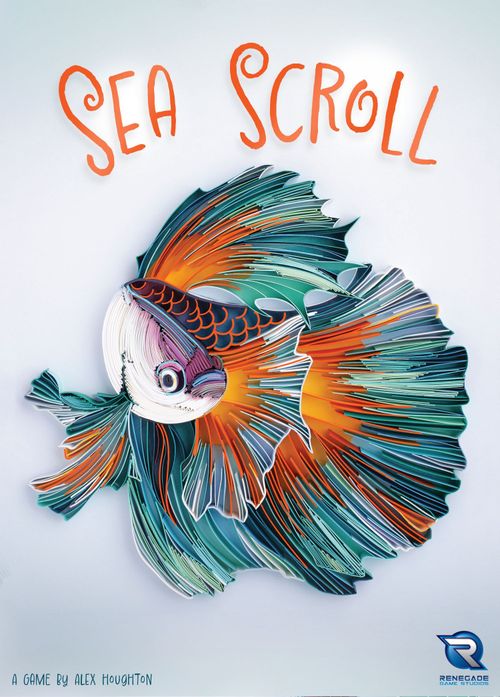
Sea Scroll
Sea Scroll Rulebook
Table of Contents
Table of Contents
Components
- 72 Fish Cards
- 13 Variant Cards
- 7 Quick Guide Cards
Goal
You will guide schools of fish from the reef to your personal habitat. At the end of the game, you will combine them with the fish in your hand. Then for each type of fish that you have, you will gain points if you have the most of that type, but lose points if you do not have the most.
Setup
-
Give each player a Quick Guide card with the "On Your Turn" side up.
-
Depending on the number of players, you may have to remove some types of fish cards from the deck:
- For 2 players, remove all 11 Royal Angelfish and all 12 Clown Fish cards.
- For 3 players, remove all 12 Clown Fish cards.
- For 4 or more players, use all 72 fish cards.
Shuffle the rest of the cards to form a deck and place it in the center of the table. We call this deck the ocean.
-
Remove a number of fish cards from the ocean and put them back in the box without looking at them, based on the chart below.
| Players | 2 | 3 | 4 | 5 | 6 |
|---|---|---|---|---|---|
| Remove | 14 | 14 | 11 | 6 | 5 |
- Deal 2 fish cards to each player to form their starting hands.
- Reveal a number of fish cards from the ocean equal to the number of players plus 1 (so, 5 cards in a 4-player game) and place them each face-up next to each other in a row near the ocean. We call these cards the reef.
- Place the Quick Guide marked "Last Round" with that side facing up on the bottom of the ocean deck.
- You're ready to begin! The player who went swimming most recently takes the first turn.
Heads Up: At the end of the game, each player will have many fish to score with. It is recommended for players to understand how scoring works before the game starts.
3-Player Setup Example
The example shows each player's hand, each player's habitat (with schools of fish such as 8 Mandarin Fish, 4 Regal Tang, 10 Betta Fish and 6 Moorish Idol), the ocean, and the reef.
The Fish
Each fish has a type and a value. A fish's value means two things:
- How many points you will gain or lose for having at least one of that type of fish at the end of the game.
- The number of fish cards of that type there are.
For example, the Clown Fish (12) is worth 12 points, and there are 12 of them in total. The Regal Tang (4) is worth 4 points, and there are 4 of them in total.
A collection of one or more fish of the same type is called a school.
Your Habitat
Over the course of the game, you will be able to take schools of fish from the reef and place them in front of you. This is your personal habitat. Your habitat can have up to 3 schools in it. Two schools of the same type cannot be merged together to make room for another.
At the end of the game, you will merge all fish from your habitat with those in your hand, then group them by type for scoring.
Playing the Game
The players take turns going clockwise around the table as described below. Turns continue until the ocean runs out of cards, at which point each player takes one final turn. Then the game ends.
A Turn
- First, you must draw 2 fish from the ocean into your hand.
- Then, you may choose to take 1 of the schools from the reef and put it face-up in front of you into your habitat. This is optional.
- Each player may only do this up to 3 times per game. Once you have 3 schools in your habitat, you may no longer take any schools from the reef.
- Finally, you must choose 1 fish from your hand to discard face-up into the reef.
- If there are already 1 or more schools with that type of fish in the reef, you must add this discarded fish to one of those, making a larger school.
- Otherwise, start a new school in the reef with the discarded fish by playing the card face-up into the reef on its own. There is no limit to the number of schools in the reef.
Ending the Game
Keep taking turns until a player cannot draw at the start of their turn because the ocean has no more cards in it (the "Last Round" Quick Guide will appear).
Miscounts: If there barely won't be enough cards in the deck, there was probably a small miscount during setup or during the game. Just add cards from the box that were set aside at the beginning so every player has the same number of turns. If there are barely too many cards, just stop drawing from the deck early so every player has the same number of turns.
Now that the ocean is empty, each player takes one final turn where they do not draw from the ocean. They may still choose to take one of the schools from the reef if they have less than 3 schools in their habitat. They must still perform the discard step!
The Reveal (Scoring)
After the last player finishes their final turn, each player puts all of the fish from their habitat into their hand and groups them by type.
First, all players play to the table all Regal Tang (4) fish that they have:
- The player(s) with the most (or tied for most) Regal Tang gain points equal to its value (4).
- The other player(s) with at least 1 Regal Tang lose points equal to its value (4). Turn those card(s) sideways to show this.
Repeat this for the next highest value fish until all fish are scored.
Important: Players gain or lose points for each group of fish they have, not each individual fish.
The player with the most points wins! Yes, it is possible to have and even win with negative points.
In case of a tie, please ask the nearest fish.
Scoring Example
Example for a given fish type: Suzanne and Erica each have 3 Betta Fish (value 10), Henry has 2 of them, and Milly has 0. Suzanne and Erica would each score +10 points for having the largest school of Betta Fish. Henry would score -10 points for having a smaller school of Betta Fish than they have. Milly would not gain or lose any points for this school of fish.
Variants
Your game includes a deck of 13 variant cards that can change the rules of the game. Try playing with 1 or 2 of these cards. You can mix and match at will or choose at random.
Some of these cards say Standalone. These variants should be played only on their own and not combined with other variants.
The variant card texts themselves are not reproduced in the rulebook; only two sample cards are partly legible in the printed illustrations, shown below as read from the pictured cards.
- Regal Tang (4) variant (sample): During the Reveal: Players who score with only a single Regal Tang (4) earn an extra +4 points. Losing with a single Regal Tang (4) costs an extra 4 points.
- Chaos (Standalone) (sample): Setup: Instead of creating the ocean and reef, mix all the cards together in a messy face-down pile in the center of the table. Players do not start with any cards in their hands. Gameplay: All players play simultaneously. They have 45 seconds to pick up cards one at a time, choose to keep that card permanently, or put it back face-up. Each player cannot have more than 10 cards. If they end up with more, they randomly discard down to 10.