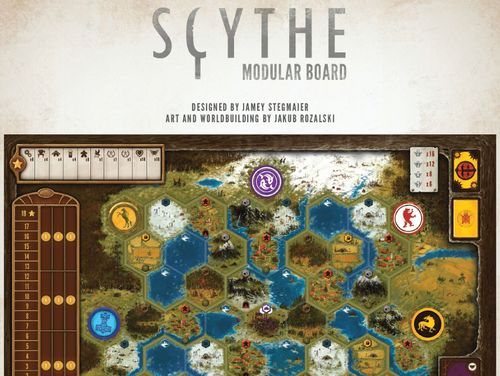
Scythe: Modular Board
Scythe: Modular Board Rulebook
Table of Contents
Table of Contents
Components
- 1 double-sided board
- 4 double-sided hex tiles
- 7 home base tiles
- 1 inactive home base tile
- 8 structure bonus tiles
Setup
-
Randomly select either side of the board.
-
Randomly place the modular tiles on the designated areas of the board, oriented in the proper direction. If a tile placement results in a lake being adjacent to a home base, flip the tile over to the other side (one of the two sides is guaranteed to fit).
(The rulebook illustrates this step with two small board images: one marked with a check, showing a valid placement, and one marked with an X, showing a placement where a lake is adjacent to a home base.)
-
Randomly place a home base tile on each of the corresponding hexes, regardless of player count.
- If you do not have The Rise of Fenris, use all 8 of these home base tiles, including the inactive one.
- If you have The Rise of Fenris, use 7 of these home base tiles and the 2 new faction tiles (after random placement, 1 faction will be excluded). Do not use the inactive home base tile. Note that we don't recommend using the modular board during campaign play, as certain random layouts may conflict with various episodes.
-
Randomly deal a player mat to each player.
-
Starting with the highest-numbered mat, select a faction. Continue in descending order through the player mats until each player has selected their faction (descending order is 5, 4, 3a, 3, 2a, 2, 1). Sit around the table so each player is near their faction's home base.
- IMPORTANT: When making a faction selection, consider their Riverwalk ability, particularly if they have access to metal (for deploying mechs) but not wood (for building a Mine). Experienced players may need to guide newer players through this decision.
- FIRST PLAYER: As normal, the player with the lowest-numbered mat will be the first player, with play continuing clockwise.
Faction-Specific Notes
-
BANNED COMBINATIONS: The player with the Industrial player mat may not choose the Rusviet faction, and the player with the Patriotic player mat may not choose the Crimean faction.
-
WAYFARE (CRIMEA): Even in 6-7 player games, Crimea should use their original Wayfare ability. Any inactive home base is eligible for this ability (e.g., there will be 1 inactive home base in a 7-player game, 2 in a 6-player game, and so on).
(The rulebook shows the Wayfare ability card, whose printed text reads: "move from a territory or home base to any inactive faction's home base or your own.")
Other Notes
- LAKES: If there is water on a non-lake territory that connects to an adjacent lake, it is considered part of the lake (you don't need Riverwalk to cross it, but you do need a lakewalk ability).
- PLAYER COUNT VARIANT: You may choose to remove modular tiles based on player count, leaving parts of the board empty. Do this after faction selection. The exact tiles and even the number of tiles removed will depend on which home bases were selected, but a general approximation is as follows:
- 2-3 players: remove 2-3 modular tiles
- 4 players: remove 1 modular tile
- 5-7 players: remove 0 modular tiles
Automa
On the normal board, the Automa is restrained by water for the early part of the game. The modular setup will not always provide that boundary between factions. Choose the starting home bases carefully or you may find yourself drowning in a sea of hostile Automa units. Expert players may actually wish to challenge themselves this way. Good luck!
Structure Bonus Tiles
The 8 new structure bonus tiles should be shuffled into the original tiles for all games of Scythe, not just those played with the modular board.
Each tile shows the points scored for the number of structures meeting its condition, as listed below.
- Adjacent to home base or Factory: Number of structures adjacent to any home base or the Factory. 1 structure: 3; 2 structures: 6; 3-4 structures: 9.
- Adjacent to same lake: Number of structures adjacent to the same lake. 1 structure: 2; 2 structures: 4; 3 structures: 6; 4 structures: 9.
- Village territories: Number of structures on village territories. 1 structure: 3; 2 structures: 6; 3-4 structures: 9.
- Mountains and forests: Number of structures on mountains and forests. 1 structure: 2; 2 structures: 4; 3 structures: 6; 4 structures: 9.
- Encounter territories: Number of structures on encounter territories. 1 structure: 3; 2 structures: 6; 3-4 structures: 9.
- Not adjacent to other buildings: Number of structures not adjacent to other buildings (your buildings or opponents' buildings). 1 structure: 2; 2 structures: 4; 3-4 structures: 6.
- Diamond formation: Number of structures within a diamond formation (the pictured formation from any angle). Use your largest collection of structures that matches this shape to score. 1 structure: 2; 2 structures: 3; 3 structures: 4; 4 structures: 9.
- Adjacent to same encounter territory: Number of structures adjacent to the same encounter territory. 1 structure: 2; 2 structures: 4; 3 structures: 6; 4 structures: 9.