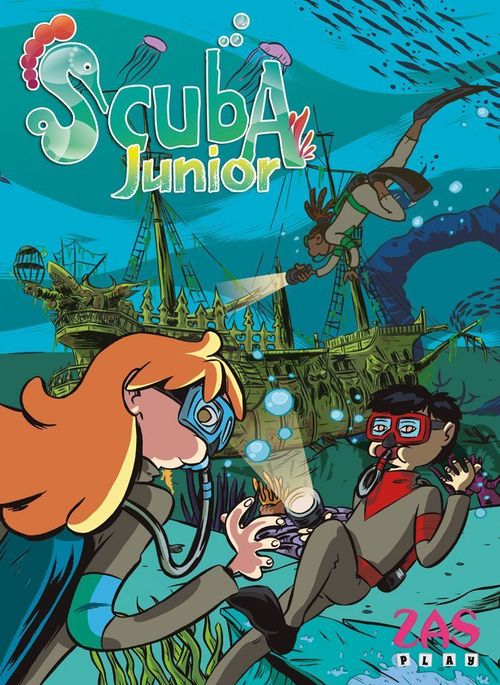
Scuba Junior
Scuba Junior Rulebook
Table of Contents
Table of Contents
Objective
The goal of the game is to recover the treasures that Captain Pirate hides in his sunken galleon. To do so, each Scuba Junior must dive from its boat to the Pirate Galleon, obtain a treasure, and return to its boat with it.
Components
- 96 Cards
- 1 Pirate Galleon Board
- Rulebook
- Marine Fauna Guide
Card Types
- Scuba Card
- Dice Card
- Bubble Card
- Treasure Card
- Sea Card
Setup
Each player randomly chooses a color of Scuba Junior and its corresponding boat. Then each player places 4 random Sea Cards face down that connect their boat with the Pirate Galleon Board.
Place 4 Treasure Cards face down at random on the Pirate Galleon Board. One of them must be the Pirate Captain card.
The setup illustration on the last page of the rulebook is numbered 1 to 8. The text does not name each callout, so the illustration is not a separate rule; the play areas and piles are defined in the sections below.
Play Areas
- Surface: where each player places the boat of its color and its Scuba Junior at the start of the game.
- Sea: represented by the 4 Sea Cards between each player's boat and the Pirate Galleon.
- Pirate Galleon: the board on which 4 Treasure Cards are placed face down, where the Pirate Captain hides.
- Sea Card Pile: where new Sea Cards are obtained.
- Discard Pile: where revealed Sea Cards are placed.
- Dice Pile: where Dice Cards are placed.
- Bubble Card Pile: where Bubble Cards are placed.
- Treasure Card Pile: where new Treasure Cards are obtained.
How to Play
Bubble Phase
At the start of the turn, each player reveals a Dice Card and determines the number of Bubble Cards its Scuba Junior has available this turn to explore Sea Cards. It then takes that number of Bubble Cards and places them in its hand.
Dive Phase Toward the Pirate Galleon
The player who obtained the most Bubble Cards begins its dive toward the Pirate Galleon, spending one Bubble Card each time it reveals a Sea Card. Its Scuba Junior card advances at the same time, to show its progress. The starting distance between the Scuba Junior's boat and the Galleon is 5 Bubble Cards.
When the Bubble Cards available this turn run out, or a Sea Card Obstacle appears that stops it, its turn ends. The turn passes to the player on its right. Its Scuba Junior begins its dive, and so on until the last player has finished.
Pirate Treasure Phase
When a Scuba Junior reaches the Pirate Galleon, it must choose a Treasure Card.
If it reveals a Treasure Card, it must start the way back to the surface. Each Treasure Card shows a value in gold coins, which can be 50, 75, 100 or 125. A new Treasure Card is placed on the Pirate Galleon and the Treasure Cards are shuffled again.
If it reveals the Pirate Captain card, the Scuba Junior flees in terror: its card is placed again next to its boat on the surface, with no Bubble Cards. Its turn is over. The Treasure Cards must be shuffled again so that no player knows the exact position of the Pirate Captain.
Surfacing Phase Toward the Boat
First, the Sea Cards revealed during the Dive Phase toward the Galleon are replaced with new Sea Cards placed face down. The Scuba Junior must then reveal Sea Cards again, spending Bubble Cards. If it reaches its boat, the treasure it carries becomes part of its score and its turn ends.
The next turn begins a new dive. The Scuba Junior keeps the Bubble Cards it had when it reached the boat and adds those it receives that turn. The maximum is 6 Bubble Cards in hand.
Sea Cards
The Sea Cards define the sea floor between the Scuba Junior's boat and the Pirate Galleon. There are different Sea Cards:
Common Sea Cards
These are simply seawater or fun, harmless sea creatures that watch the Scuba Junior with curiosity when they are revealed.
Help Sea Cards
Some sea creatures help the Scuba Juniors advance in their adventure.
The Turtle and the Seahorse make their progress easier with extra Bubble Cards: take the number of Bubble Cards indicated and use them that turn. They do not count toward the initial limit of 6 Bubble Cards in hand.
The Dolphin transports the Scuba Junior directly to the Pirate Galleon during the Dive Phase, and directly to the boat during the Surfacing Phase.
Obstacle Sea Cards
Other sea creatures are less friendly and try to hinder the Scuba Juniors by frightening them.
The Octopus, the Moray Eel, the Lionfish and the Swordfish reduce the Bubble Cards available. When one of these Obstacles appears, the Scuba Junior must spend 1 or 2 additional Bubble Cards if it wants to advance to the position occupied by the Obstacle. If it does not have enough Bubble Cards, it moves back as many positions as Bubble Cards it is missing. When it passes the Obstacle again, it does not have to spend additional Bubble Cards again.
The mischievous Jellyfish paralyze the Scuba Junior, which loses its turn and all its Bubble Cards.
The Shark frightens the Scuba Junior and returns it to its boat on the surface, losing all its Bubble Cards. In addition, during the Surfacing Phase, the Scuba Junior drops the Treasure it is carrying (the card is shuffled back into the Treasure Card Pile).
End of the Game
At the start of the game, the players must decide the number of gold coins needed to win the game. For example:
- The player who manages to gather 200, 250 or 300 gold coins.
When a player's Scuba Junior reaches its boat from the Galleon with a Treasure, and the gold coins it holds equal or exceed the number needed to win, that Scuba Junior is considered the winner. The other players who still have their last turn to play may try to do so if they can get ahead of the possible winner.
Play until the 15 Treasure Cards run out, and then make a final count. Optionally, the players may decide in advance how many Treasure Cards will be played, to shorten the length of the game.
Educational Variant
Scuba Junior includes a Marine Fauna Guide with 28 real marine species. Players can learn to tell them apart and learn their names in different languages, including their scientific names.
To facilitate this learning, the following play system is proposed:
- Do not use the Dice Cards or the Bubble Cards.
- To descend to the Pirate Galleon or ascend to the boat, when the player reveals a Sea Card it must name the marine species shown. If it names it correctly, it may keep advancing. If not, it loses its turn.
- If it names the species correctly and the card is a Help Sea Card, its effects apply: the Dolphin moves the Scuba Junior to the Pirate Galleon or to the boat. The green bubbles indicate how many Sea Cards the Scuba Junior that named the species correctly advances, and it does not need to reveal those Sea Cards if it does not want to.
- If it misses and the card is an Obstacle Sea Card, its effects apply: the Jellyfish paralyze, the Shark returns the Scuba Junior to the boat, and so on. The red bubbles indicate how many Sea Cards the Scuba Junior that missed moves back. It must name again the marine species it passes.
Source Notes
The credits, copyright and trademark boilerplate, and the promotional line on the rulebook's last pages have been omitted. The Spanish original's page numbering has also been omitted.