Scripts and Scribes: The Dice Game – Mini Expansion
Official rulebook: Dr. Finn's Games
Scripts and Scribes: The Dice Game – Mini Expansion Rulebook
Table of Contents
Table of Contents
Generic Rule Changes
- Ignore hand limit rule.
- Adjust set-up for 4-5 players (before the first turn):
- For 5 players, place cubes on starting spaces for 4 players.
- 4th player rolls 1 resource die and moves up 1 space on corresponding track.
- 5th player rolls 2 resource dice and moves up accordingly.
- All players, except the starting player, still receive an additional amount of gold (as originally stated in rules).
Rule Changes for the Mini-Expansion Power Die
- Adjust starting spaces down 1 space (except in a 2-player game). For example, in a 3-player game, use start spaces for 2 players. For 5 players, move starting space down 2 spaces; 1 for this adjustment and 1 for the generic adjustment stated above.
- The power die is rolled along with all the other dice by the active player.
- When it is a player's turn to choose dice, one may choose the power die alone and execute the specified action. The power die has 6 different sides, each with its own power:
- Gold Boost: The die starts at a value of 1 gold. For each player that does not take the die, it increases in value by 1 gold. Example: the die would be worth 4 gold if chosen by the 4th player (or if chosen by the active player in a 3-player game for his second chance at choosing dice).
- Resource Boost: The die is worth 1 resource at the start. For each player that does not take the die, it increases in value by 1 resource. A player may use it for the bishop track. The die may not be used to move up in a track in which a player is already in first place, though it may be used to move into first place. Example: It's the start of a 3-player game and no cubes have moved up the track. The active player rolls the dice; the power die shows "resource boost". The 1st and 2nd player choose other dice; the 3rd player takes the power die, giving him 3 resources. He must move up in 3 different tracks because, at this point, with any move in any track, he would take 1st place in the track.
- Random 2 Resources: The player who chooses this die receives 2 random resources. After all other players have chosen dice and taken their respective actions, the player rolls 2 resource dice and moves up in the tracks accordingly (this may include Bishop influence).
- Random 3 Resources: Same as above, but with 3 dice.
- Any 2 Resources: The player who chooses this die moves up 1 space in 2 different tracks (may include bishop track).
- Any 3 Resources: The player who chooses this die moves up 1 space in 3 different tracks (may include bishop track).
"Auction for Resources" Rule Changes with Power Die
- In an Auction for Resources, the highest bidder receives all the dice except the Power Die. The second highest bidder receives the Power Die, but only pays half of the bid, rounded down (e.g., pay 1 gold for a 3 bid), and only if he wishes. If he declines to take the power die, he keeps his gold and the power die is ignored.
- If there is a tie for the highest bidder, players choose dice as if it were a standard turn (as in original rules); however, if there is a tie only for the second highest bidder, the power die is ignored.
- The highest bidder performs all of his actions before the second highest bidder.
- A player must pay a minimum of 1 gold to use the power die (so a bid of at least 2 is necessary to win second place).
Rule Changes for "Auction for Gold"
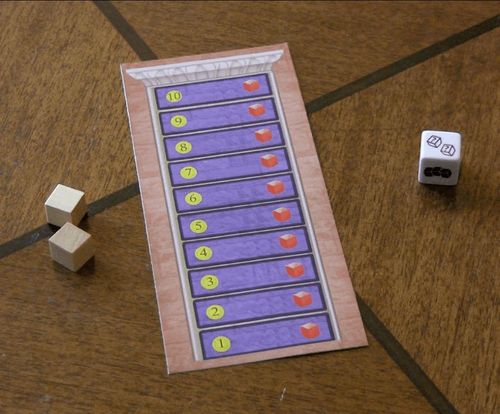
- Place the Auction Track card next to the board.
- Place a cube on the Auction Track next to the 10 gold coin (at top) and place another cube next to the 1 resource icon (at bottom). The Auction Track is always set in this manner prior to the active player's decision to bid or pass. Set this way, the Auction Track means "10 gold for 1 resource."
- When an "Auction for Gold" occurs, the active player begins the auction by bidding or passing. Bidding continues clockwise (possibly moving through players more than one time) until a final bidder remains.
- To bid, a player must either lower the gold value or raise the resource value by exactly 1. Example: If the active player makes a bid, it must be either "9 gold for 1 resource" or "10 gold for 2 resources."
- The minimum and maximum bids are 1 and 10, respectively.
- For the purposes of counting one's resources, the starting space on each track counts as 1.
- The player who wins the auction must give up the stated number of resources to receive the stated number of gold from the supply.
- To give up 1 resource, a player moves a cube on a resource track (not the Bishop Influence track) down 1 space.
- A player may remove a cube from the starting space to give up 1 resource. When off the track, the player is considered to have no resources of that type. Note: The player may put the cube back on the track when taking a resource of that type later. Due to this fact, the game does not end by 4 cubes being removed by one player (as in the original rules).
- A player may only bid an amount of resources that he is capable of paying. Example: If a player is on the starting space on each of the 5 tracks, he may bid up to 5 resources (but no more). As bids are announced, players should check to ensure that the bids can be paid.
- When lowering a cube on a track, if a player passes a gold coin in such a way that one or both of the gold coins becomes "available" again, the player must pay gold. Example: Assume a player is in first place on a track and has the only cube on a space with a 2 and a 1 gold coin; if this player drops down 1 space, both of those gold coins become "available" because there are no other cubes at that level or higher. In this case, the player must pay gold (see next point for how much gold).
- If a player lowers a cube past a gold coin in such a way that the higher value coin becomes available, he must pay that amount. If lowering the cube results in only the lowered valued coin becoming available, he must pay the lower amount. Example: Player A and Player B have cubes on the Ink track in a space one space up from gold coins, valued at 2 and 1. The remaining players are still too low to have received any coins from this track. Player A must give up 4 resources to meet his bid. He decides to lower his Ink resources by 2 and another resource by 2. On the Ink track, he moves his cube down 2 spaces and passes the gold coins. Since Player B is above these coins, the gold coin valued at 2 is not available. However, since Player A is now below the gold coin space, the gold coin worth 1 is now available. He must pay 1 gold to the supply.
- A player may use gold from his hand, or the gold he is receiving from the auction, to pay for passed coin(s).
Two notes:
- It is possible that a player must pay back more/less than he received during his movement up a track. For example, Player A may have received 2 gold as a result of being in first place and passing a coin worth 2; yet, because Player B also received 1 gold for passing that same space with a 1 gold coin, Player A only pays 1 gold if he descends passed the gold coins (while Player B now stays in first place on that track).
- It is also possible that a player pays nothing for passing a gold coin. This occurs when there are two or more opponents' cubes higher on the track.