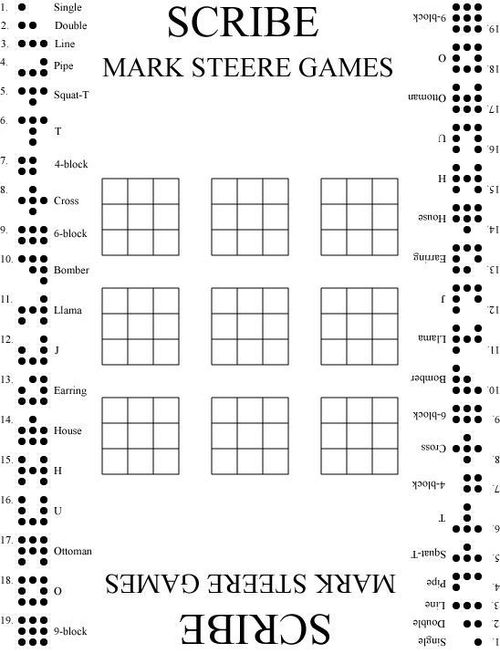
Scribe
Scribe Rulebook
Table of Contents
Table of Contents
Basic Moves
The two players, "+" and "O," take turns marking squares, one square per turn, until the entire super grid is filled. Players are not allowed to pass on their turn.
On your first turn, you can claim any square on the super grid.
The mini grid of your last move is treated as a map. The square you last claimed points to the mini grid in which you must make your next move. For example, it's +'s turn in Figure 1a. Since his last move was in the lower left corner of a mini grid, he must make his next move somewhere in the lower left mini grid as shown in Figure 1b.
If your last move points to a completely filled mini grid, you can make your next move anywhere in the super grid.
Slashing
Immediately after making his move, + must "slash" his previous move, by drawing a diagonal line through it, as shown in Figure 1b. Likewise, O must slash his previous move as shown in Figure 1c.
Only the current + move and current O move should be unslashed. All other moves should be slashed.
Object of the Game
Each glyph is worth the number of dots that compose it. For example the J is worth six points.
A glyph also represents its own mirror image and rotations. See Figure 2.
Glyphs appearing as a subset of a larger group don't count. So for example O can't claim the Double in Figure 3, and + can't claim the Pipe in Figure 6.
When a mini grid is completely filled, the glyph points are tallied and the high score wins. For example, in Figure 3 + has four Singles and O has two Singles. With a score of 4-2, + is the winner.
The last player to move in a mini grid must draw the winner's mark next to the mini grid as shown.
Majority Version: Whoever wins the majority of the nine mini grids wins overall.
Superglyph Version: Players form super glyphs on the super grid with their winning mini grids.
Glyphs
The 19 glyphs of Scribe are listed below. Each dot pattern is shown as a 3-column grid, where each "●" is a dot. Points equal the number of dots in the glyph.
- Single (1 point)
● - Double (2 points)
●● - Line (3 points)
●●● - Pipe (4 points)
··● ●●● - Squat-T (4 points)
●●● ·●· - 4-block (4 points)
●● ●● - T (5 points)
Figures
The printed sheet illustrates the rules above with the following diagrams. Figures 1a-1c show the move-and-slash sequence on the super grid; Figure 2 shows glyph rotations and mirror images; Figures 3-6 show scored mini grids.
Figure 1a: It is +'s turn. His last move was in the lower left corner of a mini grid, so he must play in the lower left mini grid (Figure 1b).
Figure 1b: +'s move is unslashed and O's previous move is slashed.
Figure 1c: O's move is unslashed and +'s previous move is slashed.
Figure 2: Examples of a glyph's rotations and mirror images.
Figure 3: Final score +=4, O=2. + is the winner, and the + mark is drawn next to the mini grid.
Figure 4: Final score +=4, O=5. O is the winner, and the O mark is drawn next to the mini grid.
Figure 5: Final score +=7, O=2. + is the winner, and the + mark is drawn next to the mini grid.
Figure 6: Final score +=0, O=4. O is the winner, and the O mark is drawn next to the mini grid.