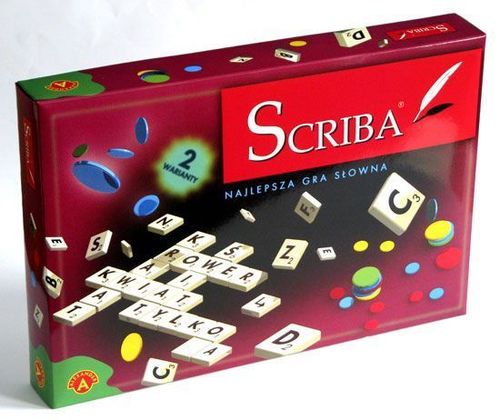
Scriba
Scriba Rulebook
Table of Contents
Table of Contents
- Game I
- Game Description
- Goal of the Game
- Features
- Components
- Setup
- Letter Tile Values and Quantities
- Start of the Game
- Course of the Game
- Scoring
- Board Field Colours
- Special Tiles
- Extending Words
- Blocking Tiles
- Stacked Letters
- Drawing Letters
- Ending the Game
- Valid Words
- Examples of Words and Their Scoring
- Rule Changes
- Solo Version
- Game II
Game I
Number of players: 1 to 4. Age: from 8 years.
Game Description
"SCRIBA" is a word game for 1 to 4 players. The main principle of the game is that players form words from randomly drawn letter tiles. Words are laid out on the board vertically or horizontally, similar to a crossword. The board contains word bonus and letter bonus fields. Letter tiles display a marking of their point value.
Goal of the Game
Players try to form words with letters and on board spaces that allow them to score as many points as possible.
Features
"SCRIBA" combines elements of chance, strategy and logic games. It forces participants to expand their vocabulary and requires concentration, logical thinking and imagination.
Components
- Board (double-sided) - 1 pc.
- Letter tiles - 100 pcs.
- Blank tiles - 3 pcs.
- Arrow tiles - 3 pcs.
- Black circle tiles - 2 pcs.
- Racks - 4 pcs.
- Tokens (large and small) - 60 pcs.
- Cloth bag - 1 pc.
- Die - 1 pc.
- Scoring pad - 1 pc.
- Pen - 1 pc.
- Manual - 1 pc.
After unpacking, check the contents against the list above or the list on the back of the box.
Setup
- Detach (cut off) the letter tiles and the symbol tiles from their frames.
- Put all tiles into the bag and shake it.
- Lay the board out on a flat surface.
- Give each player a rack for placing the letters they draw.
- Choose a player to keep the score.
Letter Tile Values and Quantities
The letter tiles are listed below, as printed in the manual. Each entry gives the letter, its point value (the digit) and the number of tiles in the set.
| Letter | Points | Tiles | Letter | Points | Tiles |
|---|---|---|---|---|---|
| A | 1 | 7 | Ń | 8 | 1 |
| Ą | 6 | 1 | O | 1 | 5 |
| B | 2 | 4 | Ó | 6 | 2 |
| C | 3 | 3 | P | 2 | 4 |
| Ć | 7 |
Total: 100 letter tiles.
Start of the Game
- Each player draws one tile from the bag. The player who draws the highest digit starts the game. If more than one player draws the highest number, the draw is repeated until a winner of the draw is determined.
- The tiles drawn to determine the order must be returned to the bag, which is then shaken.
- The other players play in clockwise order after the starting player.
Course of the Game
- At the start, each player draws (in the established turn order) 6, 7 or 8 tiles from the bag. The players choose one of these variants before the game.
- Each player places the drawn letter tiles on their rack, so that other players cannot see the letters.
- The starting player lays out on the board a word formed from at least two letters. One of the letters must cover the central square of the board (marked with a feather). The central square is a triple letter bonus field.
- After laying letters from the rack onto the board, the player draws from the bag as many tiles as were placed on the board.
- The next player adds letters to an existing word so as to form a completely separate word.
- Letters may only be placed vertically or horizontally.
- Once a letter has been placed it may not be removed or moved.
- A word placed on the board may be challenged. If, after checking in the Polish Dictionary (Słownik Języka Polskiego), the word turns out to be incorrect, the player must remove it from the board back to the rack, loses their turn, and 5 penalty points are deducted from them.
Scoring
- After a word is placed on the board, the values of the individual letters forming the word are added together.
- The value of a letter that covers a letter bonus field is multiplied by the number printed on that field (see Figure 1).
- If one of the letters is on a word bonus field, the point value of the whole word (after adding the values of all letters, including letter bonuses) is multiplied by the number of the word bonus field.
- If the letters of the word cover two word bonus fields, the value of the word is multiplied by the sum of the values of both bonuses.
- The board contains 4 negative fields. The value of a letter covering such a field is multiplied by -4.
- The circles around bonus fields show the point value of the field. The colour of the field also shows its type and value.
Example from the manual, placing the word ROWER (Figure 1):
- R = 2 points x 2 (double letter bonus) = 4 points
- O = 1 point
- W = 2 points
- E = 1 point x 3 (triple letter bonus) = 3 points
- R = 2 points
Total for the example: 12 points (the sum of the values above; the manual does not print a total for this example).
Board Field Colours
Word bonuses:
- Yellow = x4
- Dark blue = x3
- Light blue = x2
Letter bonuses:
- Green = x4
- Dark purple = x3
- Light purple = x2
- Red = x -4 (negative points)
Fields marked with the letter "S" are word bonus fields. Fields marked with the letter "L" are letter bonus fields.
Special Tiles
Blank tiles. A blank tile (without a letter) may replace any missing letter in the game. A player laying a word with a blank tile must state which letter it replaces. The blank tile then stands for that letter until the end of the game (Figure 2). To avoid misunderstandings, it is worth writing down, in the word laid out, which letter the empty tile replaces.
Arrow tiles. Words may normally only be placed horizontally or vertically. There are, however, 3 arrow tiles that make it possible to lay part of a word at a 90° angle (Figure 3). Letters may only be placed from top to bottom, or horizontally from left to right, also when an arrow tile is used. Never from bottom to top and never from right to left.
- Special tiles have no point value. If a blank tile or an arrow tile is placed on a word bonus or letter bonus field, the value of the word does not change.
Example for the word KRAWAT, as printed:
- K = 3 points
- R = 2 points
- A = 1 point
- W = 2 points
- A = 1 point x 2 (double letter bonus) = 2 points
- T = 2 points
- Total: 12 points.
- W lies on a double word bonus field, so the 12 points are multiplied by 2.
- Total: 24 points.
Remark as printed: the letter bonus of the letter R is not counted in the example (Figure 4), because it was already obtained earlier, when ROWER was laid. Only the bonuses a player obtains in their own turn are counted.
Extending Words
- A word may be formed by adding letters to words already on the board. Added letters may end or begin a word.
- A new word may also be formed by adding letters that connect at right angles to a previously placed word, or to several rows of words (vertically or horizontally) (Figures 5 and 6).
Example as printed: the word ŚWIATY is formed by adding letters at right angles to the words ROWER and KRAWAT. The total points scored for this word are 18 points x 2 (double word bonus) = 36 points.
Example as printed: the word KWIAT is formed by adding letters at right angles to the words KRAWAT and ŚWIATY. The total points scored for this word = 9.
- A word may not be extended, and a new word may not be placed directly against placed letters, if the placed letters do not form a new word with them (Figure 7).
Example as printed: adding the letters Y, L, K, O makes the word TYLKO horizontally, and vertically the word TY. Two words are formed in one turn.
- If two (or more) words are formed by one placement of letters, the point value of each word is calculated separately, counting the shared letter separately for each word. The total value of all words formed is then added up. Only one existing word may be modified; the formation of other words must happen at the same time.
Blocking Tiles
- Tiles with a black circle (Figure 8) are used to block a word. If a word being placed or already placed begins or ends with a black circle tile, it blocks any extension of that word from its beginning or end.
Stacked Letters
- To form a new word by adding letters to a word already on the board, or to lay a new word completely, the tiles may be placed in a stack on a word laid out earlier.
Points for the word formed are calculated according to the rules above, but without counting any bonuses (Figures 9 and 10 and 11 and 12).
Example as printed: the word TARKA and the word TA are formed in one turn. The points obtained are calculated by adding the values of the letters of the word TARKA and the word TA.
- Letters may be added or a whole word placed on the upper level only within the limits of the lower word. Only one upper level may be built.
- For placing all tiles from the rack onto the board at once, a player receives a bonus of 50 points. For placing one tile fewer, the bonus is 20 points. These bonuses are counted independently of board bonuses and the value of the letters placed.
Drawing Letters
- After laying out letters, calculating and recording the points scored, the player draws from the bag as many tiles as they left on the board. The drawn letters are placed on the rack, and the next player in turn lays out a word from their own rack. Each player may skip their turn, but then loses 5 points. If every player skips their turn twice, the game ends and points are totalled.
- During their turn (if they do not want to or cannot lay letters on the board), a player may exchange letters on their rack for letters from the bag (one letter must remain on the rack). Rejected letters from the rack must be returned to the bag after the same number of letters has been drawn beforehand. Opponents may not see which letters are returned to the bag.
Ending the Game
- The game ends when all tiles have been drawn from the bag and no player can lay any word with the remaining letters on their rack. All participants then add their points from every round. The value of the letters remaining on the player's rack is then subtracted from this total.
- The game also ends when all letters have been drawn from the bag and one player has laid out all the letters from their rack. The game is totalled as before, but the player who ended the game (by laying a word made of all letters on the rack) receives a bonus of 50 points.
Valid Words
- Any words and their permitted forms found in the Polish Dictionary (Słownik Języka Polskiego) may be used in the game. Abbreviations, words written with a capital letter, and words requiring quotation marks may not be used.
- The dictionary is the only basis for resolving any disputes during the game. It may only be consulted to clarify doubts about whether a word laid out by a player is correct.
- After all points have been totalled, the winner of the played game is determined.
Examples of Words and Their Scoring
Example as printed: the word WYRAZ (word bonuses and letter bonuses as shown in the example figure):
- W = 2 points
- Y = 2 points
- R = 2 points
- A = 1 point
- Z = 2 points x 2 (double word bonus) = 4 points
- Total = 11 points.
Example as printed: the word KREDKA:
- K = 3 points
- R = 2 points
- E = 1 point
- D = 2 points
- K = 3 points
- A = 1 point
- Total = 12 points x 2 (double word bonus) = 24 points.
Example as printed: the word KRATKA:
- K = 3 points
- R = 2 points x 3 (triple letter bonus) = 6 points
- A = 1 point
- T = 2 points
- K = 3 points
- A = 1 point
- Total = 16 points x 3 (triple word bonus) = 48 points.
Rule Changes
- At the start of the game, all participants may agree to change the rules as they need, for example by agreeing not to use arrow tiles or not to lay letters in stacks. All changes to the rules should, however, be clear to all and accepted by everyone at the start of the game.
Solo Version
- SCRIBA can be played by one person. All the rules of the multi-player game apply. The player may use only one rack (playing against themselves), or two racks when playing against an imagined opponent. Playing alone also gives much satisfaction from the effort of searching for a correct word. It does not allow boredom or routine, thanks to the need to draw the missing letters at random.
Game II
Game II Description
All rules described in the first version of the game (Game I) also apply to the second version. There are, however, differences, among others in drawing letter tiles, in placing them, and in collecting and counting bonuses.
Game II Components
- Board
- Letter tiles - 100 pcs.
- Blank tiles - 3 pcs.
- Arrow tiles - 3 pcs.
- Black circle tiles - 2 pcs.
- Racks - 4 pcs.
- Bag - 1 pc.
- Small tokens - 48 pcs.
- Large tokens - 12 pcs.
- Die - 1 pc.
- Manual
- Scoring pad - 1 pc.
- Pen
Game II Rules
- Board: the board has no markings of bonus fields.
- Bonuses: the bonuses are marked by small tokens, which the players lay out on the board before the game starts, as they see fit. Each game therefore has its bonuses in different places. The colours of the tokens show the type of bonus and its size. A player who lays their word on the board and reaches a token (or tokens) removes it and calculates the bonus due to them. The token is set aside on the table next to the board.
- Letter tiles must be placed on the board in the direction indicated by the letter and number markings of the fields (on the edges of the board).
Values and types of the small tokens:
| Colour | Type of bonus | Value | Quantity |
|---|---|---|---|
| Red | Letter | x3 | 8 |
| Blue | Letter | x2 | 16 |
| Green | Word | x3 | 8 |
| Yellow | Word | x2 | 16 |
- Large tokens: before the game starts, each player receives an equal number of large tokens. These are an additional points capital, which can be kept, increased or lost. A player who lays 4 letters from their rack onto the board in one turn has the right to take a large token from an opponent of their choice. Each large token is worth 10 points. Note: a blank tile (without a letter) does not count towards gaining the right to take a large token.
Drawing Letter Tiles (Game II)
- In this version, letter tiles are not drawn from the bag in the number the player lays on the board. Only in the first draw (at the start of the game) must the players draw from the bag an equal number of tiles: 7 each.
- During the game, before each draw, the player must roll the die. The number of pips rolled determines how many tiles may be drawn from the bag. A roll of six does not give the right to roll again.
- Drawing may begin (as in the first version of the game) after the player has laid their tiles on the board.
- If the player draws more tiles than there is space on the rack, they place the extra tiles on the table next to the rack.
- If there are fewer tiles left in the bag than the number of pips rolled on the die, the player takes what is left.
- If a player cannot lay letters on the board and there are no letters in the bag, that player is considered to have ended the game. They cannot, however, count their points, because other players may still take their large tokens.
Placing Letters (Game II)
- The starting player does not have to begin on the central square. A player may choose the squares on the board for laying out their word so as to score as many points as possible. Players may apply this principle not only at the beginning of the game but also during it.
- If a player has not laid out the whole word from their rack, they may add letters to words already on the board (as in the first version of the game).
- To avoid misunderstandings, it is worth writing down the letter which an empty tile replaces in the laid-out word.
- Token bonuses earned by blank tiles have no bonus value; they keep only the unit value of the token.
- If a word bonus lies under a letter that belongs to two independent words formed at the same time, its value is multiplied by the value of both words (Figures 13 and 14).
Example as printed: if the new word ARIA is laid next to the word KUR, two new words are formed at once: KURA and ARIA. If the shared letter A lies on a word bonus field, that bonus is multiplied by the value of the words KURA and ARIA, and the results are added together.
Ending and Scoring (Game II)
- After the game has ended and the points recorded during play have been totalled, the points for the tokens collected are added.
- Point value of the tokens:
- Small tokens: 1 point each (during the final count the bonus value of a small token is not counted again).
- Large tokens: 10 points each.
- The value of the letters remaining on the player's rack is subtracted from the sum of the recorded points and the points for tokens.
Rule Changes (Game II)
- Before the game begins, participants may agree on changes to its rules. Players may modify the rules. It is, however, worth writing the changes down, to avoid misunderstandings during play.