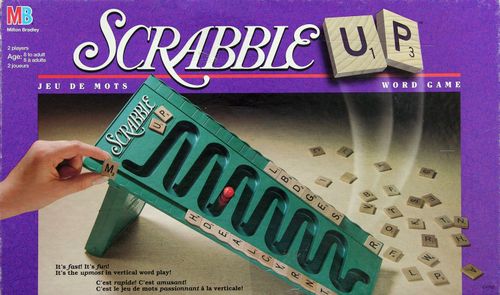
Scrabble Up
Scrabble Up Rulebook
Table of Contents
Table of Contents
Contents
2 Players or Teams
Vertical gameboard with storage tray, plastic marble, 47 letter tiles (see box bottom for letter distribution), 2-sided tape.
The letter distribution printed on the box bottom is not part of the scanned rules and is not transcribed here.
Object
Make words by "stealing" letter tiles from your opponent's gameboard track. Then stack them up on your own track! To win, be first to stack tiles to the top of the track!
Make UP
The first thing you do is make the word UP — by fitting U and P letter tiles under SCRABBLE on your gameboard. Apply a piece of the enclosed 2-sided tape to the back of one U tile and one P tile. Then carefully but firmly press each tile into its matching square, as shown in Figure 1.
Figure 1 shows the U and P tiles being placed on the gameboard under the word SCRABBLE.
Set UP!
Swing out the gameboard's storage tray, then set the gameboard vertically on a flat, level surface between you and your opponent. See Figures 2A and 2B.
Figure 2A labels: Leg, Storage tray, Tab. Caption: Gently move one leg to release tab. Then move the other leg and lift tray.
Figure 2B labels: Track, Groove.
Get on the Right Track!
Whose Track is Whose? Each side of the gameboard has a vertical track with 19 squares for stacking letter tiles. Your track is the one that's closer to you — the opposite track is your opponent's track. During each round of play you'll make words from the tiles on your opponent's track, then stack those tiles on your own track.
Try for Long Words! Your best strategy is to make the longest words possible. The longer the words, the more tiles you can "steal" from your opponent's track and stack on your own track!
Stack 6 Tiles
Separate the vowel tiles from the consonant tiles (put the Y tile and the blank tile in the consonant group). Turn the tiles in both groups facedown.
You and your opponent each draw two vowel tiles at random, then draw four consonant tiles at random. Stack your 6 tiles in any order on your own tracks.
Mix both groups of facedown tiles together and spread them out near the gameboard. This is the play pile.
Set the marble in the circle at the top of the groove, and you're ready to play!
Figure 3 shows an example of a game set up and ready for play.
Figure 3 labels: Marble, Player B's Track, Player A's Track, Play Pile, 6 tiles on each track.
Hurry UP and Play!
2-Player Game Rules
(See page 7 for Team Play.)
If you're expecting a leisurely your-turn-my-turn SCRABBLE game, forget it! In this game you and your opponent play at the same time, racing each other to think UP words!
The game is played in several rounds. There are 3 steps in each round, all explained in detail below:
- Place the Starting Tile
- Call Out a Word
- Stack Your Tiles
1. Place the Starting Tile
You and your opponent, at the same time, each draw one tile at random from the play pile and place it on the square above the tiles on the opponent's track. Each player's word must begin with the letter on the starting tile.
2. Call Out a Word
Quickly study the tiles on your opponent's track, and try to make a word using any or all tiles on that track. Remember, your word must begin with the starting tile!
As soon as you decide on a word, call it out!
Follow these rules for making your word:
- Your word must begin with the starting tile.
- Your word must be at least two letters long.
- The blank tile can represent any letter, even if it's the starting letter.
- All words listed as parts of speech (including those listed as foreign origin, and as archaic, obsolete, colloquial, slang, etc.) are allowed, with these exceptions: words always capitalized, abbreviations, prefixes and suffixes standing alone, and words requiring a hyphen or an apostrophe.
- Any form of a word may be used, including plurals, as long as the word is in the dictionary.
- Before calling out your word, make sure that all tiles in it are on the opponent's track.
Figure 4 shows examples of acceptable words. Its caption reads: With these letter tiles you could make WE, WEE, WED or WEDS. A longer word like WELDS or WEEDS would be even better!
Getting the First Word: The early word gets the edge! If you call out the first word, immediately give the marble a gentle push to start it rolling down the groove.
Changing Words: The player who called out the first word can't change it once the marble starts rolling; but the other player may change his or her own called-out word at any time before the marble stops rolling! (Come on, it's only fair!)
Now your opponent must think fast to call out a word before the marble stops rolling! If this player doesn't call out a word in time, he or she won't get any tiles.
3. Stack Your Tiles
When the marble stops, both players take the tiles in their words from the opposite track and stack them on their own tracks. (Scramble any or all of the tiles on your track, to make it tougher for your opponent to make a word.)
This ends the round.
Challenges
Either player can challenge a word's acceptability. Consult a dictionary: if the word is acceptable, the challenged player keeps the tiles; if not, the challenger takes them back!
Starting a New Round
To begin a new round of play, replace the marble at the top of the groove. Then follow Steps 1 through 3. The stacks get higher as the game goes on, giving players more options for longer words.
How to Win
After any round of play, the first player to make a word that either fills the top square or goes beyond the top square wins the game! Give this player a round of UP-plause!
If you both reach the top square after the same round, the player with the most "over the top" tiles wins.
Still tied UP? Then the player who called out the first word wins!
Figure 5 caption: At the end of this round, Player B wins the game by making the word HEAD and stacking a tile on the top square! (Figure 5 labels: Player A's Track, Player B's Track.)
Team Play
Players split up into two teams. Make sure everyone has a clear view of the gameboard.
Set up the game and play by the 2-player rules. Team members may consult before calling out a word. Or it could be a free-for-all! Make UP your minds either way before you play!
Playing for Points
Why waste the point values on those tiles? Try this game for a whole new strategy!
The object is to score the most points, so making long words isn't essential. Set up the game, then play by the 2-player or team rules with these exceptions:
Step 2 (Call Out a Word): In Step 2, try to make a word using letter tiles with high number values. See Figure 6 for an example.
Figure 6 caption: HOUR is a good choice for 7 points. HOP is a better choice for 8 points — even though it's shorter!
Step 3 (Stack Your Tiles): In Step 3, add up the point values of the tiles in your word. Each player or team does the same. Keep a running tally of points during the game.
Ending the game: The game ends when a player or team reaches the top square, as in How to Win in the regular game.
Add UP the point total for each player or team. The player or team who ended the game gets a 3-point bonus. The player or team with the highest score wins!
Storing Your Game Pieces
Turn the gameboard upside-down and press the storage tray flat. Push in above the tab to open the lid.
Put the game pieces inside as shown in Figure 7, then close the lid.
Figure 7 labels: Tab, Marble, Instructions and letter tiles.