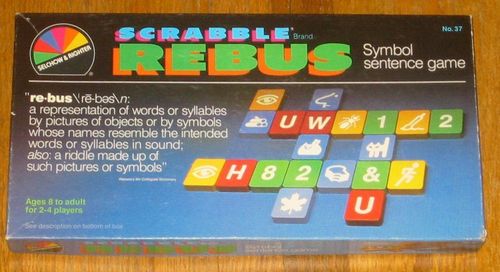
Scrabble Rebus
Scrabble Rebus Rulebook
Table of Contents
Table of Contents
Contents
- 1 Playing Board
- 108 Tiles (27 each of Red, Green, Blue & Yellow)
- 4 Tile Sacks
- 4 Racks
Object
Players must create words, phrases, titles or sentences from the letters and symbols provided. This type of word or sentence formation is called a Rebus. Players alternate turns by forming words and sentences crossword fashion on the board. The player with the highest score wins the game.
Set Up
Carefully remove the four sets of tiles from their trees and place them in their matching color tile sacks. Any excess plastic remaining on the tiles may be easily removed with a pair of scissors. Players decide who goes first. Beginning with the first player, he/she draws two tiles from each tile sack for a total of eight tiles.
The Play
The starting player arranges his/her tiles to form a Rebus sentence or word and places it vertically or horizontally on the board so that one tile covers the Center Star. NOTE: The score for the first play on the Center Star is doubled. He/she totals his/her score and replaces the tiles with the same color tiles. Players always maintain eight tiles in their racks. Play passes to the left. The second player and subsequent players must form Rebuses that connect to those words already played, crossword fashion.
Forming Rebuses
-
Sentences must be plausible and complete statements as judged by the other players. Sentences may be as simple as "I saw." All parts of a Rebus must be represented by a symbol or letter and punctuation is understood.
-
Single word Rebuses may be formed, i.e. [picture of a house and a ruler] = "Welcome."
Words can be spelled out using letters within a sentence. [D O G] = "DOG"
-
A Rebus that has already been played may be added to as long as the new portion relates logically to the old, i.e. [U R A D, sun symbol] [arrow] [2 M E] = "You are a delight . . . to me."
-
More than two words used in lists are not allowed, i.e. — He has a cat, phone, dog and leaf. An acceptable play might be: He saw a cat and a dog. [person, saw, A, cat, &, A D O G] = "He saw a cat and a dog."
-
Proper nouns and common names are allowed, i.e. Emily. [M L E] = "Emily"
-
Initials are NOT allowed, i.e. FDR. [F D R] = "FDR" (not permitted)
-
A symbol's meaning may be changed to suit the second Rebus when it connects to one previously played, i.e. Comb your hair — Welcome home. [Printed example: a well, comb and house stacked in a column, joined across to Y, a hair-like symbol, H, A, eye and R.]
-
When drawing replacement tiles and none remain in the same color, a player may choose from any of the other tile sacks.
-
If a player cannot form a Rebus, he/she may choose to replace all or some of his/her tiles and pass his/her turn.
Scoring
-
The basic score The number of tiles used in one turn for a Rebus is multiplied by three.
-
Bonus Squares If a tile is placed on an Orange/Green Square, the score is doubled. If it is placed on a Red/Blue Square, it is tripled. Once a tile covers a Bonus Square, the next player may not recount the value of the Bonus Square if he/she extends the word. Bonus Squares apply only in the turn in which they are first played.
-
Players receive a 50 point Bonus for using all eight tiles.
Winning
The game ends when all tiles have been drawn from the four tile sacks and one of the players has used all of the tiles in his/her rack or until all possible plays have been made. Players with tiles remaining in their racks must reduce their score by the amount of tiles multiplied by three. The player with the highest score wins.
Examples of Some Rebuses
Transcriber's note: symbols are pictures on the printed sheet; in the brackets below each picture is named by its glossary entry, and the example's meaning is quoted after the dash.
- [U, oar, A, D, sun, M, eye, heart] — "You're a delight my love."
- [girl, nose, W, hen, 2, leaf] — "She knows when to leave."
- [man, saw, A, cat, N, ear, bee, eye] — "He saw a cat near by."
- [wood, U, W, ant, 1, oar, 2] — "Would you want one or two?"
Glossary
On the following pages is a glossary of the symbols used in this game set. They should be used only as a guide, and if new ways of interpreting a symbol are acceptable to all players, then these new meanings can be used. Besides the possible meaning of a symbol, a simple example is given.
Transcriber's note: each entry below names the symbol picture in bold (the printed sheet shows only the picture), then its meanings as printed, then the example tiles in brackets with the example's meaning in quotes.
-
all = all. [all, S, house] — "All's well"
-
& = and. [S, &] — "Sand"
-
Ant symbol = Ant, aunt, bug, insect. [W, ant] — "Want"
-
Arrow symbol = Arrow, turn, point, up, down, left, right. [arrow, ing] — "Turning"
-
as = as. [needle, as, 2] — "So as to"
-
at = at. [at, house] — "At home"
-
Bee symbol = Be, bee. [bee, witch, ing] — "Bewitching"
-
Boy symbol = Boy, he, him, his, man, male. [boy, L] — "He'll"
-
Broken symbol = Broken, broke, break. [eye, M, broken symbol] — "I'm broke"
-
Bus symbol = Bus, ride. [bus, no-entry symbol] — "Bus stop"
-
by = By, bye, buy. [by, the, C] — "By the sea"