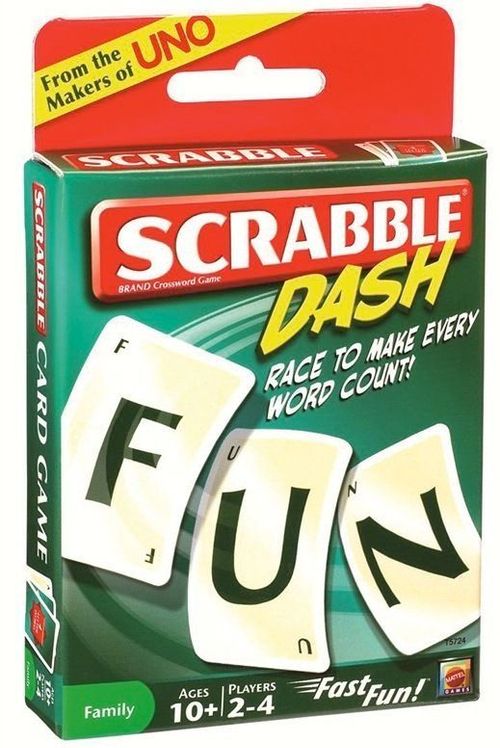
Scrabble DASH
Scrabble DASH Rulebook
Table of Contents
Table of Contents
Objective
Be the first player to collect 5 Dash cards.
Components
86 letter cards, divided into vowels and consonants; 19 Dash cards; and 1 rulebook.
- Blue cards are the vowels.
- Green cards are the consonants.
- Red cards are the Dash cards.
Setup
Separate the cards into three decks by colour. The blue cards are the vowels, the green cards are the consonants, and the red cards are the Dash cards.
Shuffle each deck separately. Deal each player three vowels and four consonants. Place the remaining cards in the centre of the table, each deck separated and face down.
Getting Started
Each player draws seven cards, taking care that the other players cannot see them. These are the player's hand. It is recommended to look at them carefully and arrange them while picturing possible words.
The first player turns over the top card of the Dash deck. They should turn it facing away from themselves, so they do not see the card before the other players do (this would give them a small advantage). Then all players try to be the first to form a word that matches what the Dash card says, using the letters in their hand.
For example, if the Dash card says "4-letter word", all players compete to form 4-letter words. Amalia has the letters A, T, L, M, N, O and E in her hand and quickly forms the word MANO. Amalia wins the Dash card.
Playing the Game
The first player to form a word on the table wins the Dash card.
Important: To make a play, it is enough to place the cards in the play area (the table or another surface). The cards do not have to be in the correct order. In the example above, if the player lays the cards down in the order ANOM, she still wins. The winner of the Dash card is the first person to play the word on the table, not the first person to say the word and then play it.
The player who wins discards the cards they used to form the word, placing them at the bottom of the deck they belong to. They must then draw new cards to bring their hand back up to 7, choosing whether to draw from the vowel deck, the consonant deck, or both.
The next player turns over another Dash card, and the players again compete to be the first to form a word according to what that card says.
Attention: If nobody can form a word that matches the Dash card, that card is returned to the bottom of the deck and a new card is turned over.
If there is a tie because several players play words at the same time, nobody wins the Dash card. It is returned to the bottom of its deck, and the players who tied take back the cards they played. Another Dash card is turned over and the game continues.
Exchanging Cards
If a player cannot form a word with the letters in their hand, they may exchange any number of cards for new cards from the deck of their choice. When they do this, they lose their turn while their opponents play to win the Dash card.
In a two-player game, if the opponent manages to form a word that matches the instructions, they automatically win the Dash card.
Discarded cards are shuffled back into their respective decks after the player has drawn new cards.
Winner
The first player to collect 5 Dash cards wins the game.
Dash Cards
Word length: The challenge is to form a valid word with the exact number of letters indicated. The "Qu" and "CH" cards count as one letter.
Word type: The challenge is to form a valid word that is either a verb or a proper noun, as indicated. A verb is a word that describes an action. A proper noun is a word that is applied to animate or inanimate beings to name them, and it begins with a capital letter, for example: Argentina or Carmen.
If you form a word that could be a proper noun but it is not clear, you may play it as long as you say which name it is. For example, you may play "LEÓN" and say it is "León Trotsky" to show that it is a name.
Card text on the Proper Noun card (Nombre propio): "A proper noun is a word that designates animate or inanimate beings and begins with a capital letter, for example: Argentina or Carmen." The other word-type card is Verb (Verbo).
Specific letter:
- When a Dash card that says "Ends with ___" is turned over, the player who turned it over then turns over a card from the vowel deck. Players use that card as their letter card; they do not need to have that card in their hand.
- When a Dash card that says "Has a ___" or "Starts with ___" is turned over, the player who turned it over then turns over another card from the top of either the vowel deck or the consonant deck, as they choose. Players also use that card as their letter card, meaning they do not need to have it in their hand.
For example, Marcos turns over the Dash card "Has a ___". He then chooses to turn over a consonant from the top of the deck, and a D comes up. Amalia has the letters B, A, T, R, M, E and F in her hand and quickly places the letters E, B and A on the table to form DEBA. The card with the letter D is discarded together with the other cards played.
Card text on the three specific-letter cards: "Tiene una ___" (Has a ___) and "Empieza con ___" (Starts with ___) say: Turn over a letter card. The word must have at least 3 letters. "Termina con ___" (Ends with ___) says: Turn over a vowel card. The word must have at least 3 letters.
Note: It is recommended to download the Lexicon app by Scrabble® on a mobile device to validate plays.
Adjustments for the Spanish-Language Edition
To make the game faster:
- The letters W, X and Z were removed, as they are considered difficult to play in Spanish.
- LL is played with two L cards. CH, however, has its own card.
- The Q card has the U added (Qu) to make this consonant easier to place, so the player does not have to wait for a U in order to play it. When the Qu card is played, the next vowel of the word must be played after it, for example: Qu + E + S + O.
- When a "Ends with ___" card is played, a vowel must be taken, because depending on the consonant drawn it would be very difficult or even impossible to form a word (for example, words ending in T, B or F, etc.).