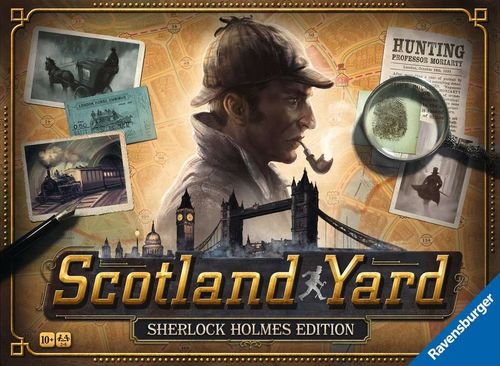
Scotland Yard: Sherlock Holmes Edition
Scotland Yard: Sherlock Holmes Edition Rulebook
Table of Contents
Table of Contents
Contents
- 1 Game Board (The board shows Victorian London around 1895, and is based on historical records, slightly modified for better gameplay.)
- 29 Start cards
- 16 tan cards ("D" for the Detectives)
- 13 gold cards ("M" and a balloon symbol, for Moriarty)
- 134 Tickets
- 58 Carriage Tickets ("Handsome Carriages," orange)
- 44 Tram Tickets ("London Horse Omnibus," turquoise)
- 23 Underground Tickets ("Metropolitan Railway," pink)
- 6 Black Tickets
- 3 Double-Move Tickets
- 6 Movers
- 6 Player Boards (double-sided)
- 1 Travel Log (with pen and paper)
- 1 Visor
- 3 Bobby Rings
For the Sherlock Holmes version:
- A. 10 Character Chips (2 per Detective)
- B. 15 Crime Scene Cards
- C. 1 Travel Log Strip
Setup
Before the First Game
Carefully remove all pieces from the punchboards. Discard the empty punchboards.
Before Every Game
-
Place the game board on the table within easy reach of all players.
-
Decide who will play Moriarty.
Tip: You need nerves of steel to be Moriarty! If possible, give this role to an experienced player.
Moriarty takes the visor and puts it on. It helps him hide his expression from the Detectives. Moriarty takes the golden mover, the travel log (with paper), and the pen and places them in front of him. He then takes his player board.
Scotland Yard variant:
- A. Moriarty places his player board in front of him so that the Scotland Yard icon is visible.
- B. He takes 5 black tickets and 2 double-move tickets and places them on his player board.
Sherlock Holmes variant:
- A. Moriarty places his player board in front of him so that the Sherlock Holmes icon is visible.
- B. He takes 1 black ticket and 1 double-move ticket and places them on his player board. The remaining double-move tickets and black tickets are placed next to the game board.
- C. Moriarty takes the 15 crime scene cards. He shuffles them face down and draws 3. He looks at these cards without letting the other players see them, and then places them face down in front of him. The remaining crime scene cards are removed from the game (do not look at them).
- D. Finally, he covers the right-hand column of the travel log (trains 17 to 24) with the travel log strip.
-
Each Detective selects a character and receives the corresponding player board and mover. Note: In a 2-player game, the Detective selects and plays 2 characters.
Tip: While Detectives may select any character, we recommend always including Sherlock Holmes and Dr. Watson whenever possible.
How to Play
The game consists of multiple rounds. Each round, Moriarty makes his move first. Then the Detectives and Bobbies play in any order.
General Movement Rules
The game board shows the transportation network of London. Each place on the map is a station for 1 to 3 means of transportation (Carriage, Tram, and Underground). The colors of the station indicate which means of transportation start and stop there.
Using a Specific Means of Transportation
- The player must begin their turn at a station marked for that means of transportation.
- The player plays the corresponding ticket.
- The player moves their mover along the corresponding colored line to the next station with the same color. All movers can only be moved to unoccupied stations.
The Carriage drives along the orange lines, the Tram follows the turquoise lines, and the Underground runs along the pink lines.
Note: The Park, Landmark, and River station symbols are only used in the Sherlock Holmes version.
Example: Green is at station 165. From there they could:
- take the Carriage to stations 149, 151, 179, or 180.
- reach stations 123 or 180 by Tram.
- note: they cannot use the Underground. It runs through station 165, but doesn't stop there (station 165 has no pink).
Moving Moriarty
Moriarty conceals his moves. He can choose between normal and special moves (described below). In the Sherlock Holmes variant, Moriarty has additional special abilities. These are explained under Professor Moriarty below.
Normal Turn:
- Moriarty secretly selects a new station, which must be directly connected to his current location by a line.
- He writes down the number of the new station on the next free space in his travel log.
- He covers his entry with the ticket that he's just used (Moriarty takes the ticket from the general supply). The Detectives are able to see which means of transportation Moriarty has used, but they can't see his destination.
Special Tickets:
-
A. Black Tickets — Instead of a normal ticket, Moriarty can use a black ticket. The black ticket offers two advantages:
- Moriarty can use any means of transportation. He simply covers his entry in the travel log with the black ticket. That way, the detectives don't know which means of transportation he used.
- Moriarty can also use the ferry on the Thames with a black ticket. The ferry lines are dark blue. They connect stations 108, 115, 157, and 194 across the river. The ferry runs from the starting point along the dark blue line to the next station.
Black tickets are always documented in the travel log.
-
B. Double-Move Tickets — If Moriarty plays a double-move ticket, he takes 2 turns in a row. He writes 1 station in his travel log and covers it with 1 ticket (first turn). He then does the same thing again (second turn). He can use the same means of transportation twice or two different ones. He can also use black tickets. Moriarty may only play 1 double-move ticket per turn. Used double-move tickets are placed in the box.
Special Events:
-
A. Moriarty shows up! — Every now and then Moriarty must show himself. Whenever he writes his entry next to a circled number on the travel log (e.g. after the 3rd, 8th, and 13th turn), Moriarty must place his mover on that current location on the board. On his next move, Moriarty removes his mover from the board.
Note: if using a double-move ticket, Moriarty can appear after the first turn, only to disappear on the second!
-
B. Moriarty is committing a crime! — After moving, if Moriarty is at a station shown on 1 of his crime scene cards, then he can commit a crime at that location. To do so, he announces that he is committing a crime and then places the crime scene card face down on the marked edge of his player board. If Moriarty manages to play all 3 crime scene cards, he wins the game immediately.
The Detectives know that a crime was committed, but don't know the location of the crime. However, each crime scene is either at a river, a park, or a landmark.
Moving Detectives and Bobbies
Once Moriarty has completed his turn, the Detectives and Bobbies take their turns in any order. Since the Detectives all share the same goal, they should work together to coordinate their moves and the moves of the Bobbies.
Detectives: Each Detective chooses which means of transportation they will use and discards their used ticket on the general draw pile. Then they move along the appropriate line to the next station.
Bobbies: The same movement rules apply to Bobbies. However, unlike the Detectives, they do not have to use tickets to move.
Notes:
- Detectives can only use the means of transportation for which they still have tickets. They cannot trade their tickets with other players.
- As long as a Detective still has tickets and can move, they must do so. If they cannot move or are out of tickets, they sit out.
- In the Sherlock Holmes variant, the Detectives have additional abilities (see Character Abilities below).
Ending the Game
Moriarty wins if:
- Scotland Yard variant: he evades the Detectives until the end of the 22nd round. Don't forget: the round is only over when the Detectives have also made their move.
- Sherlock Holmes variant: he manages to not be caught until the end of the 16th round. Moriarty also wins if he plays all 3 crime scene cards. In both cases the game ends immediately.
- Moriarty also wins if no Detectives are able to move due to a lack of tickets (i.e., all Detectives have used up their tickets, or do not have the correct type of ticket left to allow them to leave their station).
The Detectives win if at any time a Detective or Bobby is on the same station as Moriarty. In this case, Moriarty must reveal himself and has lost the game.
Remember!
- Both the Detectives and Moriarty must move if possible.
- Moriarty may never be at the same station as a Detective or Bobby. This also applies during the use of a double-move ticket. If at any time during his turn Moriarty is at the same station as a Detective or Bobby, he loses immediately.
- Only Moriarty can use black tickets. Therefore, only Moriarty can use the ferry.
Character Abilities
Tip: Keep this overview ready next to the game board for reference during the game.
These abilities apply only to the Sherlock Holmes variant.
Detectives
Every Detective has a unique special ability. In order to use them, they must still have at least one character chip. The Detectives should coordinate when to use which ability: each time it is the Detectives' turn, only one of them may use a character chip. The Detectives can activate the ability at any time during their turn together. Used character chips are returned to the box.
Sherlock Holmes: Manhunt
The game board is divided into 4 districts. When Sherlock uses his Manhunt ability, Moriarty must reveal his current district to the Detectives. The districts are marked on the edge of the game board with the roman numerals I, II, III, and IV. The brown line that runs through the game board marks the individual districts.
Example: Sherlock asks Moriarty: "What district are you in?" Moriarty is on station 132, so he answers "In district III."
Irene Adler: Transportation Ban
Irene may forbid Moriarty to use either the Tram or the Underground in the next turn.
Tip: As a reminder, Irene gives Moriarty their character chip, which Moriarty places on the appropriate general supply stack (Tram or Underground). After his next turn, Moriarty places the character chip back in the box.
Dr. Watson: Interrogation
There are three types of areas on the map: parks (green), landmarks (red), and rivers (blue). To use Interrogation, Watson chooses 1 of the 3 area types. He then asks Moriarty if he (Moriarty) is currently on a station with that symbol. Moriarty must truthfully answer yes or no.
Example: Watson asks Moriarty, "Are you on the Thames?" Moriarty is at station 127, which has a river symbol. Accordingly, he answers the question with "Yes." The Detectives now know that Moriarty is at a station with a river symbol.
Mycroft Holmes: Searching for Clues
Mycroft may ask Moriarty to reveal his location from two turns past. Moriarty then must tell Mycroft the number of the station in question.
Example: Mycroft asks Moriarty on turn 7 where he was 2 turns ago. Moriarty then must tell Mycroft the location that he wrote down on the travel log on turn number 5.
Inspector Lestrade: Roadblock
The Inspector can set up a roadblock at the beginning or end station of his current turn. To do this, they place their character chip on the station. Moriarty can no longer move to this station. However, he can still use connections that lead through this station (i.e., have no stops there). Detectives ignore the roadblock. The roadblock remains on the station until the end of the game.
Professor Moriarty
Moriarty does not need to discard character chips to use his abilities. Instead, he must be at one of his secret hideouts. These are identified by a black hat next to the station. Moriarty can (but does not have to) use exactly 1 of these 3 abilities when at a secret hideout:
A. Take a Ticket: Is Moriarty on a secret hideout after his turn? He may choose either a black ticket or a double-move ticket from the supply (if there is one left). He can only use this ticket after the Detectives have had their next turn.
B. Deep Dive: Would Moriarty normally have to reveal his location after his turn (3rd, 8th, and 13th turns)? He can use his secret hideout to make a deep dive instead. This means that he does not place his mover on the game board after completing his turn. The Detectives are only told that Moriarty is currently in a secret hideout.
C. Escape: Is Moriarty on a secret hideout at the beginning of his turn? He can try to escape the Detectives with a hot air balloon! To do this, he announces that he will attempt an escape and draws one of the face-down "M" start cards. Then he turns it over for all players to see: his spectacular escape obviously doesn't go unnoticed! Moriarty chooses one of the two stations shown on the start card and identifies the station as his landing space. Then he writes down the number in the travel log and covers it with the back of the start card.
Important: Moriarty may only use this ability once in the entire game (in contrast to abilities A and B).
Note: The escape can also be combined with a double-move ticket. Example: Moriarty uses a double-move ticket. On the first turn, he moves to a secret hideout. On the second turn, he uses his Escape ability (C) and flees with the hot air balloon. Note: After the first turn, he could also have chosen to Take a Ticket (A) or Deep Dive (B) instead.