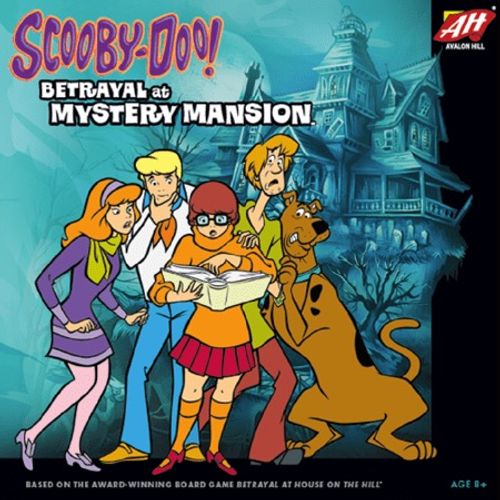
Scooby-Doo!: Betrayal at Mystery Mansion
Scooby-Doo!: Betrayal at Mystery Mansion Rulebook
Table of Contents
Table of Contents
Game Components
- 1 Rulebook
- 2 Haunt books (Monster's Tome, Secrets of Survival)
- 28 Tiles
- 5 Cardboard standees (Scooby-Doo, Shaggy, Velma, Daphne, Fred)
- 5 Plastic Bases
- 5 Character cards (Scooby-Doo, Shaggy, Velma, Daphne, Fred)
- 25 Plastic clips
- 8 Dice
- 14 Item cards
- 25 Event cards
- 10 Clue cards
- 5 Mystery cards
- 1 Timer Track
- 100 Tokens (some double-sided), including:
- 1 Alien
- 7 Angry Mob/Sheep
- 1 Automaton
- 3 Cat Creature
- 1 Devil Hound
- 5 Escape
- 8 Evidence/Bug Spray
- 1 Fog
- 1 Ghost
- 2 Giant Turkey
- 5 Junk/Magic Dust
- 4 Key
- 1 Man
- 4 Mechanical Shark
- 4 Phantom Sword
- 4 Pizza/Spotlight
Game Overview
In each game of Betrayal at Mystery Mansion™, you play members of the Mystery Inc. Gang, solving spooky mysteries. You explore the old mansion and surrounding area, finding clues, seeing strange sights, and maybe even catching a glimpse of a monster! Eventually the monster will reveal their real plan and begin something called the Haunt. The chase is on!
At the start of the game, the gang will split up to look for clues. These will help you learn what is going on. The goal in this part of the game is to find new tiles, new Item cards, and new Clue cards. You can even find some Scooby Snacks!
At some point, you will find enough clues to learn what is going on and that's when the Haunt starts. There are 25 different Haunts in the game, each one based on a Scooby-Doo episode or movie.
When the Haunt starts, one player will switch sides and play the role of the Monster. Their job is to carry out their sinister plan before the rest of the Gang can stop them. Every game is different, with different Monsters, Items, and Events. Even the board is different!
This Game Is Different from Other Betrayal Games!
If you have played the original Betrayal at House on the Hill®, many things in this game will be familiar. However, there are lots of new or different things in this game. Many rules have been streamlined to allow play for newer or younger players. Here are some of the larger changes between Betrayal at House on the Hill and Betrayal at Mystery Mansion, but please read all the rules before you play your first game, as this list is not comprehensive. If this is your first Betrayal game, skip reading this list and jump straight into the rules.
- There is no Haunt matrix - Haunts in Betrayal at Mystery Mansion are partly determined by using a Mystery Card that you choose at the beginning of the game! See the Setup section for more details.
- Haunt setup happens together - Setup for each Haunt is in Secrets of Survival. In addition, players may volunteer to be the Monster instead of being chosen by the Haunt.
- Haunts may be learned together - In other Betrayal games, the two sides learn their Haunts in secret. This can be tough for newer or younger players so Betrayal at Mystery Mansion may be learned together if the group wants.
- Damage is general - Damage is not divided into physical and mental damage. Instead, damage may be divided among all traits. Also, players may heal damage using Item cards and Haunt actions. If you heal a trait, that trait is set to its starting value.
- Players are not eliminated from the game - When a Hero takes enough damage to put them below their lowest value in a trait, they are stunned like Monsters instead of being eliminated. That Hero loses their next turn, and heals all traits. Heroes can be stunned even before the Haunt begins!
- Omens are called Clues - The Mystery Inc. Gang has no idea what Omens are, but they are hungry for Clues.
- Monsters move differently - Monsters and Henchmen move like Heroes. Instead of rolling for their Speed, they move a number of tiles equal to their Speed on a turn.
- Obstacles do not exist - Monsters and Heroes do not slow each other down. Players cannot stop each other's movement.
- Players can only GIVE and TAKE unless the Haunt says otherwise - Players cannot Fight, Search, Drop, etc., unless the Haunt book tells them they can. The only actions that players get by default are GIVE and TAKE.
Setup
- Each player chooses to play one of the five Mystery Inc. Gang characters and takes that character card and standee.
- Each player attaches four plastic clips to that character card. Each clip should point to one of the starting values for each trait (the starting values are colored green).
- Each player takes 1 Scooby Snack and puts it on their character card. Put the remaining Scooby Snacks off to the side to start the token pile.
- Find the 2 starting tiles (the Mystery Machine and the Entrance Hall) and place them reasonably far apart, with their bumps facing towards each other. The Mystery Machine is the start of the outside region and the Entrance is the start of the inside region.
- Place each player's standee on the Mystery Machine tile.
- Shuffle the Event cards and place them to the side to make the Event deck. Do the same for the Item and Clue cards to make the Item and Clue decks. Put the decks near the token pile, face down.
- Shuffle the Inside tiles to make the Inside stack, then do the same thing with the Outside tiles. Put these stacks near the token pile and card decks.
- Choose one of the five Mystery cards, read it aloud, and set it to the side, face up, near the card decks and tile stacks.
- Put the dice where everyone can reach them.
- For now, leave the rest of the tokens, books, and cards in the box. You will be told when to take them out.
- The youngest player takes the first turn.
After setup, the table should have: the tile stacks, the Timer Track, the Entrance starting tile, and the Mystery Machine starting tile placed apart from each other; the three card stacks (Clue, Item, Event) and the token pile near them; the dice within reach; the Mystery card set face up to the side; and each player's character card with clips in front of them.
The Token Pile
This is a pile of tokens that need to be available during the game but aren't currently being used or carried by anyone. The token pile always starts with Scooby Snacks. When a Haunt starts, you may be told to add other tokens to the token pile. This token pile can be anywhere on the table that's convenient.
Mystery Cards
These cards help set the scene and determine which Haunt you will play. There are five cards, at these difficulty levels:
- Automaton - Easiest to learn and play
- Alien/Witch - Medium difficulty
- Ghost/Werebeast - Most involved (but still easier than other Betrayal games)
When the Haunt begins, look at the back of the Mystery card you are using and find the Clue you just drew. Open Secrets of Survival to the Haunt matching that number.
Characters and Traits
There are five characters that players can play in the game: Scooby-Doo, Shaggy Rogers, Velma Dinkley, Fred Jones, and Daphne Blake. Each character can carry any number of Item cards and Clue cards and up to three Scooby Snacks. Each character has a special power.
Each character has four traits: Might, Speed, Brains, and Courage. These numbers range from 2 to 8. Sometimes they skip a number. That's OK!
Start with a clip at the green number for each of the traits on your character card. That number is the current value of your trait. It tells you how many dice to roll when you need to do something in the game, like opening a safe or fighting a monster.
The trait values aren't secret and can change during the game. For example, if anyone wants to see what your Might score is, they can look at your card.
Gaining, Losing, and Healing Traits
You may be told to raise or lower traits (such as "Lose 1 Speed" or "Gain 1 Might"). In that case, slide the clip for that trait up or down that number of spaces.
- If a trait is at its highest value, you cannot raise it.
- If a trait is at its lowest value, and you need to lower it, you are Stunned.
When you take damage, you get to choose which trait to lower. Slide that clip down one number.
- If you take more than 1 damage, you can split that damage among your traits however you want.
- If all your traits are at their lowest values and you need to take more damage, you are Stunned.
- You cannot choose to become stunned if you could take damage in another trait.
Example: Scooby gains 2 Might.
If you are instructed to heal a trait, return that trait to its starting value if it was lower. (If it was at or higher than its starting value, leave it where it is).
Getting Stunned and Recovering
If you get stunned, tip your standee over. If it's your turn, your turn is over.
Stunned characters can't take more damage while they are stunned.
If you start your turn stunned, you spend your turn recovering. Skip your turn, stand your standee back up, and heal all of your traits.
On Your Turn
On your turn, you can move your character up to a number of tiles equal to your Speed. You may have Item cards or powers that let you move more than your Speed. If your Speed changes after your turn starts, that doesn't change how many tiles you can move this turn (but it will affect later turns).
Example: Fred's starting Speed is 3, so he can move up to 3 tiles per turn. If his Speed becomes 2 during his turn, he can still move 3 tiles during that turn.
Regions and Moving
There are two regions in the game: inside and outside. Both of these regions will grow as players discover new tiles.
To move your character, pick it up and place it on an adjacent tile.
Tiles are adjacent to each other if:
- They share an open doorway; or
- Both tiles have a secret passage symbol (or token).
The two starting tiles, Entrance and Mystery Machine, are adjacent to each other and are the main way to travel between the inside and outside regions.
If one tile has a doorway and the other has a closed wall, that door is blocked; the tiles are NOT adjacent.
When you discover a new tile (below), your turn will end after that. You cannot keep moving.
Some Item cards and Haunts may also cause you to move. Sometimes they will give you a number of tiles you must move. If they say you may move up to a number of tiles, you can choose less if you like (the person doing the moving gets to decide, no matter who is being moved).
Example: Fred uses the Banana Item card on Velma, which allows him to move her up to 2 tiles. This means that Fred can move Velma 0, 1, or 2 tiles.
Discovering a Tile
During your turn, you can discover a new tile and add it to the board if:
- You can still move;
- You are not stunned;
- There is an open doorway on your tile where you can place the new tile; and
- There are still tiles in the tile stack for your region (inside or outside).
To discover a tile, reveal the top tile of the stack matching your region and do the following:
- Connect it to your current tile by aligning a doorway on the new tile with an open doorway on your tile.
- It's OK if you don't match up the other doorways and some lead into walls.
- Two tiles (the Entrance Hall and the Mystery Mobile) have bumps on one side, and tiles cannot be placed there. The bumps are not open doorways.
- Place your standee on the new tile.
- Read and follow any text on the tile.
- Each discovered tile will have a symbol: Clue, Item, or Event. Draw a card from the deck with a matching symbol and read it out loud (and follow any instructions).
- Your turn is now over. You can't take any more actions or move.
Doing Other Things—Actions!
During your turn, you can do things other than move. These are called Actions. Your character card lists two actions you can take during your turn: GIVE and TAKE. You will get other actions from Items, Clues, and even the Haunt, once it starts. Each action can usually only be done once per turn, unless a Haunt says otherwise.
You can take actions before you move, or at any time while you are still moving.
Example: Scooby-Doo has an Item that Velma wants. Scooby moves 2 tiles. Then Scooby-Doo GIVES Velma the Item, and then uses the rest of his movements to reach Fred. He may then TAKE an Item from Fred.
If you discover a new tile, your turn ends and you may no longer take any actions.
Dice and Trait Rolls
Dice
Each die has faces that are blank or have 1 or 2 dots. After you roll, add the number of dots showing to get your result, then do what the effect says for that result.
- You can never roll more than 8 dice or fewer than 1 die.
- Sometimes a card or effect will add to or subtract from the result of your roll.
Scooby Snacks
Anytime you roll dice, you can immediately spend Scooby Snacks to try and improve your roll. Return one of your Scooby Snack tokens to the token pile and re-roll one of the dice you just rolled. You can return more than one Scooby Snack on the same roll. Finish each re-roll before deciding if you want to use another Scooby Snack.
Trait Rolls
When you are asked to make a trait roll, look at the current value of that trait and roll that many dice.
Example: if you make a Courage roll and you have 4 Courage, roll 4 dice and add up the dots. Then look at the card, Haunt book, etc. that asked you to make the roll to figure out what happens next.
Contested Rolls
Sometimes you will take an action where you and another player will both make a trait roll. What happens next depends on who rolls higher.
In this case, the player whose turn it is rolls first and keeps track of their result. If they want to do anything to change their roll, like spend a Scooby Snack, they need to do that now. Then, the other player rolls and can also adjust their result.
After both players have settled on their results, compare them and consult the table under the action to figure out what happens next.
Example: Haunt 1 has this action:
FIGHT THE ZOMBIE Once per turn, while on the same tile as the Zombie, you may fight it. You both make a Might roll.
- If you roll higher: Stun the Zombie.
- Otherwise: Take damage equal to the difference in your rolls.
Example: Fred, a Hero, has a Might of 4. Fred's player rolls 4 dice and gets a result of 2. This doesn't seem high enough, so Fred spends a Scooby Snack to reroll a die, turning the result from 2 to 4. Better! After Fred is done with his rerolls, the Zombie rolls its Might.
Other Types of Dice Rolls
Some effects require you to roll a certain number of dice. Roll that many dice and add up the dots. These are not trait rolls and are not affected by anything that affects trait rolls, but you can still spend Scooby Snacks to reroll.
Cards
Event Cards
These represent various spooky things that will happen during the game. When you draw an Event card, read the text in italics out loud. If you need to roll dice, roll them and then only read the entry matching your result. Some Event cards will move you or place a token on your tile. After you do what the card says, bury it.
Item Cards
These are handy things you will find while exploring. When you draw an Item card, read it out loud, then put it face up near your character card to show you are carrying it.
- Keep your Item cards face up so everyone can read them.
- You can carry any number of Item cards.
- Some Item cards let you do something while your character is carrying them. Other Item cards provide a one-time benefit and then are buried.
Clue Cards
These are Clues that will lead to the Monster and the mystery! When you draw a Clue card, read it out loud, then put it face up near your character to show that you are carrying it.
Haunt Rolls
Whenever you draw a Clue card, if the Haunt hasn't started yet, roll a number of dice equal to the total number of Clues carried by all players. On a 5 or higher, the Haunt begins!
If you ever draw the ninth Clue card and the Haunt still hasn't started, skip the roll and start the Haunt with that Clue.
Burying a Card
If an effect makes you get rid of a card, put it on the bottom of the matching deck, face down. This is called burying the card.
The Haunt
When a player rolls 5 or higher after drawing a Clue (or draws the 9th Clue) the Haunt begins! Look on the back of the Mystery card and find the Clue you just drew. The number to the right tells you what Haunt you will be playing! The player who started the Haunt turns to that Haunt number in Secrets of Survival and reads the introduction out loud.
Example: Haunt 17 — the worked example below shows how a Haunt page is laid out.
On the Board
Some Haunts will ask if tokens, tiles, Clues, or Items are 'On the Board'. Tokens are 'On the Board' if they are on a tile. Items and Clues are 'On the Board' if they have been drawn from their deck.
Learning the Haunt
The heroes will use Secrets of Survival to learn the Haunt. The Monster will use Monster's Tome. Each book has new rules to follow, including new actions that each side can take. Your side must win before the other side does! Each team will have its own plan to win. In other Betrayal games, the two sides learn their Haunts in secret. This can be tough for newer or younger players so Betrayal at Mystery Mansion Haunts may be learned together. After players read Shaggy's introduction out loud and finish setup, they decide as a group, which way they want to learn the Haunt.
Introduction (Shaggy): Shaggy will help explain the mystery and walk players through whatever additional setup needs to be done, including choosing who will play the Monster! Any player may offer to be the Monster. If more than one player wants to be the Monster, the player who started the Haunt chooses. This person may choose themselves. If no other players want to be the Monster, the person who started the Haunt must be the Monster.
Sometimes there is a choice to be made during setup for how or where a token is placed. If players can't agree on a decision, the person who started the Haunt has final say.
Learning the Haunt Together
When you learn the Haunt together, both the Heroes and the Monster read almost everything in their Haunt books out loud so that the other side can hear what's happening (the Monster still has two sections to keep PRIVATE: "What's Really Going On" and the "End Game" text). The players as a group should agree on the rules to the Haunt. There will be no surprises during play but this will minimize confusion and make it easier on the Monster.
Learning the Haunt Separately
If you decide to learn the Haunt separately, the sides split up to learn their Haunt in private. The Monster should take Monster's Tome and leave the room, going far enough away so neither side can hear the other. The Monster learns their half of the Haunt alone while the Heroes learn their half together.
In this case, most information in the other Haunt book is secret at the start of the Haunt. But, when you take an action in your Haunt, the other side can ask you to read that part of your book. For example, if you set a trap, the other side may ask you how you just set that trap. They will still not know what the trap does but will know how you set it.
If the Monster makes a trait roll, the heroes may ask about its traits so they know how tough it is.
When Everyone Has Finished Learning the Haunt
When both sides are ready, players return to the room (if the groups are learning the Haunt privately) and take their turns, starting with the player to the left of the Monster.
Worked Example — Haunt 17: What a Night for a Knight
This is a sample of what a Haunt page looks like, drawn from Haunt 17 in Secrets of Survival and Monster's Tome.
Secrets of Survival page (the Heroes' side):
READ THIS BOX OUT LOUD AND FOLLOW THE SETUP INSTRUCTIONS. There is a book, lying next to a pile of junk, that says the Black Knight comes to life during the full moon. Wouldn't you know it? The moon is full tonight and the junk is transforming into a walking suit of armor! Just as we're running away from the suit of armor, one of the Mystery Inc. Gang gets lost and disappears! Zoinks!
SETUP
- Choose a player to be the Monster. Their Hero has wandered off and gotten lost. They are now the Black Knight! Bury all Item and Clue cards they were carrying and return their Scooby Snacks to the token pile. Remove their Character card from the game. Replace their standee with the Automaton token.
- Place {3/4/5} Junk tokens on top of the Black Knight.
- Though Monsters often get Escape tokens, the Black Knight does not get any Escape tokens for this Haunt.
- Put 3 Treasure tokens on tiles with either a Clue or Monster symbol.
- If the Woods tile hasn't been discovered, find it in the Outside tile stack and place it as far away from the Black Knight as possible. Then shuffle the Outside tile stack.
- Give the Monster's Tome to the person playing the Black Knight and have them turn to Haunt 17. Decide as a group if you want to learn the Haunt together or separately.
- After everyone has learned the Haunt, the player sitting to the left of the Black Knight takes the next turn!
TOKENS NEEDED
- Automaton — The Black Knight
- Junk — Armor the Black Knight is wearing
- Treasure — Artifacts that the Black Knight wants
WHAT'S THE PLAN? (Velma): Velma will explain your general plan and what you have to do. During the Haunt, Heroes should check with Velma to make sure they are staying focused on what they need to do.
Get all the junk armor off the Black Knight and then stun it!
HERE ARE SOME FACTS! (Fred): Fred will let you know any additional rules that are in place for this Haunt. Not all Haunts have new Facts.
You cannot pick up Treasure tokens that are on a tile. Only the Black Knight can do that.
HOW TO PLAY THIS HAUNT: You may move and take any (or all) of the new actions below. You can take these actions before you move, or at any time while you are still moving.
GET THE ARMOR OFF THE KNIGHT Once per turn, while you are on the same tile as the Black Knight, you may make a Speed roll.
- 1+ Take 1 Junk token from the Black Knight and remove the Junk token from the game.
- 0 Take 1 damage. It's sharp!
STUN THE KNIGHT Once per turn, while on the same tile as the Black Knight, you may try to stun it. You both make a Might roll.
- If you roll higher: If the Black Knight doesn't have any Junk tokens, it is stunned!
- Otherwise: You take damage equal to the difference in the rolls.
STEAL FROM THE KNIGHT Once per turn, while on the same tile as the Black Knight, you may try to steal from it. You both make a Might roll.
- If you roll higher: Take 1 Treasure token from the Black Knight.
- Otherwise: You take damage equal to the difference in the rolls.
- TIP: You may do this while the Knight still has Junk tokens as a way to slow down its plan!
AT THE END OF YOUR TURN: If the Black Knight is stunned, You Win!
TOKENS NEEDED (Scooby-Doo): Scooby will show you all the special tokens that will be used in the Haunt, and explain what they represent.
HOW TO PLAY (Daphne): Daphne will tell you what new things you can do on your turn to try to complete your plan. You will get one or more new actions that help you complete your goal. You may move and take any (or all) of the new actions on your turn. You can take these actions before you move, or at any time while you are still moving.
REACTIONS: These are reactions that happen automatically whether the players want them to or not. A reaction might be "AT THE END OF EVERY HERO TURN" or "IF THE MONSTER ENTERS A TILE WITH A TRAP TOKEN." These reactions may happen multiple times in a turn. There is always at least one reaction box at the very end of the haunt that tells you when you win.
VARIABLE PLAYER COUNT {3 players/4 players/5 players}: Most Haunts use different numbers depending on how many people are playing (For example, you may need to gather more treasure in the five-player game than in the three-player game). Whenever you see three numbers, such as {1/5/7}, this tells you the number changes according to how many players there are (including the Monster). The first number is for a three-player game, the middle number is for a four-player game, and the last number is for a five-player game.
Monster's Tome page (the Monster's side, kept secret even if you are learning the Haunt together):
WHAT'S REALLY GOING ON (always read this box secretly, even if you are learning the Haunt together)
I am the museum curator, and I'm trying to smuggle antiques out of the museum under the guise of the Black Knight. I'm wearing antique knight armor recently delivered to the museum. I need to hide the antiques without getting caught by those meddling kids!
WHAT'S THE PLAN?
Find all the Treasure and hide it in the Woods before those meddling kids can stun you!
HERE ARE SOME FACTS!
You cannot discover new tiles.
TOKENS NEEDED
- Automaton — The Black Knight
- Junk — Armor you are wearing
- Treasure — Artifacts you are looking for.
DO NOT READ THESE UNTIL THE END OF THE GAME (even to yourself):
- If you win, read this out loud: I made it out of that museum with smuggled treasures that will be going onto the black market soon. I'll be able to quit my job as a museum curator and retire with my new riches! I get the feeling that people will be talking about the Black Knight for a long, long time.
- If the Heroes win, read this out loud: I've been stealing treasures from the museum to sell on the black market. As the museum curator, I had easy access to all the paintings, antiques, and old artifacts. It was the perfect plan. That is, until you meddling kids got in the way!
HOW TO PLAY THIS HAUNT: First take a turn as Old Iron Face. You can take its actions before it moves, or at any time while it is still moving. Then take a turn as each Mechanical Shark following the same rules.
MONSTER: OLD IRON FACE — Might 6, Speed 5, Courage 4, Brains 4
BUILD A NEW SHARK Once per turn, while on a Clue tile, you may make a Brains roll.
- 4+ Place a Mechanical Shark from the token pile onto your tile.
- 0–3 Nothing happens.
FIGHT A HERO Once per turn, while on the same tile as a Hero, you may fight that Hero. You both make a Might roll.
- If you roll higher: Deal damage to the Hero equal to the difference in your rolls.
- Otherwise: Use your Escape token. If you can't, you are stunned.
HENCHMEN: MECHANICAL SHARKS — Might 4, Speed 4, Courage 4, Brains 4
Stunned Heroes on the same tiles as Mechanical Sharks do not unstun at the beginning of their turn.
FIGHT A HERO Once per turn, while on the same tile as a Hero, you may fight that Hero. You both make a Might roll.
- If you roll higher: Deal damage to the Hero equal to the difference in your rolls.
- Otherwise: The Mechanical Shark is stunned.
AT THE END OF OLD IRON FACE'S TURN: If all the Heroes are stunned, You Win!
(Note: the Old Iron Face/Mechanical Sharks Monster's Tome text above is the rulebook's illustrative sample of a Monster page layout, shown alongside the Black Knight's Secrets of Survival page to demonstrate the format — the two examples are not from the same Haunt.)
If You're a Hero!
Here's how the Heroes learn a Haunt in Secrets of Survival. The Monster will learn the rules for the Haunt in Monster's Tome, which is explained a little later.
- What's the Plan? (Velma): Velma will explain your general plan and what you have to do. During the Haunt, Heroes should check with Velma to make sure they are staying focused on what they need to do.
- Here Are Some Facts! (Fred): Fred will let you know any additional rules that are in place for this Haunt. Not all Haunts have new Facts.
- Tokens Needed (Scooby-Doo): Scooby will show you all the special tokens that will be used in the Haunt, and explain what they represent.
- How to Play (Daphne): Daphne will tell you what new things you can do on your turn to try to complete your plan. You will get one or more new actions that help you complete your goal. You may move and take any (or all) of the new actions on your turn. You can take these actions before you move, or at any time while you are still moving.
Reactions
These are reactions that happen automatically whether the players want them to or not. A reaction might be "AT THE END OF EVERY HERO TURN" or "IF THE MONSTER ENTERS A TILE WITH A TRAP TOKEN." These reactions may happen multiple times in a turn. There is always at least one reaction box at the very end of the haunt that tells you when you win.
Variable Player Count {3 players/4 players/5 players}
Most Haunts use different numbers depending on how many people are playing (For example, you may need to gather more treasure in the five-player game than in the three-player game).
Whenever you see three numbers, such as {1/5/7}, this tells you the number changes according to how many players there are (including the Monster). The first number is for a three-player game, the middle number is for a four-player game, and the last number is for a five-player game.
If You're the Monster!
When you become the Monster, you play the part of the villain in the story. The Hero you were playing gets captured or lost and is out of the game. You may be acting alone or you may have henchmen to help you.
Monster's Tome has very similar information to Secrets of Survival. Since the Monster reads this information on their own, some players find it difficult to play the Monster. Keep this in mind when selecting who the Monster is.
- What's Really Going On: Always read this box secretly, even if you are learning the Haunt together. This box describes who you really are, what your plan is, and what is really going on. This helps you understand the rest of the Haunt. Then keep reading.
- What's the Plan?: Like the Hero side, this box tells you what you need to do to win the Haunt.
- Facts!: Facts aren't things you can do. Instead, they are small changes to the rules for that Haunt. For example, you might be told that you get a bonus on certain rolls.
- Tokens Needed: This box will show you all the special tokens that will be used in the Haunt and explain what they represent.
- The Monster: The Monster box contains your new traits as a Monster and any special rules that apply to you now that you are playing the Monster. There might also be actions you can take on your turn in order to complete your plan.
- End of the Game: At the end of the game, you will read one of these two entries depending on which team won the game. Don't read them until then, even to yourself.
The Henchmen
Sometimes the Monster will have Henchmen helping them. The Monster and each of the Henchmen get their own turn. Henchmen get a separate box in the Haunt saying what actions can be taken by that set of Henchmen. For example, there may be a fight box in the Henchman entry but not in the Monster entry. Each henchman takes its full turn before the next henchman gets a turn.
Moving
Monsters and Henchmen move the same way as Heroes do. Sometimes the Monster or Henchmen have tokens on them. Any tokens on the Monster or Henchmen move with them.
Traits, Getting Stunned, and Escaping!
As the Monster, you have the same four traits (Might, Speed, Brains, and Courage) but they stay the same, rather than going up and down like Heroes' traits.
If you are stunned, flip your token over to the 'Stunned' side. At the start of each Monster or Henchmen turn, if that token is stunned, flip the token back over and skip the rest of that token's turn. Other Monster or Henchmen tokens still take their turns.
At the start of the Haunt, you may get a number of Escape tokens that can help you avoid being stunned. Each Haunt will outline when these tokens are used, and what happens if you don't have any.
Winning the Game (Both Sides)
Each side has a reaction box that tells them when they win the game. The first side to complete its goal wins.
At the end of the game, the person playing the Monster reads one of the two entries at the bottom of Monster's Tome, depending on which side won the game. Did they get away with their dastardly scheme, or did those meddling kids get in the way again?