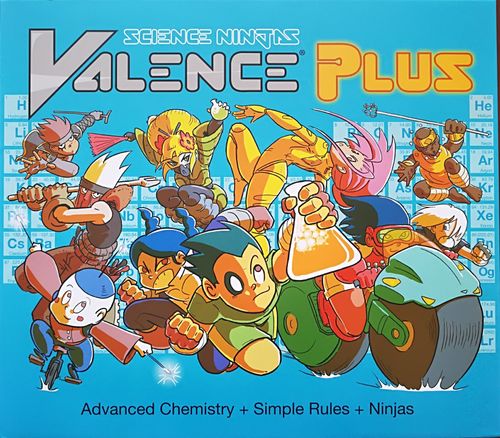
Science Ninjas: Valence Plus
Science Ninjas: Valence Plus Rulebook
Table of Contents
Table of Contents
Game Components
Element Cards
- 12 Oxygen
- 10 Hydrogen
- 8 Sulfur
- 8 Sodium
- 6 Fluorine
- 6 Chlorine
- 4 Carbon
- 4 Potassium
- 2 Copper
- 2 Zinc
- 1 Calcium
- 1 Helium*
- 1 Oganesson*
Molecule Cards
- 8 Salt
- 8 Water
- 8 Acid
- 6 Hydrogen Sulfide
- 6 Carbon Dioxide
- 6 Carbon Disulfie
- 5 Carbonyl Sulfide
- 7 Metal Oxide
- 7 Base
- 7 Metal Sulfide
- 7 Metal Hydrosulfide
- 4 Deadly Carbonyls
- 4 Thiophosgene
- 4 Sulfur Trioxide
- 4 Sulfuric Acid
- 3 Halocarbon
- 2 Metal Sulfate
- 2 Bisulfate
- 3 Transition Metal Compound
The component list prints "Carbon Disulfie"; the game board names the card Carbon Disulfide.
Element card parts: Valence Number, Color Element, Atomic Number, Science Ninja, Secondary Valence Number.
Molecule card parts: Molecule Type, Point Value, Colors, Reaction Icon, Molecule Text.
*Optional. Shogun recommends playing the game without these cards the first time you play!
Getting Started
- Arrange the Molecule Cards on the board to form the Molecule Bank. Add the Element Deck and remove the first card and place it face up next to the Element Deck to form the Discard Pile.
- Shuffle the Element Deck and deal each player 6 Element Cards.
- The player with the Element Card with the highest atomic number (that's the purple number in the bottom of the color box) goes first and the player to their left goes second (clockwise). Zinc is the highest card - whoever has it usually goes first! If there's a tie, use the next highest atomic number to determine who goes first.
Your Turn
Phase I: Collecting Cards
A player's turn begins with choosing one of the four following ways to collect Element cards:
- Draw - Draw one card from the Element Deck. If you have only one card, draw two. If you have no cards, draw three. If only drawing one card, you may draw the top card from the Discard Pile.
- Exchange - Discard your Element cards and draw three new ones.
- Trade Up - Discard (return to the Molecule Bank) a Salt or Hydrogen Sulfide card to draw three Element Cards. You can only Trade Up once per turn.
- React - React a Molecule from your Stash with another - yours or an opponent's - and draw three Element Cards from the Element Deck! You can only React once per turn (see section on Reacting).
- If the Element Deck runs out of cards, shuffle and reuse the Discard Pile.
- Players can hold more than six Element Cards at the end of Phase I.
Phase II: Building Molecules
- Build Molecules by finding combinations of your Element Cards whose Valence numbers add up to zero (see diagram). The diagram shows a Sodium card (+1) and a Chlorine card (-1), which sum to zero and build a Salt.
- Take the Molecule from the Molecule Bank that matches the colors of the Element Cards (see diagram). You can check that you made the correct Molecule by looking at the back of the Molecule card.
- Place the Molecule face up in front of you so all opponents can see - it is now in your Molecule Stash.
- Place the Element Cards that built the Molecule in the Discard Pile.
- Repeat steps 1-4. Your turn ends when you are finished making Molecules. If you have more than six Element Cards, discard to six.
Science Ninja Alert!
Players make a common error when combining too many Element cards with Valence numbers that add up to zero. But if you can make a smaller subset of those elements that add up to zero, you make those molecules instead!
Not a Molecule: the diagram crosses out a combination of four cards (Zinc, Calcium, Sulfur and Oxygen) that is not a Molecule. The example shows the smaller subsets that do make Molecules: Zinc with Sulfur and Calcium with Oxygen, giving a Metal Sulfide and a Metal Oxide.
Building Molecules with Secondary Valence Numbers
Sulfur, Zinc, and Copper have secondary Valence numbers in their lower right corners. Flip them upside down to see how they combine with other Elements.
- Sulfur: Three yellow squares next to Sulfur's secondary Valence number of +6 means you can flip it upside down to combine with three Oxygens to form Sulfur Trioxide.
- Copper and Zinc: The adjacent brown circles with zeroes mean you can flip Zinc or Copper upside down to combine with another Zinc or Copper to form Transition Metal Compound.
Reacting
If you have a navy-bordered Molecule with the Reactor symbol in your Molecule Stash, it is a Reactor and can react with other white bordered Molecules.*
- Find a Molecule and React. The bottom of your Reactor tells you what Molecules you can react with. React with an opponent's Molecule or your own!
- Discard Reactor and Draw Element Cards. Return the Reactor to the Molecule Bank. Draw three Element Cards.
- Collect Products. Whoever owns the white-bordered Molecule replaces it with the products of the reaction. Find the products of the reaction on the bottom of the white bordered Molecule.
The example diagram shows an Acid reacting with a Base. The Acid is exchanged for three Element Cards, and the Base is exchanged for a Salt and a Water.
You can only react once per turn.
*Scientifically speaking, either molecule can react with the other but for the purposes of our game only one class of molecules (acids, water) can react with the others.
Blocking Reactions
If you have a Transition Metal Compound in your Stash, you can block any reaction with your Molecules. But if an opponent reacts two acids on the same turn (either Acid or Sulfuric Acid) with your Transition Metal Compound, your opponent draws three Element Cards and you exchange your Transition Metal Compound for a Salt.
Complex Molecules
Sulfuric Acid, Metal Sulfate, and Bisulfate have the Complex Molecule symbol in their upper right hand corner. These Complex Molecules cannot be made by combining Element Cards - they can only be made as products of Reactions.
The example diagrams show two reactions: a Water reacts with a Sulfur Trioxide to produce a Sulfuric Acid, and a Sulfuric Acid reacts with a Base to produce a Water and a Bisulfate.
Winning the Game
Each Molecule is worth a different point value, noted in the diamond in the corner. The first player to 16 points wins the game!
Symbol Guide
Molecule symbols:
- Stable Molecule
- Reactor
- Vulnerable to Reaction
- Blocks Reactions
- Complex Molecule
- Trade Up
Element colors:
- Hydrogen - light blue
- Alkali / Alkaline Earth Metal - grey
- Transition Metal - darker grey
- Carbon - orange
- Oxygen - yellow
- Sulfur - lime green
- Halogen - red
Strategies
- Try to use all of your Element Cards - then draw 3 on your next turn without discarding a Reactor or a Salt! More cards = more molecules!
- You can put Element Cards in the Discard Pile in any order you choose. If you have Bases, don't put anything that could make Acids on top!
- If an opponent has Sulfur Trioxide, you may want to use Water to react and reduce their points. Just make sure they don't have a basic Molecule to react with on their turn or they'll make Metal Sulfate or Bisulfate!
- You can quickly build high-value but vulnerable Molecules, steadily add stable Molecules, or take the long path to constructing the game-clinching Complex Molecules. There's more than one way to win! Adjust your strategy to the cards you collect!
- If a player has at least 10 points, watch out - they might win on their next turn! Attack them with everything you've got!
Alternative Rules
- If playing with younger players, disregard the reactions and the text on the bottom of the Molecule cards to just focus on building Molecules.
- For a science challenge, require players name the specific Molecule they're building. For instance, if a player forms a Base from Sodium, Hydrogen and Oxygen, they must declare they've made Sodium Hydroxide. If they get it wrong, they can try again next turn. Great for classrooms!
- You can take out the Sulfur, Zinc, Copper, and two Sodium Element Cards and play a game to 10 points to play the original Valence!
- Play cooperatively! Players work together to build every type of Molecule on the board. But you only get one reshuffle of the discard pile - if you run out of cards everyone loses, so learn to work together!
- Shuffle in Helium and / or Oganesson to add some diversity. Be warned: these cards make the game longer, and sometimes, more frustrating!