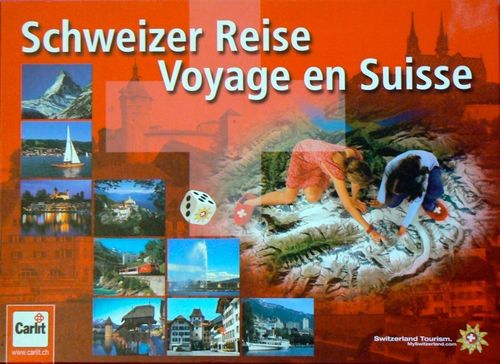
Schweizer Reise
Schweizer Reise Rulebook
Table of Contents
Table of Contents
Contents
- 4 photo boards
- 20 photo cards (4 for each attraction)
- 1 game board
- 4 point markers
- 4 dice
- 60 destination cards
- 12 figurines
- 48 adventure cards (12 in each language: German, French, Italian, English)
- 1 calendar marker "Red flag"
- 31 discovery tiles
Preparing to play
- Put the game board in the middle of the table.
- Place the calendar marker "Red flag" on the first day of travel on the calendar.
- Place all of the discovery tiles on the white circles on the game board as you please. Another option is to shuffle the tiles first, place them on the white circles and then turn them right-side up.
- Shuffle all of the destination cards and deal each player two destination cards face down. Each player is allowed to look at their own destination cards. Shuffle the remaining destination cards with the adventure cards and place them face down as a deck of cards on the draw pile space.
- On each of the five spaces on the game board, place four photo cards on each of the corresponding attractions. The photo card with the 2 point symbol should always be on the top of the pile.
- Give each player one photo board. Each board has a player colour in brackets with the point symbol 5 P.
- Each player places the point marker in their colour on the starting spot of the point scale.
- Each player has three travellers in the same colour but in three different shapes. Each player places one of their traveller figurines on the red starting spaces Basel, Geneva and Mendrisio. That means there should be the same number of figurines, in the same shape but different colours, on each of the three starting spaces as there are people playing the game.
- Have four dice ready.
Aim of the game
You are exploring Switzerland with a small group of travellers. Your three travellers start in different cities in Switzerland: one starts in German-speaking Switzerland (in Basel), one starts in Ticino (in Mendrisio) and one starts in Western Switzerland (in Geneva). You win the game if you score the most points with your three travellers. To earn points, your travellers have to reach as many destinations as possible, go on discovery tours and take pictures of attractions.
How to play
The youngest player is the tour guide and is responsible for managing the calendar during the game. The youngest player begins the game and takes a turn. A turn means they 1) roll the dice and reroll and 2) perform the roll results. After a turn, the next player takes their turn going anticlockwise, and so on. Every time the tour guide takes their turn, a new day of travel begins. The tour guide moves the calendar marker forward to the next day.
1) Rolling and rerolling
When it's your turn, roll all of the dice. If you are happy with the results, you can immediately perform them. You are also allowed to roll the dice a second time or third time. Whether or not you use all of the dice or leave the ones you want on the table is up to you. However, after the third roll at the latest, the results can no longer be changed.
2) Performing the roll results
The rolled results determine what you do during your turn:
- If a die shows one of the three travellers, you can move that traveller in your colour to the next location on the game board.
- If a die shows a question mark, you can move any one of your three travellers to the next location.
- If the die shows a card symbol, you can draw a card face down from the draw pile and look at it without showing the other players. If it is a destination card, you can keep it. If you would rather not keep the destination card, put it face up in the discard pile.
- If you draw an adventure card instead of a destination card, it must be read immediately. The text on the adventure card lets you know what needs to be done. Afterwards, you put the card in the discard pile. Once you have done so, you can move your travellers based on your roll results. You can never keep adventure cards.
- Sometimes when you have an adventure card, you might land on a location that is already occupied by a traveller or several travellers might move to the same location at the same time: with adventure cards, several travellers are allowed to land on the same location.
- If a die shows a threefold symbol, you can use it to triple another roll result. For example, if you combine these two dice, you can move the depicted traveller not just to the next location but rather three locations forward.
- You can also combine the threefold die with a rolled card symbol. Instead of just one card, you may draw three cards from the draw pile. You may keep as many of these cards as you wish. Place the cards you do not want face up in the discard pile. Perform all of the adventure cards that you draw immediately and then put them aside.
- If you combine a question mark die with a threefold die, you must select one traveller that you move forward three locations. Splitting the roll among several travellers is not allowed.
Important:
- It is not allowed to combine multiple threefold dice.
- If three dice show the threefold symbol after the last roll, you lose two of them and they are not replaced.
The sequence in which you perform the roll results is entirely up to you. It usually makes most sense, however, to perform the destination card dice first. Then you know where your next destinations will be before moving your travellers.
It is best to put aside the dice that you have already performed. Then you know which moves still need to be performed.
Moving your travellers properly
When you move one of your travellers from one location to another, the appearance of the location does not matter. It can be a grey, red or white dot, it can be a camera symbol (attractions) or a discovery tile.
You can move your travellers in any direction you wish. You are allowed to move a traveller forwards and backwards in the same turn.
If another traveller is already on a location, simply skip over that location. The same applies to white circles where someone has already collected the discovery tile. If you skip over one or more locations during a move, it still only counts as one move.
The depicted example: the yellow figurine moves directly from Rapperswil to St Gallen because there is no longer a tile on the white circle and the white dot is occupied by the red figurine. This counts as one move.
Destination cards – reaching travel destinations
Your destination cards determine which locations you would like to visit during your trip. If you land on or skip over a location that you have a destination card for with one of your travellers, you have reached one of your destinations. As a reward, move your score marker three spots forward on the score scale. Place the performed destination card face up in the discard pile.
If you draw a new destination card during the game and one of your travellers just happens to be on that location, you have performed the card and score three points. You just happened to be in the right place at the right time!
Photo cards – attractions
If you land on or skip over the camera symbol of an attraction with one of your travellers, you may draw the top photo card and place it on the free space on your photo board. At the end of the game, the photo cards count as one or two points.
You are only allowed to collect one photo card from each attraction.
Discovery tiles
If you land on or skip over a discovery tile with one of your travellers, collect the tile. The red discovery tiles count as one or two points at the end of the game. You can collect them face down on the table.
You may only use the grey discovery tiles after you have performed all of the actions on your dice. You may move the depicted traveller in your colour forward one location. If you do not want to use the grey tiles, they immediately become invalid and you put them back in the box.
End of the game
If playing with four players, the tour of Switzerland ends after seven days. If playing with three players, the trip ends after nine days. With two players, it ends after ten days. Once the tour guide has placed the calendar marker on the last day of travel (seven, nine or ten), play that round to finish the game. After that round, the trip is over and points are counted.
Scoring
Go through the following list and move your point marker forward to the number of points obtained on the point scale.
- For every attraction, count as many points as are printed on the photo card.
- If you have a complete photo board (five photo cards), you score an additional five points.
- For every one of the red discovery tiles you collect, you score the number of points printed on the tile.
- For every destination card you did not perform, you lose three points. Move your point marker backwards on the point scale to account for the lost points.
The player who is furthest ahead on the point scale after calculating the scores wins the game. If two or more players have the same number of points, the player with the most points from their collected photo cards wins.
If it still is not possible to determine a clear winner, multiple players win the round.
Any questions?
Why are some of the dots on the game board in different colours?
The colours help you find your way through Switzerland:
- The grey location dots stand for destination cards.
- The red location dots stand for adventure cards.
- The white location dots do not have a special meaning. While travelling, however, you still have to count the white dots.
- The discovery tiles are placed on the white circles. If the tiles have already been collected, you can simply skip over the circles.
- The camera symbols stand for attractions. If you land on or skip over a camera space, you receive the corresponding photo card.
Can I simply put destination cards that I drew at some point back in the discard pile?
No. If you have decided to keep a destination card, it is no longer possible to discard it during the game, unless you reach that destination with one of your travellers.
Can I have any number of destination cards in my hand?
Yes. But remember, every destination card that you do not perform counts as three minus points at the end of the game.
Can a traveller go to a location at the end of a route if it is already occupied by another traveller?
Yes. The traveller simply moves back and forth during a move as if they are skipping over that location.
For example (see picture): the green traveller is on Interlaken and can move forward one space according to the dice. The traveller intends to collect the "Jungfraujoch" photo card. The location in front of the traveller is occupied by a red traveller and the camera symbol "Jungfraujoch" is occupied by a yellow traveller. Because both spaces are occupied, the green traveller can collect the "Jungfraujoch" photo card in one move: based on the results of the dice, they move one space over the camera symbol "Jungfraujoch" to Meiringen or move back to Interlaken.