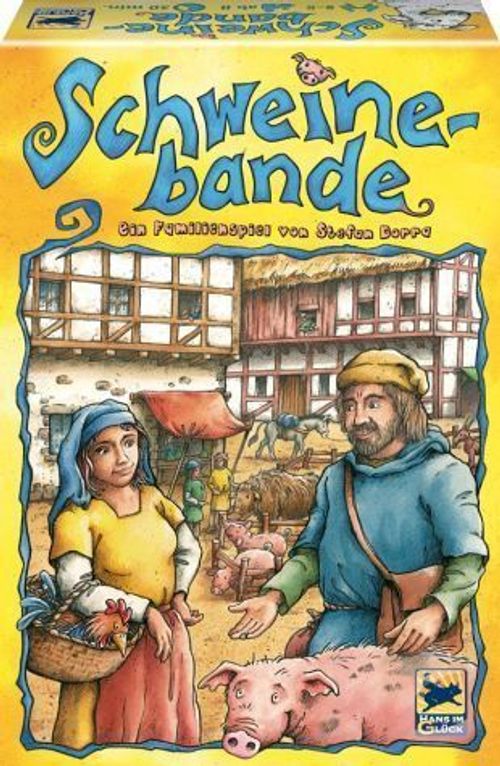
Schweinebande
Schweinebande Rulebook
Table of Contents
Table of Contents
Components and Setup
1 game board, 15 wooden farmers (3 each in blue, yellow, green, red, black), 5 farmyards, 25 wooden feed tokens, 5 turn-order tiles, and 100 hexagonal animal tiles (96 animals, 6 animal types with 16 of each, and 4 feed sacks).
The game board is placed in the middle of the table. The 25 feed tokens are placed next to the board. Each player takes 2 farmers (with 4 or 5 players) or 3 farmers (with 2 or 3 players) of one color, plus 1 farmyard of the same color, but no feed tokens. The 5 turn-order tiles are placed face up next to the game board. The 100 hexagonal animal tiles are shuffled face down and divided into several stacks. These face-down stacks are placed next to the game board. In the illustration, the first 25 animal tiles for round 1 have already been laid out (see A. Laying out animal tiles).
Course of Play
The game runs over 4 rounds. Each round is divided into the following sections:
- A. Laying out animal tiles
- B. Placing farmers
- C. Collecting animal tiles
- D. Putting animal tiles on the farmyard
- E. Feeding
A. Laying Out Animal Tiles
At the start of each round, the players lay 25 animal tiles face down on the 25 hexagonal spaces of the game board. The 100 animal tiles are thus enough for 4 rounds.
B. Placing Farmers
In the first round, the youngest player begins and first turns over 1 animal tile. He must then decide whether to place one of his own farmers on this just-revealed animal tile or to pass. After that, the next player clockwise takes a turn.
As soon as a player has placed his last farmer, he immediately takes the lowest turn-order tile still available. This player no longer takes a turn in this section and may not reveal any further animal tiles. He is simply skipped.
If only a single player still has one or more farmers not yet placed, he continues to reveal animal tiles one after another. After each reveal, he has the option to place a farmer. He must place his last farmer piece on the last animal tile at the latest. If it happens that a player still has one or more farmers but all the animal tiles have already been revealed, he can no longer place his farmers this round.
After the very last farmer has been placed, it can happen that there are still face-down animal tiles remaining; these are also revealed.
C. Collecting Animal Tiles
The player with the [1] turn-order tile begins collecting animal tiles. He chooses one of his farmers and collects all the animal tiles in a row that must originate from this farmer. After that, the other players take their turn in the order of the turn-order tiles (not clockwise!). Once the other players have likewise each collected 1 row, the player with the [1] turn-order tile takes his turn again. He takes his second farmer and again receives several animal tiles, and so on. In games with two or three players, all players get a third turn as well.
The following rules apply when collecting:
- The player takes the animal tile on which his farmer stands.
- He takes all the animal tiles still laid out in a row of his choice that originates from the farmer.
- The row ends either at the edge of the board, at another farmer, or at the last laid-out animal tile of that row.
- An empty space within a row does not end the row.
- The player takes the farmer back to himself.
In the example, 3 players have already collected animal tiles with their first farmer. Red has received 2 chickens, 1 donkey, and 1 cow. Yellow has received 1 chicken, 1 donkey, and 1 pig, and Green has collected 1 chicken, 1 sheep, and 1 cow. Blue now has 3 different rows to choose from:
- 1st option: 1 chicken, 1 goat, and 1 donkey
- 2nd option: 1 chicken and 1 goat
- 3rd option: 1 chicken, 1 goat, 1 pig, and 1 donkey (already collected in this turn)
Blue decides on the 3rd option.
Each player lays the animal tiles he picked up face up on the table in front of him. Identical animal tiles are placed one below another (tiles already collected in previous rounds are kept separate from those collected in this turn).
Animal tiles that remain on the game board after all players have finished collecting are removed from the game and put back in the box. Then this section ends.
D. Putting Animal Tiles on the Farmyard
Now all players may put animals on their farmyard. The following rules apply:
- Group of 4: The player has collected 4 animal tiles of the same kind, e.g. 4 donkeys. He places 1 donkey on his farmyard and puts the remaining 3 donkeys back in the box. If he has further donkeys that do not form another group of 4, he simply leaves them lying in front of him.
- Group of 6: The player has collected at least 1 animal of every kind, i.e. 1 chicken, 1 sheep, 1 goat, 1 donkey, 1 pig, 1 cow each. He places the cow on his farmyard and puts the remaining 5 animals back in the box.
- An animal cannot be used twice, i.e. for a group of 4 and at the same time for a group of 6.
- A player does not have to redeem a group. He may leave it lying in front of him. This makes sense when...
- ...the player has 4 pigs and wants to redeem them in the last round (see Pig Bonus).
- ...the player is hoping to use an animal, e.g. one with a low number, later for a group of 6.
Only the animals on the farmyard bring the points needed for a good result at the end of the game! A donkey on the farmyard is worth, for example, 5 points, and so on.
Pig Bonus in the Last Round
If a player has 4 pigs lying face up in front of him in the fourth and last round, he places 2 of them on his farmyard and puts the remaining 2 pigs back in the box. If he has 8 pigs, he places 4 of them on his farmyard; with 12 pigs, 6, and so on.
E. Feeding
All players must feed all of their animals that are not on the farmyard. Each animal requires 1 feed token. If a player has no feed tokens, he must sell one or more animals. An animal provides as many feed tokens as the number printed on it; 1 pig, for example, provides 6 feed tokens.
Example: Blue owns 7 animals (as in the example above): 1 chicken, 3 goats, 1 donkey, and 2 pigs, and no feed tokens. He trades in his donkey and his chicken for 7 feed tokens. The donkey and chicken leave the game and are put back in the box. For the remaining 5 animals he now has, he pays 5 feed tokens back to the supply. He has 2 feed tokens left for the next round.
With a collected feed sack, a player can feed all his existing animals once. He then puts the feed sack back in the box. Alternatively, the player can also feed his animals with feed tokens and keep his feed sack.
As soon as all players have fed their animals, the round ends.
New Round
All further rounds proceed like the first, with the following exception:
- A. Laying out animal tiles (as before)
- B. Placing farmers: Now the player with the [1] turn-order tile begins. After this player has revealed 1 animal tile and possibly placed 1 farmer, all players put their turn-order tiles back next to the game board. After that, the next player clockwise takes a turn.
- C. - E. (as before)
Special Rules for the End of the Game
After all players have placed their farmers on the game board, collected animal tiles, redeemed animal groups, and fed their remaining animals in the fourth and last round, the following also happens:
Now every player may redeem 4 animal tiles of his choice as a group of 4, provided he still has 4 or more animal tiles, and place the lowest animal tile of each such group on his farmyard.
For example, if a player still has 2 cows and 2 goats, he places 1 goat on his farmyard and puts the other 3 animals back in the box.
If a player still has 8 or more animal tiles, he can even redeem 2 or more groups of 4. Animal tiles and feed sacks that he can no longer redeem also go back in the box.
Scoring
Each player counts the points of the animals on his farmyard. Each animal counts 2, 3, 4, 5, 6, or 7 points depending on the number printed on it. The player with the most points wins the game. In case of a tie in points, the player with the most pigs wins. If there is still a tie, there are multiple winners.
Game Tips
- If a player has, for example, 2 donkeys left over from a previous round, he should try to get 2 more donkeys this round.
- To receive the pig bonus in the last round, it can be worthwhile not to redeem your pigs for several rounds, but to keep feeding them instead.
- When feeding in the last round, players should make sure to keep at least 4 animal tiles so that they can redeem them as a group of 4 at the end. So it is better to sell 1 more valuable animal beforehand than 2 less valuable ones.