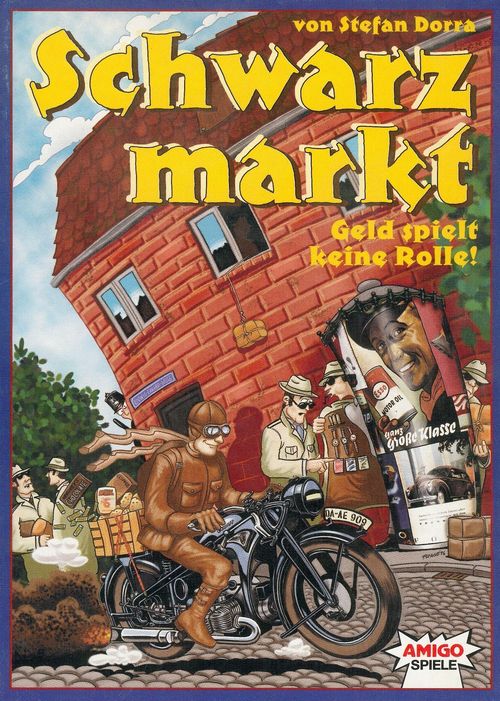
Schwarzmarkt
Schwarzmarkt Rulebook
Table of Contents
Table of Contents
Game Idea
Each player tries to make a fortune through profitable trading deals. Every player is always faced with a choice: exchange goods at the current value, or drive the price up. A price driver is not always successful, though. By the time a player's next turn comes around, another player has often already made their trade. After two game rounds the game ends. Whoever has been able to trade in their goods most profitably by then is the winner.
Setup
The game board is placed in the middle of the table. The price marker is set on the space marked "1". It always starts there again at the beginning of a new trading round. The price marker on the board always shows the current exchange value of each individual good.
The 100 luxury item cards are sorted by value and placed next to the game board, within everyone's reach.
The 30 black market cards are shuffled well. Each player is dealt three cards into hand. The rest is placed face down as a draw pile on the matching space of the game board. With black market cards, players can influence the demand for certain goods in a trading round in their own favour. The cards show either different goods or a longer text.
For the 66 goods cards in the basic game, 2 "flour" cards and 4 "potato" cards are set aside and returned to the box. Each good is now present 12 times in the game. The 60 remaining goods cards are shuffled. Each player receives nine cards into hand. The remaining goods cards are placed face down on the matching space of the game board.
Game Sequence: 1st Game Round
Whoever is on turn may exchange goods cards for luxury items and must move the price marker onward. The starting player must additionally play one black market card as their first action.
Playing a Black Market Card (Starting Player Only)
The game begins with the player to the left of the dealer. This player is the starting player for the first trading round. They set the price marker on the space "1", choose one of their black market cards and place it face up next to the game board. Each starting player must first play one black market card, either a text card or an offer card. Immediately afterwards they draw a new black market card from the matching draw pile. An open text card stays in effect until its instruction has been carried out. An offer card stays in effect for one trading round. All players, including the starting player, may take part in the trading round.
Example 1: Alwin is the starting player. He has two black market cards with different goods and one with a longer text printed on it. He places the black market card "2 sacks of potatoes - 2 pounds of butter" next to the game board and draws a new black market card from the draw pile.
Trading Goods
The starting player now has the choice of trading none, one, several or all of the goods cards that are required. If they want to trade, they lay the goods card(s) face up next to the black market card, so that everyone can see them, from their hand. They receive the current exchange value in luxury items for this.
Example 2: Since the current price for potatoes and butter is only at "1", Alwin decides not to trade.
Raising the Price
The player must now move the price marker onward, regardless of whether goods were traded or not. If goods were traded, the price marker may only be moved forward by one space in the direction of the arrow. If no goods were traded, the price marker must be moved across one or more spaces. The distance a player may move depends on the dice symbol on the price space the marker is currently on. This dice symbol always indicates the furthest move possible.
Example 3: From the starting space ("1") the price marker can therefore be moved 1, 2, 3 or 4 spaces in the direction of the arrow. Alwin decides on four spaces and places the price marker on space "9".
The Next Player and the End of a Trading Round
After that, the next player is on turn. They again have the option to trade one or more goods. For each goods card they receive the price currently shown on the board, in the form of luxury items.
Example 4: The black market card "2 sacks of potatoes - 2 pounds of butter" from Alwin is still lying next to the game board. Brigitte decides to trade one pound of "butter" and one sack of "potatoes", although she also has the other two required cards in her hand and could play them as well. She places both goods cards next to the black market card. The price marker stands on "9". The current exchange value of the two goods totals "18". For this she receives luxury items: once "cigarettes" (value 10), once "chocolate" (value 5) and three "chewing gum" (value 1 each). If the required luxury items cannot be paid out exactly, change may be given. She then moves the price marker only one space further, onto space "12", because she traded goods. The next player is on turn.
The following players can likewise trade goods in turn, and each must move the price marker in the direction of the arrow. This continues until all the goods required by the current black market card have been traded (in Example 4, therefore four goods cards), or until the price marker reaches the space "50". Goods may still be traded on space "50", but only by the player who is currently on turn. After that the trading round has ended, even if not all of the required goods cards have been traded.
The goods cards and the black market card are placed face down under their matching draw piles. Each player places the luxury items they received in front of them on the table, face up or face down, as they wish.
The Next Trading Round
The new starting player is the player sitting to the left of the previous starting player. They set the price marker back on space "1" of the price table and start the new trading round by playing a black market card.
Black Market Cards With Text
Instead of a black market card with different goods, which is headed "Angebot" (offer), there are also black market cards with longer texts. If such a card is played by the starting player, the instruction on this black market card must be carried out immediately. No trading round takes place.
Example 5: Erich is the starting player in the next trading round. He plays the card "Alte Rechnung!" ("Old Bill!"): "Draw a goods card face down from any player and take it into your own hand." He carries out this action immediately against Charlotte. Or: he could instead play the following card: "New goods discovered! Choose one goods card from the draw pile of goods cards and take it face down into your hand. Pay for it with luxury items worth 5." Erich takes a "sack of potatoes" from the pile and pays for it from his own possessions with one "chocolate" or five "chewing gum". This card, however, can only be played if one already owns luxury items.
The player to the right of the starting player (in clockwise order) then becomes the new starting player. They must play one of their black market cards. Black market cards with text may also refer to the following trading round, even though it has not yet been opened.
Example 6: "Goods short! In the next trading round, each player may trade a maximum of one goods card."
Only with the next open black market card showing an offer is a new trading round opened. It can therefore happen, not infrequently, that two or more black market cards affect one trading round. These black market cards remain open until their instructions have been carried out, but at the latest until the current trading round has ended.
End of the First Game Round
The first game round ends as soon as a player has traded in their last goods card. All other actions are cancelled. Now each other player receives new goods cards from the draw pile. For this the draw pile is shuffled briefly. Each player receives face down as many new cards as they were able to trade in so far. The player who was able to trade in all of their goods cards receives nine cards. The other players receive as many cards as they need to refill their hand to nine cards. After this, every player must again have exactly nine goods cards in hand.
The black market cards remain with the players. The face-down draw pile on the game board, however, is shuffled briefly.
Game Sequence: 2nd Game Round
The second game round runs exactly like the first. The starting player for the first trading round is whoever is next in turn after the previous sequence of play. The second game round also ends as soon as a player has been able to trade in all of their goods cards again.
End of the Game
After two game rounds the game ends. Now the scoring takes place. Each player adds up the value of their luxury items. The winner is whoever holds the highest total value in cards with luxury items.
Tips From the Pros
Push the price as high as possible when there are indications that other players no longer have the required goods. The strategy "little profit, sell everything quickly" can also make good sense. It prevents others from becoming rich. Watch carefully who is making the best trading deals and who still holds many goods cards. Some black market cards can then be played in a targeted way.
Variant
For the variant, the 6 goods cards set aside earlier (2 "flour" and 4 "potato") go back into play. For this, 6 other goods cards are set aside instead: 2 "sugar" cards and 4 "coffee" cards. The result is an unequal distribution of goods, which brings even more tension into the sequence of play. The following distribution applies: 16 potatoes, 14 flour, 12 butter, 10 sugar and 8 coffee.