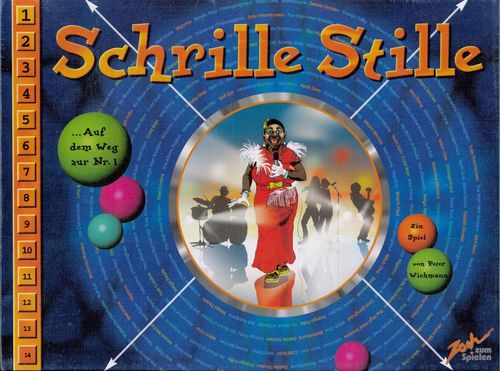
Schrille Stille
Schrille Stille Rulebook
Table of Contents
Table of Contents
Components
- 1 board
- 1 CD player made of wood (with a pedestal, 2 rods and a turntable)
- 6 CD-sets, consisting of 6 folding covers and 6 CDs
- 42 band cards
- 48 influence chips
- 12 tip chips in 6 colors
- 6 scoring markers (blocks) in 6 colors
- 14 place markers (black) with labels 1-14
- 1 numbered CD cover
- 1 black cloth sack
- Rules
Notes on the Components
Red influence chips count minus. Black chips are positive.
Each player will receive a CD set, and the matching score marker and tip chips for that color. Each band card is marked on the bottom by a color strip, which indicates one or two labels that score for that band.
Before the First Game
- Punch out the 42 band cards.
- Attach the 14 labels to the black place chips.
Setup
- Put the board in the middle of the table.
- Put the 48 influence chips into the sack.
- Assemble the CD player as shown.
- Shuffle the band cards.
- Place the rest of the bits near the board.
- Choose a moderator, who has a few extra tasks each round.
Course of the Game
- Opening phase: distribution of labels
- Normal rounds
- Place influence chips
- Load the CD player
- Figure the results of the CDs
- Score points
- 30/50 point rule
- Label change
- Add new bands
- Prepare for the new round
- End
A. Opening Phase
This part only happens at the start of the game. The moderator takes the deck of band cards, calls out the name of the band and its labels (colors at the bottom), and places it in the 14th slot on the chart. He keeps turning up cards, announcing each one until the chart is filled.
A player may, at any time, call out a label name or color. That player takes the appropriate label. His scoring stone is placed at 0 on the scoring track. Each player may only claim one label, and the player who calls first locks in that label.
The player will have contracts with the bands with his color at the bottom of their card.
All of the band cards are always in every game, even ones for labels that are not being played.
The place markers are placed on the bands, marking them from 1-14.
Now the actual game can begin.
B. Normal Game Rounds
Place the Tip Chips and Influence Chips
Each player puts his CD into the cover, so that he can see the numbers on the cover in the holes on the CD.
Each player reaches into the black sack and takes 7 random influence chips. He keeps 5 chips for himself, and places 2 chips next to the board. Once everyone takes their chips, the extras can go back in the bag.
Each player places his 5 influence chips and both of his tip chips into the holes on his CD. He may choose freely, but only one chip may be placed in each hole. The holes correspond to the position of each band on the chart.
Once all of your chips are set, hand the CD and cover to the moderator, who loads the CD into the player.
Caution: hold the CD closed with your thumb and forefingers so that the chips do not slide out.
Load the CD Player
The moderator makes sure that the turntable is in the start position, and places the CD and cover over the two rods in the CD player. He then slowly pulls the cover until the CD rests on the turntable. The chips will fall into the holes in the turntable. Leave the CD on the turntable, and stack further CDs on top of the first CD.
After all of the CDs are loaded, place the numbered CD cover on top of the stack of CDs. Hand the folding covers back to the owning player.
Reading the CD Player
The moderator turns the CD stack until hole 14 is over the output slot. Chips may fall out.
The chips go on the corresponding band card, according to the place marker on the band.
The black chips are added to the card's place, and move it up the chart. Red chips will move the band down the chart.
Pick of the Week and New #1 chips are worth +1 for the value.
If the result is positive, the band moves up that many places (on a +3, a band would jump from 14 to 11). Any bands between the two positions slide down to open a space for the rising band. If the result would take you to the left of the #1 position, you stop at #1.
If the result is negative, the band drops that many places. Other bands are moved up to fill the vacancy. If a band drops to below 14, it falls off the charts and is placed to the right of the board. Any tip chips and place markers on the card are placed next to the board.
If the result is 0, move on to the next band.
Important: do not mess with the place markers until all of the bands are moved. In addition, bands are moved according to the place markers, not the current position.
Keep moving bands from 13 up to 1. The band with place marker 13 (it was likely moved from the 13th position when the 14 band was moved) is moved according to its counters.
Special Cases
There are 3 possible special cases:
- A band drops below 14. It falls off the charts.
- If one or several bands drop off the charts, there will be empty spaces. Make sure the empty spaces are only at the back of the charts. (If 5 bands are missing, 9-14 will be the open spaces.)
- No band can get better than 1. If a band would move up more spaces, stop it at #1.
Scoring Victory Points
Once all the movement is done, the top 6 places score points for their labels. Negative points will be scored for the bands that fall off the charts and the negative tip chips.
Top Six: for the #1 band, its labels score 6 points; #2 scores its labels 5 points, and so on. (This is marked with a die symbol below the first 6 positions.) If a band has a contract with more than 1 label, both labels score full points.
New Number 1: the tip chip with a dot is a betting chip. Anyone with a betting chip on the new number 1 scores a 5 point bonus. A wrong pick for the new number 1 does not give a penalty.
Pick of the Week: the tip chip for each player that is blank is the player's Pick of the Week. The player scores a bonus according to the number of ranks that the band climbs in the charts.
Minus points — Pick of the Week: if the Pick of the Week for a player goes down instead of up, the player loses as many points as the band drops in rank. If a band drops off the charts, always assume that it drops to 15th place, regardless of how much further it would drop.
Danger Zone: bands on places 11-14 on the charts are in danger. All bands that are in this zone should be checked. If the place marker is a smaller number than their current position, the band falls off the chart (that is, if the band dropped position in the last turn). These bands, along with any bands that fell below place 14, are removed from the game.
Labels supporting a band that is removed from the charts lose 2 points for each band.
The easiest way to handle scoring is to do it by player sequence:
- Top Six
- New #1
- Pick of the Week
- Bands that have fallen from the charts
Move the player's token on the scoring track appropriately.
30/50 Point Rule
If the lead player has reached 30 points for the first time, perform the following step before beginning the next round. Remove the 1-3 bands from the charts. All the rest of the bands move up. New bands will enter the charts from the bottom.
Perform the same procedure when the lead player crosses the 50 point mark.
In both cases, the removed bands do not score any minus points for their labels.
Label Change
After scoring each round, and before starting a new one, each player may swap their label for one of the unclaimed labels.
The player takes the new label and tip chips, and sets his old label aside.
Switching labels costs 5 victory points.
If several players wish to swap labels, the player in last place gets first pick.
New Bands
Some bands will likely have been removed from the charts (especially when the 30/50 rule is invoked).
New bands are drawn from the top of the deck and placed on the empty spaces at the bottom of the charts.
Prepare for the New Round
Reset the place markers so that the band has the correct place marker corresponding to its position on the charts.
Put the influence chips back into the bag. Players keep their tip chips and CDs.
Start a new round at phase one, with players drawing 7 chips.
Game End
The player who first reaches 70 wins. If several reach 70, the player with the most points wins. If they still tie, then there are multiple winners.
Short Rules
Lay out band cards and choose labels
- Set out bands from 14 to 1.
- Players call out a color when they wish a label.
- Place markers are put on the band cards.
Place tip and influence chips
- Each player takes 7 chips, and sets 2 aside.
- 5 influence chips go on their CD, along with 2 tip chips.
- The moderator loads the CDs.
Play the CDs
- Move the CD to 14, then progress backwards to 1.
- The sum of points moves the respective band.
- The band moved is based on the place marker, not the current position.
- Tip chips are placed on the band card.
- Bands that fall below 14 are set aside.
Score
- Plus points for Top 6.
- Correct New #1 = +5 points.
- The Pick of the Week gives plus or minus points according to ranks gained or lost.
- Each dead band scores -2 points.
30/50 point rule
- When the leading player passes 30 or 50, remove the top 3 bands and slide the others up.
New round
- Label change for 5 victory points.
- Dead bands are removed. Surviving bands move up.
- New bands are added to fill the empty slots.
- Reset the place markers to match the current positions.
- Put chips back in the sack. Tip chips and CDs go back to the players.
Sequence of Play
- Each player draws 7 random influence chips, sets aside 2, then places the remaining 5 plus both tip chips in his CD.
- The moderator loads the CD player with all players' CDs and the numbered cover.
- The moderator reads the CD player starting with hole #14 and continuing to #1.
- Chips are placed on the corresponding band card according to the place marker on the band.
- Net result of all chips determines the band's position change, if any.
- Black influence chips are positive, red are negative. Each Pick of the Week and New Number 1 chip is worth +1.
- If the result is positive, the band moves up that many places; if the result is negative, the band drops that many places. If the result is 0, the band doesn't move (at this point anyway).
- If a band drops to below #14, it falls off the chart and is placed to the right of the board.
- Other bands are moved down to make room for a band that moves up, or moved up to fill any vacancy left by a band that moves down.
- When a band (or bands) drops off the charts, there will temporarily be unfilled vacancies. Make sure the empty spaces are only at the lower end of the charts, i.e. move all bands up so there are no gaps.
- If a band would move up past #1, it stops at #1.
- Check the Danger Zone (places 11-14) after all places have been determined. Bands in these spaces who moved down (their place marker is a lower number than their current position) are removed from the chart.
- Score by player.
- Top Six: #1 band = 6 points, #2 = 5 points, etc.
- New Number 1: tip chip with the dot correctly placed on the new #1 band = 5 points (no penalty if incorrect).
- Pick of the Week: tip chip without the dot = plus or minus points equal to that band's move up or down from its previous position (if it fell off the chart, its position is #15).