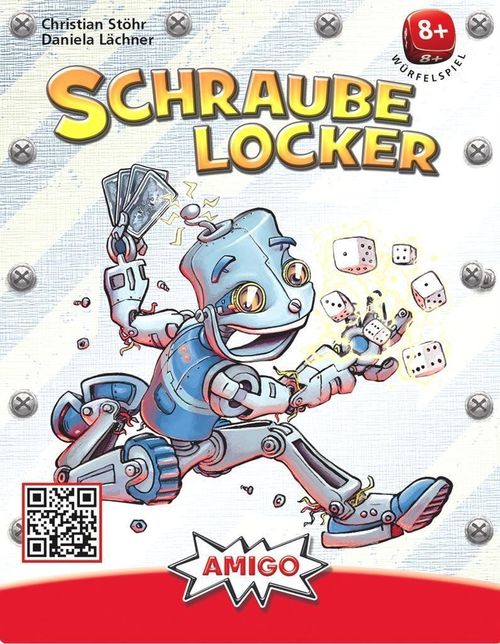
Schraube Locker
Schraube Locker Rulebook
Table of Contents
Table of Contents
Components
- A deck of 48 cards.
- 42 Point Cards (each showing a number, a colour, and a screw/nut symbol or an ability).
- 6 Bonus Cards (each showing a value of 6).
- 4 player boards.
- 4 pawns.
- 6 dice.
Setup
- Place the six Bonus Cards face up in the centre of the table.
- Shuffle the 42 Scoring Cards thoroughly and divide them into six face-down stacks of seven cards each. Arrange these six stacks in a circle around the Bonus Cards.
- Each player takes one pawn and the matching player-colour card, placing the colour card in front of them.
- Each player places their pawn on the outside of the circle next to any stack.
- Reveal the top card of each stack.
- The youngest player begins. Turns proceed clockwise.
Turn Structure
On your turn, complete the following steps in order:
- Roll and place dice (mandatory)
- Move your pawn (mandatory)
- Exchange cards (optional)
- Take a card (mandatory)
After your turn, pass all six dice to the next player.
1. Roll and Place Dice (Mandatory)
Initial Roll
Roll all six dice. You must then place matching dice onto cards as follows:
Mandatory Placement
Starting from the stack immediately clockwise from your pawn, examine each stack one by one in clockwise order.
- If the revealed card on a stack shows a specific die result, and you rolled at least one die showing that result, you must place one matching die on that card.
- Continue around the circle until you reach a stack whose revealed card requires a die value that you did not roll. At that point, mandatory placements stop.
Optional Placement
After all mandatory placements are made, you may place any remaining dice onto matching cards further ahead in the circle. Gaps are allowed: you may skip past stacks without dice if you choose.
Re-Rolling Dice
You may re-roll the remaining (unplaced) dice up to two more times, following these rules:
- Each re-roll must include all remaining dice; you cannot selectively re-roll only some of them.
- After each roll, perform mandatory placements again before making any optional placements.
Using Special Abilities During Dice Rolls
Before placing dice after a roll, you may use the following abilities if you have the appropriate cards:
- Green Ability – Re-Roll All Dice: Return one of your Green cards to the box and immediately re-roll all dice you just rolled.
- Yellow Ability – Rotate One Die: Return one of your Yellow cards to the box and change one die to any result you choose.
2. Move Your Pawn (Mandatory)
After dice placement is complete, move your pawn clockwise until you reach the last stack in the longest unbroken sequence of stacks containing at least one die. The pawn never skips over an empty card to reach a further die.
No Movement
If the very first stack clockwise from your current position contains no die, you cannot move. Your turn ends immediately:
- You may not exchange cards this turn.
- You may not take a card.
Full Circuit Bonus
If you placed dice on all six stacks, your pawn moves all the way around the circle back to its starting stack. You immediately gain one Bonus Card (worth 6 points), placing it face up in front of you.
3. Exchange Cards (Optional)
If your pawn stops on a card where another player's pawn is already present, you may interact with that player once. You may choose one of the following two options:
- Orange Ability – Swap Cards: Return one of your Orange cards to the box. You may then swap one of your face-up cards with one face-up card belonging to that player. Bonus Cards (value 6) may not be swapped.
- Red Ability – Gift a Card: Give the other player one of your face-up Red cards. The other player keeps it; you receive nothing in return. This is a way to force a negative card (-3) onto opponents.
You may only perform one interaction per opponent whose pawn shares your space.
4. Take a Card (Mandatory)
Take the face-up card from the stack beside your pawn and place it face up in front of you. Reveal the next card of that stack.
Nut and Bolt Combinations
Cards showing nuts and screws (bolts) may be combined to form protected sets. Immediately after forming a valid combination, place that set face down. Once placed face down, combinations may not be altered.
A face-down combination:
- Cannot be stolen with Orange abilities
- Grants bonus points at the end of the game
Valid Combinations
You may form any of the following:
- 1 Nut + 1 Bolt
- 1 Double Nut + 1 or 2 different Bolt cards
- 1 Double Bolt + 1 or 2 different Nut cards
- 1 Double Nut + 1 Double Bolt
End of the Turn
At the end of a player's turn, after they take a card and possibly secure combinations:
- All dice are returned to the next player (on the left).
- The next player immediately begins their turn by rolling all six dice.
- Nothing carries over between turns. Dice on cards are not left there; they only determine movement within the current turn.
This means:
- Dice placed on cards are only temporary for the duration of the current player's turn.
- At the end of the turn, all dice are removed, not left on the cards.
End of the Game
The game ends immediately after the turn in which any stack becomes empty (either a Scoring stack or the Bonus Card supply).
All players then score points.
Scoring
Each player adds:
- The point values shown on cards (regardless of whether face-up or not)
- 3 bonus points for each nut-and-bolt combination they created
The player with the highest total score wins. Ties are not broken – tied players share victory.
Professional Variants (Optional)
You may incorporate either or both of the following advanced rules.
1. Selective Dice Use
At the start of your turn, you may choose to roll fewer than six dice. Any dice you choose not to roll may not be rolled at any later point during that turn, including re-rolls.
2. Combining Dice
When placing dice onto a card, you may combine exactly two dice, adding their results to match the value shown on the card.
For example, to place on a card requiring a 5, you may place a 2 and a 3 together.