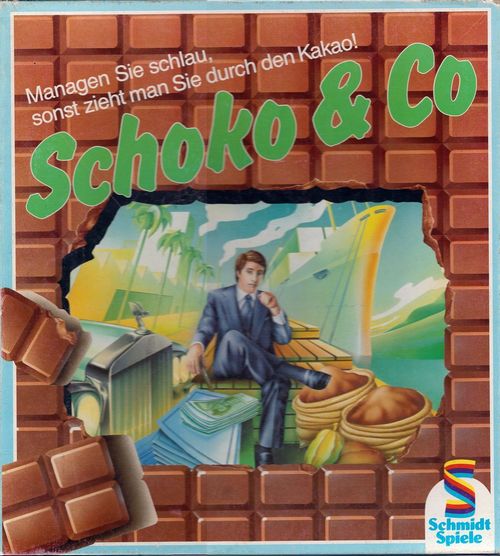
Schoko & Co.
Schoko & Co. Rulebook
Table of Contents
Table of Contents
Game Info
- Game type: Economic
- Number of players: 2 – 4
- Recommended age: 12 years up
- Game duration: approx. 2 hours or more
- Authors: Y. Hirschfeld and G. Monnet
Goal
At the end of the game, arise as the most successful Chocolate company manager by earning more money than the other game competitors.
Game Materials
- 1 Game board
- 4 Screens
- 20 brown game tokens (Workers)
- 16 green game tokens (Sales reps)
- 16 pink game tokens (Secretaries)
- 10 grey game tokens (Book keepers)
- 4 black negotiation game tokens
- 55 Cards, namely:
- 23 Contract cards
- 12 Express-cards
- 13 Loan-cards (Darlehenskarten)
- 7 Economic event cards ("Schmidt-Wirtschaftsdienst")
- 1 Pad of purchase forms (Einkaufsformularen)
- 1 Bundle of play money in the values 1000, 5000, 10.000 and 50.000
- 10 Share certificates
- 20 Bands to bundle money
- 114 Bars of cocoa (light brown side) or respectively chocolate (dark brown side)
Hint: 1 Bar equals 10 tons.
Preface
Chocolate Inc is played over a number of rounds. Each round represents 1 month and consists of 7 phases and the Express-cards. To begin playing right away we recommend playing through the first round while reading the rules. That is, first read the text for the preparation and then perform the recommended actions. Then read the text and play phase 1, phase 2, etc… At the end of phase 7 you'll have the game down. Then start again with phase 1 and refer to the rules only when needed.
Preparation
Set out the game board. Each player sits in front of their factory color. Then give each player:
- A cardboard screen (according to the color of his factory), which he positions in front of him off the game board. It shows the two tables of monthly salaries "Monatliche Gehälter" and action sequences in a month "Geschäftsvorgänge eines Monats".
- A starting capital of 100.000 (1 x 50.000 and 5 x 10.000), that is placed in one's cashier (= behind your screen). During the entire game you should hide the amount of money in your possession.
- 3 Express-cards. After the deck of cards is shuffled, each player is dealt 3 cards face-down, which only he is allowed to look at. Potential excess cards are taken out of the game.
- 1 purchase form (Einkaufsformular)
- 1 black negotiation token, which you should place on the field numbered "0" on the right side of your factory.
Additionally, each player should have a pencil at hand.
Then you shuffle the contract cards and the Economic event cards "Schmidt-Wirtschaftsdienst" and place the decks on the spaces on the game board.
The game length should be decided before starting play. Based on how much time you have, you may want to play from 6-12 rounds (months).
Note: A game played over six rounds will take approximately 2 hours.
After determining the game length, strike through the months on your purchase form that will not be played.
Example: The players have decided on 8 rounds (January through August), therefore strike through September through December.
Note: Place the Contract stone on the zero space on the game board.
Main Game (Sequence)
Each game turn consists of 7 phases, which represent the business processes of a month (see also the right overview table on the screen). These phases must be played in the proper order, and each player must complete all of one phase before the next one is begun.
Before starting the first month (January), a banker must be chosen. The banker takes the game box and its contents and distributes cash, cocoa bars, etc. as needed. He also tracks the passing of each month. The starting player is the person to the left of the banker. This player will always begin each of the 7 phases (for this turn), followed by the other players in clockwise order.
During the next turn, the starting player becomes the banker, and the new player to the left will start each phase.
Example: Players A, B, C and D are sitting around the game board in clockwise order. Player A will be the banker for the month of January. Then the player order for each phase of this turn will be B, C, D, and A. In February, player B will be banker and player C will start each phase of the next turn.
6.1. Hiring and Paying Personnel (Phase 1)
Beginning with the starting player, each player in turn may, if desired, hire personnel. Each employee type costs a different salary (the salary overview table is on the upper left of the screen) and each type performs a special task:
- The workers (brown game tokens) produce the chocolate (Each worker may convert up to 3 bars of cocoa into 3 bars of chocolate per month).
- The sales reps (green game tokens) negotiate sales contracts with the customers (and against the competition) in order to sell the chocolate for a good price (Each sales rep can attend up to 4 meetings per month).
- The secretaries (pink game tokens) prepare the contracts and provide them for accounts (Each secretary may process 1 contract per month).
- The bookkeepers (grey game tokens) cash out the contracts and collect the money (Each bookkeeper may cash out 2 contracts per month).
You may not hire more than 2 employees of any category per month. The banker gives you the new employees hired which you place their game tokens onto their appropriate work areas in your factory. Workers are positioned on the field marked "production".
To calculate the total of salaries, please refer to the table of monthly salaries "Monatliche Gehälter" on your screen top.
Hint for beginners: Hire 1 or 2 workers, 1 sales rep, 1 secretary, and 1 bookkeeper. This way you'll have money left over to buy cocoa, and that's what's important!
Enter the amount paid for employees on your purchase form for each separate month. This makes it easier in the following months to calculate your total. If for example January's total was 60.000 and you hired 1 worker in February, then February's total would be 66.000 which you would enter in the far right column.
Note: If you don't have enough money, you can always take out a loan. In this case refer to 6.7 "Financials".
As soon as you have acquired your desired personnel, pay the salaries to the bank for all your workers, according to the scales detailed on top of your factory screen.
Example: I purchase 2 workers, 1 salesperson, 2 secretaries and 2 bookkeepers. I must pay to the bank 12.000 + 12.000 + 16.000 + 20.000 = 60.000 (expensive!).
Beginning with the second month, you may also fire (or downsize) any number of workers, but you must pay them a half-salary that month as severance pay. Give back the tokens of the fired workers to the bank.
Example: In January I hired 1 worker, 1 salesperson, 1 secretary, and 2 bookkeepers (total of 46.000). In February I downsized 1 bookkeeper and hired another worker. In the far right of my purchase form I enter 42.000: 46.000 – 10.000 + 6000. However, I must pay to the bank 47.000 for the month because I must pay the severance pay of 5000 (half pay) for the bookkeeper that I fired.
6.2. Buying Cocoa (Phase 2)
Players may purchase cocoa from the 5 international markets in the center of the game board. First determine how much cocoa is going to be available on the markets. Beginning with the starting player, each player announces the number of cocoa bars that he wants. These requested cocoa bars represent the market supply. The banker takes the amount of bars from the bank and places them in the middle of the game board. The total number of cocoa bars is what the market has to offer in regards of cocoa.
Tip: How much cocoa should I request? In phase 3 we'll discover that each worker can, at most, convert three bars of cocoa to chocolate. So, with 2 workers, I could place a request for 6 bars of cocoa. Or I could request more to fill my warehouse stock, or flood the market thereby driving prices down. I could also request nothing creating a tight market for cocoa and drive prices up. If my competitors don't have enough money, I could outbid them and corner the entire market by acquiring all the cocoa.
There are two important rules when requesting cocoa:
- You don't have to purchase all of the bars that you requested. You may purchase more or less.
- You may not request nor purchase more cocoa bars from the market than your factory can store on its 16 spaces.
The banker then distributes the cocoa bars as evenly as possible between the five cities in the center of the board.
Example: You have four empty spaces remaining in your warehouse. You could request 0-4 bars for the market, and could only purchase 0-4 bars total.
Example: 20 bars are offered in the market. Each market receives 4 bars. If 22 bars were offered, then the first 3 markets would get 4 bars, and 2 markets would get 5 each.
The markets are then opened under the guidance of the banker, beginning with New York (see worksheet order). Before each market opens, the players secretly write down on their worksheet the amount they wish to pay for cocoa in the offered market. You also write down the number of bars of cocoa desired. The price for a bar is 1000 minimum or multiples thereof. If you don't want to place a bid, simply line through that city.
Example: before the "New York" market opens in February, player A writes down on their purchase form that they wish to acquire 4 bars at a price of 2000 per bar.
All players now reveal their purchase bids and beginning with the starting player announce their bids. The highest bidder pays the money to bank, takes the amount bid for and places it light-brown side up in their factory warehouse space. Any remaining cocoa goes to the next highest bidder and so on. Any left over bars are returned to the bank.
If two or more players bid the same amount, the first player (beginning with the start player and proceeding clockwise) has the right to purchase first. Any remaining bars are offered to the next highest bidders in the same manner if necessary.
Tip: If you're the banker and really want cocoa, you had better bid more than 1000, since even if you tie for this bid price, the other players will have opportunity to purchase before you at this measly price and empty the market.
Each city is resolved in this manner before another begins.
6.3. Producing Chocolate (Phase 3)
The purchased cocoa is now transformed into chocolate. Each player who has currently employed a number of workers may now process up to 3 bars (=30 tons) of cocoa into chocolate (brown game tokens). Turn cocoa bars over to dark-brown side (chocolate bars) and place them in the chocolate storage area.
Example: I have 7 bars of cocoa and 2 workers. The most I can convert is 6 bars of cocoa into 6 bars of chocolate. The remaining bar of cocoa stays in storage.
6.4. Selling Chocolate (Phase 4)
This phase is broken down into the following parts:
- The number of contract negotiations
- The sequence of each negotiation
- Secretarial work
The number of negotiations
Customers want to purchase chocolate. The contract cards represent purchase offers made by the customers to all the players.
To obtain a contract you must participate in sales contract negotiations where your interest is to sell your chocolate at the highest price possible. The number of sales reps you employ will determine the number of negotiations in which you may participate. Each sales rep may enter up to 4 sales contract negotiations per month. At the beginning of this phase, each player places their black contract token on the chart numbered 1-15 to show the number of negotiations they will participate in this month.
Example: 1 Sales rep = black marker on 4, 2 sales reps = black marker on 8, 4 sales reps = black marker on 15 (the maximum amount allowed).
The highest marked number determines the number of sales contract negotiations offered to the players. The banker takes that number of contract cards and places them facedown in the middle of the game board.
Example: the tokens from player A and B are on 8, the one from C is on 4, and D's token is on 12. Therefore, twelve meetings will be held. This is a boon for player D as they could attend all the meetings.
Special rules for 2 or 3 players: With 2 players each salesperson may only attend up to 2 meetings and with 3 players up to 3 meetings. The same applies should a player drop out of the game due to bankruptcy leaving only 2 or 3 players.
The sequence of each negotiation
The banker turns over the top contract-card. It shows an amount of chocolate between 10 and 60 tons. Each player now decides if they want to participate in this meeting. Whoever decides to participate moves their black negotiation token back one space on the number area. Naturally you may only participate if you have enough chocolate (not cocoa) in your possession to meet the contract. If all players have delivery problems the contract goes unfilled. Place the contract card on the bottom of the deck.
Note: The distribution of contract cards is as follows:
- 3 x 10 tons
- 4 x 20 tons
- 5 x 30 tons
- 4 x 40 tons
- 5 x 50 tons
- 2 x 60 tons
Now the negotiations begin. The banker announces the lowest price listed on the contract and asks each participating player in turn (starting with the start player) if they would like to sell their chocolate at this price. Important principle: The first person to accept the contract at the offered price gets the contract.
If all players refuse on the first price, the banker raises the price by a minimum of 1000 and a maximum of 5000 (banker's choice) and offers the contract round at the new price. This continues until the highest price is reached. If nobody accepts, even at the highest price, the contract is canceled and placed back to the bottom of the contract deck (this still counts as a sales meeting).
Note: When a player's black marker moves to zero, then this is their last meeting for the round.
Here's the interesting part: if a player is the only one in negotiation, the contract price automatically goes to the highest price. That's crafty salesmanship!
Tip: It is recommended to only accept contracts, when the price is high enough. If you are in the position to sell for a high price, then you'll have enough money to pay salaries in the next month and to finance the purchasing of raw cocoa. Thereby you are on your best way to become rich. But beware; if all of your fellow players are getting weak as soon as the prices are only a little high, then you must revert to another strategy.
After successfully winning a contract, the winning player removes the number of chocolate bars sold from storage and returns them to the bank. In exchange he receives the contract card and money. To show that the contract has not yet been fulfilled, the banker places a yellow band around the cash amount and gives it to the player. Money and contract are placed in the secretary's office that is located to the right of your factory card (see the imprint on your screen).
Secretarial work
After all contract negotiations are completed for the month, it's time for the secretaries to do their work. Contracts are passed from the secretaries to the bookkeepers. Each secretary can process 1 contract by placing it to the left of the factory.
If you have more contracts than secretaries, you must decide which contracts will be processed. The rest will remain in the secretary's office for the remainder of the month. Make sure that contracts are kept in the order of the month in which they have been taken.
Example: You have obtained 4 contracts but only have 3 secretaries. Three of the contracts will be processed to bookkeeping and one will have to remain in the secretary's office.
For the following month, before you process any new contract, any old ones remaining from the previous month must be processed to bookkeeping.
Example: You are in the February month. You have 2 contracts from January and 2 from February. You employ 3 secretaries. You must therefore process both the January contracts and 1 of February's contracts of your choice.
6.5. Processing Contracts (Phase 5)
Each bookkeeper can at most cash out a maximum of 2 contracts per month. If you have more contracts than your bookkeepers can cash out, then choose the best ones to keep you in the black. Remove the yellow band from the money bundles on the contracts you cash out and return it to the bank. This money is now yours to use. Take the contract card and return it to the bottom of the pile.
Any contracts remaining in bookkeeping will stay there until the following month(s).
If a player has been unable to obtain a contract in any one month and there are no more contracts in accounts to cash out, he may sell a maximum of 2 bars of chocolate to the bank for the price of 10.000 each, and receive the payment immediately from the bank.
6.6. Economic Event-Cards "Schmidt-Wirtschaftsdienst" (Phase 6)
At the end of every month except January, the top event card of "Schmidt-Wirtschaftsdienst" is turned over and the event is read aloud. It affects all players and usually isn't very pleasant. Most events take immediate effect.
Event-card example: "Cocoa shock": The 5 cocoa markets are closed for the next month. It is not possible to purchase cocoa. Cross out this month on your purchase form.
Attention: At the start of a month (before phase 1) a player may pay 15.000 to the bank and may secretly look at the top card of the economic event-cards ('Wirtschaftsdienst'). This allows you to gain valuable knowledge of upcoming events. By doing this, you can take preventive measures in anticipation of the upcoming event. Call this inside information, if you want.
When all event cards are used, they are reshuffled and a new deck started.
6.7. Financials (Phase 7)
In this phase there are 2 possible activities:
- Pay interest
- Buy shares
Pay interest
Anytime (!) during the game a player may take a loan or loans out from the bank (as long as the bank still has loan cards available). This can be of benefit, for example, when you wish to hire personnel or purchase cocoa. The banker gives the player taking out the loan 50.000 and a loan-card ("Darlehens-Karte"). In phase 7 you must pay the bank 10.000 of interest for each loan card, even if the loan was just taken out this month!
Note: A 20% interest rate may seem a bit high, but such is life in Big Business. The banks want to stay in business as well. Also, nothing ventured, nothing gained.
Loans may also be paid back to the bank only in this phase. To do so, you return the loan card to the bank with 50.000 plus the 10.000 interest for that loan.
There's one catch to taking a loan though, other than paying interest: If you have an outstanding loan, at the end of the next hire and pay employees phase (Phase 1), it is not allowed to have more employees than any other player. You may have to execute emergency terminations to bring down the number of your employees.
Example: At the end of the hiring phase you have a total of 8 employees, whereas the other 3 players have totals of 5, 6, and 7 employees. If you have an outstanding loan, you must fire 1 of your employees. If you have already paid out the required payroll for your employees, you would receive half the money back for the fired employee (remember, the other half is severance pay). Be sure to adjust your purchase form values to the proper amount.
Buy shares
If at the end of the month you don't know what to do with your money, you can always purchase shares ("Wertpapiere"). Their value increases every month so the earlier you buy the more profit you'll earn.
Example: You purchase a bond in February for 55.000 and sell it at the end of June for 83.000.
6.8. Express-Cards
Just as you may take out a loan at any time, you may also play an Express-card at any time. Feel free to play this card on fellow players just at the time it will have the most devastating impact on them. Just lay it out in front of them.
The only exceptions to this rule are: Firstly, Express-cards may not be played in the month of January, and secondly no player may receive more than 1 card per month.
Example card: "Unfortunate": Heatwave in your area! Tons of chocolate have melted. Give back every 3rd bar to the bank.
Example: If you place a nasty Express-card in front of your opponent at the beginning of May, then at least he's safe from any further cards for the rest of that month.
Game End
After the last agreed upon round, players count up their money and the value of any shares held and pay any outstanding credits with interest to the bank. The player with the greatest monetary wealth is declared the winner and is to be congratulated. He will probably celebrate his victory by treating you to a chocolate bar.
Note: It's possible that you may still have unprocessed contracts in your secretariat or in the accounts. They are now worth nothing.
Variant: Hidden Cocoa-Purchases
When the markets open in phase 2 and the players have written down their desired purchase orders on the purchase form, they are kept hidden rather than revealed. Now it's time to bluff. If someone before me has for example bid 2000 for the cocoa that I want, I could boldly state "4 bars for 3000" even though I only noted 1000 on my purchase form. Now there are two possibilities:
- A) The other players accept my offer as genuine and I settle it for 3000 a bar, or…
- B) They don't accept. If any other player shouts "Call it!" at the time of my offer, then I must reveal the actual number I have noted in my purchase form.
If my bluff has failed, I must pay a penalty of 5.000 to the player that called it. My offer is then rendered as unprofessional and will be annulled before the game continues. That means, the cocoa goes according to the rules to the highest undoubted offer. If however, my bluff turned out to be the true amount mentioned on my purchase form, then the player who called it, must pay me a 5.000-embarrassment fee and I win the bid.
Card Translations
a) "Schmidt-Wirtschaftsdienst" (Economic Event Cards)
"Schokolade: Finanzielle Magenverstimmung" (Chocolate: Financial Upset Stomach) World Crisis! Customers have payment problems. All contracts & money still at the bookkeepers are cancelled (return money to the bank).
"Schoko Protest" (Chocolate protest) The Finance Minister is in trouble again and promoting a Luxury tax bill for chocolate. Out of protest, each player must remove 5 chocolate bars from their storage area, or all if they have less than five, to place in the entryway of the Finance Ministry in the blazing heat (i.e. return them to the bank).
"Schock im Schokolager" (Shock in the chocolate store) The Finance Minister starts a no-notice audit. Everyone must pay a tax of 5.000 for each bar of chocolate in storage.
"Personal: Finanzzuschuß" (Personnel: Financial remedy) The city is overjoyed with the player that paid their employees the most money this month, thus bringing in the most taxes. The player who paid the most in salaries this month receives a 50.000 premium (split equally in case of a tie).
"Kakaoschock" (Cocoa shock) The 5 cocoa markets are closed next month. No cocoa purchase will be possible! Cross out the month on your purchase form.
"Der Kakao sitzt fest" (The cocoa stays put) The workers are dissatisfied with their pay standards and announce a "work slowdown". Each worker produces only one bar of chocolate next month.
"Arbeitsmarkt leergefegt" (Workforce depleted) The Economy is good! There are no bookkeepers to be found on the workforce open market. No new bookkeepers may be employed next month.
b) Express-Cards
"Bedauerlich" (Unfortunate) There's a heat wave in your area. Give back every 3rd bar to the bank.
"Fürchterlich" (Horrible) A Gourmet magazine publishes a bad review of your chocolate. To regain your good name, give one bar of chocolate to each player.
"Skandalös" (Scandalous) The player that gives you this card claims you received this contract by dubious means. Whether true or false, you must prevent a scandal. The person presented the card at the sales meeting must give you the contract he has just gained at the price he would have paid. (You must be present at the negotiation to play this.)
"Rührend" (Heartwarming) Your employees organize a party for you and present you with an honorary title. Moved by this action on their part you decide to pay 1.000 bonuses per employee for their loyalty (to the bank).
"Schlapp" (Beat) One of your bookkeepers is overworked this month due to your success. 1 bookkeeper can process only 1 contract this month. (The others may process them normally.)
"Katastrophal" (Catastrophic) Squirrels have plundered your nut supply. Production is reduced. Each worker converts only 20 tons (2 bars) this month.
"Großzügig" (Generous) You have an overabundance of employees and decide to send your favorite one on a free vacation. One employee goes on vacation for the remainder of this turn. The recipient chooses which. Their salary is still paid. (Move them to the park.)
"Entsetzlich" (Appalling) One of your salespeople celebrated too much after their last sale contract. They're sleeping at their desk and miss two meetings (the counter is immediately adjusted accordingly).
"Spitze!" (Great!) The "Order of the Golden Truffle" awards you the title "Grandmaster of Cocoa". You are so overjoyed that you pay each other player 5.000.
"Schmerzlich" (Painful) Your taste tester has had a chocolate overdose. One worker is ill this month and cannot produce (but must still be paid).
"Schlimm" (Bad) You end up the only person negotiating this contract. This isn't surprising as the customer is a known cheapskate. You may receive only half price for the contract you have just obtained. (Play this after the negotiation is concluded. You must be present at the meeting to play this.)
"Unglaublich" (Unbelievable) Soothsayer Irma predicts your financial situation. You must openly announce your cash holding to all others.