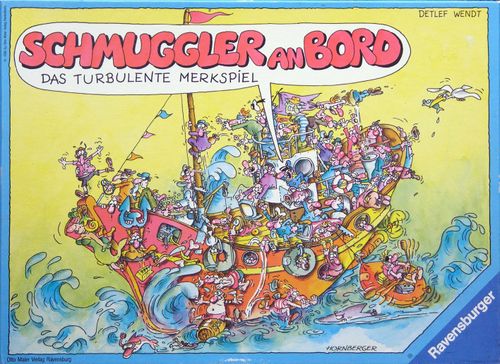
Schmuggler an Bord
Schmuggler an Bord Rulebook
Table of Contents
Table of Contents
Setup
-
Each player receives chips. With three players each receives 12 chips, with four players 15 chips, with five players 18 chips, and with six players 20 chips.
-
The game piece is placed on the yellow start space at the coffee.
-
The 30 small cards are laid face down on the table. The youngest player takes any card, shows the contraband good to the other players and says, for example, "I have the watches." He then places the card face down in front of himself.
All following players do the same in turn, until each player has three cards face down in front of him (with three players) or two cards (with four to six players).
All contraband goods must be named using the name printed under the picture on the game board.
-
The remaining cards are then placed face down on the matching spaces of the game board.
Each player tries to obtain as many contraband goods as possible and to pay as few chips as possible into the ship's kitty.
Playing the Game
Players roll in turn and move the game piece clockwise. The youngest player begins.
Space With a Card
If the game piece lands on a space where a card still lies, the player takes it.
He shows the contraband good to the other players, says, for example, "I have the gold," and places the card face down in front of himself. The next player then rolls.
Space Without a Card
If the game piece lands on a space where no card lies any more, the player must say whom he suspects of having the missing card. This can be either:
- himself, or
- a fellow player.
Suspecting Oneself
If the player suspects that he has the card himself, he says, for example, "I have the gold myself."
Any fellow player who does not believe this may raise an objection. No fellow player may say whom he suspects of having the missing card.
If no fellow player raises an objection, nothing happens and the next player rolls.
If one or more fellow players raise an objection, the player must look at his cards one after another, without the other players being able to see the cards.
If the player has the card sought: he shows it briefly and places it face down in front of himself again. Each fellow player who raised an objection must now pay one chip into the ship's kitty (in the middle of the game board), because he was wrong. The next player then rolls.
If the player does not have the card sought: he must pay as many chips into the ship's kitty as there are fellow players who raised an objection. The next player then rolls.
Example: Players A, B, C and D are playing. Player A rolls. The game piece comes to the space where the gold card was; this card is no longer on the game board. Player A says: "I have the gold myself." Players B and C do not believe this and raise an objection.
- Player A looks and finds the gold card with himself. He shows it to the other players, then places it face down in front of himself again. Players B and C must each pay one chip into the ship's kitty.
- Player A looks and does not find the gold card with himself. Player A must pay 2 chips into the ship's kitty.
Suspecting a Fellow Player
If the player suspects that the card is with a fellow player (hereafter called a "guessing round"), he points at the suspected fellow player and says, for example, "You have the watches."
The suspected fellow player must now again say whom he suspects of having the card.
- If he suspects the card is with himself, he looks among his own cards.
- If he finds the card sought, he gives it to the player who suspected him, and the next player rolls.
- If he does not find the card sought, both players have guessed wrongly and each must pay one chip as a penalty into the ship's kitty. The next player then rolls.
- If he suspects the card is with another fellow player, he must name that player as the suspect. The newly suspected player must again either suspect the card is with himself and look among his own cards, or make a new suspicion about who has the card.
A guessing round can therefore involve several fellow players.
Example: Player A comes to the empty space for the watches. Because he believes that Player B has the watches, he says to him: "You have the watches." Player B believes this as well and looks among his own cards. Player B does not believe it and says: "No, I do not have the watches; I believe Player C has the watches." Player C looks among his own cards, or says to another fellow player: "No, I believe you have the watches."
End of a Guessing Round
A guessing round always ends when a suspected fellow player
- looks among his own cards because he suspects the card sought is with himself, or
- names a fellow player who has already made a suspicion. That player must then look among his own cards at once.
When a fellow player looks among his own cards and finds the card sought, he gives it to the player who had correctly suspected him. That player places it face down in front of himself.
When a fellow player looks among his own cards and does not find the card sought, the player who was suspected last must look among his cards. If he does not have the card either, the player who was suspected before him looks, and so on.
Example: Player A says to Player B: "You have the furs." Player B says to Player A: "You have the furs." Because Player A had already made a suspicion, the guessing round ends at once and Player A must look among his own cards. If Player A does not have the furs, Player B must look, because he was the player suspected last before A. Players C and D do not look, because they were not named.
Example: Player A says to Player B: "You have the furs." Player B says to Player C: "You have the furs." Player C believes this as well and looks among his own cards. Player C finds the furs with himself and gives them to Player B. Players A and D do not look, because they were not named.
Penalty Chips
After each guessing round, the chips are settled.
Each player who has made a wrong suspicion must pay penalty chips into the ship's kitty. The amount paid is always one chip fewer than the number of players who took part in the guessing round. (Every player who made a suspicion took part.)
A player who looks among his own cards and does not have the card sought has also suspected wrongly and must pay.
When the guessing round and the payment of chips are finished, the next player rolls.
Example: Player A says to Player B: "You have the furs." Player B says to Player C: "You have the furs." Player C says to Player D: "You have the furs." Player D says to Player A: "You have the furs." The guessing round ends because Player A had already suspected Player B for the furs. Player A looks and does not find the furs. Now Player D looks, because Player C last suspected him. Player D finds the furs with himself.
Four players took part, so each wrongly guessing player pays three chips: Player A (wrong, pays 3 chips), Player B (wrong, pays 3 chips), Player C (correct, pays no chips and receives the furs from Player D), Player D (wrong, pays 3 chips, gives the furs to Player C).
Special Situations
No Fellow Player Is Named, So No One Reveals Anything
As long as a player has not been named by any other player, he may not say whom he believes has the card, even if he knows exactly.
No Objection During Guessing Rounds
If, during a guessing round, a named player looks among his own cards, the other players may not raise an objection.
An objection can only be raised when the rolling player suspected the card was with himself.
Two Fellow Players Guess Correctly
If in one guessing round two players in succession correctly name the card, the one who made the correct suspicion first receives the card. The player who made the correct suspicion second does not have to pay any chips.
Example: Player B finds the card with himself. Player A receives the card. Player D does not have to pay any chips.
No Named Fellow Player Has the Card Sought
In this case, every player who made a suspicion has guessed wrongly. Each of them must therefore pay chips into the ship's kitty.
Show the Card Found at Once
A player who looks among his own cards must show the card sought immediately once he has found it. He may not first look at all of his cards. If he does so anyway, he must pay one penalty chip into the ship's kitty.
End of the Game
The game ends as soon as a player has no chips left.
Regardless of this, the game also ends when:
- with three players, one player has 14 cards,
- with four players, one player has 12 cards,
- with five players, one player has 10 cards,
- with six players, one player has 8 cards.
At the end of the game, each player counts his cards and his chips. Each card is worth two points and each chip one point. The player with the most points has won the game. If several players have the same number of points, there are several winners.
Quick Rules (Kurzspielregel)
The short rules printed on the last page of the scan. Translated from the German.
- Roll and move.
- Space with a card = take the card.
- Space without a card = suspect where the missing card is.
- ...suspect oneself: objection possible, look among your own cards, pay penalty chips.
- ...suspect a fellow player (guessing round): he must keep searching.
- a fellow player suspects another fellow player, etc.
- A guessing round ends when:
- a) a player suspects the card is with himself and looks among his own cards, or
- b) a player is suspected who has already made a suspicion.
- Whoever guessed correctly receives the card.
- Whoever guessed wrongly pays penalty chips.
- End: card = 2 points. Chip = 1 point.