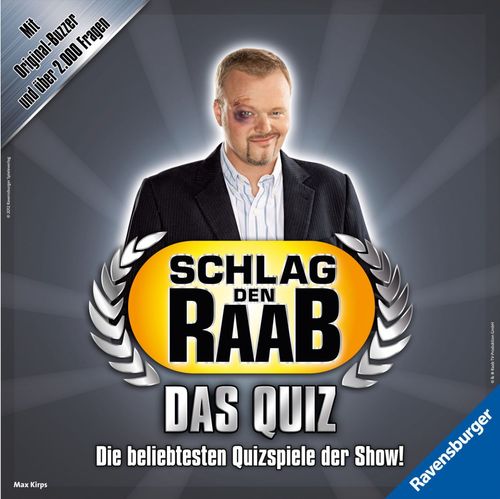
Schlag den Raab: Das Quiz
Schlag den Raab: Das Quiz Rulebook
Table of Contents
Table of Contents
- Game Material
- Basic Rules
- The Individual Games
- Autokennzeichen (Car License Plates)
- Blamieren oder Kassieren (Embarrass or Cash In) (3)
- Buchstabensalat (Letter Salad)
- Buchstaben zählen (Counting Letters) (3)
- Buchstabieren (Spelling)
- Entfernungen (Distances)
- Entweder – Oder! (Either - Or!)
- Filmzitate (Movie Quotes)
- Fremdsprachen (Foreign Languages)
- Führerscheinprüfung (Driving Licence Test)
- Kopfrechnen (Mental Arithmetic)
- Buzzer
Game Material
- 2 stand feet
- 2 "Stimmt's?" chips
- 1 Stefan stand-up, 1 Elton / Steven stand-up
- 2 playing pieces (1 red, 1 blue)
- 1 Buzzer
- 1 round indicator (grey), 2 score indicators (1 red, 1 blue)
- 1 sorting aid with sorting strips for the individual quiz games
- 2 game-selection spinners (to be assembled)
- 3 small wooden dice
- Combo spinner (double-sided) for Das Quiz + Schlag den Raab 1 or 2
- Quiz spinner for Schlag den Raab – Das Quiz
- 1 sand timer
- 240 quiz and game cards*: 233 quiz cards, 4 Teamplayer cards, 3 Wild Cards (* The quiz cards have an orange corner. This is how you can easily tell them apart from the cards of Schlag den Raab 1 (yellow) and 2 (silver).)
- 1 score track for the individual games
- 8 letter chips (4 red, 4 blue)
- 1 two-part world map (reverse sides: Germany and Europe)
- 2 risk discs (to be assembled)
Basic Rules
Game Idea
One player takes on the role of Stefan Raab. His fellow players form the candidate team and take turns competing against Stefan in up to 15 different quiz games. As in the TV show, points are awarded for every game won. The side with the most points at the end of the game wins.
Preparation
Before the first game: First carefully punch all pieces out of the frame. Then place the sorting strip in the middle of the box so that next to each quiz game name there is a compartment for the associated quiz cards. Sort the quiz cards in there. This way you always have immediate access to every game.
Before every game:
- Place the box bottom on the table and the two coloured score indicators and the grey round indicator next to it. The round indicator later marks the number of games played. The score indicators mark the total score on the edge of the box.
- Place the score track in front of the box and stand both playing pieces on the "0" space of their colour. They are later used to show the points of the individual games.
- Assemble the quiz spinner as shown. You only need the second spinner if you want to play this game together with Schlag den Raab 1 or 2 (see box "Combinations").
- Assemble the two risk discs as shown.
- Switch on the buzzer on the underside of its housing. To save the battery you should switch it off again after the game.
Combinations You can combine Schlag den Raab – Das Quiz freely with all previous Schlag den Raab games:
- 1st game + Das Quiz: Use the combo spinner with the side "Quiz & 1" up.
- 2nd game + Das Quiz: Use the combo spinner with the side "Quiz & 2" up.
- 1st game + 2nd game + Das Quiz: For the categories Action & Risk (black) and Luck & Skill (silver) use the giant spinner from Schlag den Raab 2. For the orange games (Puzzles & Brainpower) spin the quiz spinner instead. For all combinations, use the box bottom of Schlag den Raab 1 or 2 to display the total points and rounds.
Stefan First agree on who plays as Stefan. He gets the Stefan stand-up and receives 1, 2 or 3 Wild Cards (depending on the game length, see below). All blue materials belong to Stefan.
Candidates All other players together form the candidate team. Each of them takes a Teamplayer card and lays it in front of them with the team side up. If fewer than 4 candidates are playing, simply put the remaining Teamplayer cards aside. The candidates always play with red.
Host As in the TV show, every game has a host. He chooses the game, decides in cases of doubt and awards the points. And if he wants, he comments on the duel ... The host is provided by the candidate team and must be impartial for as long as he holds the office. For game number 1 you choose the host freely from the team. After that, whoever has just played against Stefan always becomes the next host. The current host receives the stand-up.
Game Length Before starting, the players agree on the maximum number of quiz games they want to play in this session. The duration of the game depends on it:
- "Ratzfatz": up to 5 games (= 1 Wild Card for Stefan), playing time approx. 45-60 min.
- "Medium": up to 10 games (= 2 Wild Cards for Stefan), playing time approx. 75-90 min.
- "Showtime": up to 15 games (= 3 Wild Cards for Stefan), playing time approx. 100-120 min.
Course of Play
- Choose a game
- Choose a candidate
- Play
- Award points
1. Choose a game First, put the grey round indicator on the "Game 1" space of the box edge. To choose a game, the host takes the spinner. He spins it with a strong swing and then stops it by tapping the spinning surface with his finger. The space his finger points to indicates the next game. Has that game already been played in this session? Then choose instead the next game clockwise that you have not yet played.
2. Choose a candidate
- As soon as the game is determined, the candidates decide which of them should play against Stefan for the team in this game.
- Only candidates whose Teamplayer card is still face up (team side) can be chosen. (At the start of the game, that is all players.)
- After a candidate has played a game, he turns his card over so that the audience side is visible. He is then no longer available for selection for the time being. Only when every candidate has played one game do all turn their cards back so that the team side is visible. A candidate may therefore only play again once all his teammates have played once.
- Wild Card: Now Stefan can decide whether he wants to use a Wild Card. With it he may name an opponent other than the one chosen by the candidate team. He too can only choose among the candidates whose Teamplayer card is face up. If Stefan uses a Wild Card, it is then removed from the game.
3. Play In every game, the side (Stefan or the team) that is behind on the score track may decide who begins. If tied, the team begins.
Now it counts! You will find the rules for the individual games from p. 5. The host reads them out or explains them before each game. During the duel the remaining teammates should cheer on their candidate loudly!
4. Award points After the game, the winning side receives points. Game number 1 is worth 1 point, game number 2 is worth 2 points, etc. Their score indicator is advanced by the corresponding number of spaces on the box edge. Then the round indicator is advanced to the next space. Then you choose the next game with the spinner again, etc.
End of the Game
The game ends immediately as soon as one of the two sides has so many points that it can no longer be caught. That side wins. The table shows how many points it needs for that:
| Game length | Points needed |
|---|---|
| Ratzfatz | 8 points |
| Medium | 28 points |
| Showtime* | 61 points |
*If at "Showtime" the score is tied after 15 games, there is a tie-break. Choose one more game. The side that wins the tie-break is the winner of the game.
The point spaces 8, 28 and 61 are highlighted on the box edge.
Rule Supplements (for 2 and for 6 or more players)
2 players: In a two-player game there is no host. Choose the games alternately with the spinner. Some games can only be played with 3 or more players. They are marked with a "3" on the spinner and in the instructions. In that case choose a new game. Since the candidate for each game is fixed, you need neither the Teamplayer cards nor the Wild Cards. Important: Read out the quiz questions alternately. Use a new card for each question.
Team game (6 or more players): In larger groups you can also play Schlag den Raab with two teams: "Candidate team" against "Team Stefan". As soon as the game is determined, both teams decide who of them plays. The host is provided either by both teams alternately, or you choose a "full-time" host in advance: since in that case he belongs to no team, he may choose the games freely in order to make the game especially exciting. You do not need the Teamplayer cards and Wild Cards in the team game.
The Individual Games
(in alphabetical order)
For some games you need additional materials (mostly pen and paper). These are set in italics in the text. A photocopiable template for notes is on p. 19. Note: In many games the answer is on the back of the quiz card!
Autokennzeichen (Car License Plates)
For which city does which license plate stand?
You need:
- Score track and playing pieces
- Quiz cards "Autokennzeichen" (1-5)
- Buzzer
Put the buzzer in the middle of the table between the two players. The playing pieces go on space 0 of the score track; the host takes the quiz cards.
How it works:
- The host takes one of the quiz cards and begins with the first license plate on the card. First he says whether the plate consists of 1, 2 or 3 letters.
- Then he names the plate. The players now have to guess which city the abbreviation stands for.
- Whoever wants to answer must press the buzzer first. If after 5 seconds nobody has "buzzed", the host gives the answer and asks the next question.
- From the moment a player buzzes, the host slowly counts down from 5. The player must answer in this time.
- If he answers correctly, he gets 1 point on the score track.
- If he answers wrongly or not at all, the opponent gets the point.
- Then the host names the next license plate, etc.
- Whoever first has 4 points wins.
Autokennzeichen for two:
- In a two-player game each player takes a quiz card.
- The players take turns reading the 6 license plates of their card to their opponent. The opponent tries to solve each within about 5 seconds. Points are awarded as described above.
- Whoever has more points at the end wins. If tied, the game is repeated with 6 new license plates each.
Blamieren oder Kassieren (Embarrass or Cash In) (3)
Who has the right answer ready quickly?
You need:
- Score track and both playing pieces
- Quiz cards "Blamieren oder Kassieren" (6-25)
- Buzzer
Put the buzzer in the middle of the table between the players. The playing pieces go on space 0 of the score track. The host takes the quiz cards and turns the host stand-up so that Elton is now visible.
How it works:
- The host chooses any quiz card and reads out the top question.
- Whoever wants to answer must press the buzzer first.
- Now the host slowly counts down from 5. The player must answer in this time.
- Correct answer: The player gets 1 point on the score track.
- Wrong or no answer: The opponent gets the point.
- In addition, the opponent may (not must!) answer himself to make a "grab" - that is, to win a further point. For this the host again slowly counts down from 5. If he answers in time and his answer is wrong, the other player gets 1 point. If he does not want to answer, nothing happens.
- Then play continues with the next question. As soon as a player has 5 points, he has won.
Notes:
- If nobody presses the buzzer for a question, the host first slowly counts down from 5. If still nobody buzzes, he asks the next question.
- If a player buzzes while the question is being asked, the host interrupts the question immediately. He also does not read on afterwards.
Buchstabensalat (Letter Salad)
Schirf anregichtet!
You need:
- Quiz cards "Buchstabensalat" (26-34)
- Score track and both playing pieces
- Buzzer
Put the buzzer in the middle of the table between the players. The playing pieces go on space 0 of the score track. The host takes the quiz cards.
How it works:
- The host takes one of the quiz cards. On it are a category and 10 associated words in which the order of the letters has been scrambled.
- He chooses one of the words and reads it out as fluently as possible. The players now have to guess what the word really is.
- Whoever wants to answer must press the buzzer first.
- He now has about 3 seconds to answer:
- Correct answer: The player gets 1 point on the score track.
- Wrong or no answer: The opponent gets the point. Note: The solution is on the back of the card.
- Then the host reads out another "twisted" word, either from the same quiz card or from any other. If he takes another quiz card, he first names the new category.
- Whoever first has 5 points wins.
Buchstabensalat for two:
- In a two-player game you need the sand timer instead of the buzzer, plus 2 pens and paper.
- Turn the sand timer over and then lay a randomly drawn Buchstabensalat card between you so that you can both read it well.
- Now you both try simultaneously to write down as many of the 10 words correctly as possible. The game ends when either the sand timer has run out or a player has noted all 10 terms on the card and calls "finished".
- Then the players swap their papers and check with the back of the card who found more correct solutions (only legible answers count!) and is therefore the winner. If tied, the game is repeated with a new quiz card.
Buchstaben zählen (Counting Letters) (3)
How many letters are in this word?
You need:
- Score track and playing pieces
- Buzzer
- Quiz cards "Buchstaben zählen" (35-39)
- 2 pens and paper
Put the buzzer in the middle of the table between the players. The playing pieces go on space 0 of the score track. The host takes the quiz cards. Both players receive pen and paper.
How it works:
- The host reads out the first word of the quiz card.
- Both players quickly think how many letters the word consists of and write down their guess face down. (All words are written without hyphens; "ö", "ä" etc. count as 1 letter.)
- Only whoever buzzes first may show his guess.
- If he is right, he gets 1 point on the score track.
- If he is wrong, the opponent gets the point.
- Then the host reads out the next word on the card, etc.
- Whoever first has 5 points wins.
Buchstabieren (Spelling)
Who spells better - backwards, no less ...
You need:
- Score track and playing pieces
- Quiz cards "Buchstabieren" (40-44)
- Sand timer
- Pen and paper
The playing pieces go on space 0 of the score track. The host holds the quiz cards in his hand, puts pen and paper ready in front of him and puts the sand timer on the table. The first player stays in the room; the opponent must leave it for the time being.
How it works:
- As soon as the first player is ready, the host turns the sand timer over and reads him the first term on the quiz card.
- The player now tries to spell this term backwards without errors (e.g.: "Mut" = T-U-M). There are 3 possibilities:
- Spelled correctly: The host confirms with "correct", the player's playing piece is advanced one space and the host immediately names the next term.
- Spelled incorrectly: As soon as the player makes a mistake while spelling, the host immediately says "wrong", the opponent's playing piece is advanced one space and the host names the next term. Every wrongly named letter counts as a mistake, e.g. also every letter wrongly named twice, etc.
- Skip a term: If the player does not want to spell the term, he may say "next", and the host immediately names the next term on the card. However, you should not do this too often, because the terms get longer and longer and a maximum of the 10 terms on the selected quiz card side may be spelled per game. A term that has once been skipped may not be spelled by the player later.
- As soon as either the sand timer has run out or the 10th term on the card has been played, the player's turn ends immediately. The host notes the points achieved for correct solutions (the player's piece) and the number of mistakes (the opponent's piece).
- Then the playing pieces go back to space 0 of the score track and the opponent is called in. He must spell the same terms as the player before, under the same rules.
- Whoever has spelled more terms correctly at the end, i.e. reached more points, wins. If tied, whoever made fewer mistakes wins. If that is also tied, the game is repeated with new terms.
Buchstabieren for two: Here the first player must spell the words on the front of the card and his opponent those on the back. And of course no player has to leave the room ...
Entfernungen (Distances)
How far is it from A to B?
You need:
- Score track and both playing pieces
- Quiz cards "Entfernungen" (45-50)
- 2 pens and paper
The players each receive pen and paper. The host takes the quiz cards. The playing pieces go on space 0 of the score track.
How it works:
- The host reads out the first two cities on the quiz card. The players now guess how far apart these cities are by the shortest car route.
- Both secretly write down the distance they estimate (in km).
- When both have noted their guess, they tell it to the host. He then gives the solution. It is on the back of the card.
- Whoever is closer to the solution (whether above or below) advances 1 space on the score track.
- Then the host reads out the next two cities, etc.
- Whoever first has 4 points wins.
Notes:
- If both players are equally far from the solution, nobody gets the point.
- The distance given in the solution is the mean value of various route planners.
Entweder – Oder! (Either - Or!)
A or B, that is the question here ...
You need:
- Quiz cards "Entweder – Oder!" (51-58)
- Letter chips A and B in blue and red
- Score track and both playing pieces
The players receive the two chips of their colour; the host takes the quiz cards. The playing pieces go on space 3 of the score track.
How it works:
- The host reads out the first question together with the two possible answers.
- Each player thinks which answer is correct and lays either chip A for the first answer or chip B for the second face down in front of him on the table.
- After both have decided, they reveal their chip.
- The host resolves the question. The answer is on the back of the card.
- Whoever is wrong loses 1 point on the score track. (If both guessed wrong, both lose 1 point.) There are no points for correct answers.
- Then the host reads out the next question, etc.
- Whoever first lands on space 0 of the score track has lost. If tied, play continues until the winner is determined. That is the case as soon as one player guessed right and the other wrong.
Filmzitate (Movie Quotes)
Play it again, Stefan ...
You need:
- Quiz cards "Filmzitate" (59-68)
- Buzzer
- Letter chips A to D in blue and red
- Score track and both playing pieces
Put the buzzer in the middle of the table between the players. The host takes the quiz cards; both players receive the 4 chips of their colour. The playing pieces go on space 0 of the score track.
How it works:
- The host reads out a movie quote. He does not yet name the four answer options.
- Whoever wants to answer must press the buzzer first. From this moment he has about 5 seconds to name the correct movie:
- Correct answer: The player gets 1 point on the score track.
- Wrong or no answer: The opponent gets the point.
- Nobody buzzes? If neither player wants to press the buzzer to answer, the four answer options come into the game (and the buzzer briefly out of it). The host now names, from A to D, the four movies the quote may come from.
- Both players think which movie is the correct answer. Then they lay the corresponding chip face down in front of them on the table.
- When both players have decided, they turn their chip over. The host names the correct answer (it is on the back of the card). Whoever is right gets 1 point on the score track.
- Then the host reads out the next movie quote, etc.
- Whoever first has 5 points wins. If tied, you keep playing until one player is in the lead.
Note: For movies with several parts, naming the film series is enough (e.g. "Indiana Jones"). The information given in brackets in the answer (e.g. "Raiders of the Lost Ark") is therefore not strictly necessary.
Filmzitate for two: In a two-player game you do not need the buzzer. Instead you guess directly with the letter chips on one of the four answer options as described above.
Fremdsprachen (Foreign Languages)
Gibberish for language pros!
You need:
- Score track and both playing pieces
- Quiz cards "Fremdsprachen" (69-78)
- Buzzer
Put the buzzer in the middle of the table between the players. The playing pieces go on space 0 of the score track. The host takes the quiz cards.
How it works:
- The host reads out slowly, one after another with a few seconds between each, up to 5 translations of the same German word in foreign languages.
- The players must guess the German word being sought.
- Whoever wants to answer must buzz first. From this moment the host reads out no further translations of the word.
- The player now has about 5 seconds to answer:
- Correct answer: The player gets 1 point on the score track and the task is out of the game.
- Wrong or no answer: The opponent gets the point and the host reads out the next translation.
- If after the 5th translation nobody wants to answer, the host gives the solution and starts the next task.
- Whoever is ahead on the score track after 5 sought words wins. If tied, the host sets further tasks until one player takes the lead.
Notes:
- The translations come from almost 20 different languages: just read them out as they are on the card.
- As a hint the host can name in advance the language the translation comes from. What abbreviation stands for which language you can find below: (da) Danish; (en) English; (es) Spanish; (fr) French; (hu) Hungarian; (is) Icelandic; (it) Italian; (lt) Lithuanian; (nl) Dutch; (pl) Polish; (pt) Portuguese; (ro) Romanian; (sv) Swedish; (sw) Swahili; (tr) Turkish; (vi) Vietnamese
Fremdsprachen for two:
- In a two-player game you do not need the buzzer. Each player takes a quiz card.
- One player begins as questioner with the top task of his quiz card. He reads out the 5 translations of the sought word one after another. After each word the person being asked may decide whether he wants to answer. If he answers correctly after the first translation, he gets 5 points on the score track, after the second translation 4, after the third 3, etc. With a wrong answer, however, the task is immediately out of the game!
- In this way the players alternately pose all three tasks of their quiz card to each other. Whoever has more points afterwards wins. If tied, the game is repeated with new tasks.
Führerscheinprüfung (Driving Licence Test)
Please fasten your seat belts!
You need:
- Quiz cards "Führerscheinprüfung" (79-93)
- Letter chips A, B and C in blue and red
- Score track and both playing pieces
Both players receive the chips of their colour. The host takes the quiz cards. The playing pieces go on space 4 of the score track.
How it works:
- The host reads out the first driving-test question and names the up to three possible answers. At least one of them is correct, but two or all three answers may also be right.
- Both players now think which of the answers is/are correct, lay the corresponding chip(s) face down in front of them on the table and cover them with a hand.
- When both have decided, they reveal their guesses and the host names the correct answer(s). They are on the back of the card.
- For every mistake the respective player loses 1 point on the score track. There are no points for correct guesses. Example: The correct answer is "A". The player guessed "B" and "C". He now loses 3 points: one for not having guessed the correct answer "A", and one each for his wrong guesses "B" and "C".
- Then the host reads out the next question, etc.
- Whoever first lands on space 0 of the score track (or "below") has lost. If tied, play continues until a player has more mistakes than his opponent on one question and thereby loses.
Kopfrechnen (Mental Arithmetic)
The game for quick calculators!
You need:
- Score track and both playing pieces
- Quiz cards "Kopfrechnen" (94-98)
- Buzzer
The playing pieces go on space 0 of the score track. Put the buzzer in the middle of the table between the players. The host takes the quiz cards.
How it works:
- The host reads out the first mental arithmetic task. The players must now work out the correct result without aids.
- Whoever wants to answer presses the buzzer. Then he has about 3 seconds to answer:
- Correct answer: The player gets 1 point on the score track.
- Wrong or no answer: The opponent gets the point.
- Then the host reads out the next task. This also applies if no player wants to solve the current task.
- Whoever first has 4 points wins.
Kopfrechnen for two:
- For the two-player game you need the sand timer instead of the buzzer.
- One player begins as task-setter. He takes a quiz card, reads the first task to his opponent and turns the sand timer over.
- As soon as the opponent has solved the task correctly, the task-setter names the next one. With a wrong solution he simply repeats the current task instead.
- When the sand timer has run out, you mark the number of solved tasks on the score track and swap roles.
- Whoever has the most points at the end of the game wins. If tied, you repeat the game with new tasks.
Lieder malen (Drawing Songs) (3)
"Picture-perfect" songs!
You need:
- Score track and both playing pieces
- Quiz cards "Lieder malen" (99-102)
- Buzzer
- Pen and paper
Put the buzzer in the middle of the table between the players. The playing pieces go on space 0 of the score track. The host takes the quiz cards and puts pen and paper ready in front of him.
How it works:
- The host secretly picks a song from a quiz card. Then he draws it on the paper. He may not use any letters or numbers.
- The players must guess which song it is. For this it is important that they can always see the drawing well.
- Whoever wants to answer must press the buzzer first. If at first nobody wants to answer, the host can give hints, e.g. name the performer.
- From the buzz the player has about 5 seconds to answer:
- Correct answer: The player gets 1 point on the score track.
- Wrong or no answer: The opponent gets the point.
- Then the host draws the next song from a quiz card, etc. This also applies if nobody wants to answer despite the host's drawing skills and hints.
- Whoever is ahead on the score track after 5 drawn songs wins. If tied, play continues until a player takes the lead.
Note: You can also use the quiz cards for the game "Lieder summen" - and vice versa!
Lieder summen (Humming Songs) (3)
Which song is that again?
You need:
- Score track and both playing pieces
- Buzzer
- Quiz cards "Lieder summen" (103-106)
Put the buzzer in the middle of the table, equally easy to reach for both players. The playing pieces go on space 0 of the score track. The host takes the quiz cards.
How it works:
- The host picks a song (known to him) from the quiz card. Then he whistles or hums its melody. The players must guess which song it is.
- Whoever wants to answer must press the buzzer first. If at first nobody wants to answer, the host can give hints, e.g. name the performer. If nobody wants to answer even then, the host hums the next song he knows from this (or another) quiz card.
- From the moment a player buzzes, the host slowly counts down from 5. The player must answer in this time:
- If he answers correctly, he gets 1 point on the score track.
- If he answers wrongly or not at all, the opponent gets the point.
- Then the host hums or whistles the next song he knows from the quiz card, etc.
- Whoever is ahead on the score track after 5 songs wins. If tied, play continues until a player takes the lead.
Schätzen (Estimating)
Whose guess is closer?
You need:
- Score track and both playing pieces
- Quiz cards "Schätzen" (107-115)
- 2 pens and paper
The players each receive pen and paper; the host takes the quiz cards. The playing pieces go on space 0 of the score track.
How it works:
- The host reads out the first estimation question on the quiz card and says in which unit (kg, cm, days or similar) he needs the answer.
- Both players secretly write down a number as their guess.
- When both have noted their guess, they tell it to the host. He then resolves the question (answer: see back of card).
- Whichever of the two is closer to the solution (whether above or below) moves 1 space forward on the score track.
- Then the host asks the next question, etc.
- Whoever first has 4 points wins.
Note: If both players are equally far from the solution, nobody gets the point.
Showquiz
Tricky stuff for connoisseurs, experts and candidates!
You need:
- Quiz cards "Showquiz" (116-125)
- Letter chips A to D in blue and red
- Buzzer
- Score track and both playing pieces
- 2 pens and paper
Put the buzzer in the middle of the table between the players. The playing pieces go on space 0 of the score track. The players each receive pen and paper as well as the chips of their colour. The host takes the quiz cards.
How it works:
- The host first tells the players whether it is a buzzer, choice or estimation question. Then he reads out the show quiz question. You find the answer on the back of the card.
- Buzzer: This is about speed. Whoever wants to answer must press the buzzer first. He then has about 3 seconds to answer. If the answer is correct, the player gets 1 point on the score track. If he gives a wrong answer or none, the opponent gets the point.
- Choice: In addition to the question, the host reads out the four answer options available. Both players think which is the correct answer and lay the corresponding letter chip face down in front of them on the table. Then they reveal their chip. For the correct answer there is 1 point on the score track; for a wrong one the opponent gets the point.
- Estimating: Both players secretly write down a number as the answer to the estimation question. When both have noted their guess, they tell it to the host. Whoever is closer to the solution named by the host (whether above or below) gets 1 point. If both are equally far from the solution, nobody gets the point.
- Whoever first has 5 points wins.
Showquiz for two: In a two-player game you simply leave out the buzzer questions.
Sortieren (Sorting)
Always nicely in order ...
You need:
- Score track and both playing pieces
- Quiz cards "Sortieren" (126-135)
- Letter chips A to D in blue and red
The playing pieces go on space 0 of the score track. The host takes the quiz cards. Both players receive the chips of their colour.
How it works:
- The host reads out the first task and names the 4 things that the players must put into the correct order. Then he lays the card on the table so that both players can read it.
- Both players think what the correct order of the 4 things is and lay their letter chips face down in a row from left to right (e.g.: A, C, D, B).
- The host now names the correct order. It is on the back of the card.
- Whoever is right gets 1 point.
- Then the host reads out the next task from a new quiz card.
- Whoever is ahead after 4 questions wins. If tied, play continues until a player is in the lead.
Sprichwörter (Proverbs) (3)
A miss is as good as a mile ...
You need:
- Quiz cards "Sprichwörter" (136-141)
- Buzzer
- Score track and both playing pieces
Put the buzzer in the middle of the table between the players. The playing pieces go on space 0 of the score track. The host receives the quiz cards.
How it works:
- The host chooses a proverb from the quiz card. Then he reads out the part that stands directly after the question number. This can be the front or the back part of the proverb.
- The players must now complete the missing part.
- Whoever wants to answer must press the buzzer first. Then the player has about 3 seconds to name the missing half:
- Completed correctly: The player gets 1 point on the score track.
- Completed wrongly or no answer: The opponent gets the point.
- Then the host reads out the next "half" proverb, etc.
- Whoever first has 5 points wins.
Stimmt's? (True?)
That can't be true! Or maybe it can ...?
You need:
- Score track and both playing pieces
- Quiz cards "Stimmt's?" (142-151)
- Both "Stimmt's?" chips
The players receive the "Stimmt's?" chip of their colour; the host takes the quiz cards. The playing pieces go on space 3 of the score track.
How it works:
- The host reads out a statement from the selected quiz card.
- The two players think about whether the statement is true. Then they lay their chip on the table, covered by their hand, so that either the side with the green check mark (= true) or the side with the black "X" (= not true) is face up.
- After both players have decided, they take their hand off the chip.
- The host resolves the statement. The answer is on the back of the card.
- Whoever guessed wrong moves back 1 space on the score track. (If both guessed wrong, both move back 1 space each.) There are no points for a correct guess.
- The host reads out the next statement, etc.
- As soon as a player moves onto space 0 of the score track, he loses the game.
- If tied (both move onto space 0 at the same time), play continues until the winner is determined.
Suchmaschinen (Search Engines) (Game 1 and Game 2)
Looking for a direct hit!
You need:
- Score track and both playing pieces
- Quiz cards "Suchmaschinen" (152-155)
- 2 pens and paper
- Internet access
The host decides whether you play Search Engine 1 or 2 (see below). He takes the quiz cards. The players each receive pen and paper. The playing pieces go on space 0 of the score track.
Search Engine 1:
- The host reads out a term from the quiz card. The players extend this term so that it gets as many hits as possible in an internet search engine.
- To do so they must lengthen the starting word by at least 3 letters. "Auto" could for example become "Autoreifen", "Autohaus", but also "Autoren". The spelling of the starting word may not be changed (so for example do not turn "Brot" into "Brötchen" or "Wahl" into "Walfang")! The starting word must always be extended at the end of the word.
- The players have 20 seconds to note their word. The host counts the seconds down aloud (or uses a stopwatch or similar).
- Then the players tell their word to the host. He enters both one after another into a search engine. Whichever player gets more hits receives 1 point on the score track.
- If both players formed the same word, another round is played immediately with the starting word. The wording formed before may not be used again, though its plural etc. may.
- Then the host reads out a new starting word, etc.
- Whoever first has 4 points wins.
Search Engine 2: The game works like Search Engine 1, with the following change: here the aim is to get as few hits as possible. There must, however, be more than 0. If both players have 0 hits, the round is repeated with the same word (see above). All other rules stay the same.
Tipp für Tipp (Hint by Hint)
A good guess is half the battle!
You need:
- Quiz cards "Tipp für Tipp" (156-165)
- Buzzer
- Score track and both playing pieces
Put the buzzer in the middle of the table between the players. The playing pieces go on space 0 of the score track. The host receives the quiz cards.
How it works:
- The host first reads out the category to which the sought term belongs (e.g. city).
- Then he names, one after another, up to 5 hints pointing to the sought term. Between the hints he gives the players a few seconds each to think.
- Whoever thinks he knows the sought term presses the buzzer. From this moment the host gives no further hints for the time being.
- The player must now answer within about 3 seconds.
- Correct answer: The player gets 1 point on the score track and the question is out of the game.
- Wrong or no answer: The opponent gets the point and the host reads out the next hint.
- If after the 5th hint nobody wants to answer, the host names the sought term and starts the next task.
- Whoever first has 4 points wins the game.
Tipp für Tipp for two:
- In a two-player game each player takes a quiz card. You do not need the buzzer.
- One player begins and reads his opponent the category and the 5 hints of the top task one after another. After each hint the opponent may decide whether he answers. If he answers correctly after the first hint already, he gets 5 points on the score track for it, after the second term 4, after the third 3, etc. With a wrong answer, however, the task is immediately out of the game!
- In this way both players alternately pose their opponent all three tasks of one side of their quiz card.
- Whoever has more points after the third task wins. If tied, you each pose another task until one player is in the lead and thereby wins.
Wann war das? (When Was That?)
The days-of-yore quiz!
You need:
- Score track and both playing pieces
- Quiz cards "Wann war das?" (166-173)
- 2 pens and paper
The players each receive pen and paper; the host takes the quiz cards. The playing pieces go on space 0 of the score track.
How it works:
- The host reads out the first event from the quiz card.
- Both players secretly write down a year as their guess.
- When both have done so, they tell their guess to the host. He then reads out the answer (see back of card).
- Whichever of the two is closer to the solution (whether above or below) advances 1 space on the score track. If both players wrote down the same year or are equally far from the solution, nobody gets the point.
- Then the host reads out the next event, etc.
- Whoever first has 4 points wins.
Wer lügt? (Who Is Lying?)
Caught out ...
You need:
- Quiz cards "Wer lügt?" (174-183)
- Buzzer
- Score track and both playing pieces
Put the buzzer in the middle of the table between the players. The playing pieces go on space 0 of the score track. The host receives the quiz cards.
How it works:
- The host reads out a statement from the quiz card. Then he begins reading the players (a few seconds apart each) the associated answers to which the statement may apply.
- At least 2 of the answers are wrong. And these are exactly what the players must find.
- Whoever thinks he has recognised a wrong answer presses the buzzer immediately.
- At that moment the host interrupts the reading and checks whether the answer is actually wrong. He recognises this by it being printed in bold.
- Hit: The answer is indeed wrong. The player receives 1 point on the score track for it. The host then reads out the next answer.
- Miss: The answer that was read out is correct. The point goes to the opponent and the host reads out the next answer.
- After all 7 possible answers have been named, the host reveals the wrong answers, reads out the next statement, etc.
- Whoever first has 4 points wins the game.
Wer lügt? for two:
- In a two-player game you need 2 pens and paper instead of the buzzer.
- Both players each take a quiz card. One player begins as questioner and reads the opponent the statement and all 7 answer options of the top task. The opponent notes the answers he considers wrong.
- For each hit he receives 1 point, for each mistake the questioner receives 1 point. Then you swap roles.
- In this way both players alternately pose their opponent all three tasks of their quiz card. Whoever has more points after the third task wins. If tied, you each pose another task until one player is in the lead and thereby wins.
Wer weiß mehr? (Who Knows More?)
The game for know-it-alls!
You need:
- Score track and both playing pieces
- Quiz cards "Wer weiß mehr?" (184-193)
The host takes the quiz cards. The playing pieces go on space 0 of the score track.
How it works:
- The host reads out the first question on the quiz card. Every question has an exact number of correct answers.
- The players answer the question alternately. The starting player begins.
- Correct answer: The opponent is next and must answer.
- Wrong, duplicate or no answer: The opponent receives 1 point and the question is out of the game.
- All correct answers to the question have been named: No point is awarded, the question is out of the game.
- Then the host asks the next quiz question. If, for example, Stefan had to answer first on the first question, now the candidate begins, etc.
- Whoever first has 3 points wins.
Wer weiß mehr? for two:
- For the two-player game you additionally need the sand timer and 2 pens and paper. Both players each take a quiz card.
- The players take turns. One player begins as questioner. He chooses from his quiz card a task with at least 7 answers, turns the sand timer over and reads out the task. His opponent writes down as many correct answers as possible.
- As soon as the sand timer has run out, the answers are checked. For each correct answer he receives 1 point on the score track. For each wrong one the questioner receives the point. Then the players swap roles.
- Whoever is in the lead after 2 tasks per player wins. If tied, you each pose another task to each other until one player is in the lead afterwards and thereby wins.
Wo läuft was? (What's On Where?)
Who knows their way around the TV jungle?
You need:
- Quiz cards "Wo läuft was?" (194-198)
- Buzzer
- Score track and both playing pieces
Put the buzzer in the middle of the table between the players. The playing pieces go on space 0 of the score track. The host receives the quiz cards.
How it works:
- The host names, one after another, up to 3 TV shows that all run on the same channel (excluding pay-TV channels). The players must guess the sought TV channel. So that they can think a little between the clues, the host reads them out a few seconds apart.
- Whoever wants to answer presses the buzzer. The player must now answer within about 3 seconds.
- Correct answer: The player gets 1 point on the score track and the task is out of the game.
- Wrong or no answer: The opponent gets the point and the host reads out the next show.
- If after the 3rd show nobody wants to answer, the host starts the next task.
- Whoever first has 4 points wins the game.
Note: Some TV shows run on several channels. It can therefore sometimes be worth waiting for another clue, because the combination of the 3 shows exists exclusively on the channel being sought.
Wo läuft was? for two:
- In a two-player game each player takes a quiz card.
- One player begins and reads his opponent the 3 clues of the top task one after another. After each clue the player may decide whether he answers. If he answers correctly after the first clue, he receives 3 points on the score track for it, after the second 2 and after the third 1. With a wrong answer, however, the task is immediately out of the game!
- In this way both players alternately pose their opponent all three tasks of their quiz card. Whoever has more points after the third task wins. If tied, you each pose another task until one player is in the lead afterwards and thereby wins.
Wo liegt was? (Where Is What?) (Germany, Europe and World Game)
Who knows their way around Germany, Europe and the world?
You need:
- Score track and both playing pieces
- Double-sided map (two parts)
- Quiz cards "Wo liegt was?" (199-204), (205-210), (211-216)
- 3 wooden dice (one each in red, blue and grey)
The host decides whether you play "Wo liegt was?" on the Germany, Europe or world map. He lays the corresponding map in the middle between the players. Then he takes the matching quiz cards (license plate "D" for Germany, "EU" for Europe or "Globus" for world) and the grey wooden die. The players each receive the wooden die of their colour. The playing pieces go on space 0 of the score track.
How it works:
- The host reads out the first question on the quiz card. It always asks for a place.
- The players place their wooden die in the square in which, in their opinion, the place lies. Once they have placed their die, they may not move it.
- If a square is already occupied by the opponent's die, the player may no longer place his die there. First come, first served ...
- If the players take too long, the host slowly counts down from 5. Whoever has not placed by "0" is out of luck this round.
- When both players have placed, the host puts the grey die in the solution square (see back of card). Then he checks who is closer to the solution. For this he counts the distance in squares (not diagonally).
- Whoever is closer advances 1 space on the score track. If both players are equally far from the solution place, nobody gets the point.
- Then the host asks the next question, etc.
- Whoever first has 4 points wins.
Wörter rückwärts (Words Backwards)
!gireiwhcs nöhcs znaG
You need:
- Score track and both playing pieces
- Quiz cards "Wörter rückwärts" (217-221)
- Buzzer
Put the buzzer in the middle of the table between the players. The playing pieces go on space 0 of the score track. The host takes the quiz cards.
How it works:
- The host reads out from the quiz card the first word written backwards as fluently as possible. The players must now guess which solution word it is.
- Whoever wants to answer must press the buzzer first.
- He now has 5 seconds to answer:
- Correct answer: The player gets 1 point on the score track.
- Wrong or no answer: The opponent gets the point.
- Then the host reads out the next word written backwards, etc.
- Whoever first has 4 points wins.
Note: You can also use the quiz cards for the game "Buchstabieren" - and vice versa!
Wörter rückwärts for two:
- In a two-player game you need the sand timer instead of the buzzer.
- One player begins as task-setter. He takes a quiz card, turns the sand timer over and reads the first word to his opponent. As soon as the opponent has named the solution word, the task-setter reads out the next word on the quiz card. With a wrong answer he simply repeats the current word instead.
- As soon as the sand timer has run out, you mark the number of solved words on the score track. Then you swap roles: the other player takes a quiz card, turns the sand timer over, etc.
- Whoever has the most points afterwards wins. If tied, you repeat the game with new tasks.
Zocken (Gambling) (3)
Bid, guess and win!
You need:
- Quiz cards "Zocken" (222-233)
- Letter chips A to D in blue and red
- Both risk discs
- Score track and both playing pieces
The host takes the quiz cards. Both players receive the chips and the risk disc of their colour. The playing pieces go on space 4 of the score track (= starting point credit).
How it works:
- The host chooses a quiz question and at first names only the subject area printed above it.
- The players now set on their risk disc whether they stake 1, 2 or 3 points of their point credit on answering the following question correctly. They show how much they bid only after both have set their bid.
- The host reads out the question and the four answer options from A to D.
- Both players think which is the correct answer and lay the corresponding chip face down in front of them on the table.
- When both players have decided, they turn their chip over.
- The host names the correct answer (it is on the back of the card).
- Whoever is right adds the staked points to his credit on the score track.
- Whoever is wrong loses the staked points on the score track.
- Then the host reads out the next subject area, the players set their bid, etc.
- The game ends a) when a player has at least 10 points. He is the winner. Or: b) when a player has 0 points. He is the loser. Or: c) when after 7 questions nobody has 0 or more than 9 points. In this case the winner is whoever has more points at that moment. If tied (whether case a, b or c), you keep playing until one player takes the lead and thereby wins.
Buzzer
The buzzer uses two 1.5V LR44/A76/KA76/V13GA batteries; replacing them must be done by an adult. (The battery compartment lid is on the underside of the buzzer.) Safety and care instructions for the battery handling and cleaning of the buzzer appear in the original rulebook and are omitted here as they are not game rules.
Note: The quiz questions and answers are current as of the editorial deadline (July 2012).