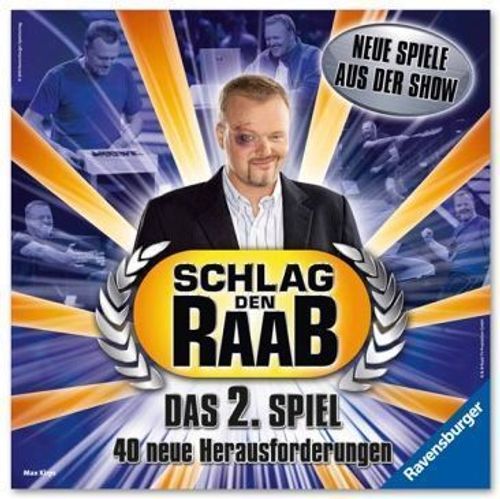
Schlag den Raab: Das 2. Spiel
Schlag den Raab: Das 2. Spiel Rulebook
Table of Contents
Table of Contents
Game Material
Important: Some punched boards are initially located underneath the box insert!
- 3 round indicators/clips (grey)
- 2 score indicators (1x red, 1x blue)
- 8 game pieces (4x red, 4x blue)
- 14 flick chips (back: ladybird)
- 2 game-selection spinners (to be plugged together)
- Spinner for Schlag den Raab 2
- Giant spinner for Schlag den Raab 1 + 2
- 4 drinking straws
- 4 polystyrene balls
- 2 stand-up figures: Stefan and Matthias
- 1 score track for the individual games (back: Pachisi® game board)
- 30 small wooden dice
- 1 laurel wreath (for "Bilboquet")
- 1 dice cup, 1 die
- 2 woollen cords (1x red, 1x blue)
- 2 Stimmt's chips
- 6 stand feet (4x large, 2x small)
- 1 white ball (two-part)
- 110 quiz and game cards*:
- 102 quiz cards
- 4 Teamplayer cards
- 3 Wild Cards
- 1 Zuschlag (slap) card
The quiz cards have a silver-coloured corner. By this you can easily tell them apart from the cards of "Schlag den Raab 1".
Page 3 of the booklet continues the component list:
- 1 divider wall (Trennwand)
- 14 plastic balls (7x red, 7x blue)
- 1 beer mat (Bierdeckel)
- 2 rulers (to fold and plug together)
- 1 sand timer (Sanduhr)
- 1 world map (two-part)
- 1 metal ball
- 1 double-sided marble track (Kugelbahn; marked START/ZIEL)
- 1 sponge ball
- 1 crossbow with rubber band (to plug together)
- 2 rackets (front: squash, back: football)
- 31 Mikado sticks
- 1 box insert (for "Elfmeterschießen" etc.)
Basic Rules
Game Idea
One player slips into the role of Stefan Raab. His fellow players form the candidate team and, in turn, compete against Stefan in up to 15 different games. As in the TV show, every game won earns points. The side that has the most points at the end of the game wins.
Preparation
Carefully punch all punched parts out of their frames before the first game.
- Plug the two game-selection spinners together (see illustration).
- For Schlag den Raab 2 you need the normal spinner. If you also own Schlag den Raab 1, you can use the giant spinner instead and so choose from over 70 different games. On it you will also find the 3 extra games, for which you need material from both editions. They are marked with a * in the table of contents on page 1.
- Lay the underside of the box on the table. Place the two coloured score indicators and one grey clip next to it as a round indicator. The round indicator later marks the number of games played; the score indicators mark the total score on the edge of the box.
- Place the score track in front of the box and put both game pieces on the field "0" of their colour. With them the points within the individual games are marked.
Stefan First agree who of you will play as Stefan. He places the Stefan stand-up figure in front of him on the table (use the small stand foot) and receives 1, 2 or 3 Wild Cards (depending on the game form, see below). All blue game materials belong to Stefan.
Candidates All other players together form the candidate team. Each of them takes a Teamplayer card and lays it in front of him with the team side facing up. With fewer than 4 candidates, put the remaining Teamplayer cards aside. The candidates always play with red.
Moderator For every game there is, as in the TV show, a moderator. He chooses the game, decides in cases of doubt and awards the points. And if he wants, he comments on the duel ... The moderator is provided by the candidate team and, as long as he holds his office, must be impartial. For game number 1 you choose the moderator freely from the team. After that, the next moderator is always the one who has just played against Stefan. The current moderator receives the Matthias stand-up figure (use the small stand foot).
Game form Before you start, agree how many games you want to play at most in this match. The play time depends on it:
- "Ratzfatz": up to 5 games (= 1 Wild Card for Stefan), play time approx. 45-60 min.
- "Medium": up to 10 games (= 2 Wild Cards for Stefan), play time approx. 75-90 min.
- "Showtime": up to 15 games (= 3 Wild Cards for Stefan), play time approx. 100-120 min.
Course of Play
- Choose game
- Choose candidate
- Play
- Award points
1. Choose Game
First put the grey round indicator on the black field "Game 1" on the edge of the box.
Game categories There are 3 game categories:
- Action & Risiko (black)
- Glück & Geschick (silver)
- Knobeln & Köpfchen (orange)
The round indicator shows which category is played. Each field shows the colour of a category. At the start the indicator is on the black field "Game 1". So the first game comes from the black category Action & Risiko. After the game the indicator moves to the silver field "Game 2". Game 2 therefore comes from the silver category Glück & Geschick, etc.
Spinning To choose the game, the moderator takes the spinner. It is divided into 12 fields. In every field there is one game from each category. The moderator spins the spinner with a vigorous swing and then stops it by tapping with a finger on the spinning surface. The field the finger points to now gives the game of the previously determined colour.
Example: The round indicator is on the orange field "Game 3". Katrin spins the spinner and taps the field in which, next to "Balancieren" (silver) and "Squash" (black), the orange game "Länderumrisse" is shown. This is the next game.
Was the game already played in this match? Then choose instead the next game of this colour (clockwise) that you have not yet played.
2. Choose Candidate
- As soon as the game is determined, the candidates decide who of them is to compete for the team against Stefan in this game.
- Only those candidates whose Teamplayer card is still open (team side up) are up for selection. (At the start of the match this is all players.)
- After a candidate has competed in a game, he turns his card over so that the audience side ("Publikum") is visible. He is then not up for selection for the time being. Only when every candidate has played a game do all turn their cards over again, so that the team side is visible. A candidate may therefore only compete again once all his team colleagues have also played once.
- Wild Card: Now Stefan can decide whether he wants to play a Wild Card. With it he may determine a different opponent than the one chosen by the candidate team. He too only has the choice among the candidates whose Teamplayer card is open. If Stefan uses a Wild Card, it then leaves the game.
3. Play
In every game, the side that is behind on the score track (that is, Stefan or the team) may decide who begins. In case of a tie, the side that rolls the higher number of pips may decide who begins. You will find the rules for the individual games from p. 6. The moderator reads them out before the current game or explains them. Of course the other team colleagues should always cheer on their candidate properly during the duel!
4. Award Points
After the game the winning side receives points. For game number 1 there is 1 point, for game number 2 there are 2 points, etc. Their score indicator is advanced by the corresponding number of fields on the edge of the box.
Afterwards the round indicator is moved to the next field. It also shows from which category the next game comes. Now you choose the next game with the spinner again, etc.
End of the Game
The game ends immediately as soon as one of the two sides has so many points that it can no longer be caught up. This side wins.
How many points it needs for this is shown by the table:
| Game form | Points |
|---|---|
| Ratzfatz | 8 points |
| Medium | 28 points |
| Showtime* | 61 points |
*If, in "Showtime", it is undecided after 15 games, there is a tie-break (Stechen). With the spinner choose a game from the black category Action & Risiko. The side that wins the tie-break is the winner of the game.
The score fields 8, 28 and 61 are highlighted in colour on the edge of the box.
Rule Additions (for 2 and 6 or more players)
2 players: In a game for two there is no moderator. Choose the games in turn with the spinner. Some games can only be played with 3 or more players. They are marked on the spinner and in the instructions with a "³". In this case choose a new game. Since the candidate is fixed for every game from the start, you need neither the Teamplayer cards nor the Wild Cards. In quiz games, read the questions out in turn. Take a new card for every question.
Team game (from 6 players): In larger groups you can also play Schlag den Raab with two teams: "Candidate team" against "Team Stefan". As soon as the game is determined, both teams decide who of them competes. The moderator is provided either by both teams in turn, or you choose a "full-time" moderator beforehand. Since in this case he belongs to neither team, he may choose the games freely, in order to make the match particularly exciting. You do not need the Teamplayer cards and Wild Cards in the team variant.
The Individual Games
(in alphabetical order)
Important! Some games get rough ... So always make sure before the start of play that the respective game cannot damage any objects or endanger any persons. Materials needed for the games that are not included in the game are set in italics.
Abräumen (Clearing)
Throw, collect, catch!
You need:
- 7 game pieces
- Score track
- 1 ruler
- White ball
Set up 5 game pieces as shown in the illustration on one side of the table. The distance between the pieces at the corners should be about 25 cm. To measure, simply use the ruler. The 2 remaining game pieces go on field 0 of the score track. The starting player receives the plugged-together white ball.
How it works:
- The players take turns, 5 times each.
- The starting player sits or stands in front of the pieces and throws the ball up into the air. While the ball is in the air, he snatches as many of the 5 pieces as possible. Then he catches the ball again with the same hand with which he threw it and has collected the pieces.
- For each piece collected this way he receives 1 point on the score track.
- If he does not catch the ball before it touches the table, floor, etc., he receives no point. How many pieces he had collected in this case does not matter.
- Then it is the opponent's turn: the pieces are set up again, he receives the white ball, etc.
- Whoever has the most points after 5 attempts wins the game. In case of a tie the game continues until one player scores more points in one round than his opponent.
Note: If you want to simplify the game, you may throw, collect and catch with both hands.
Armbrust (Crossbow)
Aim, shoot and score!
You need:
- Box bottom
- Box insert
- 2 rulers
- 4 large stand feet
- Laurel wreath
- Crossbow with handle
- Rubber band
- 7 flick chips each in blue and red
Building the target: First plug the two rulers together. Push the 4 stand feet onto the hatched areas at the ruler ends. Then place the plugged-together rulers as box dividers into the empty box bottom so that four square fields are created. Now fold the edges of the box insert down at the folded sides so that they point straight down. Push it into the box until the edges rest on the box bottom. Then stand the box up on its edge approx. 1 metre from a table end so that you can read the numbers 1 to 4 on the box insert. Now place the laurel wreath centrally at the table end.
Building the crossbow: Stretch the rubber band over the crossbow where the two lateral notches are. Then push the handle onto the rear notch. Each player receives the 7 flick chips of his colour.
How it works:
- The players take turns trying to shoot their chips with the crossbow into the target holes in order to score as many points as possible.
- The starting player takes the crossbow. He rests his elbow inside the laurel wreath on the table. Then he places a chip on the crossbow in front of the rubber band. With one hand he holds the crossbow; with the other he pulls the chip back as far as he likes, tensioning the rubber band. As soon as he lets go of the chip, it shoots off. If the player hits one of the 4 target holes, he later receives the corresponding points.
- Then it is the opponent's turn, he receives the crossbow, shoots once, etc.
- When each player has shot his 7 chips, scoring takes place. To do so, lay the box down and pull out the box insert. Each chip in target field 1 now counts one point, each one in field 2 two points, etc.
- Whoever has the most points wins. In case of a tie you continue until one player scores more points in a round than his opponent.
Notes:
- If a chip jumps out of the box again after the shot, it does not count as a hit.
- Never aim the chips at living beings or fragile objects!
Balancieren (Balancing)
Who has more fingertip feeling?
You need:
- 2 rulers
- 4 large stand feet
- Score track and 2 game pieces
Push one stand foot onto both hatched ends of each ruler. Each player takes a ruler. The game pieces go on field 0 of the score track.
How it works:
- Both players turn the palm of the hand upward and stand their ruler upright on the foremost joint of the outstretched index and middle fingers. At first the players hold the ruler with the other hand at the upper stand foot.
- The moderator gives the start command. From now on the players balance their ruler only on the outstretched index and middle finger.
- Whoever manages this longer without the ruler falling down, touching other objects or the player himself touching it with the body, receives 1 point.
- Then the next round is played, etc.
- Whoever first has 3 points wins.
Note: If you want to make the game somewhat harder, simply play with the "weaker" hand!
Ball saugen (Sucking the Ball)
Who has the longer breath?
You need:
- 2 drinking straws
- 2 polystyrene balls
- Score track and 2 game pieces
The game pieces go on field 0 of the score track. Both players take one drinking straw each. Both receive one polystyrene ball each, which they place in front of them on the table.
How it works:
- The moderator gives the start command.
- Immediately both players suck up their ball with the drinking straw and so lift the ball. They sit upright and try to hold the ball on the straw for as long as possible only through the "air draught".
- As soon as a player's ball falls down, the round ends. The opponent receives 1 point on the score track.
- As many rounds are played until one player has 3 points and thus wins.
Notes:
- Clean the drinking straws under warm water after use.
- The game comes with 2 additional polystyrene balls and straws as spare material.
Ball wedeln (Fanning the Ball)
Who becomes fanning world champion?
You need:
- World map (two-part)
- 2 polystyrene balls
The players each receive one half of the world map and 1 polystyrene ball. The moderator determines a circuit, for example once around the table, through the living room or similar. The players stand back to back at the start, place their polystyrene ball on the floor in front of them and take their part of the world map in both hands.
How it works:
- The moderator gives the start command.
- The players try to cover the route in opposite directions with their polystyrene ball faster than their opponent. They may not touch the ball, but must drive it forward exclusively by the gust of wind caused by fanning with the map. Whoever touches the ball with the map (or otherwise) must go back to the start and begin again.
- Whoever fans his ball into the goal first wins. If both players do not reach the goal (because their balls get stuck or can no longer be moved by mere fanning), the race is repeated with a changed route.
Notes:
- The balls are not easy to steer. So choose an easy route.
- If you want to ensure that the map perhaps does not take a kink or two, use a magazine or similar instead.
- To keep the balls apart more easily, mark one of them with a pen.
- The game comes with two spare balls in case balls get lost.
Bilboquet
Into the cup!
You need:
- Dice cup
- Laurel wreath
- Blue woollen cord
- White ball (two-part)
- Score track and 2 game pieces
First push the laurel wreath onto the dice cup by sliding the laurel wreath from below as far up as possible to the rim of the cup. Then knot one end of the woollen cord to the small hole at the edge of the laurel wreath. The other end of the cord you place into one half of the opened white ball. Then push the two halves together so that the ball hangs on the cord. The starting player takes the game device and stands in the room. He needs "free swinging room", so make sure he has enough free space around him. The game pieces go on field 0 of the score track.
How it works:
- The starting player holds the cup (below the laurel wreath) in his "strong" hand (= right-handers right, left-handers left) and lets the ball hang down on the cord.
- He has 3 attempts to swing the ball up with a pendulum movement and then catch it in the cup. For each successful attempt he receives 1 point.
- Then the opponent has 3 attempts with his "strong" hand.
- After that both players have 3 further attempts, this time with their "weak" hand. The starting player begins again.
- Whoever is ahead on the score track afterwards wins. In case of a tie the players each make one attempt with the weak hand until in one round only one of them scores.
Note: An attempt only counts as successful if the ball stays in the cup. If it jumps out again, there is no point.
Blamieren oder Kassieren³ (Embarrass or Cash In)
Who has the right answer ready quickly?
You need:
- Score track and 2 game pieces
- Quiz cards 1-20
- Zuschlag (slap) card
Lay the Zuschlag card centrally between the players on the table. The game pieces go on field 0 of the score track. The moderator takes the quiz cards.
How it works:
- The moderator chooses any quiz card and reads out the top question.
- Whoever wants to answer must be first to slap the Zuschlag card with his hand.
- Now the moderator slowly counts down from 5. In this time the player must answer.
- Correct answer: The player receives 1 point on the score track.
- Wrong or no answer: The opponent receives the point.
- In addition, the opponent himself may (not must!) still answer, in order to make a "dust-off" (Abstauber), that is, a further point. For this the moderator again slowly counts down from 5. If he answers in time and his answer is wrong, the other player receives 1 point. If he does not want to answer, nothing happens.
- Then it continues with the next question, etc. As soon as a player has 5 points, he has won.
Notes:
- If no player slaps on a question, the moderator first slowly counts down from 5. If there is still no slap, he reads the next question.
- If a player slaps during the reading of the question, the moderator interrupts the question immediately. He then also does not read it out any further.
Bücher tragen (Carrying Books)
Sport for bookworms & library fanatics!
You need:
- 30 wooden dice
- 2 rulers
- World map (two-part)
The two players stand at the table as far apart from each other as possible. Each lays one half of the map in front of him as a base. Each receives a ruler, which he lays in front of him. The starting player gets 10 wooden dice.
How it works:
- The starting player lays the 10 wooden dice on his map in a straight row directly next to each other. With the help of the ruler he can align the dice once more.
- Then he lifts this row of dice: for this he may only use his two index fingers, which he places left and right at the end of the row of dice. With them he presses the stones together, not too firmly and not too loosely.
- Thus he must carry the row of dice to the opponent's map and set it down there. During this he must keep the entire transport horizontal. When setting down the dice none of the dice may slide beyond the map.
- Then it is the opponent's turn. He receives 1 additional die and must now carry this row, which now consists of 11 dice, across without error. Then the starting player must transport 12 dice, etc.
- Alternately 1 die at a time is added to the row until a player makes a mistake. A mistake is when ...
- a player lets the dice fall on the way, or
- when lifting or setting down, dice slide beyond the map.
- After a mistake the game ends immediately and the opponent wins.
Note: If you play at a small or round table, play with only one map. Both players must then carry the dice from there once around the table.
Die Theke (The Bar)
Flick the chip!
You need:
- 7 flick chips each in blue and red
For the game you need a "free track" on the table. Each player receives the 7 chips of his colour. Both stand at the same end of the table.
How it works:
- The starting player lays one of his chips at the table end so that he can flick it comfortably with his fingers.
- Then he tries to flick the chip as close as possible to the other table end, but preferably not beyond it.
- Then the opponent is on turn to flick a chip, etc.
- In doing so it is allowed at any time to play at opposing and/or one's own chips. If chips fall off the table, they are out of the game.
- The game ends as soon as all chips have been played. Whoever's chip lies closest to the other table end wins. In case of a tie the second-closest chips of both players are compared, etc.
Note: The chips slide more easily and further when the "Schlag den Raab" logo is facing down.
Elfmeterschießen (Penalty Shootout)
The round must go into the square!
You need:
- Box bottom with insert
- Both rackets
- Sponge ball
- 1 wooden die
- Score track and 2 game pieces
Stand the box bottom together with the box insert upright at a table end as a goal. Both players each take a racket. The starting player receives the sponge ball. The game pieces go on field 0 of the score track.
How it works:
- The starting player is the first penalty taker. He places the ball about 1 metre from the goal centrally on the table and takes a racket in his hand. Best mark the penalty spot with the wooden die at the side edge of the table.
- His opponent is the goalkeeper. He stands behind the goal, takes the other racket and holds it in front of the goal box.
- The shooter has 5 attempts in a row to score as many goals as possible. To do so he "shoots" the ball with the racket in the direction of the goal. The goalkeeper tries to parry the shot with his racket. If he parries it with anything other than his racket (e.g. hand or arm), the attempt is repeated.
- Every shot that gets into the goal box counts as a goal. Whether it jumps out again does not matter. Each hit is marked on the score track.
- After 5 attempts the starting player becomes the goalkeeper. His opponent as the new shooter now also has 5 attempts.
- Whoever has scored the most goals wins. In case of a tie both players alternately each make one attempt until in one round only one of the two scores.
Entfernungen (Distances)
How far is it from A to B?
You need:
- Score track and 2 game pieces
- Quiz cards 21-26
- 2 pens and paper
The players each receive a pen and paper. The moderator takes the quiz cards. The game pieces go on field 0 of the score track.
How it works:
- The moderator reads out the first two cities of the quiz card. The players now guess how far apart these cities are by the shortest car route.
- Both secretly write down their estimated distance (in km).
- When both have noted their guess, they tell it to the moderator. He then announces the solution. It is on the back of the card.
- Whoever is closer to the solution (regardless of whether above or below) moves 1 field forward on the score track.
- Then the moderator reads the next two cities, etc.
- Whoever first has 4 points wins.
Notes:
- If both players are equally far from the solution, nobody gets the point.
- The distance given in the solution is the mean value of various route planners.
Fremdsprachen³ (Foreign Languages)
Gibberish for language pros!
You need:
- Score track and 2 game pieces
- Quiz cards 27-37
- Zuschlag (slap) card
Lay the Zuschlag card between the players on the table. The game pieces go on field 0 of the score track. The moderator takes the quiz cards.
How it works:
- The moderator slowly reads out, one after another with a few seconds' pause each, up to 5 translations of the same German word in foreign languages.
- The players must guess the German word being sought.
- Whoever wants to solve must be first to slap the Zuschlag card with his hand. From the slap on, the moderator reads out no further translations of the word.
- The player now has 5 seconds to answer:
- Correct answer: The player receives 1 point on the score track.
- Wrong or no answer: The opponent receives the point.
- Then the moderator begins the next task. The same applies if no player wants to solve even after the 5th translation of a word.
- Whoever is ahead on the score track after 5 sought words wins. In case of a tie the moderator sets further tasks until one player takes the lead.
Notes:
- The translations come from approx. 30 different languages. Just read them out as they appear on the card.
- As a tip, the moderator can name beforehand the language the translation comes from. Card 37b lists which abbreviation stands for which language.
Geld fühlen³ (Feeling Money)
Whoever does not honour the cent is not worth the points!
You need:
- Dice cup
- Beer mat
- Score track and 2 game pieces
- 2 pens and paper
- Small change
The game pieces go on field 0 of the score track. Both players receive pen and paper. The moderator takes the beer mat and the dice cup and prepares various coins (of the same currency) so that the players cannot see them.
How it works:
- The moderator secretly chooses 2 coins and, protected from curious eyes, puts them into the dice cup. Then he covers it with the beer mat and hands it to the starting player.
- The starting player pours the coins, unseen, into one hand. He must now feel the value of the coins without looking at them.
- For this he may use only one hand. He holds it under the table during this, the other above the table. The player has 20 seconds for the task. The moderator watches over the time.
- Then he puts the coins back, unseen, into the dice cup. He covers it with the beer mat and gives it back to the moderator. After that he secretly writes down the total value of the coins as he estimates it.
- The moderator now gives the dice cup to the second player. He has just as much time as his opponent to feel the same coins "blind".
- When both players have written down their estimate, the moderator pours the coins onto the table. Whoever is closer to the actual value receives 1 point on the score track. If both are exactly right or equally far away, both receive 1 point.
- For the next round the moderator chooses 3 coins. This time the other player begins. Both now have 25 seconds.
- With each round 1 new coin is added and the players get 5 seconds more time.
- Whoever first has 3 points has won. In case of a tie play continues until one player takes the lead.
Note: Make sure the players always hold all coins in the same hand and feel the value with it.
Hoch-Stapler* (High Stacker)
Who builds the highest tower?
You need:
- 1 sand timer and all other game materials from Schlag den Raab 1 + 2
Lay all game materials in the middle of the table so that both players can reach them well. The moderator takes the sand timer and places it in front of him.
How it works:
- The moderator turns the sand timer. Each player now tries to build a higher tower from the game materials than his opponent.
- In doing so:
- Only one hand may be used.
- Every game material that is touched must immediately be built into the tower.
- If both reach for the same material, the one who touched it first may build it in.
- If a tower collapses, the player may of course rebuild it within the playing time.
- The game ends as soon as the sand timer has run out. Whoever's tower is the higher one standing freely at this moment wins.
Notes:
- The two box lids and box bottoms are not used for this game.
- The players may not touch the opponent's tower.
- After a collapse, the materials used are available to both players again until they are built in again.
Knobeln (Dice-Guessing / Marble Guessing)
The what-do-you-think-do-I-think-you-think game
You need:
- 3 plastic balls each in blue and red
- Score track and 2 game pieces
The game pieces go on field 0 of the score track. Both players receive the 3 balls of their colour and hold them hidden under the table from their opponent.
How it works:
- On the moderator's command both players secretly choose between 0 and 3 of their balls. They take them in the hand and lay the hand, clenched into a fist, on the table.
- The starting player (= player A) must now be first to guess the total number of balls that are in both hands on the table (0 to 6).
- Then player B guesses the total number. He may not give the same guess as player A.
- Then both players open their hand:
- If a player guessed correctly, he receives 1 point on the score track.
- If neither player is right, no point is awarded.
- In the next round both players choose a number of balls again. Now player B guesses first and then player A.
- As many rounds are played until one player has 3 points and thus wins.
Kopfrechnen³ (Mental Arithmetic)
The game for quick calculators!
You need:
- Score track and 2 game pieces
- Quiz cards 38-42
- Zuschlag (slap) card
The game pieces go on field 0 of the score track. Lay the Zuschlag card centrally between the players on the table. The moderator takes the quiz cards.
How it works:
- The moderator reads out the first mental arithmetic task. The players must now work out the correct result without aids.
- Whoever wants to solve slaps the Zuschlag card first with his hand. Then he has 5 seconds to answer:
- Correct answer: The player receives 1 point on the score track.
- Wrong or no answer: The opponent receives the point.
- Then the moderator reads out the next task. This also applies if no player wants to solve the current task.
- Whoever first has 4 points wins.
Kreiseln* (Spinning)
Whose spinner spins longer?
You need:
- Both game-selection spinners from Schlag den Raab 1 + 2
- Score track and 2 game pieces
The game pieces go on field 0 of the score track. Each player receives 1 spinner.
How it works:
- The moderator gives the start command: simultaneously both players spin their spinner, at a distance of at least 30 cm from each other, with a vigorous swing on the table top.
- Whoever's spinner spins longer receives 1 point on the score track.
- Then you play the next round, etc.
- Whoever first has 3 points wins.
Notes:
- The spinners may touch each other during the game.
- Decisive for awarding the point is which spinner comes to a complete standstill first.
Kugellabyrinth (Marble Maze)
The journey is the destination!
You need:
- Score track and 2 game pieces
- Box bottom with insert
- 2 rulers
- 4 large stand feet
- Marble track (Kugelbahn)
- Sand timer
- Metal ball
First plug the two rulers together so that a cross is formed. Then push the 4 stand feet onto the hatched areas at the ruler ends. Then place the plugged-together rulers as box dividers into the empty box bottom together with the insert so that 4 square fields are created. The moderator decides whether side A or B of the marble track is played, and lays it on the ruler cross in the box. He takes the sand timer and puts the game pieces on field 0 of the score track.
How it works:
- You play in turns. The starting player puts the metal ball into the start corner and takes the box bottom in both hands.
- As soon as the player is ready, the moderator turns the sand timer. The player now has 2 sand timers' time to guide the ball through the course by slight tilting movements of the box. The ball must roll along the path prescribed by the line. The line only determines between which holes the ball must roll through. So the ball does not have to roll exactly on the line.
- If the ball falls into a hole, this gives 1 error point. The moderator marks it with the player's game piece on the score track.
- The player quickly takes the ball out of the box and may continue playing immediately (the clock is not stopped!). For this he puts the ball back on the start corner and tries to renew his luck.
- In the corners of the course marked "1", "2" and "3", the player can secure his state of play. As soon as the ball has reached a corner along the course, the player may continue from there after a mistake and no longer has to start from the start corner.
- A round ends as soon as the time has run out. Whoever has passed through more corners on the course within the time (so at best up to the goal field) wins. If both players have got to the same corner field, whoever has collected fewer error points in total wins. If there is also a tie here, repeat the game on the other side of the marble track!
Note: To increase the difficulty you can shorten the time by letting the sand timer run through only once!
Länderumrisse³ (Country Outlines)
Where is Nepal again?
You need:
- Score track and 2 game pieces
- Quiz cards 43 and 44
- World map (two-part)
- 2 pens and paper
The game pieces go on field 0 of the score track. The moderator lays the two-part world map between the players on the table so that the side with the drawn-in country borders is visible. He takes the two quiz cards. The players each receive pen and paper.
How it works:
- The moderator picks a country from the quiz cards and names it to the players. They must now find this country on the world map.
- Each country on the world map is assigned a number. The players secretly write down the number of the country they believe is the one sought.
- When both have noted their guess, they tell it to the moderator. He then announces the solution number from the quiz card and shows the country. He can easily find it on the world map using the coordinates behind the number.
- Correct solution number: The player gets 2 points on the score track.
- Wrong solution number: The opponent receives 1 point on the track.
- Then the moderator names a new country, etc.
- Whoever first has 8 points wins. In case of a tie play continues until one player is in the lead and thus wins.
Note: For better clarity not all countries of the world have been marked with numbers and included in the map legend.
Lieder malen³ (Drawing Songs)
"Picture-pretty" songs!
You need:
- Score track and 2 game pieces
- Quiz cards 45-49
- Zuschlag (slap) card
- Pen and paper
Lay the Zuschlag card centrally between the players on the table. The game pieces go on field 0 of the score track. The moderator takes the quiz cards and lays pen and paper ready in front of him.
How it works:
- The moderator secretly picks a song from a quiz card. Then he draws it on the paper. He may not use any letters or numbers.
- The players must guess which song it is. For this it is important that they can always see the drawing well.
- Whoever wants to solve must be first to slap the Zuschlag card. If at first nobody wants to solve yet, the moderator can give tips, e.g. name the performer.
- From the slap the player has 5 seconds to answer:
- Correct answer: The player receives 1 point.
- Wrong or no answer: The opponent receives the point.
- Then the moderator draws the next song from a quiz card, etc. This also applies if nobody wants to solve despite the moderator's drawing skills and tips.
- Whoever is ahead on the score track after 5 drawn songs wins. In case of a tie play continues until one player takes the lead.
Note: You can also use the quiz cards for the game "Lieder summen" (humming songs) from Schlag den Raab 1 – and vice versa!
Marienkäfer³ (Ladybirds)
Point by point to victory!
You need:
- Box bottom with insert
- 14 ladybird chips (back of the flick chips)
- Score track and 2 game pieces
First place the game pieces on field 0 of the score track. The moderator takes all ladybird chips, moves his chair a little away from the table and takes the box on his lap. The two players take seats right and left next to him so that they can look well into the box.
How it works:
- The moderator takes any number of ladybirds in both hands. He throws the ladybirds about 10 cm up above the box so that they land in the box afterwards.
- Immediately after the "landing" of the ladybirds the moderator begins to move the box gently in circles (as in "gold panning") so that the ladybirds move back and forth.
- The players must now count the points on the ladybirds as quickly as possible. In doing so, they must subtract the points of the blue ladybirds from those of the red ladybirds.
- As soon as a player wants to solve, he calls out the total sum. The moderator stops the movement and counts the points (= sum of points of red ladybirds minus sum of points of blue ladybirds).
- If the player is right, he receives 1 point on the score track. If he is wrong, the opponent gets the point.
- Whoever first has 3 points wins the game.
Notes:
- Chips that land so that the ladybird cannot be seen do not count.
- If there are more blue than red ladybird points, the result is negative.
- If ladybirds lie partly covered on top of each other, the moderator makes sure they slide apart during the "gold panning".
Medizinbälle (Medicine Balls)
Marble ping-pong!
You need:
- Box lid and box bottom
- Divider wall
- 2 grey clips
- 8 flick chips
- 14 plastic balls
- Sand timer
Lay the box bottom and box lid next to each other in the middle of the table. Their openings point upward. Place one flick chip under each of all four corners of both box parts. Now push the divider wall between the adjoining box sides. To fasten it, where the recesses in the divider wall are, put one clip each over both box edges (see illustration). Each player stands at a table end behind one of the two box halves. He receives 7 plastic balls of any colour and puts them in his box half. The moderator takes the sand timer.
How it works:
- The moderator turns the sand timer and gives the start command.
- As long as the sand timer runs, the players try as quickly as possible to convey as many balls as possible from their box half into the opponent's half.
- To do so they always take one ball from their box half and let it bounce in front of their box half so that it flies over the divider wall and stays in the opponent's box half (see illustration).
- If the player does not hit, he must fetch the ball back immediately (and loses valuable time doing so).
- A player may never have more than one ball in his hand at the same time.
- As soon as the time is up, the game ends. Whoever now has fewer balls (regardless of colour) in his box half wins. In case of a tie the game is repeated.
Note: Make a few practice throws before the start of the game.
Mikado
The stick classic
You need:
- 31 Mikado sticks
- Pen and paper
The moderator takes pen and paper, one player receives all Mikado sticks.
How it works:
- The game runs over 2 rounds. First player A grips all the sticks with his hand and sets the hand down firmly on the table so that the Mikado sticks stand vertically. The blue "Mikado" must be in the middle of the sticks. Then the player opens his hand so that the sticks fall onto the table.
- Player B now begins to clear away the sticks. In doing so:
- The sticks must be picked up individually.
- When picking up, no other stick may move.
- If one has picked up the blue "Mikado" or a black-yellow "Mandarin", one may use it as an aid to pick up other sticks with it.
- He lays the collected sticks in front of himself.
- If a player makes a mistake, it is immediately the opponent's turn.
- The round ends when both players have made two mistakes. Then the moderator notes the points of the first round. The sticks have different values:
| Stick | Value |
|---|---|
| Mikado (blue) | 20 points |
| Mandarin (black-yellow) | 10 points |
| Bonze (orange) | 5 points |
| Samurai (green) | 3 points |
| Kuli (red) | 2 points |
- For the 2nd round player B takes the sticks as described and lets them fall onto the table. Player A may now be the first to collect the sticks, etc.
- When the 2nd round is also finished and the points are noted, the game ends. Whoever has scored the most points wins.
Note: Make sure nobody is injured by the points (tips) of the Mikado sticks!
Pachisi®
Who gets to the goal first?
You need:
- Pachisi® board
- Die
- 4 game pieces each in blue and red
Lay the Pachisi® board between the two players on the table. Each player receives the 4 game pieces of his colour. He places 3 pieces on the correspondingly coloured round hideout field ("Versteck") and 1 on the start field ("Startfeld") marked with an arrow. The starting player takes the die.
How it works:
- The aim of the game is to be the first to move 1 of one's own pieces around the board into the top goal field ("Zielfelder") of one's own colour.
- The players take turns. Whoever is on turn rolls once and moves with a piece as many fields forward as the number of pips shows. Special rules apply to the 6:
- Whoever rolls a 6 must place a piece from his hideout onto his start field. If the hideout is empty, he may instead move any piece of his own 6 fields.
- Then he is in any case on turn once more. If he has placed a piece on the start field, he must move it away with the next roll of the die. Otherwise he may use any piece of his own.
- Other pieces may be jumped over. Occupied fields do count when moving, however.
- If the piece lands on a field with an opposing piece, this one is captured and put back on its hideout field.
- If the player would be forced by his roll to capture a piece of his own, he may forgo the move.
- If a player has no pieces on the course, he may roll three times. If a 6 is rolled in doing so, he places a piece from the hideout onto his start field as described and moves it away with the following roll from there.
- The game ends as soon as a player has moved 1 piece onto the top one of his 4 goal fields. It can only be moved there with a fitting roll. Whoever manages this first wins.
Schachtelträger* (Box Carrier)
Who can last longer?
You need:
- Both Schlag den Raab boxes including contents
Both players each receive a full box and take it in their "strong" hand (right-handers right, left-handers left). They position themselves at a distance of approx. 2 m from each other.
How it works:
- On the moderator's starting signal both players lift the box on the outstretched arm so high that the arm sticks out sideways from the upper body at a right angle.
- As soon as a player clearly bends his arm or lowers the arm by more than approx. 10 cm because his strength is running out, the moderator ends the game and declares the opponent the winner.
Note: Since you have to take the indicators off the box edges before the start of the game, you should note down the round number and the score.
Schätzen (Estimating)
Whose guess is closer?
You need:
- Score track and 2 game pieces
- Quiz cards 50-57
- 2 pens and paper
The players each receive pen and paper, the moderator takes the quiz cards. The game pieces go on field 0 of the score track.
How it works:
- The moderator reads out the first estimation question of the quiz card and says in which unit (kg, cm, days or similar) he needs the answer.
- Both players secretly write down a number as their guess.
- When both have noted their guess, they tell it to the moderator. He then resolves the question (for the answer see the back of the quiz card).
- Whoever of the two is closer to the solution (regardless of above or below) moves 1 field ahead on the score track.
- Then the moderator asks the next question, etc.
- Whoever first has 4 points wins.
Note: If both players have written down the same number, nobody gets the point.
Scheiben schnappen (Snapping Discs)
Snip-snap, snap up the points!
You need:
- Score track and 2 game pieces
- Beer mat
Put the two game pieces on field 0 of the score track. The starting player receives the beer mat.
How it works:
- The players take turns.
- Whoever is on turn lays the beer mat with the 2 facing up on the table edge so that it projects as far as possible without falling down.
- Now the player "catapults" the beer mat upward with his fingertips/the heel of the hand and catches it with the same hand.
- If he succeeds, he receives 1 or 2 points, depending on which side of the beer mat faces up after the catch. He moves his game piece forward on the score track by the corresponding number of points.
- No points are awarded if ...
- he does not catch the beer mat,
- after the catch no side of the beer mat clearly faces up, or
- on catching (or directly afterwards) the beer mat touches the table or anything else.
- Whoever has the most points after 5 rounds wins. In case of a tie play continues until one player scores more points in a round than his opponent.
Sortieren (Sorting)
Always nicely in order ...
You need:
- Score track and 2 game pieces
- Quiz cards 69-75
- Zuschlag (slap) card
- Pen and paper
Lay the Zuschlag card centrally between the players on the table. The game pieces go on field 0 of the score track. The moderator takes the quiz cards. Both players receive pen and paper.
How it works:
- The moderator reads out the first task and names the 4 things that the players must bring into the correct order. Then he lays the card legibly for both players on the table.
- Both players quickly think about what the correct order of the 4 things is and write down the corresponding letters as their guess (e.g. A, C, D, B).
- Whoever is first to slap the Zuschlag card with his hand may show his guess.
- The moderator names the correct order. It is on the back of the quiz card.
- If the player is correct, he receives 2 points.
- If he is wrong, the opponent receives 1 point.
- Then the moderator reads out the next task from a new quiz card. This also applies if no player wants to solve a question.
- Whoever is ahead after 4 questions wins. In case of a tie play continues until one player is in the lead.
Sorting for two: In a game for two you do not need the Zuschlag card. Both players must write down their guess. Afterwards both are checked for correctness. So a player can receive up to 3 points per round (with a correct own guess and a wrong guess of the opponent).
Squash
Match ball with sponge ball!
You need:
- Box lid and box bottom
- 2 rackets
- Sponge ball
- Score track and 2 game pieces
First lay the box bottom, centrally on the table, a little more than 1 metre from the (narrow) table end. Then place the box lid upside down over the box bottom at the side, so that the front of the lid stands upright and points toward the players (see illustration). Both players each take a racket. The starting player receives the sponge ball. The game pieces go on field 0 of the score track.
How it works:
- The starting player has the first serve. He places the ball near the table edge in front of him on the table and takes his racket in his hand as illustrated. His opponent prepares himself next to him together with his racket.
- Then the starting player hits the ball against the lid. The ball may only be touched once with the racket, must then roll/fly against the lid and, after bouncing off, touch the table at least once.
- The opponent now tries to play this ball. So both alternately play the ball against the lid until a player makes a mistake and the opponent thereby scores.
- A mistake occurs when:
- The ball does not hit the lid on the player's own stroke.
- After bouncing off the box, the ball no longer touches the table.
- The player does not reach the ball legitimately played by the opponent before it lands on the floor.
- After a mistake there is a new serve. The players alternate with the serve.
- Whoever first has 10 points on the score track wins the game.
Note: Before the start of the game make a few practice strokes for practice, then the match becomes even more exciting!
Stäbchenessen (Chopsticks Eating)
Patience, skill, speed!
You need:
- Box bottom with insert
- 2 rulers
- 4 large stand feet
- Dice cup
- 14 plastic balls
- 8 Mikado sticks
- Sand timer
First plug the two rulers together so that a cross is formed. Then push the 4 stand feet onto the hatched areas at the ruler ends. Lay the plugged-together rulers as box dividers into the empty box bottom together with the insert so that 4 square fields are created (see illustration). Place the box between both players on the table within easy reach, so that one corner points toward each player. The players receive the 7 balls of their colour and place them in the field that is nearest to them. Then stand the dice cup, opening upward, in one of the two remaining empty fields.
How it works:
- Each player gets 4 Mikado sticks, of which he takes 2 in each hand in any manner. It is best to try out different ways of holding the sticks.
- As soon as both players are ready, the moderator turns the sand timer. The players now have one sand timer's time to "chopstick" their balls with the Mikado sticks into the dice cup.
- The game ends when a player has sunk all his own balls in the cup and thereby wins, or when the sand timer has run out. In this case, whoever was able to sink more balls than his opponent wins. In case of a tie you repeat the game.
Notes:
- The balls may not be touched with the hands. If a ball should fall down or land next to the dice cup, it may nevertheless only be transported further with the 4 sticks. You can of course also concentrate on other balls of your own first.
- Make sure nobody is injured by the points (tips) of the Mikado sticks!
- Tip: With the traditional Far-Eastern chopstick grip you will presumably not get very far in this game ...
Stimmt's? (Is It True?)
That can't be true! Or maybe it can ...?
You need:
- Score track and 2 game pieces
- Quiz cards 61-68
- Both "Stimmt's?" chips
The players receive the "Stimmt's?" chip of their colour, the moderator takes the quiz cards. The game pieces go on field 0 of the score track.
How it works:
- The moderator reads out a statement from the chosen quiz card.
- Both players consider whether the statement is true. Then they lay their chip, covered by the hand, on the table so that either the side with the green tick (= true, "stimmt") or the side with the black "X" (= does not hold, "stimmt nicht") is facing up.
- After both players have decided, they take their hand off the chip.
- The moderator resolves the statement. The answer is on the back of the card.
- Whoever has guessed wrong moves 1 field ahead on the score track. (If both guessed wrong, both also move ahead one field each.)
- The moderator reads out the next statement, etc.
- As soon as a player moves to field 3 of the score track, he loses.
- In case of a tie (both move to field 3 at the same time) play continues until the winner is determined.
Strippenzieher (String Puller)
Who has the better reaction?
You need:
- Score track and 3 game pieces
- 1 ruler and 2 large stand feet
- Beer mat
- Red woollen cord
- Dice cup
- Die
2 game pieces go on field 0 of the score track. Push the two stand feet onto the hatched areas of the ruler and stand the ruler vertically on the table. Lay the beer mat approx. 10 cm in front of the ruler. Tie one end of the woollen cord around the neck of the third game piece.
How it works:
- One player is the hunter ("Jäger"). He gets the dice cup. The other is the string puller ("Strippenzieher") and receives the woollen cord with the game piece. He stands this on the circle in the middle of the beer mat. He holds the free end of the woollen cord in his hand so that the cord only hangs down slightly.
- The hunter holds the dice cup, opening downward, above the beer mat. In doing so the cup may not drop below the red-marked "5" on the ruler.
- The moderator rolls the die. On a 2, 3, 4 or 5 nothing happens. On a 1 or 6 the string puller pulls the woollen cord as fast as possible to rescue the game piece. At the same time the hunter tries to catch the game piece with the dice cup while it is still on the beer mat.
- If the string puller is successful, he gets 1 point on the score track. If the hunter is successful, he gets 1 point. Then both players swap roles.
- For a wrong reaction the other player gets 1 point. A mistake is when:
- The string puller pulls the game piece completely off the beer mat on a 2 to 5.
- The hunter, on a 2 to 5, lets the cup drop down so that it touches the beer mat. In these two cases the roles are not yet swapped.
- Whoever first has 5 points wins the game.
String puller for two: Both players roll the die in turn, while at the same time holding the woollen cord or the cup with the other hand.
Suchmaschine 1 + 2 (Search Engine 1 + 2)
Direct hit wanted!
You need:
- Score track and 2 game pieces
- Quiz cards 58-60
- 2 pens and paper
- Internet access
The moderator decides whether you play Search Engine 1 or 2 (see below). He takes the quiz cards. The players each receive pen and paper. The game pieces go on field 0 of the score track.
How it works:
- The moderator reads out a term from the quiz card. The players complete this term so that it achieves as many hits as possible in an internet search engine.
- To do so they must lengthen the starting word by at least 3 letters. From "Auto" one could thus make, for example, "Autoreifen", "Autohaus", but also "Autoren" (the spelling of the starting word may not be changed, so e.g. not from "Brot" "Brötchen" or from "Wahl" "Walfang"). The starting word must always be lengthened at the end of the word.
- The players have 20 seconds to note down their word. The moderator counts the seconds out loud (or uses a stopwatch or similar).
- Then the players tell the moderator their word. He enters both one after the other into a search engine. Whoever of the two players achieves more hits gets 1 point on the score track.
- If both players formed the same word, another round is played immediately with the starting word. In doing so the previously formed word may not be used again, but its plural may, etc.
- Then the moderator reads out a new starting word, etc.
- Whoever first has 4 points wins.
Search Engine 2: Here the aim is to achieve as few hits as possible. There must however be more than 0. If both players have 0 hits, the round is repeated with the same word (see above). All other rules stay the same.
Turm bauen (Build a Tower)
Stack until the tower falls!
You need:
- 30 wooden dice
- Zuschlag (slap) card
Each player receives 15 wooden dice (the colour does not matter). The Zuschlag card is laid out within easy reach of both players.
How it works:
- The players build a shared tower. The starting player begins with his first die and places it on the table within easy reach of both players.
- Then he touches the Zuschlag card as a sign that his turn is over.
- Now it is the opponent's turn. He puts his die on the opponent's die and afterwards likewise lightly touches the Zuschlag card.
- In this way both players alternately build the tower ever higher until at some point it collapses.
- The player in whose turn the tower collapses loses.
Note: The players may only build with one hand. They may – while it is their turn – also straighten or otherwise align the tower with this hand.
Was fehlt? (What's Missing?)
Well noticed is half won!
You need:
- Score track and 2 game pieces
- 30 arbitrary objects from the game
- Sand timer
- 2 pens and paper
The game pieces go on field 0 of the score track. Both players receive pen and paper.
How it works:
- The moderator picks 30 arbitrary objects out of the game box and spreads them out on the table.
- Then he turns the sand timer. The players may memorise all the objects laid out exactly until the sand timer has run out.
- Then the players briefly leave the room.
- The moderator now takes 5 of the objects laid out from the table and hides them well from curious eyes. Then the players come back.
- Now the moderator turns the sand timer again. Both players must write down the missing 5 objects until the sand timer has run out.
- When the sand timer has run out, the players read out one after another which objects they think are missing.
- Then the moderator shows which objects he has taken away. For each correct guess the player receives 1 point on the score track. For each mistake the opponent receives 1 point.
- The player with the most points has won. In case of a tie the game is repeated – this time with a higher degree of difficulty (see note).
Note: To adjust the difficulty of the game, simply lay more or fewer objects in the middle of the table at the start. You can also change the number of objects that the moderator removes.
The game for two: In a game for two you play one after the other. One player prepares the layout of objects for his opponent in each case.
Wer weiß mehr?³ (Who Knows More?)
The game for know-it-alls!
You need:
- Score track and 2 game pieces
- Quiz cards 76-87
The moderator takes the quiz cards. The game pieces go on field 0 of the score track.
How it works:
- The moderator reads out the first question of the quiz card. For every question there is a fixed number of correct answers.
- The players answer the question alternately. The starting player begins.
- Correct answer: The opponent is on turn and must answer.
- Wrong, repeated or no answer: The opponent receives 1 point and the question leaves the game.
- All correct answers to the question have been named: No point is awarded; the question leaves the game.
- Then the moderator asks the next quiz question. If player A had to answer first on the first question, player B now begins, etc.
- Whoever first has 3 points wins.
Wo liegt was? (Where Is What?)
The game for globetrotters!
You need:
- Score track and 2 game pieces
- World map (two-part)
- Quiz cards 88-93
- 3 wooden dice (1x each red, blue and grey)
The moderator lays the two-part world map on the table so that the side with the exclusively green land areas is visible. Both players should be able to reach it equally well. Then the moderator takes the quiz cards and the grey wooden die. The players each receive the wooden die of their colour. The game pieces go on field 0 of the score track.
How it works:
- The moderator reads out the first question of the quiz card. It always asks for a place.
- The players place their wooden die in the square in which, in their opinion, the place lies. As soon as they have placed their wooden die, they may not move it any more.
- If a square is already occupied by the opponent's wooden die, the player may no longer place his wooden die there. Whoever arrives first, chooses first ...
- If the players take too long, the moderator slowly counts down from 5. Whoever has not placed by "0" has had bad luck in this round.
- When both players have placed, the moderator puts the grey wooden die in the solution square (see quiz card back). Then he checks who is closer to the solution. To do so he counts the distance in squares (not diagonally).
- Whoever is closer moves 1 field ahead on the score track. If both players are equally far from the solution place, nobody gets the point.
- Then the moderator asks the next question, etc.
- Whoever first has 4 points wins.
Note: By the globe in the upper right corner you can easily tell the cards apart from the "Wo liegt was?" questions from Schlag den Raab 1.
Wörter rückwärts³ (Words Backwards)
Igirelwhcs nöhcs znaG (i.e. "Ganz schön schwierig" spelled backwards: "Quite difficult")
You need:
- Score track and 2 game pieces
- Quiz cards 94-98
- Zuschlag (slap) card
Lay the Zuschlag card centrally between the players on the table. The game pieces go on field 0 of the score track. The moderator takes the quiz cards.
How it works:
- The moderator reads out the first word written backwards from the quiz card as fluently as possible. The players must now guess which word it is when "the right way round".
- Whoever wants to solve must be first to slap the Zuschlag card.
- He now has 5 seconds to answer:
- Correct answer: The player receives 1 point on the score track.
- Wrong or no answer: The opponent receives the point.
- Then the moderator reads out the next word written backwards, etc.
- Whoever first has 4 points wins.
Note: You can also use the quiz cards for the game "Buchstabieren" (spelling) from Schlag den Raab 1 – and vice versa!
Zungenbrecher (Tongue Twister)
A tongue twister is very hard to speak very fast ...
You need:
- Score track and 2 game pieces
- 3 wooden dice
- Quiz cards 99-102
- Sand timer
The game pieces go on field 0 of the score track. The moderator puts the sand timer in front of him on the table and takes the quiz cards and the 3 wooden dice.
How it works:
- The moderator reads out the first tongue twister. The player who begins may repeat it once in peace, in order to memorise the tongue twister.
- As soon as the player is ready, the moderator turns the sand timer. The player now has 1 sand timer's time to recite the tongue twister as often as possible without error.
- Every correct recitation: The moderator confirms with "correct" and advances the player's game piece by 1 field.
- Recited wrongly: As soon as the player makes a mistake while reciting, the moderator immediately says "wrong". (Every slip of the tongue, every "um" and the like counts as a mistake.) The player begins immediately, reciting the tongue twister anew.
- As soon as the sand timer has run out, the player's turn ends.
- Now the opponent is on turn. He recites the same tongue twister. He too may recite it once in peace, then the moderator turns the sand timer, etc.
- Whoever has recited the tongue twister correctly more often receives 1 wooden die as a victory point. In a tie no victory point is awarded.
- The game pieces go back to field 0 and the moderator reads out the next tongue twister. If player A began with the first tongue twister, player B must now begin, etc.
- Whoever first has 2 victory points wins the game.