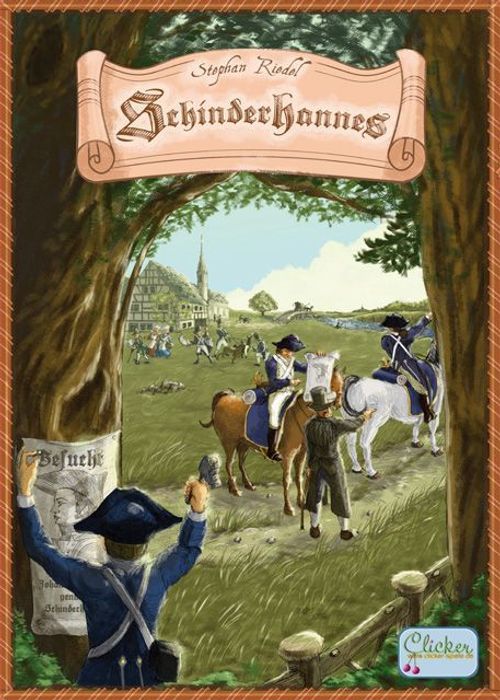
Schinderhannes
Schinderhannes Rulebook
Table of Contents
Table of Contents
Game Overview
1 to 4 players, ages 9 and up, about 45 minutes.
Each of the 16 locations on the board will end up with exactly one of the 16 delicts pinpointed to it. At the start of the game any of the 16 delicts may have taken place at any location (mathematically 16! = about 20 trillion possibilities). With the help of the info cards these possibilities are reduced until, at the end, exactly one delict is assigned to each location.
Components
- 1 game board
- 1 rulebook
- 4 scoring figures
- 4 "Remove one marker" cards
- 80 clue markers (small) and 16 crime-scene tiles (large): 16 different delicts in 4 groups
- 76 info cards
The four delict groups
- Livestock theft (blue): donkey theft, sheep theft, horse theft and beehive theft
- Crime (yellow): break-in, robbers' ball, stolen goods sold, show of power
- Imprisonment/Jailbreak (orange): arrest, jailbreak, imprisonment, hideout
- Felony (green): robbery, extortion, murder, highway robbery
The four info card types
- Type A: Delict cards
- Type B: Group cards
- Type C: District cards
- Type D: Location cards
(See "The Card Types" below.)
The game board and compass directions
The board shows rivers (district borders), the score track, bridges, paths, locations, areas on which to place markers and crime-scene tiles (three per location), and a space for the draw piles.
The compass directions used on the cards are:
- North: Simmern, Thiergarten, Trifthütte, Boos, Griebelschied, Hahnmühle, Kirn, Herrstein
- South: Oberhausen, Meddersheim, Lettweiler, Obermoschel, Hundsbach, Bärenbach, Antes Mühle, Meisenheim
- West: Griebelschied, Hahnmühle, Kirn, Meddersheim, Herrstein, Bärenbach, Antes Mühle, Hundsbach
- East: Simmern, Thiergarten, Trifthütte, Boos, Oberhausen, Lettweiler, Obermoschel, Meisenheim
Setup
- The game board is spread out on the table.
- Each player chooses a figure and puts it on space "0" of the score track.
- The player who looks most like Schinderhannes becomes the start player. This player is also the game co-ordinator.
- Each player receives one "Remove one marker" card (with fewer than four players the remaining cards are not needed).
- The 16 crime-scene tiles are laid out face up next to the board.
- The 80 clue markers are sorted and placed on the corresponding crime-scene tiles.
- Cards No. 73 to 76 ("S" on the back) are set aside. They are not needed for the multiplayer game.
- All info cards with delicts on their backs are sorted by the 4 colours, making 4 piles. For the Type C cards, the colour of the large delict (top) decides on which pile the card is placed. Each pile is shuffled separately and placed face down next to the board.
- All info cards with a location on their backs are shuffled and placed in two extra face-down piles next to the other four piles.
Note: there are a total of 6 draw piles next to the board.
Update (for 2 to 4 players), alternative draw piles: the info cards are laid out face down in 6 piles as follows: all Delict cards in 1 pile (A), all Group cards in 1 pile (B), all District cards (C), and all Location cards divided into two piles (D). (Tip from the update sheet: prepare the card piles of type A, B and C in this way; separate the Location cards (D) and the District cards (C) into two piles, as shown in the sheet's illustration.)
Starting the Game
Beginning with the start player, each player in turn draws 1 card from any pile until everyone has 4 cards in hand. The players also take the "Remove one marker" card into their hand.
Tip: if you are playing for the first time, you should draw only cards of type A, B and C at the start of the game.
The Turn
The player whose turn it is carries out the following actions:
- he plays any card from his hand
- he may additionally discard one card from his hand
- he draws as many cards as he has played or discarded
If a player does not want to or cannot play a card (= "passes"), he may:
- discard any number of cards from his hand and draw as many cards as he discarded plus one additional card.
At the end of the turn all played and discarded cards go back in the box. The player puts the marker(s) he has won back in the game box and moves his scoring figure on the score track forward by the corresponding number of spaces.
Before the next player begins his turn, the game co-ordinator checks the draw piles for unplayable cards (see rule 11).
End of the Game
The game ends when
- the locations of all delicts are defined, i.e. a crime-scene tile lies on every location, or
- the draw piles are used up and all playable hand cards have been played.
The player with the most points on the score track wins the game.
Update (for 2 to 4 players): The player who pinpoints the last but one delict also removes the markers for the last delict. If no markers have yet been placed for this delict, the player would score 5 points without having to present any extra information. Tip: it is therefore suggested that if the markers have not yet been placed on the board, the player only scores 1 point for the final delict.
Playing the Cards
Note: the game contains many new and unusual elements which are best learned by trying them in play. Rules 1-12 are the basic rules. If questions arise during the game about whether a card is playable, read rules 13-16 and all the examples.
At the start of the game, any of the 16 delicts may have taken place at any location (mathematically 16! = 20 trillion possibilities). With the help of the info cards these possibilities are reduced until, in the end, exactly one delict is assigned to each location.
Info cards have two possible effects:
- If no markers of the delict on the played card are on the board yet, they are placed.
- If markers of the delict on the played card are already on the board, some of them can be removed again and so turned into victory points.
The active player may play any card of any type (also the "Remove one marker" card) at any time, as long as he keeps to the following rules (rules 1-16). All rules apply to all cards and card types, regardless of the cards named in the examples (exception: rules 5 and 6).
The Card Types
Type A: Delict card
The clue on these cards refers to one specific delict (e.g. donkey theft). This delict is shown with a symbol (e.g. a donkey) on the front and back of the card.
There are always four possible locations (e.g. Antes Mühle, Bärenbach, Hundsbach, Meddersheim) at which the delict can have taken place.
These cards can be played at any time (they are especially useful at the start of the game).
Type B: Group card
The clue on these cards refers to one specific group of delicts (e.g. Imprisonment/Jailbreak) and one compass direction (north/south/east/west).
The player of this card chooses one of the four delicts named.
At the start there are eight possible locations at which the delict can have taken place. Since there are only five markers per delict, these cards can only be played when at least three of the locations are defined, or when the markers of the chosen delict are already on the board.
Type C: District cards
These cards give clues as to whether two delicts took place in neighbouring locations, i.e. whether their clue markers or crime-scene tiles are connected to each other by a path. Depending on the card, the two delicts lie either in the same district or in adjoining districts (river = district border).
To be able to play these cards, clue markers or a crime-scene tile of at least one of the delicts named on the card must be on the board, and/or one or more locations must be defined by crime-scene tiles.
Attention:
- There are locations which are not connected to a location in the neighbouring district.
- The size of the delicts on the back only serves as an aid for sorting the cards at the start of the game. It has no significance for playing the card.
- It does not matter on which of the three areas of a location the markers lie for "neighbourhood". The paths always apply to the whole location (i.e. to all 3 areas).
Type D: Location cards
These cards give clues as to which delicts can have taken place in a location.
These cards can only be played when clue markers already lie on this location. In this way, wrong delicts can be excluded in the named locations.
Update (for 2 to 4 players): The rules state that Location cards can only be played if clue markers already lie on that location. Change: the Location card may also be played if one of the four delicts named can be exactly defined at this location. This happens when the other three delicts have already been defined in other locations.
Placing Clue Markers
(1) General placing rule
The player takes all clue markers of the delict named on the info card into his hand (the crime-scene tile stays where it is) and places one marker on each named location. Every marker of this delict that does not have to be placed on the board may be kept by this player. Each marker counts one victory point.
Example: the delict "break-in" is not yet on the board. Player A plays card No. 11: he places one break-in marker on any area of each of the locations Oberhausen, Obermoschel, Meddersheim and Lettweiler. Since the player only has to place 4 markers, he may keep the fifth. He moves his scoring figure one space forward on the score track (+1).
(2) Locations with a crime-scene tile
If a crime-scene tile already lies on a location, no marker may be added to it. For each clue marker that cannot be placed because of this rule, the player receives one victory point.
(3) Two locations - two delicts
If the same two markers lie on each of two locations, and no further markers of these two delicts are left on the board, it is not allowed to place another marker of a different delict on these two locations. Reason: two locations only have room for two defined delicts (= 2 crime-scene tiles). For each clue marker that cannot be placed because of this rule, the player receives one victory point.
Example: on the locations Oberhausen and Boos lie the markers break-in and highway robbery in each. Player C plays card No. 3: he now places 3 markers of the delict beehive theft on the locations Trifthütte, Thiergarten and Simmern. He may not place a marker on the location Boos. If the break-in took place in Boos, then the highway robbery took place in Oberhausen. But if the highway robbery was committed in Boos, then Oberhausen was the break-in. Another (third) delict cannot therefore have taken place in Boos. Player C receives 2 points for the 2 remaining markers (+2).
Removing Clue Markers
(4) General removal rule
The player removes all markers on the board that contradict the information on the card just played and records them as victory points. Of course it must not happen that all markers have to be removed. In that case the card is not playable.
Example: the 4 break-in markers lie on the following locations: Oberhausen, Obermoschel, Meisenheim and Lettweiler. Player B plays card No. 38: in the adjoining district the highway robbery took place next to the break-in. The player places the 3 highway robbery markers on the locations Boos, Meddersheim and Hundsbach, since Boos lies in the district adjoining Oberhausen, and Meddersheim and Hundsbach lie in the district adjoining Meisenheim. In addition he removes the two break-in markers from Lettweiler and Obermoschel, since these locations are not connected directly by a path to locations in another district. The player receives a total of 4 markers (2 x highway robbery and 2 x break-in) (+4).
(5) Excluding delicts
With the Location cards (type D) delicts can be excluded. Location cards cannot be used to place markers, only to remove them. For the removed clue markers the player receives one victory point each.
Example: on the location Oberhausen lie the markers break-in, stolen goods sold and murder. Player A plays card No. 71 ("One of these events took place in Oberhausen"). With this card the player excludes that both the delict stolen goods sold and the delict murder took place in Oberhausen. The player removes the two markers stolen goods sold and murder and receives two victory points (+2).
(6) "Remove one marker" card
The "Remove one marker" card can be played instead of an info card. When a player plays this card, he may take any one marker from the board. He receives one victory point for it. If this card is used skilfully, one or more delicts can under some circumstances be defined.
Example: the break-in markers lie on the locations Oberhausen and Meisenheim. Player B plays the "Remove one marker" card and takes the break-in marker from the location Meisenheim. Since now only one marker of the delict break-in is on the board, he may replace this marker with the break-in crime-scene tile (see rule 7). Player B receives a total of two markers (victory points) (+1, +1, total +2).
Placing a Crime-Scene Tile
(7) Last clue marker
If only one marker of a certain delict is left on the board, the marker is replaced by the corresponding crime-scene tile, since the location of this delict is now clearly defined. The tile is placed so that it covers all 3 areas of the location. The areas are thereby blocked (see rule 2). The active player receives the replaced marker as a victory point.
Example: the 3 highway robbery markers lie on the following locations: Boos, Meddersheim and Hundsbach. Player C plays card No. 27 ("Schinderhannes commits a felony north of the river Nahe") and decides on the felony highway robbery. He removes the two highway robbery markers from the locations Meddersheim and Hundsbach, since these locations lie in the south (see rule 4). Now only one highway robbery marker is left on the board (in Boos). This marker is replaced by the corresponding crime-scene tile. The player gets a total of 3 victory points (for the removed markers at Meddersheim and Hundsbach and for the replaced marker in Boos) (+2, +1, total +3).
Further Rules
(8) Information of cards already played
Information from cards that have already been played may not be referred back to later in the game. The clue markers and crime-scene tiles on the board are what count.
(9) Correcting mistakes
For players playing for the first time it can happen, through carelessness, that after the end of a turn two different markers lie on a location and no further markers of these delicts are left on the board. The markers then stay until one of the delicts is determined by a corresponding card. The markers that are removed are received by the active player.
(10) Overlooked victory points
If a player has ended his turn and has overlooked that, as a result of a logical deduction, one or more markers can be taken off the board, another player may call "STOP", take the corresponding markers and credit them to himself as victory points.
(11) Unplayable cards on the draw piles
The game co-ordinator checks whether there are cards on the draw piles which can absolutely no longer be played, and takes them out of the game (= back in the box).
Example: the crime-scene tile break-in lies on Oberhausen (i.e. the location is defined for this delict). If the Location card Oberhausen lies on top of one of the draw piles, it must be removed. The same applies to the card No. 11 with the information for the break-in (this card no longer provides any new information).
(12) Draw piles used up
If the draw piles are used up before all delicts could be assigned to locations, the players continue playing with their hand cards until no player has a playable info card in hand. The game is then over.
When Is a Card Not Playable?
(13) More than 5 markers needed
There are only 5 markers per delict in the game. Therefore no info cards may be played that specify more than 5 possible locations.
Example: Player B wants to play card No. 18 ("The event 'Imprisonment/Jailbreak' took place in the East"). With this card the player may choose one of the four delicts named (imprisonment, jailbreak, arrest, hideout). Player B decides on jailbreak. The player would now have to place a marker on each of the eight locations (in the east). But there are only five markers per delict in the game. As long as at least three of the eight locations are not already occupied by crime-scene tiles (see rule 2) or markers (see rule 3), he may not play this card.
(14) Contradiction to crime-scene tiles
Only info cards may be played whose information does not contradict the crime-scene tiles on the board.
Example: the crime-scene tile arrest lies on the location Meddersheim. Player C wants to play card No. 48 ("In the same district Schinderhannes was arrested next to the place where the robbers' ball was celebrated"). Since Meddersheim is only connected with locations in the adjoining district and the arrest is already established, it is not allowed to play this card.
(15) Location is full
Only 3 markers may lie on each location at the end of a turn. If 3 markers already lie on a location, it is not allowed (at that moment) to play a card which requires a further marker to be placed on this location.
Example: on the location Oberhausen lie the markers break-in, stolen goods sold and murder. Player A wants to play card No. 12 ("Schinderhannes and J. Leyendecker write an extortion letter in the house of P. Haas, a ferryman" - Oberhausen, Meisenheim, Simmern, Griebelschied). The player would now have to place an extortion marker on Oberhausen. This is not allowed at this moment. The player may play this card at another time if appropriate.
(16) (Currently) unplayable cards
Cards that are currently not playable can become playable again later in the game. There are also cards that can never be played again (e.g. because the location of the delict named has already been defined). These cards can be put away as part of the turn action "discard a card" or "pass".
Game for 2 Players (Update)
Tip (for experienced players, from the English update sheet): you may play up to 2 cards per turn. But you still only draw one card. Rule No. 15 (maximum of three markers per location) only counts at the end of a player's turn.
Drawing info cards: beginning with the start player, both players alternately choose a card pile. From this pile they take the top 5 cards and, using the symbols on the backs, choose 1 card (face down). The remaining four cards are put back on the pile (the order must not be changed). This process is repeated until each player has 4 info cards.
The course of play: the players alternately play info cards or "Remove one marker" card(s) and remove or add the markers on the board according to the text. Per turn a player may play 1 to 3 cards. At the end of the turn he may draw 1 info card, regardless of how many cards he has played. As at the start of the game the player may choose the new card from the top 5 face-down cards of a pile. Afterwards he may additionally discard up to 2 info cards and draw the same number of cards face down (without a preview).
In return for paying 1 victory point, the active player may shuffle 1 draw pile before or after drawing cards.
Solo Game
The solo game plays like a logic puzzle: using the information available, the player tries to solve the puzzle.
The info cards needed for the game are picked out of the card pile (cards 73-76 are also needed for this). The player puts the remaining cards back in the box. While playing, the player may use the information on the cards in any order.
At the end of the game exactly one delict should be assigned to each location, and none of the info cards should contradict the solution.
Of the multiplayer rules only the following apply to the solo game: 1, 2, 3, 4, 5, 7, 13, 14 (rules 6 and 8 do not apply!!).
Tip: as a support it is useful to use the game board, the clue markers and the crime-scene tiles.
Info cards needed for the solo game
- Puzzle No. 1: 3, 4, 6, 11, 15, 38, 39, 40, 42, 43, 47, 48, 50, 51, 53, 57, 60, 64, 66, 68, 70
- Puzzle No. 2: 1, 3, 6, 7, 9, 10, 12, 14, 15, 16, 35, 37, 39, 40, 41, 42, 48, 53, 54, 58, 60, 68, 69, 75
- Puzzle No. 3: 2, 4, 5, 8, 9, 12, 13, 14, 33, 34, 35, 41, 43, 45, 47, 56, 63, 72, 73
- Puzzle No. 4: 8, 10, 33, 35, 36, 41, 48, 49, 50, 51, 56, 58, 63, 64, 71, 73, 74, 76 (Erratum: use cards No. 9 and 13 instead of No. 73 and 36.)
Solutions to the solo game
| Location | Puzzle 1 | Puzzle 2 | Puzzle 3 | Puzzle 4 |
|---|---|---|---|---|
| Antes Mühle | Donkey theft | Sheep theft | Donkey theft | Robbers' ball |
| Bärenbach | Sheep theft | Show of power | Sheep theft | Arrest |
| Boos | Beehive theft | Beehive theft | Beehive theft | Jailbreak |
| Griebelschied | Robbers' ball | Imprisonment | Murder | Beehive theft |
| Hahnmühle | Horse theft | Arrest | Horse theft |
Erratum (official sheet): the solution of Puzzle No. 2 is: Hundsbach = Highway robbery, Meisenheim = Horse theft, Simmern = Jailbreak, Thiergarten = Break-in. (The table above has been corrected accordingly.)
Erratum, Puzzle No. 4: use cards No. 9 and 13 instead of No. 73 and 36. Solution: Antes Mühle = Robbers' ball, Bärenbach = Arrest, Boos = Jailbreak, Griebelschied = Beehive theft, Hahnmühle = Hideout, Herrstein = Donkey theft, Hundsbach = Sheep theft, Kirn = Murder, Lettweiler = Show of power, Meddersheim = Horse theft, Meisenheim = Highway robbery, Oberhausen = Imprisonment, Obermoschel = Robbery, Simmern = Extortion, Thiergarten = Break-in, Trifthütte = Stolen goods sold.
Terminology Erratum (symbols)
| Symbol | English | German |
|---|---|---|
| (orange symbol) | Arrest | Verhaftung |
| (orange symbol) | Jailbreak | Ausbruch |
| (orange symbol) | Imprisonment | Gefängnis |
| (orange symbol) | Hideout | Unterschlupf |