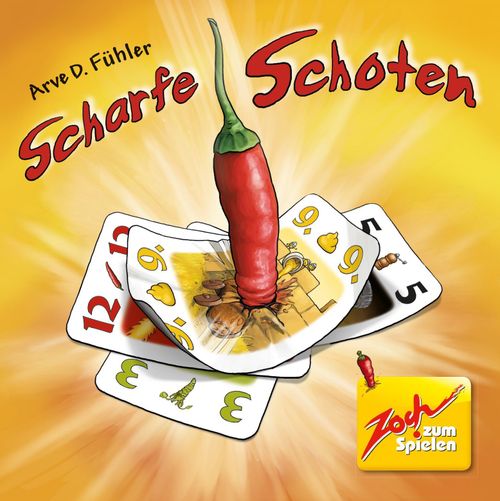
Scharfe Schoten
Scharfe Schoten Rulebook
Table of Contents
Table of Contents
Game Materials
- 16 prediction tiles (4 tiles in each of 4 colors)
- 64 game cards:
- 48 spice cards (12 cards in each of 4 colors)
- 12 number cards (super trump)
- 4 color cards (trump color)
Object of the Game
Before each trick-taking game round, players make predictions as to which color they will collect more cards of and which color they will collect fewer cards of than any other color. Anyone who is right with his predictions at the end of a round scores points. The player who has made the most points after the final round wins.
Course of a Game Round
1) Distributing the cards and tiles
- Before the game, each player gets 4 prediction tiles – one tile in each color. He keeps these tiles for the entire game.
- The spice cards are shuffled and dealt at the beginning of each trick-taking game round: In the 3-player game, each player gets 12 cards as his hand; with 4 players, each player gets 10 cards.
Sort the remaining spice cards by color and lay them out with the backside facing up, fanned out. They form the "spice cupboard".
Important! The colored backs of the spice cards always have to be well visible to all players. This applies to the players' hand cards as well as to the cards of the spice cupboard. Nobody is allowed to see the fronts of the spice cupboard cards!
2) What's trump?
The ranking of the super trumps and colors
First, what colors and numbers are more valuable than others is determined by the cards. To this end, place one of the well-shuffled number cards face down next to each of the four color cards on the table.
Now turn over the number cards and sort the four color-number pairs according to the numbers, highest number first:
This determines the ranking of the super trumps and colors, going from left to right. The four super trumps are the most valuable cards in the game. The highest-ranking super trump is the color and number of the card furthest left.
Example: "green 10" is the highest super trump, "black 9" is the second highest super trump … and "yellow 1", the lowest super trump. Green is the highest color and yellow the lowest; so, green cards trump all cards of any other color that are not super trumps.
- Super trumps trump all other cards in the game.
- Higher super trumps trump lower super trumps.
- Cards of a higher color trump cards of a lower color (except for the super trumps).
3) The predictions
Players take the spice cards that have been dealt to them into their hand in such a way that the other players can easily see the backs of the cards (on request, you have to show the backs). This way, each player knows the color distribution of all hand cards.
Now, before the trick-taking game begins, each player makes two predictions. He predicts …
- which card color he will take more cards of than any other color; and
- which card color he will take fewer cards of than any other color.
To this end, each player "secretly" takes the two prediction tiles in the colors of his choice into his hand, turns them to the side he wants – at the same time as the other players – and lays them down in front of him, well visible to everybody. The two unused tiles are put aside; they are no longer needed in this round.
- The big symbol on the full-colored side means: "The most cards of my collection will be this color."
- The small symbol on the white-framed side means: "The fewest cards of my collection will be this color."
Example: The player wants to collect more cards in red than in any other color. He wants to have fewer yellow cards than any other color.
4) The trick-taking game
The player with the hottest haircut is the starting player. He plays one spice card from his hand face up onto the middle of the table. Now each of the other players, in turn, plays one card as well. The following possibilities and restrictions apply:
- If you have a card of the color played in your hand, you have to "show your colors" by playing one card of the same color (you must follow suit).
- If you have no card in the just-played color in your hand, you play a card of any color.
Important! Super trumps must "show your colors" too.
Who takes the trick?
When everybody has played one card, the player who has played the highest-ranking card takes the trick (all cards played). The value of the cards depends on the ranking of color and number (with the super trumps always taking priority). You take the trick if
- you have played the only or the highest super trump, or
- you have played the highest number card of the highest-ranking color.
The spice cupboard
Each winner of a trick additionally takes any one card from the spice cupboard, without looking at the front (the number value) of this card. He sorts, by colors, all these cards with the backs up and lays them down in front of him as his personal collection. The backs of all cards of his collection have to be well visible to all players at all times.
In the 4-player game: If the spice cupboard has been emptied, the winner collects only the cards of the trick.
Trick example: The first player lays down the red 9 as the trick. The next player has no red cards in his hand. He plays the black 8 and, with this, trumps the red 9 (black ranks higher than red). Since the two next players have at least one red card, they have to follow suit (red). A red 11 follows, which has a lower value than the black 8. The last player plays a super trump, "red 2". Since this is the most valuable card in the trick, he takes the trick. He puts the three red and one black card plus one more card from the spice cupboard in front of him, face down, easily visible to everyone. If the second player had played the super trump "black 9" instead of the black 8, he would have taken the trick, since his super trump would have exceeded the value of the "red 2".
The player who has taken the trick plays the next card.
5) End of the round and scoring
When all spice cards have been played, the round ends with the taking of the final trick. The players receive points if their predictions were completely or partly correct. To this end, each player compares the cards he has collected against his two predictions.
- Each correct prediction is scored 5 points.
- If the prediction is not uniquely correct (it is tied with another color), it is scored 3 points. This applies also if a player has not collected any cards.
- If both predictions of a player are correct, he additionally scores for the difference between the numbers of cards of his two predicted colors.
Write down the points on a piece of paper.
Scoring examples
1. The prediction "The most cards will be black" is fulfilled: 5 points. The prediction "The fewest cards will be green" is not fulfilled: 0 points. Total: 5 points.
2. The prediction "The most cards will be red" is not fulfilled: 0 points. The prediction "The fewest cards will be yellow" is fulfilled as a tie: 3 points. Total: 3 points.
3. The prediction "The most cards will be red" is fulfilled: 5 points. The prediction "The fewest cards will be yellow" is fulfilled: 3 points (tie: yellow and black cards = none). Both predictions are fulfilled (5 + 3 = 8 points), therefore the player also gets the difference between his red and his yellow cards (here, 6 points). Total: (8 + 6) 14 points.
A player who has taken absolutely no tricks receives 6 points (3 points for the least of a color and 3 points for the most of a color, plus the difference of 0).
Now a new round begins. After the spice cards are dealt out and the new trump has been determined, all players make their new predictions. The player sitting to the left of the starting player of the previous round plays the first card of this next round.
Ending and Winning the Game
Players play as many rounds as there are participants. Therefore, the game ends after each player has been the starting player once. The player who was able to score the most points wins.