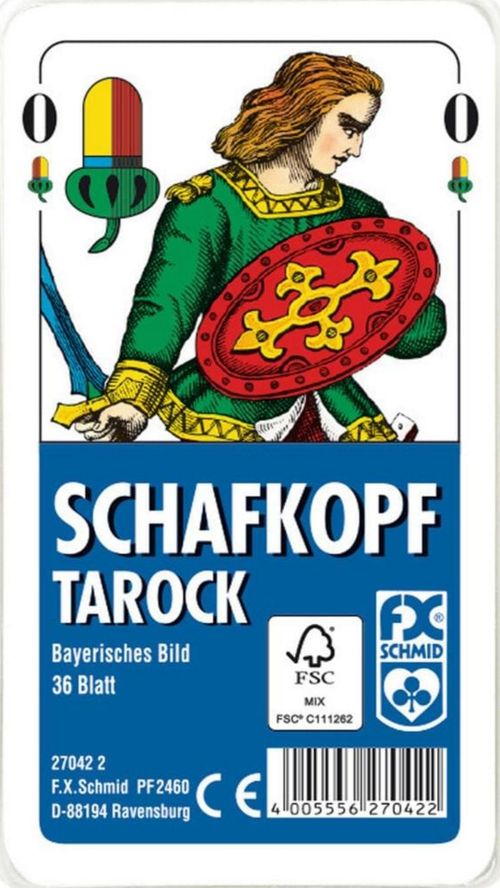
Schafkopf
Schafkopf Rulebook
Table of Contents
Table of Contents
Basic Games
There are two indispensable kinds of game: the Rufspiel ("call game") and the Solo. In the Rufspiel, two players play against the other two. The Solo is a game for one player alone. In the Solo, one player plays against the other three. The highest trumps are the Obers, then the Unters, ranked by their suits, namely Acorns, Leaves, Hearts, and Bells. In the Rufspiel, Hearts is additionally always trump. In the Solo, the lone player determines the trump suit. After the Obers and Unters, the ranking within the trump suit is the same as within the other suits: Ace, Ten, King, Nine, Eight, and Seven. In the Solo there is a further increase in value, the Solo Tout. In this variant, the lone player must take every trick. If a player holds all the Obers and Unters in hand, they may play a Sie.
Additional Games
In addition, a Wenz and a Geier, a Farbwenz and a Farbgeier, as well as a Bettel can also be agreed upon. In the Wenz, only the four Unters are trump, ranked by suit as Acorns, Leaves, Hearts, and Bells. The Obers are ranked within their own suit, between the King and the Nine. In the Farbwenz, one suit is additionally trump. In the Geier, only the four Obers are trump, and the Unters are ranked within their suits between the King and the Nine.
In the Farbgeier, as with the Farbwenz, one suit is additionally trump. The Bettel is a game in which the lone player must not take a single trick. Points are not counted. In the Bettel there are no trumps. Within each suit, the cards rank as follows: Ace, King, Ober, Unter, Ten, Nine, Eight, and Seven.
Order of Precedence
Which game is played after the deal is decided by asking all players in turn what they wish to play. The game with the highest value in a fixed order of precedence is then played.
The full order of precedence is:
Sie – Solo Tout – Wenz Tout – Farbwenz Tout – Geier Tout – Farbgeier Tout – Solo – Wenz – Farbwenz – Geier – Farbgeier – Bettel – Rufspiel
Playing strictly by this order of precedence can be replaced by bidding, in which the lone-player role is won by auction. In this case, all players who wish to play a game better than Bettel but lower than a Tout game may raise the target score of 60 points (exactly 61) in steps of ten.
Announcing the Game
The announcement phase decides who becomes the game-maker. In turn, starting to the left of the dealer, the players declare themselves. Whoever believes they can win a game alone or with a partner declares "Ich spiele" ("I'm playing"). Whoever does not believe this declares "Weiter" ("Pass"). Once a participant has declared they will play, the players who come after must still make their own declaration. With their "Weiter" they signal that they do not hold a higher-ranking game.
If a participant holds a lone game and "Ich spiele" has already been announced ahead of them, the lone player must declare "Ich spiele auch" ("I'm playing too"). If the first player to declare then says "Weiter", the lone player may announce their game. If the player sitting ahead wishes to play alone themselves, they name their lone game. The next participant can then only enter the game with a higher-ranking lone game. If bidding is used, the following participant can take over by making the highest bid of winning points.
If a player holds the Ace in all their suits themselves, they cannot call and therefore cannot announce a Rufspiel either. They are blocked.
If nobody is willing to play, the following options exist, depending on the house rules in use:
- Throw in the cards and deal a new hand
- Throw in the cards, deal a new hand; if a game now comes about, it costs double the price from the outset
- Throw in the cards, deal a new hand, and pay the price of a Rufspiel into a pot
- Throw in the cards, deal a new hand, and pay double the price of a Rufspiel into a pot
- Whoever holds the Alte (Acorn Ober) must announce a Rufspiel
- Play a Ramsch
Leading and Following
The actual game begins with the player sitting to the left of the dealer leading a card. After that, the following players in turn (clockwise) each add a card. From then on, the lead always passes to whoever took the previous trick. When following, a player must always follow suit or trump if possible. A player who does not hold the led suit may either play a trump — trumping the trick — or discard a card of another suit. Likewise, any card may be discarded once it can no longer be established whether trump is still held. A trick consists of one card from each of the four players. The trick belongs to whoever played the highest card of the suit led. If trump is led, the trick belongs to the player who played the highest trump. If a suit is trumped, the trick likewise belongs to whoever played the highest trump.
The called Ace must always be followed when the called suit comes to the table for the first time. If the called suit has not been led by the last trick, the called Ace may only be thrown in on the last trick. If the called partner is on lead and wants to lead the called suit, they can only do so with the called Ace itself. However, if they hold at least three further cards of the same suit in addition to the called Ace, they may instead lead one of these under the Ace. The called Ace can then be added to a later trick.
End of the Game
After each game is played out, it is determined how many points each of the two parties has taken. From this it follows who has won, and by how much. If a party has taken between 61 and 90 points, it has won the game plainly. If both parties have 60 points, the party that included the game-maker loses. If a party has taken 91 points or more, it has won "Schneider". The non-game-maker party needs only 90 points to win with Schneider.
If a party has taken all eight tricks, it has won "Schwarz". In a game played with bidding, the relevant target for winning is the agreed bid instead of 61 — so 71 for a bid of "70", 81 for a bid of "80", and so on.
Stakes
Stakes in Bavarian Schafkopf can be freely agreed. Tournament rules can only be played to preset point values. The following stakes are only a guideline for a sensible relation between the various prices:
- Rufspiel – 10 cents
- Schneider, Schwarz, Laufende – 10 cents
- Hochzeit – 20 cents
- Bettel – 30 cents
- Solo, Wenz, Geier – 50 cents
- Ramsch – 20 cents
In the Rufspiel, the Geier, and the Solo, running Obers may additionally be counted as Laufende ("runners"); in the Wenz, running Unters and further running trumps may be counted. How many consecutive trumps are needed before Laufende are paid must be agreed in advance. On request, the losers pay for consecutive trumps they hold or do not hold, one unit per running trump. Laufende are counted down to the last trump — in the Rufspiel, as far as the Seven of Hearts. In the Tout, the Solo tariff is used as the base. The Laufende are then added, and this sum is doubled. The Sie costs four times the Solo. Schneider and Schwarz are not counted in a Tout or a Sie. Every Stoß doubles the price of the game. Likewise, the price of the game is doubled again with each Doppeln.
Knocking
If an opponent believes that the playing party will not reach the points required to win the game, they may "stoß" (also called "Spritze geben" or "Contra"). The Stoß must be declared at the start of the game; exactly when is set by the house rules in use. Where the house rules allow it, both the game-maker and their partner may answer a Stoß with a counter-Stoß ("Re", "Zurück"). In turn, a player of the opposing party may raise again with "Supra" or "Sup". As the final form of raise, a member of the game-maker's party may add one more with "Resupra".
Forced Game
If nobody wishes to play, under the Muss-Spiel ("forced game") house rule the player holding the Acorn Ober must call a partner. If they cannot call an Ace because they themselves hold the Ace in every suit they hold, they play with an As-Renonce ("Ace renounce") and must announce this. If they hold all three Aces themselves, they play with a Ten they do not hold, or — purely theoretically, if they hold all Aces and Tens — with a King. No Stoß is possible in a Muss-Spiel.
Renounce
If nobody wishes to play, it can be agreed that a player who is blocked — that is, holds no suit card without its Ace — may play with an As-Renonce. If they hold all three Aces themselves, they may play with a Ten they do not hold, or — purely theoretically, if they hold all Aces and Tens — with a King.
Ramsch
A Ramsch may be agreed for the case in which every player has said "Weiter". In a Ramsch, each player plays for themselves alone. The aim is to take as few points as possible, ideally no trick at all. Cards are trumped as in the Rufspiel — all Obers and Unters, and the Hearts, are trumps. In a Ramsch, whoever has collected the most points loses. If two or even three participants have the same number of points, the one with the most tricks loses. If the number of tricks is also equal, the ranking of the trumps decides: whoever holds the higher trump among their tricks loses. If a player takes every trick — a "Durchmarsch" — the other three players have lost and that player alone has won.
The Pot
If every player says "Weiter", a Stock ("pot") may be paid in. Every participant pays the base price of a Rufspiel into a temporary kitty. In a game played with Doppeln, double, quadruple, and so on may be paid in instead, depending on the number of doublings. This Stock then counts as an extra premium for the next game. The Stock can only be won in a partnership game. The Stock can be claimed by the game-maker alone, or, depending on agreement, together with their partner. If the game-maker wins with their partner, they receive the Stock in addition to the regular payment for the game. If, however, the game-maker's party loses, it must pay the winners the regular payment for the game, and the game-maker must, alone or with their partner, additionally double the Stock. This doubled Stock then again counts as the premium for the next partnership game. The doubling repeats until a game-maker and their partner actually win a Rufspiel and so collect the premium from the Stock. It can also be agreed that lone games may win the Stock as well; in that case they must of course also double it if they lose.
Marriage
An additional kind of partnership game is the Hochzeit ("marriage"). Before the announcement phase, a player who holds only a single trump may lay it out, face up or face down as agreed, and say: "I offer a marriage." The other three players then have the additional option, instead of calling an Ace, to marry — that is, to take up the Hochzeit-player's trump and slide them one of their own non-trump cards face down in return, thereby determining the partner. A player who has no non-trump card to give up may not marry. The Hochzeit has no precedence over a normal Rufspiel.
Doubling
Through Doppeln, the players can double the value of a game. This is done by announcing "Ich dopple" ("I double") immediately after picking up the first half of the cards. Who is permitted to double can be set by house rule.
Passing Round
There are many ways of playing special extra rounds. The Schafkopf software recognizes only a simple passing round, the Schieberrunde. It is only possible after a won Herzsolo. In this passing round, the player in Vorhand (first seat) receives the Acorn Ober and the Leaves Ober from the dealer beforehand. Then, as usual, two batches of four cards each (three with the short deck) are dealt, leaving the dealer short of cards on the second round. Vorhand can now set aside two poor cards and play a suit solo. If Vorhand cannot play a suit solo, they say "I'm not playing" and offer the dealer the high trumps, who then decides whether to play a solo. If Vorhand does play, they pass the discarded cards to the next player, who in turn passes on two cards. In the passing round with hinting, the passer indicates to the third player, by means of the passed cards, which trump suit they consider likely. For example, if they pass a Hearts card and hint "two above", they mean that they believe Acorns will be trump. The third player passes two cards without giving any hint. If Rückhand (last seat) plays, no passing takes place. If neither Vorhand nor Rückhand plays, both pay the price of a solo to the other two players.
Schafkopf with the Short Deck
In Schafkopf with the short deck, the Sevens and Eights of each suit are removed from the pack. This leaves 24 cards, which are dealt in two rounds of three cards each. Otherwise, the same rules and game options apply as for play with 32 cards, with the following restrictions:
- There is of course no Sie.
- No Bettel is played.
- Ramsch is not possible.