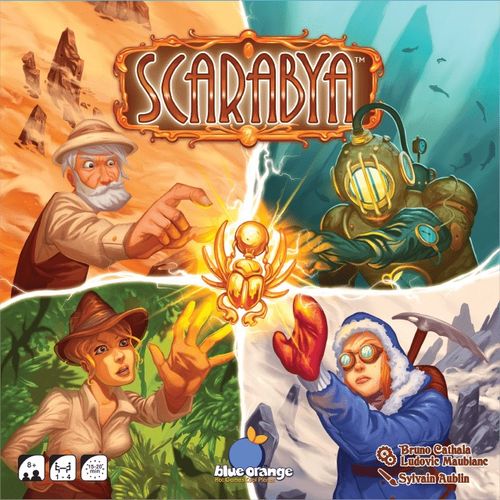
Scarabya
Scarabya Rulebook
Table of Contents
Table of Contents
Game Components
- 4 sets of 12 Tiles (to create excavation areas)
- 4 sets of 4 Boards (to create Archaeological Sites)
- 4 sets of 8 Rocks
- 4 Frames (to delineate the Archaeological Sites)
- 72 Scarab Tokens (worth 1, 2, 3, or 4 points)
- 12 Mission Cards
Object of the Game
Strategically position your Tiles to outline excavation areas that surround point-earning Scarab Symbols. An excavation area is a group of 4 squares or less that is surrounded by Tiles, Rocks, and/or Frame. Uncovered Scarab Symbols are worth 1 to 4 points each, depending of the size of the excavation area they are in. Scarab Symbols hidden by a Tile, or located in areas larger than 4 squares, do not earn points. The player with the most points at the end of 12 rounds wins the game.
Set-up
- Have each player choose a color and take the matching components: 1 Frame, 4 Boards, 12 Tiles, and 8 Rocks.
- The youngest player is assigned the role of Great Explorer. They shuffle the Mission Cards and place the pile face down in the center of the table.
- Make sure the pile of Scarab Tokens is accessible to all players.
- The Great Explorer then sets their 4 Boards inside their Frame, in any direction they like, to form an Archaeological Site that is 10x10 squares. The other players must replicate this Archaeological Site by arranging their 4 Boards in the exact same way.
- Then, all players must place their Rocks on the squares illustrated with a rock. (It does not matter which Rocks go where as long as there is one Rock per rock square).
Playing the Game
The game is played over 12 rounds.
At the start of each round, the Great Explorer draws a Mission Card. This card indicates which Tile players must place that round. All players will then pick up the indicated Tile and simultaneously position it on their Archeological Site, wherever they want, following the Layout Rules. Players then collect any Scarab Tokens they have earned in the round following the rules stated under Collecting Scarab Tokens.
Layout Rules
- The first Tile must cover at least 1 of the 4 central squares on the Archaeological Site.
- All other Tiles must connect to a previously placed Tile by at least one side. Connecting diagonally does not count.
- Tiles must be placed within the Frame, and cannot overlap it.
- Tiles must be placed around the Rocks. These are natural obstacles that all players need to work around.
- Tiles may not overlap.
Important Notes
- Scarab Symbols can be covered by a Tile, but will not score any points.
- If a Tile can be placed on the Archaeological Site, it must be played.
- If a Tile cannot be placed, it must be discarded.
Collecting Scarab Tokens
- Only Scarab Symbols located in an excavation area can earn points.
- An excavation area is:
- An enclosed space of 4 squares or less.
- This space can be bordered by Tiles, Rocks, and/or the Frame itself.
- Each Scarab Symbol located in an excavation area is worth as many points as the number of squares in that excavation area (1, 2, 3, or 4 points).
- To score points, take a Scarab Token with a point value that correlates to the number of squares in the excavation area and place it on top of each Scarab Symbol within that area (this process is repeated if there are any additional excavation areas created by placing the Tile).
- If there is no available token equal to the number of squares, add together several tokens of lesser value to create the required total.
Example: A player creates an excavation area made up of 4 squares that contains 2 Scarab Symbols. On each of these symbols, they place a Scarab Token worth 4 points (if all 4-point tokens have been used, they use a 3-point token and add a 1-point token).
The round is over when all players have placed their Tiles and the Scarab Tokens they have earned, on their Archeological Site. Then, the Great Explorer flips the next Mission Card and a new round begins.
End of the Game
The game ends after the 12th Mission Card has been drawn, the corresponding Tiles have been played, and any earned Scarab Tokens have been collected on each player's site. Each player then counts all the points from the Scarab Tokens they have collected. The player with the highest point total wins the game. In the event of a tie, the players share the victory.
Variations
One-on-One
Two archaeologists are competing, trying to find as many Scarabs as possible in one shared Archaeological Site.
Set-up:
- Take one set of components (1 Frame, 4 Boards, 12 Tiles, and 8 Rocks) and set up the 4 Boards inside the Frame to create an Archaeological Site. Place the Rocks on any open rock spaces.
- Then, place the site and the Tiles in the center of the table.
- Shuffle the Mission Cards and place them face down in a pile. Make sure the pile of Scarab Tokens is accessible to both players.
Playing the Game:
- Taking turns, flip over a Mission Card and place the corresponding Tile on the Archaeological Site following the Layout Rules on page 2.
- When you create an excavation area that contains Scarab Symbols, you score Scarab Tokens following the rules stated under Collecting Scarab Tokens. However, in this variation, you keep the corresponding tokens for yourself in a separate pile.
- To mark this newly-created excavation area as accounted for, place any unused Scarab Token onto one of its squares. The value of the token does not matter as it is just a reminder.
- If there is at least one way a Tile can be placed on the Archaeological Site, it MUST be played. In this variation, you have to place a Tile on your turn. If you cannot place a Tile, discard it, then flip the next card over. Continue this way until you can place a Tile.
The game ends when all the Mission Cards have been flipped over. In this variation, the player who went second may have positioned one less Tile than the player who went first. If that is the case, the player who went second gets one Scarab Token, with a 1-point value, for each Scarab Symbol that is not in an excavation area. Players then add up all their tokens. Whoever has the highest point total wins the game.
Note: After the first game, you may decide to rematch on the same Archaeological Site. To do this, reverse the order of play but keep the order of the Mission Cards.
Solo
You are the last remaining descendant of a civilization that was thought to be extinct. Your ancestors left you a mission: ensure the secrets of your people are never discovered! To do this, you must make sure that any archaeological searches fail. Your goal is to cover all of the Scarab Symbols.
Set-up:
- Take a set of components (1 Frame, 4 Boards, 12 Tiles, and 8 Rocks) and set up the 4 Boards inside the Frame to create an Archaeological Site. Place the Rocks on any open rock spaces.
- Shuffle the Mission Cards and place them face down in a pile. Put the Tiles and the Scarab Tokens within reach.
Playing the Game:
- To play, flip the Mission Cards over one after another and place the corresponding Tiles on the Archaeological Site as you go, strictly following the Layout Rules on page 2.
- Remember: You're trying to cover all the Scarab Symbols!
- If there is at least one way a Tile can be placed on the Archaeological Site, it MUST be played. If the Tile cannot be placed, discard it.
- Continue flipping the Mission Cards and placing the Tiles until you have run out of Mission Cards or can no longer play. Then, the game is over.
- You win if, and only if, you have covered ALL the Scarab Symbols.
- If you fail on your first try, you can flip the Mission Cards over face down, without changing their order, and try again!