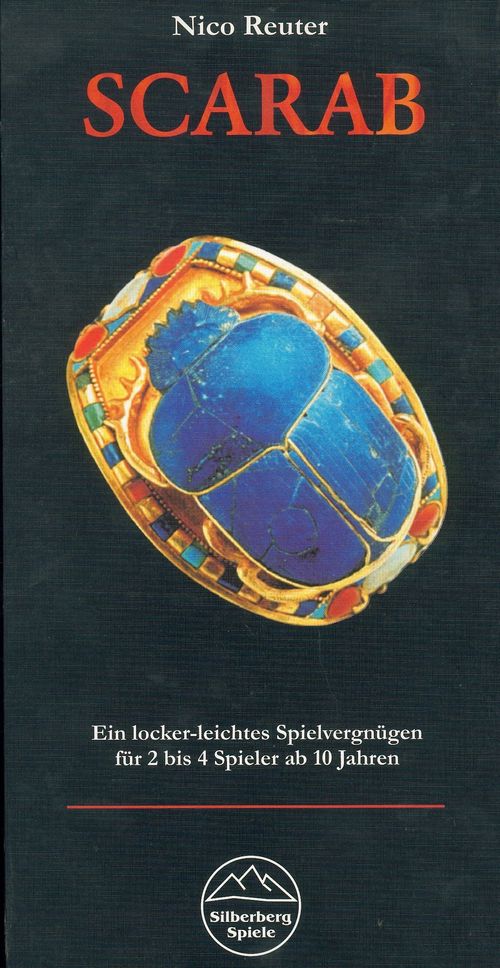
Scarab
Scarab Rulebook
Table of Contents
Table of Contents
Component Parts
- 1 game rule
- 1 game board
- 1 red Priest game piece made of wood
- 96 Scarab game pieces (sets of 6 pieces with values ranging from –8 [red] to +8 [green]); 8 of these pieces are marked yellow
- 3 Ankh game pieces
Terminology
Ankh
- Symbol of fertility and life as such, was used like an amulet by the Egyptians.
Scarab
(Egyptian „Cheprer“)
- Dungbeetle, symbol of reincarnation.
- The Scarab was used in many ways: as grave gift, seal, jewellery or amulet.
- The image of the dungbeetle who crawls backwards leaving the sand and pulls a little red ball behind himself was compared to the image of the rising sun, the reincarnation of the sun.
Thot
(Egyptian: „Dehuti“)
- Universal god, he fulfilled various roles: „lord of the moon“ and therefore „lord of time“ as well as „counter of the years“.
- „God of the art of writing“ and „protector of the writers“.
- „Tongue of Ptah“, „heard of Re“.
- Helper of the dead, companion in the under world.
- Was keeping book of the sins of the dead in the under world.
- God of knowledge.
- Thot is known as INVENTOR OF THE GAME.
Tricks Concerning the Component Parts
If the players happen to forget which way they have to turn during the game, the following trick helps: Paint a straight line on the centre of the Priest piece using a Permanent-Marker. Now once a player has finished his turn, he sets the Priest piece onto the board so that the line points towards the directions to which the following player must turn.
The Game of Thot (Basic Game)
Preparation
The game board is placed at the centre of the table. The 96 Scarab pieces and the 3 Ankh pieces are dumped onto the board. They get randomly assigned by the players. At the end the "priest" piece is set onto the last empty field that is left.
How to Play the Game
The youngest player starts first.
The game is played clockwise. If there are only two players, then they take turns.
The First Turn
The first player takes the Priest piece and drags it vertically or horizontally to the position of any Scarab piece in the same row. This Scarab piece will then be removed from the game board and becomes property of the player who made this move.
Now is the turn of the next player.
The Following Turns
The current player also drags the Priest piece to the position of a Scarab or an Ankh piece (see Ankh piece). If the previous player was moving vertically, then the current player must move horizontally now and vice versa. The Scarab piece now occupied by the Priest piece is removed from the game board and becomes property of the current player.
It's the turn of the next player now.
Ankh Piece
Eventually a player may be able to drop the Priest piece onto an Ankh piece. If that happens, the player is allowed to immediately drop one of his collected Scarab pieces onto any unoccupied field on the game board. This Scarab piece should have a very high negative value if possible. The Ankh piece will be removed from the game board.
Basic Rules
-
The Priest piece must always be dropped onto a Scarab or an Ankh piece. It can never be dropped onto an empty field. If one player can no longer move the Priest piece (because there are no more pieces in the corresponding row or column), then the game is over.
-
Turns must be made. Missing a turn is forbidden.
-
It is not allowed to hide collected Scarab pieces. They must all be visible to the other players.
Note: the source prints the item numbers as 1, 2, 2; they are transcribed as printed.
End of the Game
The game ends when a player can not make any moves or when all Scarab pieces are removed from the game board.
The players now sum up the values of all their Scarab pieces (red numbers are negative values, green numbers are positive values). The player with the highest total value may call himself the highest priest of Thot. In case of an end in a draw the player who owns most of the "+8" pieces wins. If there is a draw as well on the "+8" pieces, then the player who owns most of the "+7" pieces wins, and so on …
Variations
Short Game
In order to shorten the duration of the game, the players may only use the inner part (8 x 8 fields) of the game board. Therefore the following Scarab pieces must be left out before the game begins:
- 2 pieces of the value: -8, -7, -6, -5, -4, -3, 3, 4, 5, 6, 7, 8
- 3 pieces of the value: -2, -1, 1, 2
These pieces are not needed for the short version of the game.
Note: For playing the Turn-Off-Version all Scarab pieces with yellow marks must be left in the game!
Turn-Off-Version
You may have noticed that some of the Scarab pieces have a yellow mark. If a move crosses one of these pieces, then the player may turn off in a right angle at the position of this piece. For each move only one turn off is allowed. The turning direction for the next player is changed accordingly.
4-Player-Team-Version
A team is formed by two players. They have to sit next to each other, so that they turn one after another.
Objective: Each team tries to gain more points in total than the opponent team. Therefore the first player of a team may use his position to provide a good starting position for the other player of that team.
Note: Consultations are not allowed in the Team-Version.
Tricks for Winning
Try to gain as many points as possible and ignore the Ankh pieces at the beginning of the game. The Ankh pieces do not become useful until you own pieces with really high negative values to return to the board. This usually does not take place until the second half of the game.
Do not only try to play on high values. Sometimes it is more effective to play on lower values if the next player is thereby forced to take a piece with an even lower or negative value.
In the last part of the game you may try to enforce your strategy upon the opponent by playing in a row with only two pieces. In that case your opponent must take the piece that is left in that row. By doing so it is even possible to enforce various moves onto the opponent.