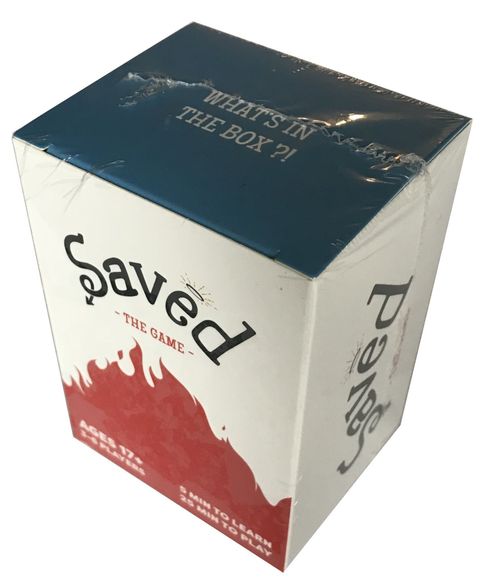
Saved
Saved Rulebook
Table of Contents
Table of Contents
Components
Contents:
- 8 Player Cards
- 12 Religion Cards
- 2 End Cards
- 30 Morality Cards
- 10 Karma Cards
- 82 Life Cards
Objective: The goal is to have the highest Virtue by the end of the game in order to ascend. If you don't, you will join the other unlucky souls destined for a more sobering fate.
Cards
Player Card
The Player Card shows:
a. Score tracker b. Player Card name c. Initiative d. Player Card ability
Religion Card
Religion Cards are placed face down (see Game Setup). The reverse side of a Religion Card is the Score Card.
Score Card
The Score Card is the reverse side of a Religion Card. It carries the score track.
Optional Score Tracker
To keep track of your score, simply place your player card on top of the score card and point the "score tracker" at your current point total.
Game Setup
-
Randomly deal one Player Card (face up) and one Religion Card (face down) to each player. Players may look at their own Religion Cards.
-
Shuffle all Vice, Virtue, Karma and Morality Cards together.
-
Deal each player seven cards, if they receive a Karma Card, randomly put it back into the deck and draw another card.
-
Cut the deck and shuffle the End Cards (Armageddon and Apocalypse) into the bottom half, then recombine.
NOTE: For a shorter game shuffle the End Cards into the bottom three-fourths of the deck.
-
The player with the lowest initiative on their Player Card begins. Play proceeds clockwise.
On Your Turn
Your turn consists of a "play phase" and a "draw phase".
Play Phase
You may play one Vice or Virtue Card on any player's life deck.
- Life decks are each player's collection of Vice and Virtue Cards in play.
Draw Phase
Draw a card and end your turn (there is no hand limit).
- If a Karma Card is drawn, play it immediately. After resolving the Karma Card, draw a replacement card.
- If an End card is drawn, the game ends (see The End Is Here!).
Vice and Virtue
- Vice Cards (red) are negative points and are the "abominable" things people have done in their lives. The intent is to play them on others to drag them through the mud.
- Virtue Cards (blue) are positive points and are "pleasing" things people have done with their lives. These are intended to be played on yourself, embarrassing as they might be.
- Your life deck is the collection of Vice and Virtue Cards you have in play.
- When you play a card worth 5 points you draw two cards at the end of your turn instead of one (even if that card is played on someone else).
Karma
- Karma immediately affects players who draws it and cannot be redirected or interrupted.
- The effect is based on the last card played (Vice or Virtue) this round. If no card was played this round, discard the Karma and redraw.
- Karma has no effect on lust if their last card was placed face down.
Morality
- Morality Cards can be played at anytime, on any turn before either the Armageddon or Apocalypse cards are drawn.
- Morality cards can interrupt other cards as they are played (even other Morality cards), if this happens, resolve the most recent Morality first.
- Morality cards cannot redirect or void Karma or Player Card abilities.
The End Is Here!
The sheet's section heading reads "THE END IS NIGH HERE!" with "NIGH" struck through; the heading is given here as printed, with the struck word removed.
- When an End Card (Apocalypse or Armageddon) is drawn, the game is at its end. No further cards can be played.
- Players reveal their Religion Cards and resolve them.
- Players resolve The End Card (discard or play).
- Players tally their life total by adding all Vice and Virtue cards in addition to any applicable Religion bonus.
- The player with the highest Virtue at the end of the game wins and ascends while everyone else is left to their fate.
NOTE: If a player has the Narcissist Religion, they win if they have the highest Vice (this overrules the normal win condition).
Example Play Area
The example shows a Player card (WRATH), a Religion card and a life deck of three Vice and Virtue cards (values 30, 10 and 35) laid out left to right.
Card Examples
Vice
Example Vice Card: 15, "I passed out drunk in a confessional".
Virtue
Example Virtue Card: +5, "...Because I'm a virgin". DRAW TWO CARDS.
Karma
Example Karma Card text, Virtue side: "VIRTUE: player to your left passes you a VIRTUE from their life deck".
Example Karma Card text, Vice side: "KARMA" / "VICE: Player to your left passes you a VICE form their life deck". (The printed word "form" is reproduced as it appears on the sheet.)
Morality
Example Morality Card: "MORALITY. Redirect VIRTUE being played to your life deck." Flavour text: "You got the wrong guy, I'm the dude, man!" There are both Vice (red) and Virtue (blue) Morality cards.
Player Card and Religion Card Examples
The sheet shows two example cards. The full lists of Player Cards and Religion Cards are not printed on this sheet.
Example Player Card: PRIDE. Ability: "You may play an additional VIRTUE card on your own life deck during play phase.* *This action counts as a VICE."
Example Player Card: WRATH. Ability: "Anytime someone plays a VICE on you, you may play a VICE of 10 or higher on them."
Example Religion Card: JEHOVAH'S WITNESS. "+5 VIRTUE for each opponent playing".
Source note: transcribed from the official two-page English rules sheet published by Uffda Games (2018), obtained from the publisher's WordPress uploads.