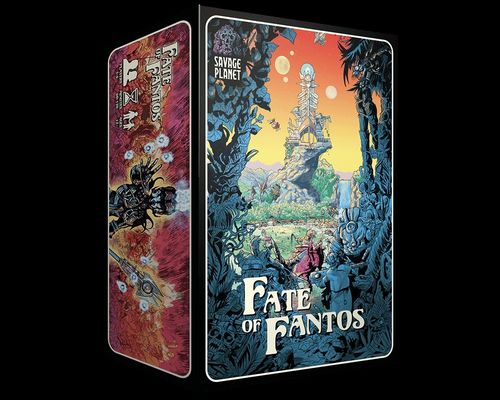
Savage Planet: The Fate of Fantos
Savage Planet: The Fate of Fantos Rulebook
Table of Contents
Table of Contents
Game Overview
Savage Planet: Fates of Fantos is a tableau-building card game with competitive and co-operative elements for 3–6 players. Each player takes on the role of a unique Citadel of Fantos. As Citadels, players must hire Legacies to manage their affairs.
Hired Legacies can be tasked by their Citadels to Harvest more Shards, go to War with a neighboring Citadel, be nominated to vie for Tribute, pay for Labor, or activate their unique abilities. Every time Citadels choose to Harvest from the planet's Trove, they further contribute to the pollution of Fantos and new Trials are revealed. Life on Fantos becomes increasingly difficult as Zodraz unleashes plagues, summons cosmic creatures, and forces dissent between the Citadels. Resolve them together as a planet, or watch as rival Citadels struggle to survive.
Plan wisely and make every turn count because Zodraz himself lurks among the Trials. When the Cosmic Warden is drawn, Citadels will have a final round of reckoning to prove themselves worthy of Fantos.
Game Objective
Iridium poses an ominous dilemma for the inhabitants of Fantos. On one hand, it is essential for the survival and health of all Fantosians. On the other, over-population and extreme harvesting has caused great harm to the planet. Thus, a cleansing is required. Using hired Legacies as managers for your Citadel, your challenge is to regulate your Citadel's Iridium use and acquisition in order to build up its supply before the cull begins.
When Zodraz is drawn from the Trials Deck, the final round commences. At the end of that round, the Citadel in control of the most Iridium Shards will be declared the new Ward of Fantos, while the rest perish.
An alternative path to victory can be achieved by outlasting every other Citadel before Zodraz makes his final decision. (See "Winning the Game" on page 34.)
Iconography of Fantos
Symbols used while playing the game.
- Harvest – The Fantos Action of Harvest.
- War – The Fantos Action of War.
- Tribute – The Fantos Action of Tribute.
- Task – Task a Legacy.
- Fantos Action Phase – Labor cards and Legacy abilities with this icon may only be played during the Fantos Action Phase.
- Secondary Actions Phase – Labor cards and Legacy abilities with this icon may only be played during the Secondary Actions Phase.
- Legacy – Legacy cards.
- Labor – Labor cards.
- Shard – Iridium Shards.
- Untask – Untask a Legacy.
- Instant – Labor cards and Legacy abilities with this icon may be played at any time, during any phase.
Races of Fantos
All Legacies belong to one of these six races. Although their populations have become mixed over the eons, each Citadel remains historically tied to the race that established it.
- Feral
- Marked
- Hollow
- Enlightened
- Cult
- Overseer
Game Setup
Create the Legacy Pool and the Legacy Deck
Shuffle the Legacy cards. Take 5 cards from the top and place them face up in a row in the center area of play. This is called the Legacy Pool. Stack the remaining Legacy cards face down next to the Legacy Pool to create the Legacy Deck. (Be sure to leave space near it for a face-up discard pile.)
Deal the Player Hands and Create the Labor Deck
Shuffle the Labor cards. Deal 5 cards face down to each player. These 5 cards become the player's hand and are kept secret until played. After the hands are dealt, stack the remaining Labor cards face down, within reach of every player, to create the Labor Deck. (Be sure to leave space near it for a face-up discard pile.)
Create the Trials Deck
First, locate the bright blue dots on the face of every Trial card; these signify the tiers of the Trials (1–4). Next, place the cards into groups based on the number of dots. Shuffle the group of Tier 4 cards together (including Zodraz), and place them face down. Then, continue shuffling and stacking the card groups on top of Tier 4: Tiers 3, 2, then 1, in that order. (The Tier 1 Trials should be face down on the top of the stack when finished.) Place this Trials Deck within reach of every player. Leave space next to it for 3 cards, which will be drawn as the game progresses.
We suggest setting up the Trials Deck in this manner for the first few games; then you may choose to increase the difficulty by mixing the tiers together; see "Alternative Ways to Play" on page 35.
Assign the Citadels
Shuffle and place the Citadel Mats face down on the table. Each player randomly selects a mat and places it face up in front of them. Make note of each Citadel's Hiring Incentive as they are assigned. (The front of the mats display the Citadels' names; the back of each gives a quick guide to Fantos Actions.)
Create the Reserves and the Trove
Deal out 15 pink (value: 1) and 5 blue (value: 5) Shard Tokens to each player, giving every Citadel's Reserve a total starting Shard value of 40. The remaining Shards are placed in a pile within reach of every player to create the Trove. (Feel free to use the Trove throughout the game to make change or exchange denominations as needed.)
Shard Die
Place the Shard Die within reach of every player.
Tribute Marker
Set aside the Tribute Marker until it is needed.
Legacy Hiring
Every player takes a turn rolling the Shard Die, starting with the person who most recently paid tax and continuing clockwise. The first person to roll a 3 begins the Hiring part of the setup by choosing and hiring one Legacy from the Legacy Pool.
To hire a Legacy, first choose a card from the Legacy Pool and place it face up in the vertical, untasked position directly above, or next to, your Citadel Mat. Then, pay the Legacy's Hiring Cost (the number on the top right of the card) by transferring that exact number of Shards, no more and no less, from your Reserve onto the face of the hired Legacy. (The Trove is not involved in this transaction unless using a Hiring Incentive, as noted on the Citadel Mats.)
Every time a Legacy is hired, immediately fill the vacancy in the Legacy Pool by drawing a new card from the Legacy Deck and placing it face up in the empty spot. (The Legacy Pool should always include 5 cards.)
Hiring continues, clockwise, until every Citadel has hired 3 Legacies. (1 per turn.)
Determining the First Citadel
After hiring is completed, the Citadel with the most Shards remaining in its Reserve is designated the First Citadel and will take the first turn. (If there is a tie, the First Citadel is the one with the most in its Reserve that completed hiring most recently.)
This player claims the First Citadel Marker and remains First Citadel for the entire game. (If the original First Citadel is eliminated prior to the end of the game, the designation passes to the Citadel to its left.)
If this is your first time playing Fate of Fantos, or if you are still learning, it is very important to familiarize yourself with the key concepts, card uses, and definitions discussed on the following pages. However, if you are already familiar with the game, you may proceed to page 16 to begin the Phases of Play.
Suggested Table Setup
The rulebook shows a diagram of a suggested table layout with the Labor Discard, Labor Deck, Legacy Pool, Legacy Deck, Legacy Discard, Trials Deck, Trove, Shard Die, First Citadel Marker and Tribute Marker placed around the Citadel Mats. The diagram is not reproduced here.
Playing the Game
If this is your first time playing Fate of Fantos, or if you are still learning, it is very important to familiarize yourself with the key concepts, card uses, and definitions discussed below.
Playing Fate of Fantos requires constant communication and interaction. The player taking the current turn should talk through choices and actions, and give other players the chance to respond before moving on. Don't rush; this is a game of management and politics.
If the text on any card contradicts the instructions in this rulebook, the instructions on the card take precedence.
Tasking and Untasking
Most actions in Fate of Fantos are performed by a Citadel's hired Legacies. It is helpful to think of Legacies as managers. Whenever a Legacy is delegated to an action by its Citadel, it must be Tasked to that action, unless otherwise specified by card text. For example, every Fantos Action – Harvest, War, and Tribute – requires at least one Legacy to be tasked in order to be completed. Additionally, playing cards and activating abilities may require a Legacy to be tasked. (This will be specified on the card itself and is considered an action).
A tasked Legacy card is rotated 90 degrees, horizontal to the player's Citadel Mat. A tasked Legacy cannot be delegated to other tasked actions until it is Untasked.
A Legacy is untasked at the beginning of its Citadel's next turn, or if a card or ability is played to untask it before then. To physically untask a Legacy, return the card to its upright position, vertical to the Citadel Mat.
Important Notes
- A Citadel may only task or untask its own hired Legacies, unless playing cards and/or abilities that can affect its choice of Legacies.
- A Legacy can be tasked to a specific action only once per turn. For example, if a card or ability is played that untasks a Legacy, it cannot be tasked back the same action during that turn, to either repeat or complete it. (However, it may be tasked to a different action, if applicable).
- If a card or ability is played that forces a Legacy to become untasked after being tasked to an action, but before the action has been completed (scores tallied, resources exchanged, etc), the untasking has the effect of either cancelling the entire action or just that Legacy's part in it.
- If a Legacy is forced to be tasked by a played card or ability, this does not mean it is tasked to an action; it simply means that Legacy cannot be tasked to anything else until it becomes untasked.
- The intention to task or untask a Legacy takes effect, even if a player forgets to physically move the card(s) into the tasked or untasked position. Players should be paying attention and remind each other if forgotten!
Card Types and Uses
There are 3 types of cards used in Fate of Fantos: Legacy cards, Labor cards, and Trial cards. The following pages detail their layouts and uses.
Legacy Cards
The Legacy Deck consists of 48 unique Legacy cards, including an equal number of characters from each of the six Races of Fantos who will be hired to act as managers for each Citadel. Once hired, Legacies provide value to their Citadels by collecting Shards from Harvest, going to War, vying for Tribute, paying for Labor, and activating their unique abilities.
Card layout (example: the Bailiff Legacy):
- Race: Indicates the Fantos Race of the Legacy.
- Harvest Stat: Indicates the amount the Legacy can contribute to its Citadel's Harvest Score.
- War Stat: Indicates the amount that the Legacy can contribute to its Citadel's War Score and to its own Duel Score.
- Tribute Stat: Indicates the amount that the Legacy can contribute to its Tribute Score.
- Hiring Cost: The Legacy's Hiring Cost is the amount specified by this number; no more, no less. Once hired, Shards transferred from a Citadel's Reserve to the Legacy during the hiring process become its health and currency:
- Health: When a Legacy takes damage for any reason (when losing a War or Duel, for example), Shards are transferred from it as specified by the action.
- Currency: An untasked Legacy may spend its Shards to play Labor from its Citadel's hand. Some Legacies must also spend Shards in order to activate their abilities. Other Citadels may also play cards and/or abilities that force the Legacy to transfer Shards from its available currency.
- Phase Condition: Indicates the phase during which the Legacy's ability can be activated.
- Ability: Indicates the unique ability that the Legacy may activate. Most abilities require Legacies to meet special conditions before they can take effect. Required conditions are noted in bold and followed by a colon on the card's text. Conditions noted before the colon must be met by that specific Legacy before the effect (the text after the colon) can activate. A few Legacies possess native abilities. These abilities do not have any special conditions that must be met; the effect activates as long as the Legacy is hired and not disabled. (There are no bolded conditions on these cards).
The example Bailiff card (Hiring Cost 4; Harvest 0, War 1, Tribute 2) shows the ability "1 Shard AND Task: Choose a Legacy and Disable it." The caption on the example reads: "This Legacy must spend 1 Shard and be tasked to activate its ability."
If a Legacy's Shards are exhausted for any reason, it must be discarded.
Important Notes
- A Legacy must spend Shards from its currency before being tasked. However, Shards can be forcibly transferred from a tasked Legacy when required by a played card or ability.
- Legacies in the deck, pool, and discard pile cannot be tasked, and they do not possess any Shards until hired.
- A Legacy's ability may be activated any time its conditions are met, even out of turn and/or to help or hinder other Citadels.
- Whenever a Legacy is tasked to its ability, the effect is activated once, immediately when tasked.
- A Legacy's ability cannot be compounded. For example, if activating the ability requires spending, the amount paid cannot be doubled to play the ability twice at the same time, or double the effects, etc.
- The terms "a Legacy" or "any Legacy" refer to any hired Legacy from any Citadel, unless otherwise specified.
- If a Legacy is forced to be discarded while still in possession of Shards, those Shards are transferred to the Trove.
- Legacy cards are discarded face up into a Legacy discard pile. After the Legacy Deck is exhausted, shuffle the discards into a new deck.
Labor Cards
The Labor Deck consists of 54 Labor cards that act as additional resources, which can be played from a Citadel's hand by its hired Legacies. These cards can only be played by a Citadel's untasked Legacies.
In order to play Labor from its Citadel's hand, an untasked Legacy with sufficient currency must pay the card's cost, even if that cost is zero. The cost of a Labor card cannot be split or shared among multiple Legacies; however, multiple Labor cards may be played by a single Legacy, as long as it has enough Shards to pay in full for each. Shards spent on Labor are transferred to the Trove.
Paying for Labor does not task the Legacy, and played Labor may be given to any hired Legacy or Citadel to use, even a Legacy that is tasked and/or one that has been hired by another Citadel. Multiple Labor cards, even those of the same type, can be applied to a single action and/or Legacy, unless otherwise specified on the card.
Card layout (example: the Council Labor card): the card shows a Cost (the number in the gold circle, here 2), a Phase Condition (the phase icon at the bottom left of the card), and an Effect (the text beneath the art). The Council card's effect reads: "Choose a Legacy and give it +3 Tribute for one action."
Labor is considered played as soon as it is paid for and revealed, at which time its effect is applied once and the card is discarded, unless otherwise specified. If played Labor is cancelled before its effect is resolved, or if the action it affects is cancelled before completion, the card is immediately discarded.
Labor Important Notes
- A Labor card may be played any time its Phase Condition is met and an untasked Legacy can pay for it, even out of turn and/or to help or hinder others.
- Some Labor cards specify that they should be "attached" to Legacies. Once assigned, attached Labor continues to give resources to that Legacy, and/or its Citadel, until the Legacy is discarded for any reason (at which time the attached Labor is discarded as well), or another card or ability is played that cancels (discards) the attached Labor.
- Labor cards are discarded face up into a Labor discard pile. After the Labor Deck is exhausted, shuffle the discards into a new deck.
Trial Cards
The Trials Deck consists of 17 Trial cards to further test the Citadels of Fantos at various times during the game. There are 2 types of Trials, plus Zodraz.
Diplomacy Cards. The Fantosians may band together in an attempt to combat these Trials. When a Diplomacy Trial is drawn, every Citadel must vote "yea" or "nay" to game altering resolutions. (Each Diplomacy Trial card is enhanced with the same illustration, as a visual reminder that a vote is required.)
Example, Bad Blood (Diplomacy): "Fantos Action: War is now directed at the Citadel to the right. Let the vote commence."
Cosmic Cards. The arrival of Zodraz is preceded by various game altering events from the stars. When a Cosmic Card is drawn, gameplay is affected by the card's challenge, either immediately or during future phases.
Example, Riot (Cosmic): "Secondary Action: Any untasked Legacy may challenge another Legacy to a Duel. Challenges should be issued in turn order, beginning with the active Citadel."
Zodraz Card. As the ultimate Cosmic Trial, when Zodraz is drawn, the end game condition is at hand. The final round begins, and the Citadels of Fantos prepare for their fates to be decided.
Zodraz card text: "End Game Condition: No new Trials may be drawn during this final round, but Trials currently in play still take effect, as applicable. NO Harvest ALLOWED. The new Ward of Fantos will be decided at the end of this round!"
Trial Important Notes
- The bolded text on each Trial card, followed by a colon, specifies the phase of the game that the Trial affects while it is in play.
- For detailed information about playing Trials, see the Trials Phase section on pages 28 and 29.
Key Concepts and Definitions
Communication
Playing Fate of Fantos requires constant communication and interaction. The player taking the current turn should talk through choices and actions, and give other players the chance to respond before moving on. Don't rush; this is a game of management and politics.
Resolution Order
Labor cards and Legacy abilities can be played, or activated, whenever their conditions are met, even during another player's turn. This creates constant opportunity for every player to affect the course of the game. The player whose turn it is plays first; then cards and abilities may be played by everyone else, either in reaction to the choices of others or independently. If played reactively, the effects are resolved in descending order, starting with the most recent card or ability played. If played independently of others (to steal Shards, for example), the effect is resolved immediately, unless others choose to meddle with it by playing cards or abilities in reaction, before the effect can be completed. Each card's text and Phase Condition will help determine how and when it can be played.
Example: The active Citadel chooses to go to War for its Fantos Action. The defending Citadel uses one of its untasked Legacies to play the A Time of Peace Labor card, cancelling the War. Then, the active Citadel (or even an entirely different one!) uses one of its untasked Legacies to play the Shell Game Labor card, cancelling A Time of Peace. No other cards or abilities are played in reaction; this means that the War can now proceed.
Negotiation
During the course of a game, players are encouraged to create and shatter alliances. Negotiations, including bribes and trades, may be arranged between consenting parties. Citadels may work together to combat undesired effects or take out a particularly powerful rival. However, negotiations are not binding or enforceable, so do not enter into them lightly: all choices have consequences on Fantos!
The Golden Rule
If the text on any card contradicts the instructions in this rulebook, the instructions on the card take precedence.
Hiring Incentive
Each Citadel Mat specifies a hiring discount associated with its founding race. This does not mean that the Citadel can only hire from that specific race; however, if it chooses to do so, the Trove will help pay the Hiring Cost.
Active Citadel
This term refers to the Citadel of the player who is taking the current turn.
Hand
This term refers only to the cards held in secret in a player's hand, not to any part of the public tableau.
Shards
These tokens represent Iridium, the health and currency of Fantos. They come in denominations of 1 (pink) and 5 (blue). The Shard Die is rolled to influence actions during the game.
Spend
This means that the required Shard payment must be transferred to the Trove.
Reserve
This term refers to a Citadel's main supply of Shards. The Reserve does not include any Shards currently in use by that Citadel's Legacies.
Trove
This represents the planet's available Shards. It is helpful to think of it as a public field of Iridium mines that may be harvested for Shards and used as a bank to exchange denominations, as well as the place to make payments whenever spending Shards to play certain cards and abilities.
Disable
A disabled Legacy is still hired but is temporarily unable to assist its Citadel. To Disable a Legacy, flip it over, face down. A disabled Legacy cannot be discarded, and its Shards cannot be spent, transferred, or used toward any tallies; its assets are frozen and unavailable. Additionally, any Labor associated with that Legacy is discarded, including "attached" Labor. If the Legacy is the current Reigning Tribute, the Tribute Marker is removed, and there is no Reigning Tribute until another Tribute action is completed. A disabled Legacy is restored to the face up, untasked position at the beginning of its Citadel's next turn.
Cancel
A card or an ability that cancels an action must be played, or activated, before the action has been completed (scores tallied, resources exchanged, etc). Any Legacy tasked to the action before it was cancelled stays tasked. Labor played to affect the action before it was cancelled is discarded, with the exception of "attached" Labor.
Phases of Play
A Citadel's Turn
Each Citadel's turn is divided into a series of six Phases of Play. The phases must be played one at a time, in order, by the active Citadel.
- Untask & Draw Up
- Fantos Action
- Trials
- Secondary Actions
- Hiring
- Discard
After a phase has ended, it cannot be returned to during that turn, so the active Citadel should act as "turn master" and verbally confirm readiness before moving on to its next phase.
As a Citadel progresses through the phases, remember to check for in-play Trials that may affect that phase. During the progression of the turn, other Citadels may also affect outcomes by participating in actions as applicable, or by playing cards and/or abilities that meet the phase conditions. After the active Citadel has progressed through every phase, play continues clockwise to the next Citadel. Play begins with the First Citadel.
1. Untask & Draw Up Phase
At the beginning of its turn, the active Citadel untasks its Legacies and/or restores any that are disabled, then draws up from the Labor Deck to the starting hand size of 5 cards, if needed.
Important Notes
- If the Labor Deck doesn't have enough cards, draw from the deck until there are none remaining, then shuffle discarded Labor to form a new Labor Deck.
- It is possible to have more than 5 Labor cards in hand, due to a variety of factors. This is fine, but more cannot be drawn at this time, unless specified by a card in play.
2. Fantos Action Phase
At the beginning of the Fantos Action Phase, the active Citadel may choose to task one or more of its Legacies to one of these Fantos Actions: Harvest, War, or Tribute.
- Harvest (page 18)
- War (page 20)
- Tribute (page 24)
Important Notes
- Citadels cannot complete more than one Fantos Action per turn, unless specified by a card in play, nor may the same Fantos Action be attempted more than one time per turn (for example, if the first attempt is cancelled).
- If a Fantos Action is cancelled for any reason, Legacies tasked to that action remain tasked. The active Citadel may attempt to complete a different Fantos Action if it has any remaining untasked Legacies available.
- Taking a Fantos Action is not required.
- Any Citadel may play cards and/or abilities to affect a Fantos Action, as long as the conditions are met.
- There is a "Quick Guide to Fantos Actions" on the back of each Citadel Mat.
Fantos Action Phase: Harvest
Every Citadel craves Iridium. When Harvest is chosen, the active Citadel is allowed to mine the Iridium fields for precious Shards. Follow these steps to complete a Harvest Action:
- Gather your Workforce: Select any number of your currently untasked Legacies to task to the Harvest.
- Establish your Harvest Score: Tally the Harvest Stats for each of your harvesting Legacies to determine their Harvest stat sum. Then, roll the Shard Die one time for each Legacy you have tasked to the Harvest. Add the results of the die rolls to the Harvest stat sum to establish your Harvest Score. Additionally, untasked Legacies from any Citadel may play cards and/or abilities to affect the outcome, so remember to also take those into account before establishing the final score. (After the final Harvest Score is established, nothing else may be played to affect it.)
- Harvest the Shards: Your Harvest Score becomes the number of Shards you gain from the Trove. Shards gained from Harvest are transferred to your Reserve, not to your Legacies.
Important Notes
- Completing a Harvest triggers the Trials Phase. Harvest is the only Fantos Action that does so, unless it is the First Citadel's turn. (See "Trials Phase" on page ___.) (The page number is blank in the source rulebook.)
Basic Harvest Example
- The active Citadel chooses to task both its BISHOP and its COOK to the Harvest.
- The BISHOP has a Harvest Stat of 3 and the COOK a 1, for a Harvest sum of 4. The Citadel then rolls the Shard Die 1x for each Legacy it has tasked to the Harvest, resulting in rolls of a 1 and a 2. These rolls are added to the Harvest stat sum, for a Harvest Score total of 7.
- The Citadel transfers 7 Shards from the Trove to its Reserve, then proceeds to the Trials Phase.
This example does not include any cards or abilities played that may affect the scores or outcome. If any such effects are in play, simply adjust as specified by the card text.
Fantos Action Phase: War
Some Citadels wish to exert their power. When War is chosen, the active Citadel can send any number of its Legacies to attack the Citadel directly to its left. Follow these steps to complete a War Action:
- Gather your Army: Select any number of your currently untasked Legacies to task to the War. The defending Citadel may then select any number of its currently untasked Legacies to task to its defense. (However, the defending Citadel is not required to defend with Legacies, or it may not have any untasked Legacies available; see "Defending Without the Aid of Legacies" on page 21.)
- Establish your War Score: Tally the War Stats for each of your warring Legacies to determine their War stat sum. Then, roll the Shard Die one time for each Legacy you have tasked to the War. Add the results of these die rolls to the War Stat sum to establish your War Score. Next, the defending Citadel establishes its War Score. Additionally, untasked Legacies from any Citadel may play cards and/or abilities to affect the outcome, so remember to also take those into account before establishing the final scores. (After final War Scores are established, nothing else may be played to affect those scores.)
- Compare War Scores & Establish the Damage Score: The higher score is the winner. Subtract the losing score from the winning score to establish the Damage Score. (If there is a tie, the war ends in a draw. No damage occurs and no spoils are awarded; the Legacies remain tasked and the active Citadel moves on to the next applicable phase of play.)
- Allocate the Damage & Award the Spoils of War: The losing Citadel must now allocate the damage among its warring Legacies in order to pay the winner its spoils. The loser must take the Shard amount equal to the Damage Score from its warring Legacies; either the entire amount from one or dispersed across multiple. Any excess damage unable to be taken from its warring Legacies must be removed from the losing Citadel's Reserve. Shards won in War are transferred to the winning Citadel's Reserve, not to its Legacies.
Defending Without the Aid of Legacies
When defending against War, if you choose not to task any of your Legacies to the defense, or if you do not have any untasked Legacies available, you may still defend yourself by rolling the Shard Die one time. The result of the die roll, plus any cards and/or abilities played to affect the score, becomes your War Score. If you lose, all spoils are transferred from your Reserve.
Important Notes
- War is always aimed at the Citadel to the left, unless otherwise specified by a card in play or when the Citadel of the Reigning Tribute attacks a Citadel of its choice. (See "Reigning Tribute Favors" on page 27.)
- If the defending Citadel wins the War, the active (attacking) Citadel still gets to complete its turn as normal.
- Legacies that were tasked prior to the onset of the war are not available to defend their Citadel if it is attacked, unless cards or abilities are played to untask them first.
- Turn the page for an example of a War action.
Basic War Example
- The attacking (active) Citadel chooses to task its EXECUTIONER and KNIGHT to the War. The defending Citadel chooses to task its SHIRAZAD to defend.
- The defending Citadel's SHIRAZAD has a War Stat of 3. The attacking Citadel's EXECUTIONER has a War Stat of 2 and its KNIGHT a 3, for a War stat sum of 5. Both Citadels then roll the Shard Die 1x for each Legacy they have tasked to the War. These rolls are added to each Citadel's War stat sum. The defending Citadel rolls 2, for a War Score total of 5. The attacking Citadel rolls a 1 and a 1, for a War Score total of 7.
- The attacking Citadel has a War Score of 7, and the defender has 5. The attacking Citadel is the winner with a Damage Score of 2 (7 − 5 = 2) and is owed 2 Shards of spoils from the defender's SHIRAZAD.
- The defending Citadel gives 2 Shards from its SHIRAZAD to cover the damages, which are transferred to the attacking (winning) Citadel's Reserve as the Spoils of War. Then, the active Citadel proceeds to its next applicable phase. (Trials, if it is the First Citadel, or Secondary Actions, if it is not.)
This example does not include any cards or abilities played that may affect the scores or outcome. If any such effects are in play, simply adjust as specified by the card text.
Fantos Action Phase: Tribute
Every Citadel wishes to receive special favors from Zodraz. When Tribute is chosen, the active Citadel can attempt to win those favors by nominating one, and only one, of its Legacies to vie for the title of Reigning Tribute of Fantos. Follow these steps to complete a Tribute Action:
- Nominate your Tribute: Select one of your currently untasked Legacies to task to the Tribute. Then, each other Citadel may select one of their currently untasked Legacies to task as challengers. Before moving on to the next step, you should verbally check to make sure all other Citadels are ready to proceed. (However, other Citadels are not required to participate, unless it is a "Special Tribute Action"; see page 25.)
- Establish your Tribute Score: Each participating Citadel rolls the Shard Die one time, in turn order. (Even if your Legacy is the only one vying for Tribute, you still get to roll the die.) The die roll result is added to the Tribute Stat of the nominated Legacy to establish the Tribute Score for each participating Legacy. Additionally, untasked Legacies from any Citadel may play cards and/or abilities to affect the outcome, so remember to also take those into account before establishing the final scores. (After final Tribute Scores are established, nothing else may be played to affect those scores.)
- Compare Tribute Scores & Select a Reigning Tribute: The Legacy with the highest Tribute Score is the winner. (If there is a tie, each tied Citadel continues taking turns rolling the die until one emerges victorious.) This Legacy becomes the Reigning Tribute, which grants its Citadel special favors, and claims the Tribute Marker. (See "Reigning Tribute Favors" on page 27.) It remains Reigning Tribute until a challenger takes away the title by winning a future Tribute Action or until the Legacy is discarded or disabled.
- Collect the Tribute Reward: The difference between the Tribute Scores of the winner and the runner-up becomes a Shard reward paid to the Citadel of the Reigning Tribute. This reward is taken from another Citadel, or split between multiple Citadels, of the Reigning Tribute's choosing. Shards paid in Tribute are transferred between the Citadels' Reserves, not between their Legacies.
Important Notes
- If the active Citadel completes a Tribute Action without its Legacy being challenged, it claims the entire Tribute Score as the reward.
- The title of Reigning Tribute refers to the Legacy that won the title, not the Citadel itself, nor any of that Citadel's other Legacies.
- If a challenger wins the Tribute, the active Citadel still gets to complete its turn as normal.
- If the Reigning Tribute must be discarded or disabled for any reason, the Tribute Marker is removed from it, and there is no Reigning Tribute until another Legacy wins the title.
- Turn the page for an example of a Tribute action.
Special Tribute Action
Occasionally, a card may be played that requires a Special Tribute Action to be performed. This simply means that every Citadel must participate, and currently tasked Legacies are allowed to be nominated as challengers. All other Tribute Action rules apply as normal.
Basic Tribute Example
- The active Citadel chooses to task its VIZIER to the Tribute. Two other Citadels also choose to nominate challengers. One Citadel tasks its MARQUIS; the other tasks its ASTROLOGERS.
- Each tributing Legacy has a Tribute Stat of 3. Each participating Citadel rolls the Shard Die 1x, then adds those roll results to the Tribute Stat of their tributing Legacy. The active Citadel rolls a 2, giving its VIZIER a Tribute Score of 5. The first challenger rolls a 3, giving its MARQUIS a Tribute Score of 6. The second challenger rolls a 1, giving its ASTROLOGERS a Tribute Score of 4.
- The MARQUIS has the highest Tribute Score with 6. He is now the Reigning Tribute and claims the Tribute Marker. His Citadel claims all favors associated with this rank for as long as he holds it.
- The MARQUIS also claims a Tribute Reward for his Citadel. The runner-up Tribute Score (the VIZIER's 5) is subtracted from the winning Tribute Score (the MARQUIS' 6) to establish the number of Shards to claim (6 − 5 = 1). Therefore, the MARQUIS' Citadel collects 1 Shard for its Reserve from another Citadel's Reserve. Then, the active Citadel moves on to its next applicable phase. (Trials, if it is the First Citadel, or Secondary Actions, if it is not.)
This example does not include any cards or abilities played that may affect the scores or outcome. If any such effects are in play, simply adjust as specified by the card text.
Reigning Tribute Favors
When a Legacy is selected as the Reigning Tribute, place the Tribute Marker next to, or on, that Legacy to indicate its status. The Citadel of the Legacy that has successfully won favors from Zodraz is given the following diplomatic bonuses, which can greatly alter the fate of Fantos:
- If the Citadel of the Reigning Tribute chooses War as its Fantos Action, it can attack any Citadel it wishes (instead of only the Citadel to its left).
- When a new Trial is required to be drawn from the Trials Deck and there are already 3 cards in play, the Citadel of the Reigning Tribute decides which in-play Trial to remove. (See "Trials Phase" on page 28.)
- If a tie occurs when voting on a Diplomacy Trial, the Citadel of the Reigning Tribute acts as tiebreaker.
3. Trials Phase
Iridium pollution has pushed Fantos to the brink of destruction. Zodraz has decreed that further harvesting shall bring consequences. If the active Citadel chooses to go to Harvest for its Fantos Action, it must draw from the Trials Deck after the Harvest is completed.
Encountering the Trials
The active Citadel must draw and reveal Trial cards one at a time, and the number to be drawn depends on how many Shards it gained from the Harvest:
- Shards Harvested 1–6: Trials Revealed 1
- Shards Harvested 7–12: Trials Revealed 2
- Shards Harvested 13+: Trials Revealed 3
The Trials Phase is skipped if the active Citadel chooses a Fantos Action other than Harvest, does not complete its Harvest, or chooses not to take a Fantos Action, UNLESS it is the First Citadel's turn. The First Citadel must draw at least one Trial during the Trials Phase of every turn it takes.
However, if Harvest is chosen and completed by the First Citadel, the Trials proceed as described above. (In other words, an additional card is not drawn if the First Citadel completes a Harvest for its Fantos Action.)
Establishing the Trials in Play
When a Trial card is drawn, it is immediately placed face up next to the Trials Deck to signify that it is an in-play Trial. Read the text aloud (preferably in a menacing voice), and take any immediate action required before drawing another Trial or moving on to the next phase. Some Trials do not require immediate action but will affect specific phases during every Citadel's turn, as noted in bold on the cards, for as long as they remain in play.
Each drawn Trial is placed face up in a row next to the Trials Deck, up to a max of 3 in play at any time. If there are already 3 Trials in play, the Reigning Tribute decides which Trial to remove from play before the next Trial is drawn. (If there is no Reigning Tribute, the active Citadel decides.) However, an in-play Trial cannot be removed during the same turn it was drawn, unless directed by the card's text.
Playing the Trial Cards
Diplomacy Trials must be voted on immediately when they are drawn into play. Each Citadel is awarded one vote of either "yea" or "nay." If a Diplomacy Trial does not pass, it is removed from the game. If the vote passes, the card stays in play until removed, and its effects are resolved during every turn when specified.
Majority Rules when voting: if there is a tie and no Reigning Tribute to break the tie, it doesn't pass.
Cosmic Trials are world events. Each card stays in play until removed, and their effects are resolved during every turn when specified. (Some Cosmic Trials are removed immediately after their effects take place, but these still require an open space to play them when drawn.)
Remember: Zodraz is lurking somewhere among the last 5 cards in the Trials Deck. This Trial triggers the end game condition. (See "Final Round" on page 33.)
Important Notes
- The First Citadel must always draw at least one Trial card during its turn, even if it didn't complete a Harvest or choose to take a Fantos Action.
- Every Trial MUST be put into play when drawn, which requires an available space BEFORE drawing a new card.
- After being removed, Trials do not re-enter play, so the cards can be placed back into the box.
4. Secondary Actions Phase
During this phase, any Citadel may choose to perform Secondary Actions by playing, or activating, phase-appropriate cards and/or abilities. The active Citadel acts as "turn master" by taking the first Secondary Actions of the phase (if desired), then passing along the option to each other Citadel in turn order. Secondary Actions may continue being played until all Citadels verbally agree that they are finished and the phase is over. (However, no Citadel is required to take Secondary Actions.)
A Note About Dueling
Duel is a popular Labor card that can be played by a Citadel's untasked Legacy of choice during the Secondary Actions Phase. Scores and damages are calculated in the same way as War. (See pages 20–23.)
The difference is that a Duel takes place between two hired Legacies only; thus, the damages and awards only affect the Legacies involved, not their Citadels. Damages are taken from the losing Legacy's Shard currency and awarded to the winning Legacy. If the losing Legacy does not have enough Shard currency to cover the entire damage amount, then it simply awards what it can to the winner and is discarded. Shards in either Citadel's Reserve are not involved.
The challenger must be currently untasked, but the Legacy being challenged may be currently tasked. Once a Duel is issued, both Legacies are then considered tasked to the Duel. If the Duel is cancelled or otherwise interrupted (perhaps by the Shell Game Labor card or by a card or ability that untasks or disables one of the involved Legacies), the Duel card is discarded.
Card text (Duel): "Use one of your untasked Legacies to challenge another Legacy to a Duel."
5. Hiring Phase
During this phase, the active Citadel may choose to hire one new Legacy (but is not required to do so). To hire a Legacy, simply follow the same Hiring process as described in the setup instructions. (See "Legacy Hiring" on page 5.)
Card layout (example: the Alchemist Legacy): the card shows a Cost (the number in the gold circle, here 5) and Shard Tokens (the Shards paid to hire the Legacy, placed on its face). The Alchemist's ability reads: "Task: Choose a Citadel and dictate the Fantos Action it must take on its next turn, if it decides to take one."
Important Notes
- A Citadel may only hire one Legacy during this phase, unless a card or ability is in play that allows more.
- The active Citadel may choose to hire any card from the Legacy Pool, regardless of its race. The Hiring Incentive noted on each Citadel Mat is simply a discount for races with historical ties to each Citadel.
- If the Legacy Deck is exhausted, shuffle the discarded Legacy cards to form a new Legacy Deck.
6. Discard Phase
During this phase, the active Citadel may discard any number of unwanted Labor cards from its hand (but is not required to do so). The chance to draw back up, if needed, will come at the beginning of its next turn.
Important Notes
- Be careful with this phase! Labor can be important; sometimes even more so when played out of turn.
- Before the turn passes to the next Citadel, any in-play Trial effects specified as "END OF TURN" must be resolved.
Turn Progression
After every phase has been completed by the active Citadel, the turn is over, and play continues in clockwise order with the next Citadel beginning its turn. This continues until either Zodraz is revealed, triggering the end game condition (see "Final Round" on page 33), or one Citadel outlasts all others.
Player Elimination
If, at any time and for any reason, a Citadel's Shard Reserve is exhausted, that Citadel is immediately eliminated from the game. Any remaining Legacy and Labor cards are discarded. If a Citadel is eliminated in the middle of its turn, the turn ends immediately and the next Citadel's turn begins.
Final Round
The Cosmic Warden approaches! As the ultimate Cosmic Trial, the appearance of Zodraz signals the end game condition: the final round of play.
- No Harvest is allowed during this round, and no new Trials are drawn, even by the First Citadel.
- Any Trials currently in play when Zodraz is placed in the pool still take effect, as applicable.
Consider your moves carefully: after the Citadel that drew Zodraz completes its final Fantos Action Phase, Shard counts will be tallied, and the new Ward of Fantos will be chosen.
Tracking the Final Round
The final round begins when Zodraz is drawn into play. To help track the turns during the round, Shards may be used. Simply place Shards on the Zodraz card equal to the number of Citadels in play at the time it was drawn, then remove a Shard after each Citadel completes its next Fantos Action Phase. The round, and game, ends when the Citadel that drew Zodraz completes its final Fantos Action Phase. (Adjust as needed if any Citadels are eliminated before the final round ends.)
Winning the Game
After the final round is completed, the game ends and Zodraz carries out his cull. At this time, each Citadel counts the Shard Tokens in their Reserves and those possessed by their Legacies. (Remember, if a Legacy is currently disabled, its Shards do not count in the tally.) The Citadel with the greatest Shard total is declared the new Ward of Fantos.
In Case of a Tie
Reigning Tribute Scenario: If one of the tied Citadels is in control of the Reigning Tribute, that Citadel is chosen as victor.
Most Valuable Legacies Scenario: If none of the tied Citadels are in control of the Reigning Tribute, the winner is the tied Citadel with least amount of Shards in its Reserve.
If there is still a tie, each tied Citadel must nominate one of their Legacies to compete in a final Special Tribute Action. The Citadel in control of the Legacy that wins this action wins the game.
Alternate Path to Victory
Citadels are eliminated from the game if the Shards in their Reserves are exhausted. If all Citadels but one are eliminated before the end of the final round, the last Citadel standing is declared the new Ward of Fantos.
Alternate Ways to Play
The gameplay of Fate of Fantos lends itself to many possible variations. Here are a few:
- Want more difficulty? Mix up the Trials Deck. For a medium level, shuffle together Tiers 1 and 2 on the top of the deck. For a harder level, shuffle together Tiers 1, 2, and 3 to go on the top. For a more extreme game, shuffle Tiers 1–4 together, without Zodraz, then shuffle Zodraz into the bottom 5 cards. Another option is for Citadels to start the game with fewer Shards in their Reserves – 30 instead of 40, for instance – which makes Citadel elimination more likely as the game progresses.
- Want a longer game? Don't Harvest as much, place the Zodraz card as the very last Trial of the deck, start with more Shards in the Reserves, and/or hire an additional Legacy during Setup.
- Want a shorter game? Remove some Trials (not Zodraz, though!), and/or Harvest more.
- Players taking too long? When faced with making decisions during the game, some players may find themselves struggling with "analysis paralysis." If this becomes an issue, you may decide to instigate timed turns. For example, a maximum of 5 minutes per turn should allow plenty of time for each player to make their choices and carry out their actions.
- House rules are also encouraged, if desired. For example: No Citadel elimination allowed; if one Citadel runs out of Shards, everyone takes 10 from the Trove into their Reserves, or: If you discard a Labor card, you must spend a Shard, or: No negotiation outside the rules allowed (etc...).
Most importantly, have fun exploring the world of Fantos during your games!
Card Clarifications
During the course of play, you may find that the following cards require some further explanation. If you have more questions, feel free to contact us anytime! (Our contact info is on the back cover of this rulebook.)
Legacies
- Apothecary: The ability takes effect only if the Apothecary's Citadel chooses to discard him before his Shards are exhausted (not if he is forced to be discarded).
- Diver: When resolving the ability, the Shards are transferred from the harvesting Citadel's Reserve.
- Gong Farmer: The ability takes effect only if the Gong Farmer's Citadel chooses to discard him before his Shards are exhausted (not if he is forced to be discarded).
- Gravedigger: When using the ability, the Gravedigger's Citadel chooses how to rearrange the cards face down, and future hires of those cards will be "blind."
- Herzog: When using the ability, the mirrored Legacy must be currently hired (by any Citadel), and it may be in either the tasked or untasked position (but not disabled).
- Mummers: When using the ability, the Fantos Stat added from Mummers must be for the same action being performed by the other Hollow Legacy.
- Navigator: The ability may be activated by keeping your Navigator untasked throughout your entire turn OR by playing a card or ability to untask it before your turn ends.
- Pioneer: When resolving the ability, "attached" Labor that was paid for and attached during this War is affected. If it was attached before the War started, it is unaffected.
- Quarryman: The ability may be activated if the Quarryman's Citadel is attacked during War, but only if he is not already tasked.
- Sapper: The ability takes effect only if the Sapper's Citadel chooses to discard him before his Shards are exhausted .
Labor
- Alms: If there is a tie for the Citadel with the most Shards in its Reserve, each with the most must give 1 Shard to the one with the least. If there is a tie for the Citadel with the least Shards in its Reserve, the one with the most must give 1 Shard to each tied for least. If there are ties for both the most and the least, each Citadel tied for the most must give 1 Shard to each Citadel tied for the least.
- Bled Dry: Cannot be used to cancel a Special Tribute Action.
- Camp Followers: Shards are transferred from the warring Citadels' Reserves.
- Duel: Dueling is explained in detail on page 30.
- Mill Fee: Shards are transferred from the harvesting Citadel's Reserve.
- Raid: Shards are transferred from the targeted Citadel's Reserve.
- Shell Game: The Citadel that played Shell Game chooses which Labor to cancel and discard. (Attached Labor can be affected, regardless of when it was attached.)
- Skull of Lodan: The effect can be activated after any Duel, but only if the bearer of Thacko is not already tasked.
- Thacko: The Shard must be spent before the Legacy is tasked, and the effect cannot be compounded by spending more Shards.
- Zradas: The effect is native; it is activated during diplomatic voting, as long as Zradas is attached, regardless of whether the Legacy is tasked or untasked.
Trials
- Bad Blood: If this Trial is removed from play, War goes back to normal.
- Cull of Kytu: If one Citadel has two or more Legacies tied for the most Shards, that Citadel chooses which to discard.
- Dark Unions: If the hiring Citadel chooses to reveal the next Legacy in the deck but does not hire it, that Citadel may not hire another until its next Hiring Phase.
- Overtime: The extra roll applies only to the total Harvest, not to each harvesting Legacy.
- Star Witch: You may find it helpful to track this round in the same manner as suggested for the Final Round.
- Stimulus: If you have 7 or more cards in hand, you cannot draw more. If you have 6, you may choose to draw and pay for 1 extra. If you have 5, you may choose to draw and pay for up to 2 extra. If you have less than 5, you may draw up to 5 as normal and may also choose to draw and pay for up to 2 extra. Shards are spent from your Reserve.
Frequently Asked Questions
Q: Can a Legacy ever have more Shards than specified by its Hiring Cost? A: A Legacy cannot be hired with more Shards than specified, but it may gain more, depending on cards and abilities played over the course of the game.
Q: Can I "save" a hired Legacy by transferring more Shards to it? A: Only if certain cards or abilities are played that allow it.
Q: Can I trade one of my hired Legacies for one in the pool? Or, return a hired Legacy to get my Shards back? A: No, the only way to get a Legacy out of the pool is to hire it using Shards from your Reserve. "Returning" a Legacy is not allowed either.
Q: Can a Legacy hire another Legacy? A: No, only a Citadel can hire a Legacy, using Shards from its Reserve.
Q: Is there a limit to how many Labor cards can be played during each turn? A: There is no limit to playing Labor, other than the natural limits set by hand sizes and the rules for playing the cards, as discussed on page 12.
Q: Can Labor be transferred? For instance, if my Legacy is disabled or discarded after I applied Labor to it? A: No. Labor can be paid for by one untasked Legacy and given to another for immediate use, but if that Legacy is then disabled or discarded before the Labor takes effect, the Labor must be discarded.
Q: How do I "attach" a Labor card to a Legacy when it specifies to do so? A: There is no one correct way to "attach" a Labor card; simply arrange it under the designated Legacy card so that the effect can be easily seen as a reminder.
Q: Can the SHELL GAME card be used against attached Labor? A: Yes, even after it's been attached and its effects have been used.
Q: How are ties resolved during Duel? A: The same way as ties during War. The only consequence of a tie in Duel or War is that the Legacies remain tasked.
Q: Can two of my Legacies duel each other? A: Yes, as long as the one challenging the other is currently untasked.
Q: Can I Disable one of my own Legacies with a card or ability? A: Yes, this may even be helpful in some instances.
Q: Can Fate of Fantos be played with 2 players? A: The game was designed and developed with larger, social groups in mind. That said, it is possible to play with 2, but it is much less interactive; the choices and decision-making are very limited with only 2 players. If you do choose to play with 2, you may want to take some cards out. Feel free to experiment with the decks to create your optimum level of fun!
Not transcribed: the printed section index (page 39) and the back-cover acknowledgements and component list, which are navigation and credits rather than rules.