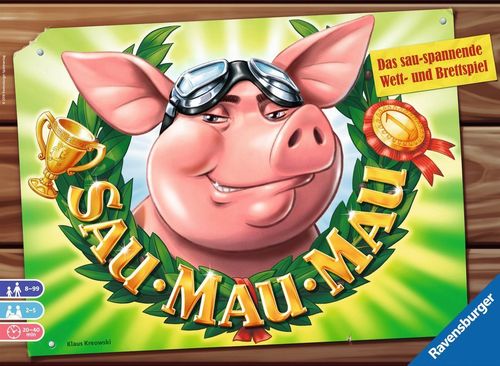
Sau Mau Mau
Sau Mau Mau Rulebook
Table of Contents
Table of Contents
Components
- 1 game board
- 4 pigs
- 1 laurel wreath stone
- 5 victory point markers
- 60 cards:
- 39 playing cards
- 20 bet cards (4 per player)
- 1 starting player card
Setup
Place the game board in the middle of the table. Place the 4 pigs on the large "Start" space of the race course.
Place the laurel wreath stone on the number space of the race course that matches the number of players. It shows the goal of the four races and stays there for the rest of the game.
Each player receives 4 bet cards and 1 victory point marker in a colour of their choice. The 4 bet cards each show one of the pigs. Place your cards face down in front of you. Place your victory point marker on space 0 of the victory point track.
Shuffle the 39 playing cards. Then deal 5 cards to each player. Each player takes their cards into hand so that no other player can see them.
Place the remaining playing cards as a face-down draw pile on the dark brown mud pit of the game board. Turn over the top card and place it face up as the first card of the discard pile, next to the straw bales.
This first card has no follow-up action yet (see the last page of this rulebook). If it is a "+2", an "X" or a "Schlappi", only its colour counts. If it is a "Bauer", the starting player may play any hand card on it.
Side note (printed on the rulebook page): If you play with fewer than 5 players, leave the surplus bet cards and victory point markers in the box.
Whoever can best imitate the grunt of a pig begins. That player places the starting player card in front of them.
Playing the Game
The starting player begins and places one matching card from their hand face up on the discard pile. Then the player to their left places a matching card, and so on.
"Matching" means that the colour (pink, brown, black, beige), the number (1, 2, 3, 4, 5, 6) or the symbol (X or +2) must match the card lying on top of the discard pile. A green special card ("Schlappi" or "Bauer") may always be played on any other card.
Example: If the brown 5 is on top of the discard pile, any brown card, any 5, or any green special card may be played on it.
Immediately after you play a card, a follow-up action occurs (⇒ Follow-up action). The follow-up actions are explained in the overview on the last page of this rulebook and must always be carried out.
If you cannot or do not want to play a hand card, you must instead draw a card from the draw pile and take it into your hand. Your turn then ends. Before the next player takes their turn, you may place a bet.
Side note (printed on the rulebook page): If the draw pile runs out, leave the top card of the discard pile face up. Shuffle all other discarded cards well and place them as a new draw pile.
Betting
Whenever you have drawn at least one card from the draw pile (this also applies to the "+2" cards), you may place a bet. With a bet you guess which pig will have its snout furthest forward at the end of the race.
To do so, place your bet card face down, with the chosen pig facing down, on the first free betting space of the game board. The betting spaces are the narrow strips of farmland along the left edge of the game board. The first betting space is the one at the top, next to the arrow. The last space is the one at the bottom, next to the straw bales (with victory points 6-4-3-2-1).
Later, after drawing a card, you may change your bet, but you do not have to. Each player may have at most one bet card in place at a time. In this case, first take your already placed bet card back into your hand, and then place a new one instead.
Note: If removing your bet card leaves a gap in the row of bet cards (1), you must close it first by sliding all bet cards below the gap up (2). Only then do you place your new bet card on the first free betting space at the bottom of the row (3). In other words, you should consider a new bet carefully, because it always goes to the end of all the bet cards currently in place.
End of a Race
A race can end in two ways:
A) The race ends immediately when a pig is moved onto the laurel wreath stone. The player who achieves this receives 3 victory points, i.e. they move their victory point marker 3 spaces forward.
B) The race may also end earlier, when one of you has placed your last hand card on the discard pile and its follow-up action has been carried out. This player moves their victory point marker 5 spaces forward.
Side note (printed on the rulebook page): If both end conditions occur at the same time, i.e. a lucky player plays their last hand card and its follow-up action also moves a pig onto the finish, they naturally receive 3 + 5 = 8 victory points for it!
Evaluating the Race
The race is evaluated immediately after its end.
In case A), the pig that reached the laurel wreath stone is naturally the sole winner.
In case B), the race winner is the pig that is now furthest forward. If several pigs are equally far forward, all of them count as race winners.
Then reveal all the bet cards that are in place. Each bet card that does not show a winning pig is taken back by its owner. The bet cards that remain in place are then scored from top to bottom:
- 1st place: The topmost bet card brings its owner 6 victory points.
- 2nd place: The second bet card brings 4 victory points.
- 3rd to 5th place: Each further bet card brings 1 victory point less than the one before it.
Move your victory point marker forward accordingly, and then take your bet card back into your hand.
The Remaining Three Races
Play the following three races in the same way:
- Pass the starting player card to the left neighbour.
- Place the 4 pigs back on the "Start" space.
- Shuffle all 39 playing cards and deal 5 hand cards to each player again.
- Place the remaining cards as the draw pile.
- Turn over the top card to begin the discard pile.
End of the Game
The game ends after the evaluation of the fourth race. Whoever now has the most victory points is the winner. In case of a tie, there are several winners.
Variant
If you want, you can of course also play this game with the well-known rule that "Mau" or "Mau Mau" must be called in time:
If you play your second-to-last hand card, you must say "Mau" while doing so. If you play your last hand card, you must say "Mau Mau" while doing so. If you forget, and one of your fellow players notices within the following approximately 5 seconds, you must take the card you have just played back into your hand as a penalty. If you have already carried out its follow-up action, that action is reversed!
Then, as usual, the next player takes their turn.
Follow-up Actions
The follow-up actions are determined by the corner symbol of the card that was played.
Number Cards (Corner Symbol: 1 to 6)
There are 24 number cards, 1 for each number from 1 to 6 in each colour.
Whoever plays a hand card with a number 1, 2, 3, 4, 5 or 6 must move the pig of the same colour along the race course by the corresponding number of spaces. Several pigs may stand on the same space at any time.
Example: Whoever plays the black 4 must move the black pig forward by exactly 4 spaces, whether they want to or not!
X Cards (Corner Symbol: X)
There are 4 X cards, 1 for each colour.
Whoever plays an X moves no pig forward. Instead, the next player is made to skip their turn. That player is simply passed over.
+2 Cards (Corner Symbol: +2)
There are 4 "+2" cards, 1 for each colour.
Whoever plays a "+2" moves no pig forward. Instead, the next player is forced to take 2 cards from the draw pile. However, that player may "extend" by also playing a "+2" (then the player after them must take 4 cards, unless they too extend, and so on).
Whoever finally takes 2, 4, 6 or 8 cards may, as a small consolation, move any pig of their choice back by 1 space for each of these cards (but naturally not behind the "Start" space!), and place a bet if they wish. Then the next player takes their turn.
Example: Anna plays a "+2". Bernd extends by placing a "+2" on it. If Christiane cannot or will not extend, she must take 4 cards. For these 4 cards she may now move pigs back by up to 4 spaces in total. She could move one pig back by all 4 spaces, or one pig back by 2 spaces and two other pigs back by 1 space each, and so on.
Caution: If someone plays a "+2" as their last hand card, no cards are drawn in that case, and therefore no pigs are moved back either!
Schlappi (Green Special Card)
There are 4 "Schlappi" cards, 1 for each colour.
The "Schlappi" may be played on any other card.
Whoever plays it must move the pig that lies furthest back by exactly 3 spaces, regardless of its colour. If several pigs are furthest back, the player must choose one of them and move it 3 spaces forward.
The question mark in the circle below the "Schlappi" indicates which colour the next card must have. (It may also be played again on another green special card.)
Translator's note: the symbol is reproduced as described in the rulebook text.
Bauer (Green Special Card)
There are 3 "Bauer" cards (the farmer cards).
The "Bauer" may be played on any other card.
Whoever plays it moves no pig forward. Instead, they announce aloud the colour (pink, brown, black or beige) that the next card must have. (It may also be played again on another green special card.)