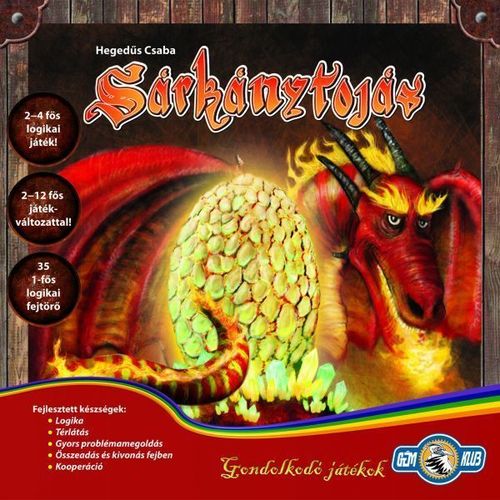
Sárkánytojás
Sárkánytojás Rulebook
Table of Contents
Table of Contents
Components
- 55 tiles:
- 24 positive-value Dragon Egg tiles (Sárkánytojáslapka), 3 each of the values 1, 2, 3, 4, 5, 6, 8 and 10
- 24 negative-value Dragon tiles (Sárkánylapka), 3 each of the values 1, 2, 3, 4, 5, 6, 8 and 10
- 3 Pit tiles (Veremlapka)
- 3 Shield tiles (Pajzslapka)
- 1 Start tile (Startlapka)
- 1 wooden Dragon Egg piece (Sárkánytojás fából)
Aim of the Game
Collect as many Dragon Egg points as possible and as few Dragon points as possible!
Setup
Sort out the 3 Shield tiles and the 3 Pit tiles and set them aside. They are not needed in the base game.
Shuffle all the other tiles face down. Arrange them face up into a 7×7 playing area so that the tiles are roughly equally spaced from one another. Place the tiles in order, from left to right and from top to bottom. Once a row has 7 tiles, continue placing from the left side of the next row, and so on.
Take out the Start tile and set it aside, and put the wooden Dragon Egg piece in its place.
The starting player is the one who most recently was on a mountain.
Playing the Game
Rules for 2 Players
The starting player chooses a tile from the row in which the Dragon Egg is. The row consists of the tiles lying perpendicular to the starting player's viewpoint. The starting player places the chosen tile face down in front of themselves, and moves the Dragon Egg onto the space the taken tile occupied.
The column consists of the tiles lying perpendicular to the direction of the starting player's move (the row).
The starting player likewise places the chosen tile face down in front of themselves, and moves the Dragon Egg onto the space the taken tile occupied.
Each player, when their turn comes, chooses a tile in this way and moves the Dragon Egg onto the space of the tile they took.
Always choose from the tiles that lie perpendicular to the direction of the other player's last move, where the Dragon Egg is. A tile may be taken from any distance in the row or column in which the Dragon Egg is.
End of the Game
The game can end in two ways:
I. All the tiles are gone from the table (this happens very rarely; see below).
II. The next player cannot take a tile according to the rules (there are no more tiles in that row or column). In this case, the player who last took a tile receives the Dragon Egg.
As soon as one of the two possibilities occurs, the player who last took a tile receives the Dragon Egg. Then the points are counted.
Add up the values of the Dragon Egg tiles that are worth positive points, and from this sum subtract the total value of the Dragon tiles that are worth negative points. The player who received the Dragon Egg adds 5 further points to their points. The player who scored the most points wins.
Rules for 3 Players
3 players play according to the rules for 2 players, with the following modification:
The starting player takes a tile horizontally, the player after them takes a tile vertically, and the player after them takes a tile horizontally again. Each player chooses a tile in the other direction relative to the player before them. With this rule, every player changes direction with every take.
The game continues and ends according to the rules for 2 players.
In case of a tie, the tied players share the victory.
Rules for 4 Players
All rules are the same as for 2 players, with the addition that players sitting opposite each other form pairs and collect points together. During play, they may not discuss their next move!
Tiles are again taken in alternating directions. The starting player moves the Dragon Egg horizontally, the next player vertically, the starting player's partner horizontally, and so on.
At the end of the game, each pair adds up the points it has collected, and these results form the final result. The pair that has collected more points wins the game.
Shield and Pit Supplement
Using the Shield and Pit tiles makes the game more tactical and varied. Apply the rules above together with the following supplementary rules:
Setup: When you shuffle the Dragon Egg tiles and the Dragon tiles together during setup, secretly draw 6 tiles from among them, face down. Remove these from the game. Put the Shield and Pit tiles in place of the removed tiles. Then shuffle the tiles again and build the 7×7 playing area (as described above in the Setup section).
Pit tile: A player who takes a Pit tile must at that moment get rid of one of the Dragon Egg tiles they have collected so far. The Pit tile and the discarded Dragon Egg tile are placed face down beside the playing area. The player decides which Dragon Egg tile to discard. (It is best to discard the lowest-value one.) Tiles set aside in this way do not take part in the scoring.
Shield tile: A player who takes a Shield tile must at that moment get rid of one of the Dragon tiles they have collected so far. The Shield tile and the discarded Dragon tile are placed face down beside the playing area. The player decides which tile to discard. (It is best to discard the highest-value one.) Tiles set aside in this way do not take part in the scoring.
If there is no tile that could be discarded when a Pit or Shield tile is taken, the Pit or Shield tile is not kept either: it is discarded immediately after being taken. In a 4-player game, only your own collected tiles may be discarded, not your partner's.
Competitive Play for 2, 3 and 4 Players
The players agree in advance how many games they will play. The winner of each game receives points, and the points gathered over the games played determine the overall winner.
- 2 players: the winner receives 1 point, the loser 0 points.
- 3 players: the winner receives 2 points, the second-placed player 1 point, and the third-placed player 0 points. In case of a tie, each player involved receives the higher point value.
- 4 players: the winning pair receives 1 point, the losing pair 0 points.
The Dragons' Path
A quick logic game for 2–12 players.
Level I
Setup
From the Dragon Egg tiles and the Dragon tiles, take one tile each of the values 1, 2, 3 and 4, and also the Start tile. Shuffle the resulting nine tiles thoroughly and randomly arrange them on the table into a 3×3 playing field.
How to Play
The players, applying the rules of the base game, simultaneously try to work out the greatest number of points they can score. At first, everyone only follows the path of the moves with their eyes, and no one may touch the tiles. Starting from the Start tile, in the imagination, take tiles by moving once horizontally and then vertically, and add up the values of the tiles taken. Keep moving in this way in the imagination until no more tiles can be taken.
A player who believes they have found the route worth the most points announces the score reached (the wooden Dragon Egg piece scores no points here). The other players then check whether it is possible to collect more points.
- If they find a route that collects more points, they show it, and the checking players each receive as many points as the difference between the route's value and the guess. The guessing player receives negative points equal to their guess.
- If they cannot find a more valuable route, the guessing player shows the correct route and receives points equal to their guess.
- If the guessing player cannot show the correct route (they forgot it or planned it badly from the start), they receive negative points equal to their guess.
Example 1: Erik's guess is 3. The others check the puzzle and find no more valuable route. Therefore Erik may write 3 points for himself.
Example 2: Móni's guess is 1. The others check the puzzle and find a route worth 4 points. Therefore everyone except Móni receives 3 points each, and Móni "receives" −1 point.
Example 3: Anett's guess is 3. The others find no more valuable route, so Anett may show the route for her guess. However, she fails to do so, because she miscounted along the way, so she receives −3 points.
The game lasts as many rounds as there are players, but for at least 4 rounds (in a game of 2–3 players). The player who collects the most points wins.
Timed Variant
If you want to make the game faster and give more room to bold guessing, agree at the start of the game on how much time is available for checking. As soon as the guess is announced, the guessing player times it, and the others may check whether there is a more valuable route until the time runs out.
Suggestion: do not allow a checking time longer than 30 seconds!
Level II
All rules are the same as for Level I, with the difference that now, alongside the Start tile, you take two Dragon Egg tiles each of the values 1, 2, 3 and 4, and from the Dragon tiles two each of the values 1, 2 and 3, and one of the value 4. Shuffle the resulting 16 tiles together and lay them on the table as a 4×4 field.
Level III
All rules are the same as for Level I, with the difference that now, alongside the Start tile, you take two each of the Dragon Egg tiles and the Dragon tiles of the values 1, 2, 3, 4, 5 and 6. Shuffle the resulting 25 tiles together and lay them on the table as a 5×5 field.