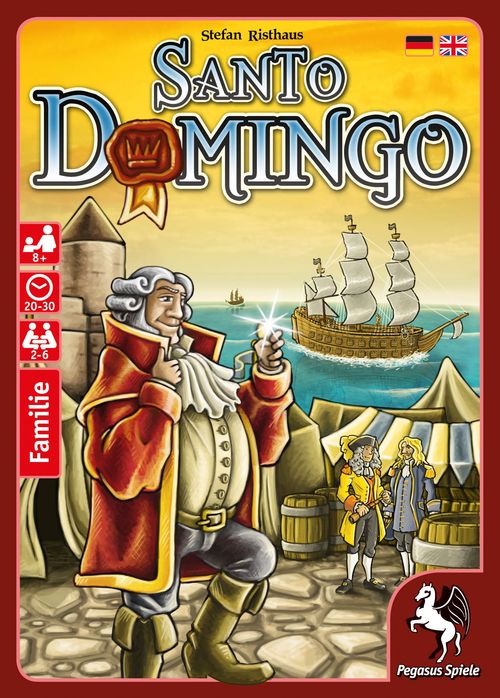
Santo Domingo
Santo Domingo Rulebook
Table of Contents
Table of Contents
Components
60 playing cards, consisting of the following action cards numbered 1-8, for each player:
- Captain (1)
- Admiral (2)
- Governor (3)
- Frigate (4)
- Galleon (5)
- Customs (6)
- Trader (7)
- Beggar (8)
The backs of the cards have 6 different colors – 1 color for each set of 8 action cards for 1 player.
... and 6 each of the following 2 display cards, 1 set for each player:
- Victory Points Display Card
- Goods Display Card
1 Game Board (in 2 sections) — Front Side: Standard Version. Back Side: Winter Version.
15 Wooden Markers (7 red, 7 blue and 1 yellow)
Setup
- Place the assembled game board in the middle of the playing area where everyone can see it. (We recommend using the Standard Version for your first few games. For a change of pace, you can try out the Winter Version later.)
- Place a wooden marker of matching color in the 1st space on each row on the game board: a) Place a red wooden marker in the first space of the Victory Point row on top. b) Place a blue wooden marker in the first space of the Goods row in the middle. c) Place the yellow wooden marker in the first space of the Trader row on the bottom.
- Give each player a matching set of 8 action cards (with the backs matching their player color).
- In addition, give each player 1 Victory Point Display card and 1 Goods Display card as well as 1 red and 1 blue wooden marker. Place both the Victory Points Display card and Goods Display card in front of you with the side showing the numbers 1 – 15 face up. Place the red wooden marker beside your Victory Points Display card. Place the blue wooden marker on the number on the Goods Display card matching the number of players in the game. (In a 4-player game place it on the 4 space.) You begin the game with these goods.
Take your 8 action cards in hand and begin!
Goal of the Game
In Santo Domingo you are trying to use your 8 action cards in the cleverest way possible. All players choose an action card for the round and reveal them simultaneously. The cards are then performed in ascending order. Part of selecting your action card for the round is determining which cards your opponents are most likely to play. Depending on the cards played, you can obtain victory points (by means of cards 1, 2, and 6) or goods (by means of cards 3, 4, and 5). The Trader (card 7) allows you to exchange your goods for victory points. And the Beggar (card 8) allows you to return your played cards back into your hand. The game ends as soon as at least 1 player has 30 or more victory points at the end of a round. Then the player with the most victory points wins the game.
Sequence of Play
A game of Santo Domingo continues for several rounds of play.
Each round consists of the following 3 phases:
- Supply Phase
- Play Action Cards
- Resolve Action Cards
1. Supply Phase
Advance all of the wooden markers on the board by moving them the following number of spaces forward, depending on the player count. This information is displayed on the top of the game board as well as in the following table:
| Player Count | 2 | 3 | 4 | 5 | 6 |
|---|---|---|---|---|---|
| Space Number | 3 | 5 | 3 | 4 | 5 |
If a marker reaches space 15 it ends there and any additional advance is lost.
Example: In a 4-player game, all 3 markers are advanced 3 squares in the supply phase.
2. Play Action Cards
Select action cards to play for the round: 2 cards in a 2- or 3-player game and 1 card in 4- to 6-player games. The game board provides a reminder icon in the upper left and right corners. Place the card(s) face down in front of you. When all players are ready, all cards are revealed simultaneously.
3. Resolve Action Cards
Now evaluate all of the actions cards played in ascending order (starting with the Captain, if played). Identical action cards are performed at the same time. (There is no start player or player order!) Leave all action cards face up until the end of the round. Do not discard them into your personal face down discard pile until all of the cards have been evaluated.
Before explaining the action cards in order of evaluation, it is necessary to clarify some basic principles:
- If you receive victory points or goods, move the marker on your corresponding Display card forward and the corresponding marker on the game board back. (Exceptions: Governor, Customs, and Beggar do not affect the game board rows). If there are not sufficient victory points or goods on a row, you will get less.
- Important: For all players who play the same card, they are evaluated simultaneously. Since not enough victory points/goods can be present on the corresponding game board row for all of the players involved to get the full amount, proceed as follows: Give each involved player victory points/goods so that they all receive the same amount with any leftover victory points/goods remaining on the corresponding game board row.
- Your Victory Point Display card continues on the back with numbers 16 – 30. Once you reach 15 victory points, continue counting any new victory points on the other side.
- Your Goods Display card does not continue on the other side. You can never have more than 15 goods. If you receive enough goods to go over 15, any excess past 15 are forfeited but are still removed from the game board row.
Now we can move on to evaluating the action cards. Always start the evaluation with the action card of the lowest value. Continue evaluation in ascending order, skipping any numbers that were not played.
Captain (1)
All players who have played their Captain repeatedly receive 1 victory point from the Victory Point row on the game board until each has received a maximum of 2 victory points.
Admiral (2)
All players who have played their Admiral repeatedly receive 1 victory point from the Victory Point row on the game board until each has received a maximum of 5 victory points.
Although the Admiral can bring you more victory points than the Captain, there is the risk that Captains may have already emptied the supply of victory points on the board.
Governor (3)
All players who have played their Governor receive 4 goods for each Captain who has been played this round, as well as 2 goods for each Admiral that has been played this round.
Important: You do not receive these goods from the game board! Move the marker forward on your Goods Display card, but do not move the marker on the Goods row on the game board.
Important: In 2- and 3-player games, you will not get any goods for your own Captain or Admiral.
Example: 1 Captain, 2 Admirals and 1 Governor have been played. There are 9 victory points on the Victory Point row on the game board. First, the player who played the Captain gets 2 victory points. The two Admirals will now split the 7 remaining victory points. Evenly distributed this means each gets 3 (of the possible maximum of 5) victory points and 1 victory point remains on the Victory Point row on the game board. The Governor will receive a total of 8 goods – 4 for the Captain and 4 (2 each) for the 2 Admirals. These goods do not come from the game board row.
Frigate (4)
All players who have played a Frigate repeatedly receive 1 good from the Goods row on the game board until each player has received a maximum of 3 goods.
Galleon (5)
All players who have played a Galleon repeatedly receive 1 good from the Goods row on the game board until all goods on the game board row have been evenly divided. Any left over goods that cannot be divided evenly are forfeited and left on the row.
Although the Galleon can bring in lots of goods, there is the risk the Frigates have already emptied the supply of goods on the board.
Customs (6)
All players who have played Customs receive 3 victory points for each Frigate played this round as well as 1 victory point for each Galleon played this round.
Important: You do not receive these victory points from the game board! Move the marker forward on your Victory Point Display card, but do not move the marker on the Victory Point row on the game board.
Important: In 2- and 3-player games, you will not get any victory points for your own Frigate or Galleon.
Example: 1 Frigate, 1 Galleon and 1 Customs have been played. 10 goods are available on the Goods row on the game board. First, the player who played the Frigate gets 3 goods from the Goods row, which leaves 7 goods for the Galleon. Since only 1 Galleon was played, the player with the Galleon receives all 7 remaining goods and the blue marker is moved to 0 on the Goods row on the game board. The Customs now receive 4 victory points in total – 3 for the Frigate and 1 for the Galleon. These victory points do not come from the game board!
Trader (7)
If more than one Trader has been played, the yellow wooden marker on the Trader row on the game board must be moved back 2 spaces for each Trader after the first one to a minimum of zero (to the 0 space).
Example: If 3 Traders were played, you must move the yellow marker back 4 spaces.
Now, based on the space occupied by the yellow marker, all players who played a Trader may exchange any number of goods for victory points at the given ratio in that space. (If needed let the player with most victory points start.)
Move your blue Goods marker back the number of spaces for the goods exchanged and move your red Victory Point marker forward the number of spaces for victory points gained. Place your blue goods marker beside your Goods Display card if you have spent all of your goods.
Note: You are allowed to exchange goods for victory points at a worse rate of exchange than the current position of the yellow marker on the Trader row on the game board.
If at least 1 Trader was played, now move the yellow wooden marker to zero (the 0 space) on the Trader Row on the game board regardless whether any player has traded goods.
Example: Alex and Stefan have each played a Trader. The yellow marker must be moved back 2 spaces. Now, both players may exchange at the rate of 3/2 (3 goods for 2 victory points). Alex exchanges 9 goods and receives 6 victory points in return. He could also return his last 2 goods for 1 victory point (a worse rate of exchange), but he decides not to do so. After Alex and Stefan have exchanged their goods for victory points, the yellow marker must be reduced to zero.
Beggar (8)
All players who have played a Beggar will first receive a number of goods depending on the number of cards left in their hand.
| Cards in Hand | 0 | 1-2 | 3-4 | 5-7 |
|---|---|---|---|---|
| Goods | +4 | +3 | +2 | +1 |
Next, each of these players receives 2 goods for each Trader played this round.
Important: In 2- and 3-player games, you will not get any goods for your own Trader.
Important: You do not receive these goods from the game board! Move the marker forward on your Goods Display card, but do not move the marker on the Goods row on the game board.
Finally, all players who played a Beggar take back all of their played cards from the current and previous rounds back into their hand. They will have all 8 action cards available for the next round.
Example: In a 3-player game, Alex has played his Trader and Beggar and has 2 cards left in his hand. Another player has also played his Trader this round. Since Alex still has 2 cards left in his hand, he receives 3 goods. He also receives 2 more goods for the Trader played by another player, but not for his own Trader. Finally, he takes back into his hand all of his played cards – including the Beggar and Trader from this round as well as any cards played from previous rounds. In the next round, Alex will be able to choose from all 8 of his action cards.
End of a Round
All players who did not play a Beggar this round now discard their played cards into their own facedown discard pile. Each round, these players will have fewer cards to choose from until they play their Beggar, which will return all of their cards to their hand.
Game board makers are left in place for the next round.
If no one has reached 30 or more points, a new round begins.
End of the Game
The game ends as soon as at least one player has 30 or more victory points at the end of a round. (Once you reach 30 victory points, continue counting any new victory points on the other side again.)
Players now exchange all remaining goods for victory points at a trade exchange rate of 3 to 1. (Adjust your markers on your Goods and Victory Point Display cards accordingly).
Whoever now has the most victory points wins.
If there is a tie, the tied player with the most goods remaining wins.
If still tied, the tied player with more cards remaining in hand wins.
If there is still a tie, then the tied players share the victory!
For Experienced Traders
For 2- and 3-player games with experienced Santo Domingo players, we recommend continuing play until at least 1 player has 45 or more victory points at the end of a round. As soon as you exceed 30 victory points, take a second Victory Point track card and red marker and begin tracking the additional points with those.
The Winter side of the game board offers a greater challenge regardless of the number of players because winter makes trading a lot more difficult. This is accomplished through making the Trader row exchange rates more difficult as you have to deliver a larger quantity of goods to trade for victory points.