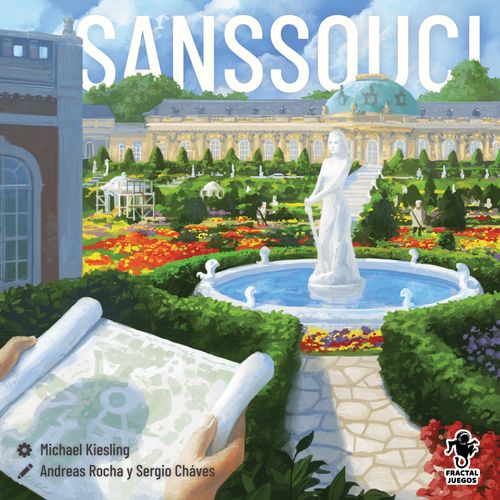
Sanssouci
Sanssouci Rulebook
Table of Contents
Table of Contents
Game Materials
-
1 game board: It shows on the outside a victory point track, and on the inside, 10 boxes (2 each in the colors white, gray, orange, purple and turquoise), where over the course of the game garden tiles will be taken. To the left and to the right, there are 8 fields (green) for stacks of the face-down garden tiles.
-
4 gardens (two-sided): Every garden shows exactly 54 fields, created from 9 vertical columns (with the motifs Maze, Statue, Pavilion, Figure, Stairs, Fountains, Rose Arch, Spiral Garden and Vine) and 6 horizontal rows (in the colors beige, white, gray, orange, purple and turquoise, with 1 to 6 victory points). 15 of the 54 fields are already printed with Garden tiles to be used (e.g., the entire first row).
-
81 garden tiles: They show on their face the same motifs as the 9 columns (mazes, statues, ...) and on their reverse side 3 different gardeners. Each motif is available 9 times.
Note: The diversity of the individual motifs of the same category (such as six different pavilions) serves only the atmosphere; these differences play no role in the game.
-
90 cards:
- 72 game cards (18 per player color)
- 4 victory point cards "50 / 100" (1 for each player color)
- 9 mission cards (lilac-colored reverse side)
- 5 replacement cards (not necessary for play)
-
36 aristocrats (9 per player color)
-
4 scoring markers (1 for each player color)
-
4 expansion boards (two-sided)
Preparation
The game board is placed in the middle of the table.
-
Each player receives a random garden placed with either side up to build upon.
-
In addition, each player receives the nine aristocrats, the scoring marker, the 18 playing cards and the victory point card in the color of their choice:
- The 9 aristocrats are placed on each of the fields of their castle's terrace, one per column (top row).
- The scoring markers are placed on the (0/50) box of the scoring track on the edge of the board.
- Their 18 playing cards are shuffled and placed face-down as a deck in front of them. Each player then takes the top 2 cards of their stack into their hand.
- Everyone places the victory point card in front of them.
-
The 9 mission cards (lilac-colored back side) are shuffled and distributed: Each player receives 2 cards, looks at them and then keeps them secretly. These cards provide additional victory points at the end of the game (see below). Any extra mission cards are placed in the box.
-
Of the 81 garden tiles, the following are used depending on the number of players in the game:
- 2 players: the 45 tiles with the pictured gardener (and a Roman numeral II) on the back
- 3 players: the 63 tiles with these gardeners (and a Roman numeral II or III) pictured on the back
- 4 players: all 81 tiles (Roman numerals II, III and IV)
For 2 and 3 players the remaining tiles are placed in the box.
-
All tiles that are in the game are mixed, placed face down (= gardener showing), and then set as a stack of arbitrary height on each of the 8 green fields on the board. The 10 colored squares on the game board are then filled with random tiles from any of the piles. These 10 tiles are always laid open, with the motif (e.g. statue) face up.
-
The expansion boards are only used in the expansion (see below) and remain in the box for the basic game.
Gameplay
The oldest player starts and players follow in clockwise order. The person whose turn it is plays out their turn in the following order:
- They play one of their two hand cards (face up) onto the table, take a corresponding tile from the game board and lay it into their garden.
- They move, if they can or want, any one of their 9 nobles, and then move their points marker the number of victory points corresponding to the destination row.
- They uncover a new garden tile from any stack and set it on the previously occupied space on the board. There will again be 10 tiles laying open.
- They draw the top card from their deck, so they again have 2 cards in their hand.
Then the next player takes their turn, and so on, until the game is completed after 18 rounds.
1) Play a card from your hand and place the corresponding tiles in the garden
The player whose turn it is plays one of the two cards from their hand onto their open-faced discard pile, which is next to their covered draw deck. Depending on which card the player plays, the following applies:
-
The played card is a combination of 2 colors (each player has 8 of this card type). The player must take one of the 4 tiles matching these colors from the corresponding 2 x 2 area of the board and place it in their garden.
Example: Sybille plays a "Grey / Turquoise" card: She now takes one of the 4 tiles from the board, from any of the 2 gray or the 2 turquoise fields, and places it in her garden.
-
The played card is a motif (each player has 9 of this card type). The player takes a tile of this motif from the board and places it in their garden. However, if none of the 10 tiles on the display matches the motif of the played card, the player may take any of the 10 available tiles and place it in their garden.
Tip: The player should take advantage of this "free choice" as often as possible!
-
The played card displays "free choice" / "freie Auswahl" (this card occurs once). They take any of the 10 face-up tiles and place it in their garden.
Example 1: Michael plays the card "Pavilion". There are 3 pavilions. Michael opts for the one in the white box and places it in his garden.
Example 2: Annalena plays the card "Staircase", there is no staircase. Annalena may now take any tile from the board (just as if she had played "free choice") and place it in her garden.
Garden tiles must always be placed! For each tile taken from the game board, there is only one corresponding field in the player's garden. This is determined by the design of the tile motif (= corresponding column) and the color of the game-board field from which the tile was taken (= corresponding row). There are no other restrictions to be considered when placing; tiles may be placed at any time without connecting to other tiles in a garden.
Example: Annalena uses the "Violet / Turquoise" card, and takes a "Pavilion" tile from a turquoise space on the board. Accordingly, she places it in her garden at the intersection of the turquoise row and the "Pavilion" column.
Annalena uses the "Spiral Garden" card and takes a tile from an orange space on the board. Accordingly, she places it in her garden at the intersection of the orange row and the "Spiral Garden" column.
Gardener? If the required field for the tile placement in the garden is already in use, the player turns the acquired tile to the gardener's side (i.e. face down). This gardener is now placed in a vacant field belonging to either the same row (horizontally) or column (vertically) as the occupied field.
Tips:
- All gardeners have the same function, regardless of their design.
- If all the fields of the required row, as well as all fields of the required column, are occupied, the player's gardener may be placed on any empty field.
Example: A few rounds later, Annalena takes another "pavilion" tile from a turquoise-colored space on the board with the "free choice" card. Since the corresponding field in the garden is already occupied, she now places her new tile as a gardener on one of the 7 marked, unoccupied fields; most probably on "Pavilion, violet".
2) Move an aristocrat
The player may move one of their aristocrats in their garden. The following rules must be observed:
- An aristocrat may only travel via a continuous path (using any combination of both motif tiles and gardener tiles). They may travel over many tiles, in any direction, but never through empty fields.
- At the end of their travel, the aristocrat must always stand below its starting position in the same vertical column. In other words, although an aristocrat may travel back towards the castle, and may briefly leave its column, at the end of its movement, it must again stand in its original column — and at least one row deeper than before.
- An aristocrat may pass by other aristocrats and gardeners at any time, but may never stop their travel on a gardener tile! (Be careful, this is easy to forget!)
- An aristocrat may be moved once per round, and thus six times at most over the course of the game (initially to row 1, then row 2, then row 3, etc., down to row 6).
Tips:
- If a player cannot or does not want to move an aristocrat, they simply skip the second part of their turn.
- The movement of an aristocrat is not required to have something to do with the most recently placed tile, but it may.
- Of course, aristocrats can also (according to the rules of motion) finish their movement on or above the most recently placed field.
Victory Points!
Once a player has moved an aristocrat, they receive as many victory points as shown on both the left and right of the row on which the aristocrat's journey was ended. The field from which the aristocrat started their movement is irrelevant.
The victory points are marked by the player with their scoring marker on the victory point track. If by moving their marker the player exceeds or lands on the "0 / 50" box, they mark this by placing their victory point card next to the board with the number 50 face up. If a player later exceeds 50 for a second time, they should rotate the card to the 100 side.
Example 1: Julian moved his aristocrat from the terrace to the gray, pavilion row: He gets 3 victory points. The pavilion of the beige or white row can no longer be used to score points as the game progresses.
Example 2: Julian moved his aristocrat from the fountain of the beige row to the fountain of the gray row. He gets 3 victory points.
Example 3: Julian moved his aristocrat from the vine on the beige row to the vine on the turquoise row. He receives 6 victory points. He cannot move to the vine on the orange row, because there is no way to get there.
Example 4 (IMPORTANT): Julian moved his aristocrat from the stairs of the white row to the stairs of the purple row. He gets 5 victory points. In this way he can in a later round move the aristocrat to the stairs of the turquoise row to receive another 6 victory points.
3) New garden tiles
The player takes the top tile from any stack on the board and places it in the field emptied most recently by them. Thus there are always 10 tiles for the next player.
4) New hand card
As the final action of their turn, the player draws the top card from their deck so that they again have 2 cards in their hand. In the penultimate round, no more cards are available to be drawn, so that all players play only their last card in the 18th round. After this the game ends.
Note: A player may count the cards in their draw pile at any time (so they know how many moves their aristocrats can still make). However, they cannot look at these cards!
Game End
The game ends after each player has played and executed their 18th card. Then the final victory point tally begins:
- For each fully occupied, horizontal row (except the first row!), the player gets 10 victory points minus the value of the corresponding row (2-6). It does not matter if gardeners are also present.
- For each fully occupied, vertical column, the player gets 5 victory points. It does not matter if gardeners are also present.
- The two mission cards provide as many victory points as the rows corresponding to where their two aristocrats finished the game.
Example: Julian receives for the fully occupied, gray row 7 (= 10 - 3) victory points and for the two fully occupied columns (rose arch and stairs) each 5 victory points. His two mission cards net him 8 more victory points (3 for the maze and 5 for the pavilion). Overall, he receives a further 7 + 5 + 5 + 3 + 5 = 25 victory points.
Whoever has the most victory points wins. In the case of a tie, the winner is the tied player with the most gardeners in their garden. If there is still a tie, there are several winners.
Expansion
All previously stated rules remain in effect, with the following changes: At the beginning of the game, each player receives a random expansion board, in addition to their garden. Prior to placing this in their garden, they will first examine their two mission cards and then decide which side of the expansion board is placed up. The board must be placed so that its top covers the "Staircase, gray" location.
12 of the 16 fields are marked on every expansion board. For these fields, the following applies:
- Bonus for motifs: If a player places a tile with a motif on such a field, they immediately receive the corresponding victory points (1, 2 or 3). If a gardener tile is placed thereon, nothing happens.
- Bonus for gardeners: If a player places a gardener tile on such a field, they immediately receive 3 victory points. If a tile with a motif is placed thereon, nothing happens.
- Penalty for motifs or gardener (red frame): If a player places any garden tile on a red-framed field, they immediately lose the corresponding victory points (-2 or -3).
All other rules, in particular regarding victory points for completed rows or columns, still apply. The fields of the expansion boards are only considered occupied if garden tiles lay upon them.