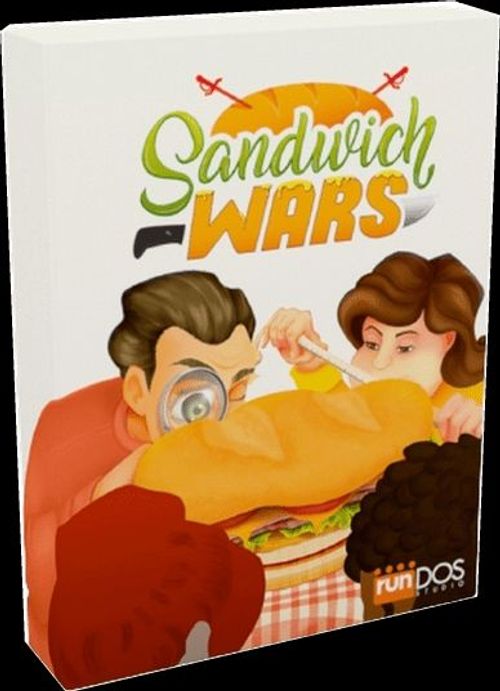
Sandwich Wars
Sandwich Wars Rulebook
Table of Contents
Table of Contents
Introduction
In Sandwich Wars each player represents a contestant in the contest and competes for the title of Grand Sandwich Master. You will prepare sandwiches with all kinds of ingredients, trying to fulfil the orders set by the judges and trying to impress them to gain more prestige. You must be able to manage a budget to obtain the different ingredients from the market or to hire assistants, and hurry to complete orders before the other contestants. You can also take advantage of the opportunities that arise during the contest and gain an edge over the other competitors, or play fair and keep your prestige.
Components
- 50 Market cards
- 25 Order cards
- 7 Assistant cards
- 5 Summary cards
- 1 Starting Player/Prize card
- 35 Coin tokens (20 of value 1, 15 of value 5)
- 37 Victory Point tokens (22 of value 1, 10 of value 5, 5 of value 10)
Market Cards
There are 2 types of Market cards:
Ingredients. They represent the different ingredients we will use to complete the judges' orders. Each ingredient card shows: its cost (in coins), its quality level, the ingredient name, its effect, and its category (shown by the background colour and the texture of the tablecloth).
There are 7 categories of ingredients, each with 6 different ingredients, distinguished by background colour and tablecloth texture: Meats, Dressings/Sauces, Vegetables, Cheeses, Eggs, Extras, and Cold cuts/Cured meats.
Opportunities. They represent events that we can take advantage of during the game. Each shows an action icon, its effect, and its end-of-game victory points.
Order Cards
They are the different types of sandwiches ordered by the judges. Each order card shows: the colour of the order type, the number of ingredients, the victory points at the end of the game, the required quality level, the bonus ingredients, and the reward.
There are 5 types, distinguished by the number of ingredients they require (1, 2, 3, 4 or 5 ingredients), the illustration, and the colour of the top-left corner of the card.
Assistant Cards
They can be hired for a time and will help us with a certain type of ingredient, but we must pay for their services. There is one assistant for each ingredient category (7). Each shows its hiring cost, the improved ingredient category, its effect, its reward effect, and its maintenance cost.
Summary Cards
They briefly explain the steps of a turn and the final scoring.
Starting Player / Trophy Card
It serves to remember who started the game and who won.
Coin Tokens
They represent our budget within the contest.
Victory Point Tokens
They represent extra victory points.
Setup
- Shuffle the Market deck and deal 5 cards to each player. Place the rest of the deck face down on the table.
- Shuffle the Order deck and place 5 cards face up in a row in view of all players. Place the rest of the deck face down next to the revealed orders.
- At no time in the game may there be 3 revealed orders of the same type. When a 3rd is revealed it must be placed at the bottom of the deck and a new one must be revealed.
- Place the 7 assistants face up in a row in view of all players.
- Give each player coins worth a total of 10. Form a pool with the remaining coins within reach of all players.
- Form a face-up pool of victory point tokens within reach of all players.
- Give each player a Summary card.
- The last player who ate a sandwich starts the game and receives the Starting Player card, which they place to their right.
General Idea and Objective of the Game
In Sandwich Wars the players must fulfil sandwich orders. To do this they must lay down ingredients from their hand on the table that correspond to the needs of the orders and complete them before the others. When a player has completed their fifth order, the round is completed and the game ends. The player who has obtained the most victory points is the winner.
Turn
On their turn the player must perform 2 actions in the order they wish, and may choose the same action 2 times:
Play an Ingredient
The player must pay the cost indicated on the card with their coins and lay it down in their Play Area. Each player has a limit of 5 ingredients in their Play Area.
When placing an ingredient in play, its effect must be read and applied (at that moment or at the moment indicated on the card). Each effect applies only to the player who played the card.
If the player has 5 ingredients in their Play Area and wants to play a new one, they can replace them. To do so, they must pay a fine of 2 coins in addition to the cost of the new ingredient (food is not thrown away!) and discard the previous one.
Complete an Order
To complete an order the player must:
- Have the necessary number of ingredients available in their Play Area. Orders must be completed with the exact number of ingredients indicated on the card. They can be completed with any ingredients regardless of category; ingredients of the same category may also be used.
- The sum of the quality of the ingredients used must be equal to or greater than that indicated by the order. Assistants (see "Hire an Assistant" below), opportunity cards and ingredient effects, if any, must be taken into account to calculate the quality.
Example: one order requires 3 ingredients; another requires quality 7. (Example shown: an order card requiring 3 ingredients and quality 7 is completed with three ingredients of quality 2, 2 and 3, whose sum is 7.)
If the player meets the requirements, they may take the order card and place it face up in their Play Area, indicating that they fulfilled the judges' order. Then they must collect the reward indicated at the bottom of the card. There are two types of rewards:
- Hire 1 assistant without paying its cost, or receive 2 extra victory points by taking the tokens from the pool.
- Collect the indicated amount of coins or cards (2/3/5), choosing to collect only coins, only cards, or splitting between both.
The victory points printed on each order card are counted at the end of the game.
All orders have a bonus for using specific ingredient categories. If the player completes the order using ingredients of the categories specified on the card, they obtain 2 extra victory points for each different category used (if there are 2 or more ingredients of the same category, only 1 of them scores).
If the player has assistants in their Play Area they could obtain more extra victory points when completing the order (see "Hire an Assistant" below).
The player must take the extra victory points from the pool and bring them to their Play Area. The ones obtained may be kept hidden from the other players.
Finally, they will discard from their Play Area all the ingredients used to complete the order.
Hire an Assistant
The player must pay 5 coins and choose an assistant among those available, to take it to their Play Area. They may have any number of assistants in the Play Area as long as they can pay their maintenance cost (see "End of the Turn" below).
Each assistant improves all ingredients of one category while it remains in the Play Area:
- Adds 2 to the quality.
- Reduces the cost by 2 coins.
- Adds 2 extra victory points when completing an order with at least 1 ingredient of that category (if there are 2 or more ingredients of the same category, only 1 of them scores).
At the end of their turn, the player will take one card from the Market deck for each assistant in their Play Area and will pay the cost of each one (see End of the Turn).
The effect of the assistants applies only to the player who hired them.
Example: Carola has the Violet assistant in her Play Area. As her 1st action she plays a violet ingredient that costs 6 coins (Fried Egg), paying only 4 coins. The card has a default quality of 5, and now has 7. As her 2nd action, Carola decides to complete an order of 1 ingredient of quality 6. Carola earns 2 extra victory points for completing the order with an ingredient of the violet category while having the Violet assistant in her Play Area. At the end of the game she will add 5 victory points, as indicated by the completed order.
Replenish Cards
The player may discard from their hand as many cards as they wish and replenish from the deck until they have 5 cards again.
The number of cards to discard may be 0. This means the player can use this action simply to replenish their hand of cards without discarding any.
Take Coins
The player must take 4 coins from the pool and bring them to their personal supply.
Opportunities
Opportunities are a special type of card:
- They do not count as an action of the turn.
- They cost no coins.
- They are not played in the Play Area.
To play an opportunity, on their turn, the player must lay the card down from their hand, apply its effect and hand it to the player on their left (as indicated by the arrow icon on the card).
As many opportunity cards can be played as are held in the hand.
At the end of the game each opportunity card grants 4 victory points to whoever has kept it in their hand.
Clarifications
- An opportunity card that allows taking an assistant from the reserve without using an action and without paying its cost. However, its maintenance must be paid at the end of the turn.
- An opportunity card that allows playing up to 2 ingredients without using actions or paying their cost. The effect of the ingredient cards played applies normally.
End of the Turn
When finishing their turn the player must perform the following steps in order:
- Collect what is indicated by all their cards with the hand symbol in their Play Area.
- Pay (maintenance) 2 coins or 1 victory point for each hired assistant. Once its cost is paid, the player may decide to return the assistant or keep it one more turn. If a player cannot pay the cost of all their assistants they must pay those they can (in coins or victory points) and then return ALL their hired assistants to the central area.
- If they completed any order, replenish cards in the central row of orders until there are 5 again. There cannot be 3 revealed orders of the same type; when a 3rd is revealed it must be placed at the bottom of the deck and a new one revealed.
- Count the cards in hand; if necessary, discard down to 5.
- If they have a total of 5 completed orders they must announce the end of the game.
End of the Game
When a player completes their fifth order, the current round (marked by the starting player card) is finished and the game ends.
Scoring
Each player adds victory points from:
- The completed order cards (they add the value printed in the bottom-left corner).
- The extra victory point tokens obtained during the game.
- Opportunity cards, 4 points for each one left in their hand.
- The diversity of orders delivered: 1/4/8/15 points if 2/3/4/5 different orders were delivered (orders showing a different type of sandwich are considered different).
The player with the highest score is the winner of the game and the Grand Sandwich Master (receives the trophy card). A tie is decided by who has more points in extra victory point tokens. If the tie still persists, it is decided by who has more coins. If the tie persists, the victory is shared.