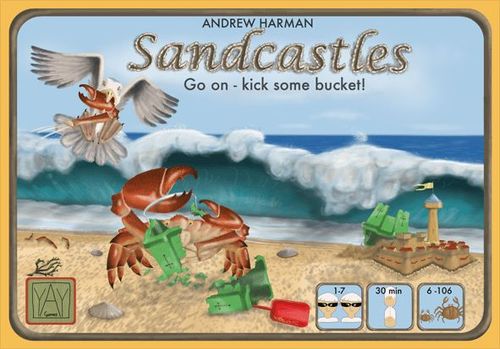
Sandcastles (2015)
Sandcastles (2015) Rulebook
Table of Contents
Table of Contents
Overview
Build sandcastles - gain points. Attack sandcastles - gain points. Win bonuses - gain points.
Crab, bucket and seagull towers come in many shapes. Attack and counterattack with these crab, bucket and seagull cards. Earn bonuses based on what is in your sandcastle and what shape it is.
Aim
You are trying to complete as many sandcastles on your own section of beach as possible before the next big wave ends your fun. Completed sandcastles earn points at the end of the game and may bring in extra bonuses. But beware, other players may attack to steal valuable sandcastle pieces.
Once the Big Wave appears players have one final turn. Incomplete sandcastles do not score.
The player with the most points in his 'sandbank' wins.
Completed sandcastles and bonuses
A completed sandcastle has all its walls connected.
Immediately a sandcastle is completed check if it earns bonuses. Then collect the parts making up the sandcastle, turn them face down into the player's 'sandbank' of points. Place any earned bonuses next to the player's 'sandbank'.
Example: this sandcastle would gain the +6 shape bonus AND the 3 x bucket bonus.
Components
Cards have different backs to distinguish the main play deck from the bonus deck. Keep the decks separate.
Main deck cards: the sandcastle cards (crab, bucket and seagull cards, plus the Big Wave card).
Bonus cards: these can have different symbols on the back. Bonus cards include seaweed, pebbles, the Biggest Sandcastle, the Tallest Tower, and the material and shape bonuses described below.
Setup
Dealing the main deck
First find the Big Wave card and put it to one side. Shuffle the main deck and deal 3 face down cards to each player. They may look at their cards. Place 3 face up cards in the centre of the table. This is the 'beach' area where players will take cards to restock their hand. Shuffle the Big Wave into the bottom ten cards of the draw deck and stack these face down next to the beach area.
Dealing the bonus cards
Place the 'Biggest Sandcastle' and 'Tallest Tower' bonus centrally where all can see. Split the remaining bonuses and deal depending on number of players (see table). These are the bonuses that will be used in this game. Place the remaining bonuses in the box to be used in future games.
Table of bonus cards dealt by number of players (the Biggest Sandcastle and Tallest Tower bonuses are always dealt in addition). The column headings are the bonus-card pictures on the sheet (1 pebble, 2 pebbles, seaweed); the printed table has no words:
| Players | 1 pebble | 2 pebbles | Seaweed |
|---|---|---|---|
| 2 | 1 | 1 | 1 |
| 3 | 1 | 1 | 2 |
| 4 | 1 | 1 | 3 |
| 5 | 2 | 2 | 2 |
| 6 | 2 | 2 | 3 |
| 7 | 2 | 2 | 4 |
For five players deal 2 each of 1 pebble, 2 pebble and 1 seaweed plus 'Biggest Sandcastle' and 'Tallest Tower'.
Playing Sandcastles
The player who was most recently barefoot on the beach goes first.
Play ONE card to take ONE ACTION.
Once the player's turn is complete RESTOCK your hand to 3 CARDS from the beach face up cards or from the main draw deck. Make sure the beach area has 3 cards showing before the next player's turn starts.
In a PLAYER's TURN there are 3 actions a player can take. Choose one.
- Building a sandcastle.
- Attacking another player.
- Exchanging a card.
1) Building a sandcastle
PLAY 1 card from your hand in front of you to start a sandcastle or add to an existing one of yours. Once placed a card cannot be moved or rotated.
You can have more than one sandcastle being built in your area during the game, however these cannot later be joined together.
When adding to a sandcastle the new part must join by connecting walls together.
Crabs, buckets and seagulls can be mixed in a single sandcastle.
Crab and bucket cards can only be placed in a single layer directly onto the play area.
Seagull towers can be played IN THE SAME WAY OR PLACED ON TOP OF ANY OTHER of that player's cards. The seagull tower can be a different shape but must join walls correctly.
Any number of seagull towers can be placed vertically - in fact that's the only way you can win the 'tallest tower' bonus.
Sandcastle walls must join up.
Sandcastle tiles must join existing tiles (unless starting a new sandcastle).
Placing a seagull tower on top of another card can change the shape. There is no limit to the number of seagull towers placed.
Buckets and crabs cannot be stacked as towers.
Completing a sandcastle
As soon as the final piece of a sandcastle is placed, check to see if it earns any bonuses (see earning bonuses). Collect any bonuses - this can be from other players.
Note: Immediately a sandcastle is completed it cannot be changed or added to. It earns bonuses and is collected for points.
Take ALL the cards from that castle (even those covered by seagulls), turn them face down and keep them in your 'sandbank'. These will give points (1 per card) at game end.
2) Attacking another player
There are 3 types of attack cards: crabs, seagulls and buckets. Attack cards can be used to attempt to steal a placed sandcastle card from another player OR played against an attack card (either to counter an attack or to increase an attack).
It is worth spending time making sure all players are clear with the way these cards are used.
A crab will always beat a bucket (by tearing a hole in it). A bucket will always beat a seagull (when it is thrown at the gull). A seagull will always beat a crab (by grabbing it and flying off).
An attack card explained
This 'crab' attack is used against any card showing a bucket icon. In this case a seagull shows the card to counter a crab attack.
The 'wheel of power' is a reminder that seagull beats crab, crab beats bucket, bucket beats seagull and so on.
The target card type is shown by the card being attacked.
- A seagull takes a crab sandcastle card or stops a crab attack.
- A crab takes a bucket sandcastle card or stops a bucket attack.
- A bucket takes a seagull sandcastle card or stops a seagull attack.
A simple attack
Choose any opponent's sandcastle card in play and attack with the correct card. A seagull attack will take a crab sandcastle card, a crab attack takes a bucket card and a bucket attack takes a seagull card.
If the targetted player cannot (or chooses not to) counter, then the attack is successful. The attacker takes the targetted sandcastle card and puts it immediately into play in his area. He also takes his attack card and adds it face down to his 'sandbank'.
Example: Player A is attacking the seagull sandcastle card with a bucket attack. If successful, Player A takes the seagull card into his area and keeps the bucket attack card face down in his 'sandbank'.
Note: A sandcastle card cannot be taken if it splits a sandcastle under construction. Example: taking this crab would split the seagull and bucket. It cannot be taken this turn.
Attacks can be countered and added to. This is explained over the page.
Countering and Re-strengthening Attacks
Countering an attack
Is there a way that Player B can stop the above attack? Of course. He plays from his hand the attack card that beats Player A's attack. In this case Player B could use a crab attack to stop the bucket.
Player B uses a crab attack from his hand against Player A's bucket. Since crabs always beat buckets the attack is stopped. Player B keeps the seagull sandcastle tile in his area. He ALSO keeps the two attack cards taking them into his 'sandbank'. Player A gets nothing.
Counter attacks can ONLY be played by the player under attack.
A counter attack with a crab means Player B keeps the sandcastle tile card AND gains the two attack cards.
Re-strengthening an attack
Is there a way that Player A can get something out of his failing attack? Well, of course. By playing a seagull attack from his hand he can beat the crab which stopped his original bucket attack. Victory is once again his and he takes the seagull sandcastle card and ALSO all 3 attack cards.
Player A takes the crab with the seagull leaving the bucket to take the seagull sandcastle card. Player A takes the seagull sandcastle card and all three attack cards.
Strengthening a counter attack and increasing the skirmish
Is there a way that Player B can still save something from this attack? Well, of course. By playing a bucket from his hand against the most recently played seagull he can beat it. In this case Player A's attack crumbles and B keeps the original seagull sandcastle card and ALSO all four attack cards.
Naturally Player A can increase his attack again should he choose. This can involve a maximum of 6 attack cards and cause much angst to the losing player.
Attack Cards: Secondary Attacks
Tip: Keeping track of which attack cards you need in your hand may seem confusing at first. The 'second attack' card you need is shown in the bottom of the attack card. This will fend off a counter. Having all 3 attack types means you should succeed.
If you play this crab attack you will need a bucket to follow up with a secondary attack.
If you play this seagull attack you will need a crab to follow up with a secondary attack.
Restocking your hand after an attack
The player who lost the skirmish picks up from the beach first choosing face up/face down cards. The beach is not restocked during this. Only when the losing player has 3 cards in hand is the beach restocked and the victorious player in this skirmish refills his hand. Play continues to the left.
3) Exchanging a card
As an action a player can exchange a card with any of the three face up beach cards, or by secretly replacing the face down top deck card. Place one card in the 'beach' area and take a card. This completes his turn.
The Bonus Cards
As soon as a sandcastle is complete, check if it earns any bonuses. Place those bonuses face up next to your sandbank for all to see. If the new sandcastle matches or betters ANY bonus held by another player - then take it from them - you earned it! You will keep these bonuses just as long as no one else matches or beats you.
Biggest Sandcastle
Take this when you complete a sandcastle with an area of 7 or more pieces. The score a player gets is shown by the face furthest away from the player. Turn this to the correct face when taking the card. For example, this shows 9 points from a 9 piece sandcastle.
Note: If a player has earned the 'Biggest Sandcastle' or 'Tallest Tower' bonus these can only be taken by another player if the NEW Sandcastle is 'Bigger' or 'Taller.' For example, a new 7 piece sandcastle cannot take a 9 piece bonus that is in play.
Tallest Tower
Take this when you complete a sandcastle with 3 or more sandcastle tiles on top of each other (ie 1 crab and 2 seagulls, 3 seagulls etc). Turn this to the correct face when taking the card. For example, this shows 7 points from a tower six cards high.
Material bonuses
Take these when a completed sandcastle shows that number or more of that item. For example, take this if the completed sandcastle shows 3 or more buckets.
Note: more than one type of icon bonus can be earned by one sandcastle on completion. But only one of each type per sandcastle, i.e. you cannot earn 5 buckets AND 3 buckets from the same sandcastle.
Shape bonuses
Take these when a completed sandcastle is exactly the same shape as shown on the bonus. There are often many ways to achieve these shapes.
The shape bonuses printed on the sheet are: The Donjon (+2), The Axe (+3), The Wyrm (+4), The Barracks (+5), The Staircase (+5), The Peacock (+6), The Cactus (+6), The Abbey (+6) and The Goldfish (+6).
When ANY bonus is earned by a complete sandcastle - take it. Even if this is from another player.
The Bonus pool is not restocked during a game.
Game End and Scoring
Game end
Game end is triggered as soon as the Big Wave appears. Place it in front of the player whose turn it was. Each other player has one more turn. The game ends when play gets back to the player with the Big Wave. In this last turn players do not restock their hand.
Scoring
Incomplete sandcastles and cards in player's hands do not count.
Count the cards in each player's 'sandbank'. Score one point for each card. Then add any bonuses. The player with the highest score wins.
Examples of Play
Building sandcastles
Player A's sandcastle can be completed by laying a corner seagull tower to cover the 4 way crab. The covered 4 way crab is part of the completed sandcastle and so will be included in A's 'sandbank'.
However, in this game the 4 x crab bonus is in play. Playing the seagull in this way will not earn the bonus as four crabs are not showing in the completed sandcastle.
Player A decides to push his luck and take 2 turns to play two end buckets. This completed sandcastle earns him all the cards in the sandcastle as well as the 4 x crab bonus AND the 'Biggest Sandcastle' bonus.
A 7 piece sandcastle gives 6 points.
Attack and defence
Player B attacks A's crab sandcastle card with a SEAGULL attack. If he succeeds he will place the stolen crab card into one of his sandcastles AND put the SEAGULL into his 'sandbank'.
Player A counters with a BUCKET attack from his hand. If A succeeds he will keep this crab card in his sandcastle AND put BOTH attack cards in his 'sandbank'.
Player B is having none of this and so increases his attack by adding a CRAB from his hand to beat the BUCKET. If B succeeds he will place the fought over crab card into one of his sandcastles AND put ALL THREE attack cards in his 'sandbank'.
Will player A defend with another SEAGULL?
Variants
2 player variant
This variant introduces a 'shared' sandcastle for use by both players. It can be added to or attacked in your turn and your opponent can choose to counter, or not.
Set-up as normal but deal 4 cards to each player and deal 4 bonuses in addition to the 'Biggest Sandcastle' and 'Tallest Tower'.
A player now has 2 actions in his turn.
-
If you choose 'Build Sandcastle' as your first action then this must be to your own area. Your second 'Build Sandcastle' action is played to the shared single sandcastle between both players.
-
If you choose 'Attack' as your first action, you can attack your opponent OR the shared sandcastle. Your second action can only be to attack the shared sandcastle. Your opponent may choose to counter these in the normal manner. If successful she keeps the attack cards and the targetted card remains with the shared sandcastle.
Neither of you restock until both actions are completed.
| Action 1 | Action 2 |
|---|---|
| Build to YOUR OR SHARED sandcastle. | Build to SHARED sandcastle ONLY. |
| Attack OPPONENT's OR SHARED sandcastle. | Attack SHARED sandcastle ONLY. |
| Exchange. | Exchange. |
Completing the shared sandcastle. The player who completes the shared sandcastle scores as if it were their own. Take all the cards and any bonuses owing. If one of those bonuses matches your own, you keep it.
Game end and scoring are as normal.
Sandcastles solo variant
This version is all about getting the bonuses out before the game screws you.
Set-up. Remove the 'Tallest Tower' and 'Biggest Sandcastle' from the game. Shuffle the bonus cards and deal four. If you earn all of these before the game ends - you win. You can earn more than one bonus for a single sandcastle (though not for the same icon, e.g. 2 crab bonuses).
Deal yourself 3 cards, place three on the beach and use the 'Big Wave' as normal.
Your turn. Play one action in the normal way. At the end of your turn restock your hand then discard the remaining beach cards. Now deal 'The Game's Turn'.
'The Game's Turn'. Place 3 cards out - the 'Game's Hand'. If one or more of these is an attack card play this immediately against you. You choose which one. You can counter in the normal manner. If there are no relevant sandcastle cards there will be no attack. Once one attack has been carried out, or countered, discard the remaining 'game hand' cards and deal three new for your play. Restock your hand now.
Any completed sandcastles earn bonuses as usual. If you have taken all the bonuses before the Game Ends then you win. The game ends immediately the 'Big Wave' appears. If there are any bonuses remaining unearned at Game End then you lose.
You can increase the difficulty by dealing yourself five or more bonus cards. But be sensible - at some point beating the game will become impossible.