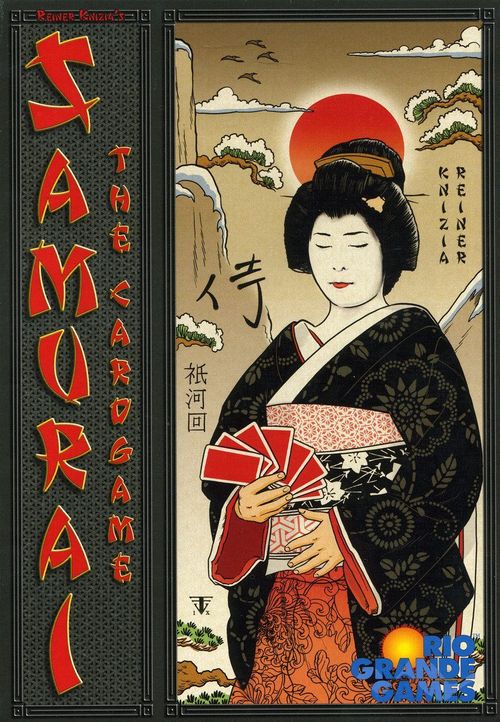
Samurai: The Card Game
Samurai: The Card Game Rulebook
Table of Contents
Table of Contents
Components
- 60 cards (4 colored sets with 15 cards each)
- 44 village cards (15 with 1 symbol, 27 with 2 symbols, 2 with 3 symbols)
- 48 score markers (16 triangular helmets, 16 round buddhas, 16 square rice fields)
- rules
Preparation
Shuffle the village cards and place them as a face up deck on one side. Only the topmost village should be visible on the deck. Take the top village card and place it in the middle of the playing area.
Sort the score markers by shape and place them as three separate supply piles to one side. With two players, only play with ten markers of each shape.
Each player chooses one colored set of cards. With four players, remove one 1-samurai and one 2-samurai from each set. Each player shuffles his cards and places them as a face down deck in his play area (the area near him on the table). Then each player draws the top five cards from his deck into his hand.
Play
Select one player to start, then play progresses clockwise. On a player's turn, he plays one card from his hand face up onto the table. The card must be placed adjacent to at least one village. Then check:
- whether new villages are to be placed in the middle (see below), and
- whether any villages are scored (see below).
At the end of his turn, the player draws one new card from his deck to replenish his hand to five - as long as cards are available in his deck.
New Villages
When a player plays a card adjacent to a village card that already has a card from another player at a neighboring side of the same village card, then he must place the top village card from the deck on the space between these two cards, provided the space is still empty. He places no village card when the two cards are of the same color (i.e. both belonging to him).
During the game, the table will develop into a chessboard-like grid of village cards and player cards.
Playing a card may cause the above situation to occur more than once. In this case, the player must fill all of the corresponding spaces with new villages; he takes the first village card from the top of the deck and, while already seeing the next village card, he decides where to place the first village card; then he takes the next village card from the top of the deck and places it, and so on.
HINT: When deciding which card to play, a player should keep in mind which village card will be placed next from the face up village deck. When a card causes new village cards to be placed, the player ideally wants his card to influence these village cards, as described above.
Scoring a Village
When a player plays a card such that a village card is completely surrounded by four adjacent cards, this village is scored. For each symbol depicted on the village, determine which player asserts the most influence on it. Influence is asserted from the four adjacent cards if they match the symbol, or if they show a samurai. The player with the most influence wins a corresponding scoring marker. In the case of a tie, the scoring marker is not awarded. Players keep their scoring markers in their play areas, separated by shape, for all to see.
After scoring a village, turn the village card face down. When cards are surrounded by four face down villages, also turn these cards face down. This makes it easier to see which villages and cards may still be scored.
Playing a card may cause more than one village to be scored. If the scoring markers of one shape run out before all those villages have been scored, the remaining villages are still scored and missing score markers are still scored, and players take missing markers with coins or some other substitute.
Game End
When the scoring markers of one shape run out, the current turn is completed, then the game ends. The game also ends after completing a turn, if the last village was placed on the table or if all players have played all their cards.
The winner of the game is determined in the following way:
- Players who do not dominate any one of the three shapes are eliminated from consideration. A player dominates a shape if he possesses more scoring markers of this shape than any other player. In the case of a tie, the shape is not dominated by any player.
- If one player dominates two or three shapes, he is the winner. Otherwise all players who dominate one shape set aside their scoring tiles of that shape and count the number of scoring tiles they have in the other two shapes. The player with the highest number is the winner. In the case of a tie, the number of scoring tiles in the dominant shape is used as a tie breaker. If the tie remains, the respective players rejoice in their shared victory.
Scoring example: Green has 4 triangle, 7 square, 6 circle; red has 2 triangle, 4 square, 7 circle; blue has 5 triangle, 7 square, 3 circle. Green does not dominate a shape and is eliminated. Red dominates the round buddhas and scores 2+4 = 6. Blue dominates the triangular helmets and wins with 7+3 = 10.
Clarifications
The following clarifications come from reading the BGG forums and are not part of the original printed rules.
A new village is placed only if there are at least 2 differently-colored cards adjacent to the place where you're putting it. If all cards are of the same color (whether 1, 2, 3, or 4 of them), the village does NOT get placed.
A player who is eliminated through lack of domination cannot win, but their pieces remain in the game for scoring purposes.
If you must simultaneously place 3 villages, the rules seem to suggest that you would take 2 tiles (and so see all 3 before placing anything), but it's not explicitly stated, and people in the forums seem to favor the "see 2, place 1, see 2 more" approach, although no particularly valid reason is given for this.