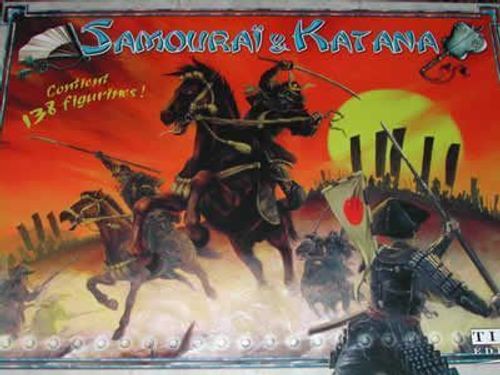
Samurai & Katana
Samurai & Katana Rulebook
Table of Contents
Table of Contents
- 1) Goal of the Game
- 2) Number of Players
- 3) Components
- 4) Setup
- 5) The Emperor
- 6) Turn Sequence
- 7) Phase 1: Purchase and Placement of Samurai
- 8) Phase 2: Clan Activation
- 9) Combat
- 10) Counting Honor Points
- 11) Phase 3: Determination of the Emperor and the Shogun
- 12) Phase 4: Tax Collection
- 13) Special Rules and Clarifications
- 14) End of the Game
- 15) Optional Rules
- Advice to Players
- Design Note
1) Goal of the Game
The player who exceeds 25 honor points is declared the winner. If several players exceed 25 points, the player with the highest value wins. In case of a tie, players are separated in the following order: the player with the most clan points, cities, territories, castles, then samurai wins.
Introduction: To start the game simply and quickly, a short game is recommended, where the total of honor points for victory is set at 20.
2) Number of Players
Samurai & Katana is a game for 3 to 6 players.
3) Components
1 game board representing 16th-century Japan, 55 cards, 120 samurai figurines (20 per player), 18 castle figurines (3 per player), 19 city tokens (minor and major), 24 koku tokens (1, 2 or 5), 6 clan cards.
Note: The 6 honor markers used to count points are missing. Use a samurai at 5 or 6 players; otherwise, create 6 honor markers.
4) Setup
The youngest player receives the "Emperor" figurine and places it in front of him.
Each player chooses a clan card and takes the corresponding samurai pieces and the 3 castles, as well as 5 koku of treasure.
At 4 players, 20 samurai are used, at 5 players 18, and at 6 players 15.
The clan card is a memory aid and also serves as a reserve for the pieces. It represents a powerful clan of the period.
Shuffle the city markers into 2 separate piles, the major cities and the minor cities, then each player draws 1 major city marker and 2 minor city markers. These 3 cities represent your clan's possessions at the start of the game.
When playing with 3 or 4 players, each player draws 1 major city marker and 3 minor city markers.
The city markers are printed double-sided; the draw of starting cities must be made in the box without the player looking at what he draws. Use 2 separate places in the box to make a draw pile containing the major cities worth 2 clan points and the minor cities worth 1 clan point.
Exception: Kyoto, the imperial capital, cannot be owned from the start. It is therefore removed from the group of major cities before the draw.
Place 1 samurai per city, then each player receives 3 additional samurai which he distributes as he likes among his 3 cities. The samurai are placed clockwise starting from the Emperor.
When playing with 3 or 4 players, place 1 samurai per city, then each player receives 4 additional samurai which he distributes as he likes among his 4 cities.
The remaining "city" tokens are then placed on the corresponding territories.
Shuffle the cards.
Each player receives 5 cards on the first turn.
The Cards
All cards have a value at the top left, which represents the card's combat value during a battle; some also have a power indicated by text. When a player has such a card, he may choose to use it either for its power or for its combat value. The more powerful the power, the higher the card's combat value. Some cards have a value at the bottom right. Depending on the symbol, this value is either a bonus to your combat value (fan symbol), or the cost to be spent to play the card (koku symbol). Cards with a blue background are special cards whose powers can only be played during battles. Cards marked "playable at any time" are the only cards that can be played during other players' turns. However, a player who has only 2 cards left in hand can no longer play "playable at any time" cards; these cards are considered to lose their power. A player may decide to play against himself cards that make him lose honor.
Note: "Playable at any time" cards must be played before or after a combat, but never during it.
5) The Emperor
On the first turn, the youngest player becomes Emperor; afterwards, the player with the fewest honor points becomes Emperor. If several players are tied, it is the one with the fewest clan points, cities, then the fewest koku and finally the fewest samurai.
6) Turn Sequence
A game turn is divided into several phases:
Phase 1) PURCHASE AND PLACEMENT OF SAMURAI. The Emperor decides the order of the players for this phase.
Phase 2) CLAN ACTIVATION. The Emperor decides the order of the players for this phase.
Phase 3) DETERMINATION OF THE EMPEROR AND THE SHOGUN. The player with the fewest honor points becomes the new Emperor, the player with the most points becomes the Shogun.
Phase 4) TAX COLLECTION, RECEIVING CARDS. Players count their territories and receive their koku. Players refill their hands with cards. This phase is played simultaneously by all players. The Emperor manages this phase.
6.1) Order of Play
The turn order is defined by the Emperor. The Emperor names a player who will carry out his Purchase and Placement of Samurai phase. Then the Emperor names a second player, and so on until all players have carried out their Purchase and Placement phase. The Emperor may play his turn when he wishes. The Purchase and Placement phase ends when all players have played. Then the Emperor repeats the same operation for the Clan Activation phase.
7) Phase 1: Purchase and Placement of Samurai
7.1) Purchases
Players make their purchases at the following costs: 1 koku per samurai, 4 koku per castle, 6 koku per castle in Kyoto.
Warning! Movements are only paid for during clan activation. During this phase, no card may be played.
7.2) Placing Pieces
Each player may place his samurai or castles in territories in which he already has a piece. There may be only one castle per territory.
Warning! A placed piece is a played piece; players cannot reposition their pieces.
8) Phase 2: Clan Activation
The Emperor announces which player plays his turn. The player may, in any order he wishes, perform actions as long as his treasure and his cards allow. An action may be repeated several times in a row. A player may move, play a card, then move, fight, play 2 cards, and so on. A player's turn ends when he has no more actions to perform. The possible actions are:
8.1) Playing a Card
A player may play a card, whose power he carries out immediately. If there are honor points on the cards, they are immediately counted or deducted.
8.2) Moving Your Samurai
You move from one territory to another territory by land or by sea (blue link). This action costs 1 koku, and allows you to move as many samurai as you wish. Moving to a territory containing a castle belonging to you is free. A move into a territory controlled by one of your opponents is considered an attack, and there is then combat. The battle is resolved before any other movement. To control a territory, you must have there either a samurai or a castle. At the end of combat, the honor points won or lost are immediately counted. Warning! A placed piece is a played piece; a move cannot be replayed.
8.3) Negotiations
A player may decide to negotiate with another player by exchanging 1 card or by offering koku. Negotiations may be started only once per turn and must be conducted openly, around the table.
Note: Play this rule as an option, with the agreement of all players. Do not play this rule in your first games.
9) Combat
When samurai belonging to 2 different players are in the same territory, there is combat. An attack cannot be made from several territories. The combat must be resolved before any new action. Whatever the outcome of the battle, the player whose turn it is resumes his phase normally.
Each player chooses 2 cards and each may add 1 additional special card (blue background). The attacker announces the number of cards he plays, 2 or 3 (2 combat cards + 1 special). He places his cards so that, if there is a special card, it stands apart from the other cards. The defender may then announce the number of cards he plays and proceeds like the attacker.
A player is always obliged to place 2 cards in a combat. If an attacked player does not have 2 clan cards to defend with, he fills his hand up to 2 cards. Only the combat value of his cards is then taken into account; events or "playable at any time" cards are no longer valid.
The players then reveal their cards at the same time. The first 2 cards serve as combat value; they are placed to the left of the player, and the special card is placed on the right. Each player adds up the combat points of his first cards, then adds his samurai (4 maximum) and carries out the power of his special card if he played one (particular effect or combat bonus).
A player may commit as many samurai as he wishes to a combat, but only 4 will count for the combat. Each samurai is worth 1 combat point. A player defending in a mountain territory benefits from an additional +1 bonus in combat.
The player with the most combat points wins the battle. The winner of the battle gains 1 honor point. He advances his honor marker on the track by that amount, and takes control of the territory. In case of a tie, the defender keeps his territory and the attacker returns to the territory from which he came. No one wins an honor point. The loser must remove his surviving samurai from the territory. Each player loses a number of samurai equal to the number of swords on his opponent's cards.
Warning! A player cannot suffer more than 4 swords of losses in a combat. Additional swords are lost. The winner's surviving samurai remain in the territory; the loser's surviving samurai must leave the territory. If they belong to the defender, they are repositioned as he pleases on one or more of his territories. If they belong to the attacker, they return to the territory from which they launched the attack. If the winner loses all his samurai during the combat, then he does not seize the territory. The territory belongs to no one any more; it becomes free. If the territory had a city, the marker of the city that has become free is placed on the game board. The cards played are all discarded. Each player receives 2 new cards, except if the winner is the defender, in which case he receives 3 new cards.
9.1) Castles
In a combat, the castle multiplies the weakest combat card by 2. The combat value of a castle alone is 0 combat points. Thus in a battle involving a castle without samurai, only the combat value of the cards played counts, the weakest card being multiplied by 2. Moving to a territory containing a castle of your color is free. A player who seizes a castle may destroy it or replace it with one of those he still has in reserve. A player who has all his castles on the board may destroy one of his castles to put it in place of the newly conquered castle. A player may build only one castle per turn. Ikko Ikki uprisings and sects are not effective against castles. When the player has finished all his actions, he ends his turn by announcing it and begins to count his honor points.
9.2) Elimination of a Player
The eliminated player returns on the following turn with a free Ikko Ikki uprising, 5 samurai and 4 koku.
10) Counting Honor Points
For each clan, honor points are counted on the border of the board with a samurai figurine of its color. A player receives honor points when he wins combats (1 honor point per combat won) or by playing certain cards. He also receives them by controlling provinces, a set of territories of the same color. A province is controlled when a player has at least 1 samurai or 1 castle on each of the territories making it up. When a player has a complete province, he collects the honor points that this province yields (see the province table on the board).
11) Phase 3: Determination of the Emperor and the Shogun
The player with the fewest honor points becomes Emperor. A player receives 1 honor point per turn if he remains Emperor. He decides the order of play of the players.
The player with the most honor points becomes Shogun. This prestigious office is difficult to bear. Each time the Shogun loses a battle, he loses 1 honor point. The Shogun receives an additional free move each game turn.
12) Phase 4: Tax Collection
When all players have finished their turn, each player's taxes are calculated. Each player receives koku for the territories he controls. Each plain territory yields 2 koku, each mountain territory yields 1 koku.
12.1) Receiving Cards
The number of cities owned determines the number of cards each player receives during the tax collection phase. A player may discard as many cards as he wishes before refilling his hand to 5 cards. He receives additional cards depending on the cities he owns. Each city, according to its importance, yields clan points (CP). A major city yields 2 CP, a minor city yields 1 CP.
From 1 to 5 CP: you receive 1 additional card.
From 6 CP and more: you receive 2 additional cards.
A player who has no city receives no additional card. Cards played are discarded face up. When the draw pile is empty, the discarded cards are shuffled to form a new draw pile.
13) Special Rules and Clarifications
Kyoto: the city of Kyoto yields 1 honor point per turn if you do not own the complete province. Building a castle costs 6 koku.
Selling honor: during his turn, a player may exchange honor points for koku: 2 honor points = 1 koku.
Dispute: In case of a dispute, it is always the Emperor who decides.
Shogunal Justice: if you are countered by a shogunal justice, you cannot perform the action you had undertaken. A shogunal justice can only be played on oneself.
Ikko Ikki Uprising or Sects (Hokke, Nichiren): One of these cards cannot be played against a player who has only one territory left.
Dishonor: You cannot go lower than the dishonor space; losses of honor points beyond this threshold are no longer counted. A player may voluntarily play insult or plot cards against himself.
Tsunami: the player who is countered recovers the koku he had just invested for his sea movement.
Alliance: only adjacent land territories are taken into account. All samurai pieces, with a maximum of 4, are added to your own samurai.
Ninja: the card chosen from the opponent's hand is added to your hand of cards. You may play it normally.
Scorched Earth: the card is played either before the targeted player has moved or during his movement; in the latter case, the movement is cancelled and the player recovers his koku.
14) End of the Game
When a player passes the 25 honor point mark, the game ends once all players have taken their turn. The player who has reached the highest number of honor points wins the game.
15) Optional Rules
Once you know the game, it is recommended to add the diplomacy rules.
NEGOTIATION AND DIPLOMACY: A player may exchange 1 card with another player. Cards cannot be exchanged for koku. A player may give koku as he wishes to any other player. Negotiations must be conducted around the table, in full view of everyone.
SEPPUKU: On his turn, a player who has only one territory and 3 samurai or fewer may decide to dissolve his clan in order to return as an eliminated player on the following turn.
SHOGUNAL JUSTICE: The card may be played to defend another player.
CLAN TREASURE: Whenever you wish, you set aside koku (out of the sight of the other players). At the end of the game, players reveal their secret treasure, and these koku are exchanged for honor points (3 koku are worth 1 honor point). These koku can never be stolen, nor return to play in following turns. If you play this option, note the koku kept on a piece of paper.
DURATION: The length of a game can be varied by setting an honor point limit (30, 35 or 40 honor points).
IN THE LAND OF KOKU: On the last game turn, players take in their taxes and convert them into honor points at 3 koku for 1 honor point.
THE POWER OF THE SHOGUN: Once per turn, the Shogun may cancel the power of the card of his choice, provided the card is not aimed at him.
EXCHANGE: A player who has a full hand of combat cards (warriors) announces it and may discard 1 of them to draw 1 new card.
EMPEROR: Once per turn, the Emperor may sell an office worth 1 honor point to the player of his choice. The price is set by the Emperor. This power disappears as soon as a player passes the 25 honor point mark.
SUPPORT OF THE EMPEROR: Once per turn, the Emperor may give his support to a clan of his choice in a combat. In this case, he announces it, and the player who receives the support must be willing. The Emperor then takes between 1 and 3 samurai from anywhere on his territories and places them on the territory where the battle is taking place. These troops are added free to the 4 samurai of the allied player (maximum total 8 samurai). If the supported player wins the combat, the Emperor receives as many honor points as the number of samurai he committed, then the samurai return to their territory of origin. If he loses, the Emperor loses all his samurai. Imperial samurai never suffer losses from swords during the battle.
New options proposed by Pascal Bernard
Kyoto, imperial city: There can be no Ikko Ikki uprisings in the city of Kyoto.
Province variant: Here is another way of playing even more strategic games: simply change the value of each of the provinces by "?1" honor. Example: Kinai 5(1), Tokaido (3), etc. This variant gives greater importance to the battles that yield 1 honor point. [Translator's note: the French text prints "de ?1 d'honneur", a garbled symbol, probably "-1"; the examples shown are reproduced as printed.]
The Limited Emperor (variant that makes the game less random): The player who plays the Emperor has his power limited; he decides once and for all at the start of the turn the order of play of the clans and announces it. Players can thus plan their strategy further ahead.
Disregard of rank (with the Limited Emperor rule): Players may, for the sum of 3 honor, move their clan forward or back one rank in the order of play given by the Emperor. A player may perform this operation only once. He may do it only after the Emperor has given the order and before the first player has played. This attempt can be countered if the player whose rank is being taken also decides to spend 3 honor to return to the previous situation.
New political deal: The clan points determining the drawing of cards follow this new scale:
0 to 2 CP = no additional card
3 to 5 CP = 1 additional card
6 and more CP = 2 additional cards
New Ninja (variant that makes the game less random): Ninjas can only be played at the start of a player's turn, before he has begun to play; afterwards they can no longer be used. This rule avoids destabilizing players too much during their turn and finding their strategy broken by the intervention of a Ninja.
Advice to Players
Make the best use of the events, look for possible interactions between your cards, make combos. Study the sea routes in particular; they are very dangerous.
Constantly watch your opponents' play and adjust your plans accordingly.
In your turn, play with a plan and a precise objective for the number of points you want to gain.
Always calculate your opponents' possibilities of scoring honor points.
The office of Emperor should allow you to climb back up the ranking, so study carefully the order in which you will make your opponents play. Do not hesitate to make them play when they are in a delicate situation.
You will never be strong enough alone against everyone.
Castles are one of the keys to victory; the lightning gathering of your troops and their concentration will allow you to seize any territory. Always place castles on territories that have many sea connections.
Beware of the Wako pirates and always keep plenty of gold for your movements. Never neglect the culture cards Tea Ceremony and No Theatre, which may bring victory.
Design Note
Samurai & Katana is part of my idea of a historical triptych (Montjoie!, Azteca, and Samurai & Katana) in which I tried to introduce players to peoples and eras rarely covered. Each time, I tried to immerse myself in those eras to create game systems peculiar to them. My aim is not to simulate each event of the period exactly, but rather to put players in a playful atmosphere that helps them feel the dilemmas of the belligerents of the time.
The Sengoku period is infinitely complex, because of the multiple successions, the disappearance of clans and the impressive number of battles that took place.
The game deals in a general way with the Sengoku period 1477-1600, with particular interest in the years 1560 to 1600, the period corresponding to the reunification of the country. I did not want to give a precise date for each turn, but each represents more than ten years. The importance of terrain, the difficulties of communication, the scattering of clans, and negotiations are essential data of the theater of Japanese medieval wars.
My aim was to make a simple game without perverting the historical aspect of these wars, as far as possible. Thus the mountains and the division into provinces, inspired by the administrative division of the time, limit movement and localize battles. The sea routes were deliberately overestimated to convey that the player is carrying out a considered act of conquest, part of a policy of extending his fief over about ten years. The daimyos fought to enlarge their domain, but also to control the richest region of Japan: the Kinai. This region is the cradle of Japanese civilization; it contained many cities, was extremely rich in rice paddies and had the imperial capital Kyoto, whose cultural influence dazzled the crudest warriors of the north and the savage Wako pirates of the south. The difficulty of the game was to find a balance between the rich center and the poorer, wilder north and south. In the game, control of the Kinai is an essential element, but not required to win.
I paid very particular attention to the cards, which by themselves convey the atmosphere of rivalry among the clans. These cards are the heart of the game and, despite their small number, can be combined with one another to form many combinations. The player is always faced with the dilemma of how to use his cards: combat or power? The game pushes you to maximize your hand of cards.
Japan had a very hierarchical society, and the Emperor had real ideological force; I wanted to represent all of this through the 2 offices, Emperor and Shogun, that players must assume.