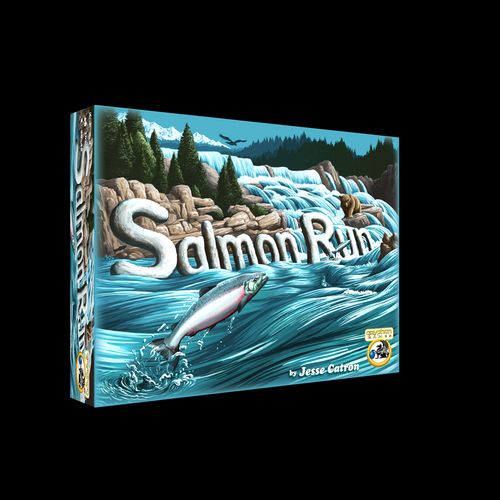
Salmon Run
Salmon Run Rulebook
Table of Contents
Table of Contents
Objective
Be the first player to have his/her salmon swim upstream and reach the spawning pond to continue the cycle of life.
Players: 2-4 Playing Time: 20-45 minutes
Components:
- 8 two-sided game boards
- 4 salmon pawns
- 6 bear pawns
- 4 11-card Swim Decks
- 32-card Fatigue Deck
- 48-card Supplemental Deck
- 1 standard die (d6)
Game Overview
Salmon Run is a race. The goal is to be the first to reach the spawning pond with the least amount of fatigue. Each player starts with a basic Swim Deck which they alone use to move and perform other actions. Each card a player plays goes to his own Discard Pile (next to his Swim Deck). When a player's Swim Deck runs out, he simply shuffles his Discard Pile to reform his Swim Deck. Managing the Swim Deck properly is vital to doing well. As the game progresses, other cards will be added (or removed) that may either benefit the player or hinder him.
Each player will use Swim cards to navigate the board on the way to the spawning pond. Swim cards include the basic swims (Swim Right, Swim Left, and Swim Forward), the Double Swims (Double Swim Right, Double Swim Left, and Double Swim Forward) and the Wild Card. Salmon are simple-minded and don't swim backwards! Along the way, there are various obstacles like rocks and waterfalls to maneuver around or over. There are also special hexes that allow you to add (or remove) cards from your deck. Some of the special cards enhance your ability to navigate the river, while others allow you to hinder your opponents.
Swim Deck Anatomy: Each player's color-coded Swim Deck consists of the following cards:
- 3 Swim Forward
- 3 Swim Right
- 3 Swim Left
- 1 Wild
- 1 Bear
Set-Up
The game boards in Salmon Run are modular so the river will be different each time you play. There are eight 2-sided boards: one Starting board, one Finish Board, and 6 numbered boards. Each numbered board is rated Easy (E), Medium (M), or Hard (H). This allows you to customize the river by difficulty. The length of the river is also customizable. For a shorter game, use fewer numbered boards. For a longer game, use more numbered boards.
For the first game and for beginners, it is recommended you create a river with a length of 5 boards (1 starting, 3 numbered, and 1 finish) using Easy-rated boards. For more experience gamers, it is recommended you create a river with a length of 6 boards.
- Create the River. Find the Starting Board marked S1 on one side and S2 on the other. Choose which side to use. Next, lay out one of the numbered boards using whichever side you prefer next to the starting board. Make sure to align the three half hexes and be sure the current arrows on the edges point toward start. Note that when adding boards, they may end up being staggered in relation to the previous board. This is normal. Lay out two (or three) more numbered boards in the same way, using the side of your choice. Finally, align the Finish board marked F1 and F2. Again, choose the side you prefer.
- Place a Bear Pawn on each Paw-Print hex on the board.
- Place the Fatigue Deck face-up next to the board. Using the cards from the Supplemental Deck, make separate face-up piles for the Bear cards, the Eagle cards, the Wild cards, the Current cards, the Rapids cards, the Double Swim cards, and the Basic Swim Cards (Swim Forward, Swim Left, and Swim Right).
- Each player chooses a color and places their corresponding salmon pawn on the start hex. Each player then takes the matching 11-card Swim Deck, shuffles it and draws 4 cards to make their starting hand.
- Roll to randomly determine the "current" (first) player.
The center of the river is marked with a semi-circle on the upper and lower edges of the boards to assist with set-up.
Card Reference
- Fatigue – a card with no effect when played.
- Swim Forward – move your salmon one hex forward.
- Double Swim Forward – move your salmon two hexes forward.
- Wild – swim forward, right or left.
- The Eagle – look at any player's hand and discard a card of your choice.
- The Bear – move a bear up to 2 hexes. Fatigue all salmon in that same hex.
- Current – each salmon moves along the current.
- Rapids – each player discards a card from hand for each current arrow on the hex they occupy.
Gameplay
The "current" player plays up to 3 cards from his hand and resolves them one at a time in the order played. The following rules must be followed when playing cards:
- If he plays 3 Swim cards, he must add a fatigue card to his Discard Pile.
- Playing non-Swim cards doesn't make you add a Fatigue.
- If you play nothing but Fatigue cards, return one of them to the Fatigue Deck.
As each Swim card is played, he moves his salmon token in the direction indicated by the card. The following rules must be followed when moving:
- A salmon may not move onto or directly jump over a Rock hex (or any land hex).
- A salmon may not move into a Waterfall hex, but may jump over it. Jumping involves combining 2 consecutive swim cards (see Jumping).
- Moving onto other special hexes allows the player to add the corresponding card to his Discard Pile.
For example, when you swim into a hex with the Double Swim icon, you add the Double Swim card of your choice from the Supplemental Pile to your Discard Pile. This card is then available for you to use when it cycles through your deck.
After resolving all the cards he played, the "current" player places the cards he just played into his own discard pile. Then, he draws from his Swim Deck to replenish his hand back to four cards and ends his turn. Note that any cards he did not play remain in his hand.
The next clockwise player becomes the "current" player and plays up to 3 cards and resolves them in order before replenishing his hand back to four cards. Players take turns until a salmon reaches the spawning pond.
Winning the Game: Once a salmon reaches the spawning pond, play continues until the last player's turn. After the last player ends his turn:
- If only one salmon is in the spawning pond, that player wins.
- If more than one salmon reaches the spawning pond, the winner is the player with the fewest Fatigue cards in his Swim deck (including his discard pile and his hand).
- If they have the same number of Fatigue cards, the game is a tie.
Game Details
Countering Cards: Some cards have the added function of countering (canceling) other cards played. These are as follows:
- A Current card counters the Current card.
- A Rapids card counters the Rapids card.
- An Eagle counters an Eagle card.
- There is no counter to the Bear.
Note that only the player who played the countering card gets this benefit. For example, Player 1 played a Current card, which affects all players. Player 2 decides to counter the Current by discarding a Current card from his hand. Player 2 no longer has to move along the current. Player 3 doesn't have a Current card in hand, so he must move downstream along the current.
It is possible for a player to counter his own card play if they he has a second copy in hand. The card used to counter does not count as a card play. For example, Player 1 has two copies of a Current card in hand and plays one of them to affect all players with the Current. Player 1 may discard his second Current card to nullify the first Current's effect on him. He no longer has to move along the Current.
Currents: Most hexes on the board have one or two arrows indicating the direction of the current. When the Current card is resolved, all salmon move along the current to the adjacent hex as indicated by the arrow. If there are 2 arrows, the die is rolled. Each player rolls individually, if necessary. On an odd-numbered roll, move in the direction of the arrow labeled "1". On an even-numbered roll, move in the direction of the arrow labeled "2". The Bear is unaffected by the current. Any salmon on a hex with no arrows is unaffected by the current. A few currents move the player forward.
If the Current brings you to a Waterfall hex, you must move backward another hex as indicated by the arrow on the Waterfall hex. A second die roll may be necessary if there are two arrows on the Waterfall hex.
If the Current brings you to a special hex, you still add or remove cards as appropriate.
Current Arrows: The number of current arrows a hex contains is the number of arrows that originate within the hex and not the number of arrows coming into the hex.
Discard Pile: Each card you play forms your own discard pile next to your Swim deck. When your Swim deck runs out, simply shuffle your discard pile to form a new Swim deck.
Fatigue Cards: Fatigue cards have no inherent function, but instead limit your options and slow you down! If you have a Fatigue card in hand, you may play it on your turn – it just doesn't do anything. If you play only Fatigue cards on your turn, you may return one of them to the Fatigue Deck.
Hand Size: Each player's hand size is always four cards. If you have less than four cards at the end of your turn you must draw back up to four. If you have more than four cards at the end of your turn then you must discard down to four. The hand size requirement only applies at the end of your turn and not other player's turns.
Jumping: Jumping allows your salmon to overcome the Waterfall hex. To perform a jump, you combine two Swim cards. With a jump, you immediately move the salmon to the second hex, skipping the first. Jumping expends a lot of your salmon's energy, so every time you jump you must add a Fatigue card to your Discard Pile. A Bear doesn't affect you if you jump over it. If your salmon jumps over a Waterfall hex with a special icon, you still get the hex's effect. You may combine a Double Swim and a Swim to Jump.
For example, if you jump over a Waterfall hex containing an Eagle icon, you still add an Eagle card from the Supplemental pile to your Discard pile.
Miscellaneous: More than one salmon may occupy the same hex.
Moving Off the Board/Into a Waterfall or Onto Rocks: If you play a Swim card(s) that would move you off the board (onto land) or into a Waterfall or Rock hex, ignore this movement and discard the card. This is a good way to remove unwanted cards from your hand enabling, you to draw new ones. Each card played this way still counts as a card play.
Special Hexes: Some special hexes are obstacles, while others allow you to add or remove cards from your deck. Whenever you move into a special hex with an icon on it, you add the appropriate card from the supplemental deck to your Discard Pile. In the cases of the Basic Swim cards and the Double Swim cards, you choose which card to add. Either add a Swim Forward, Swim Left, or Swim Right when moving onto the Swim special hex. The player must choose from what's available in the supplemental pile. For example, if there are no more Swim Forward cards left, you must choose a Swim Right or Swim Left. When a supplemental pile runs out, moving to that special hex no longer allows you to add that card.
The Bear: When your salmon moves onto the Bear hex (paw print), you add a Bear card from the supplemental pile to your discard pile. This will allow you to move the Bear up to two hexes in any direction once the card cycles through your deck and into your hand to play. Any time a salmon occupies the same hex as a Bear, that player must add a Fatigue card to his Discard Pile. This includes movement of a Bear to the salmon, the salmon swimming to or through a Bear, and the current moving a salmon into a Bear. A Bear may move onto and through any hex and is unhindered by rocks, waterfalls, or land. When a Bear moves into a space with a salmon, it stops. A Bear will fatigue all salmon on the same hex it occupies. When playing a Bear, you may move the Bear one hex and then back to the hex you started on.
Current Hex: When your salmon moves onto the Current hex add a Current card to your discard pile. Note that a few hexes give you the option between a Current and a Rapid card.
Double Swim Hex: When your salmon moves onto the Double Swim hex, add the Double Swim card of your choice from the supplemental pile to your Discard Pile. If there aren't any Double Swims left in the supplemental pile, you don't get to add anything to your deck. The Double Swim may be combined with another card to "jump", but may not be used to "jump" by itself.
Draw+1: When your salmon moves onto the +1 hex, draw the top card of your Swim deck. If there are no cards in your Swim deck, reshuffle your Discard pile and draw one. If you have more than four cards at the end of your turn (not your opponent's turn), you must discard down to four. If the current moves you onto the Draw +1 hex, you still get to draw.
The Eagle: When your salmon moves onto the Eagle hex you add an Eagle card from the supplemental pile to your discard pile. This will allow you to play the Eagle once the card cycles through your deck and into your hand. When playing the Eagle, you get to look at any player's hand (including your own) and discard a card of your choice. The affected player may discard his own Eagle to prevent this.
Fatigue Hex: When your salmon moves onto a Fatigue hex, you add a Fatigue card to your Discard pile.
Rapids: When your salmon moves onto the Rapids hex, you add a Rapids card to your Discard pile. Note that a few hexes give you the option between a Current and a Rapids card. When played, every player counts the number of current arrows on the hex his salmon occupies. This may be 0, 1, or 2 arrows. Each player must discard that number of cards from their hand. This includes the player who played the Rapids card.
Reeds: When your salmon swims onto the Reeds hex, you may remove any card from your hand, Swim Deck or Discard Pile. If you remove a card or look through your Swim Deck, you must reshuffle it (without shuffling in your Discard Pile). If the Reeds hex has two icons, you may remove two cards from your deck. The two cards removed may be from your hand, Swim Deck, Discard Pile or any combination thereof.
Rock Hex: The Rock hex is an obstacle. A salmon may not swim through, land on, or jump directly over a Rock hex. The Bear may move freely on or over the Rock hex.
Swim Hex: When your salmon moves onto the Swim hex, you add the basic Swim card of your choice from the supplemental pile to your Discard Pile. If there aren't any Basic Swims left in the supplemental pile, you don't get to add anything to your deck.
Waterfall Hex: The Waterfall hex is an obstacle. You MUST jump over a Waterfall hex. You may not land on or move through a Waterfall hex. The Bear may move freely on or over a Waterfall hex.
Wild Card: When your salmon moves onto the Wild hex, you add a Wild card from the supplemental pile to your Discard Pile. The Wild card is a Swim card that allows you to swim either forward, right, or left (your choice).
Optional Rules
Random Set-Up
- Roll the die. On an even roll use S2, on an odd roll use S1.
- Roll again and use the corresponding numbered board. Roll again. On an even roll use the Easy side (E), on an odd roll use the Medium or Hard side.
- Repeat Step 2 for however many numbered boards you want to use.
- Roll the die again for the last board. On an even roll use F2, on an odd roll use F1.
- Short Game: Use only two boards between the Starting and Finishing Boards.
- Beginner Game: Use 3 boards between the Starting and Finishing Boards.
- Experienced Game: Use 4 boards between the Starting and Finishing Boards.
- Long Game: Use 5 boards between the Starting and Finishing Boards.
- Marathon Game: Use all 6 boards between the Starting and Finishing Boards.
Hex Reference
- Bear – Add a Bear card from the supplemental pile to your Discard Pile.
- Rapids – Add a Rapids card from the supplemental pile to your Discard Pile.
- Reeds – Remove any card from your hand, Swim Deck or Discard Pile – one per Reeds symbol on the hex.
- Current – Add a Current card from the supplemental pile to your Discard Pile.
- Rocks – Large rocks are obstacles, indicated by a gray hex. Salmon may not enter, land on, or jump over Rock hexes. Bears can enter Rock hexes.
- Swim – Add a Basic Swim card (Swim Left, Swim Forward, or Swim Right) from the supplemental pile to your Discard Pile.
- Draw +1 – Draw the top card of your Swim Deck.
- Double Swim – Add a Double Swim card (Double Swim Left, Double Swim Forward, or Double Swim Right) from the supplemental pile to your Discard Pile.
- Eagle – Add an Eagle card from the supplemental pile to your Discard Pile.
- Waterfall – Waterfalls are obstacles, indicated by a dark blue outline. Salmon may not enter or land on Waterfalls, but must jump over them. Bears can enter Waterfall hexes.
- Fatigue – Add a Fatigue card from the supplemental pile to your Discard Pile.
- – Add a Wild Swim card from the supplemental pile to your Discard Pile.